Biological Sciences

Meiosis
Meiosis is a type of cell division that occurs in sexually reproducing organisms, resulting in the formation of gametes (sperm and egg cells). It involves two rounds of division, leading to the production of four genetically diverse daughter cells with half the number of chromosomes as the parent cell. This process is essential for genetic variation and the continuation of sexual reproduction.
Written by Perlego with AI-assistance
Related key terms
1 of 5
11 Key excerpts on "Meiosis"
 eBook - PDF
- Julianne Zedalis, John Eggebrecht(Authors)
- 2018(Publication Date)
- Openstax(Publisher)
Meiosis I is a reduction division all the cells of a multicellular organism except the gametes or reproductive cells haploid cell that can produce a haploid multicellular organism or can fuse with another spore to form a diploid cell a multicellular diploid life-cycle stage that produces haploid spores by Meiosis formation of a close association between homologous chromosomes during prophase I protein lattice that forms between homologous chromosomes during prophase I, supporting crossover two duplicated homologous chromosomes (four chromatids) bound together by chiasmata during prophase I CHAPTER SUMMARY 11.1 The Process of Meiosis Sexual reproduction requires that diploid organisms produce haploid cells that can fuse during fertilization to form diploid offspring. As with mitosis, DNA replication occurs prior to Meiosis during the S-phase of the cell cycle. Meiosis is a series of events that arrange and separate chromosomes and chromatids into daughter cells. During the interphases of Meiosis, each chromosome is duplicated. In Meiosis, there are two rounds of nuclear division resulting in four nuclei and usually four daughter cells, each with half the number of chromosomes as the parent cell. The first separates homologs, and the second—like mitosis—separates chromatids into individual chromosomes. During Meiosis, variation in the daughter 462 Chapter 11 | Meiosis and Sexual Reproduction This OpenStax book is available for free at http://cnx.org/content/col12078/1.6 nuclei is introduced because of crossover in prophase I and random alignment of tetrads at metaphase I. The cells that are produced by Meiosis are genetically unique. Meiosis and mitosis share similarities, but have distinct outcomes. Mitotic divisions are single nuclear divisions that produce daughter nuclei that are genetically identical and have the same number of chromosome sets as the original cell. eBook - PDF
- Cecie Starr, Beverly McMillan(Authors)
- 2015(Publication Date)
- Cengage Learning EMEA(Publisher)
Sections 18.3, 18.4, 18.9 Meiosis: Cells for Sexual Reproduction Sperm and oocytes form by the type of cell division called Meiosis. Meiosis reduces the number of chromosomes so that each gamete has half the number of chromo-somes of the parent cell. Sections 18.6–18.9 © iStockphoto.com/ArtisticCaptures 353 Top: L. Willatt, East Anglian Regional Genetics Service/Photo Researchers, Inc.; Middle and bottom: © Cengage Learning CELL REPRODUCTION 18 Copyright 2016 Cengage Learning. All Rights Reserved. May not be copied, scanned, or duplicated, in whole or in part. Due to electronic rights, some third party content may be suppressed from the eBook and/or eChapter(s). Editorial review has deemed that any suppressed content does not materially affect the overall learning experience. Cengage Learning reserves the right to remove additional content at any time if subsequent rights restrictions require it. chromosome A DNA molecule together with the proteins attached to it. chromosome number The sum of the chromosomes in a species’ body cells. diploid Having two of each type of chromosome occur-ing in a species; body cells are diploid. life cycle The recurring series of events in which individuals grow, develop, maintain themselves, and produce a new generation. reproduction The process in which a parent cell or organism produces a new individual cell or whole organism. n The continuity of life depends on the ability of cells to faithfully reproduce themselves. n Links to Life’s characteristics 1.1, Cell nucleus 3.6, Formation of eggs and sperm 16.2, 16.4 In biology, reproduction is when a “parent” cell produces a new gen-eration of cells, or when parents pro-duce a new individual. Reproduction is part of a life cycle , a recurring series of events in which individuals grow, develop, maintain themselves, and reproduce a new generation. The instructions for the human life cycle are encoded in our DNA, which we inherit from our parents. eBook - PDF
- Karen Sermon, Stéphane Viville(Authors)
- 2014(Publication Date)
- Cambridge University Press(Publisher)
Chapter 3 Meiosis How to get a good start in life Ursula Eichenlaub-Ritter Introduction Meiosis comprises fundamental processes that permit sexual reproduction and species evolution. Indeed, in addition to producing haploid gametes, it provides a stochastic distribution of maternally and paternally inherited chromosomes, which undergo allelic recom- bination. Thus it generates diversity within the pop- ulation, and is essential for the formation of euploid germ cells that will contribute to a euploid, healthy embryo after fertilization. Meiosis is therefore the basis for maintaining genomic integrity, high developmen- tal potential, and health of the embryo and offspring, and normal fertility in males and females [1]. This chapter will introduce the principles underlying the meiotic process including pairing and recombination, chromosome segregation at Meiosis I and Meiosis II, and formation of oocytes and sperm that will form a euploid embryo after fertilization. Since many of the genes in Meiosis are highly conserved between species, the chapter will also give a brief overview on exper- imental studies. Sexual dimorphism that contributes to gender-specific predisposition to disturbances is briefly discussed. This may increase risks for spe- cific chromosomal aberrations in oogenesis or sper- matogenesis (for instance, aneuploidy, predivision, or genomic instability), as well as meiotic delay, arrest, or cell death that cause subfertility or infertility. Principles of chromosome segregation at Meiosis During mitosis of a diploid cell there is typically one round of replication of all chromosomes during the S phase. The separation of chromatids at mitotic divi- sion results therefore in the formation of two diploid daughter cells, each containing a set of originally maternally and paternally derived chromosomes (see Chapter 1 and Fig. 3.1A). eBook - ePub
- Julia E. Richards, R. Scott Hawley(Authors)
- 2010(Publication Date)
- Academic Press(Publisher)
In humans the result of Meiosis I is two daughter cells each of which has 23 chromosomes. It is critical to note that what segregates at Meiosis I is whole chromosomes – not sister chromatids! When chromosome 1 separates from its partner it does not separate its two sister chromatids! It is precisely this absence of sister chromatid separation that necessitates the mitosis-like second meiotic division, known as Meiosis II. In a human cell that has just finished Meiosis, the individual chromosomes now line up on a newly built spindle, with their sister chromatids pointed toward opposite poles, just as they do during a mitotic division. This is known as metaphase II. When you think of it, Meiosis II is really just like any other mitosis, just with half the number of chromosomes.The process of Meiosis in humans is diagrammed schematically in Figure 6.13 , which shows a cell with a pair of homologous chromosomes. This figure shows both the separation of the chromosomes during the two meiotic divisions (seen for spermatogenesis on the left). It also shows a fundamental difference between Meiosis in males and females. In males all four products of Meiosis become sperm. But in females the cell divisions are grossly unequal, resulting in one very large cell that keeps virtually all the cytoplasm and three tiny cells, called polar bodies, that are discarded and then die.As we continue our discussion it is important to focus on two questions. First, what is a meiotic cell trying to do in terms of the chromosomes? The answer is that Meiosis functions to precisely reduce the chromosome number by one-half. The second question is: what is the cell trying to do in terms of building two very different types of cells, a sperm and an egg? Sperm cells are short-lived and consist basically of a propulsion system that allows them to swim and a DNA “payload”. An egg, on the other hand, needs to have all of the resources and information required for a zygote to become a rather complex embryo capable of attaching itself to the endometrium of the mother’s uterus. A single conception event usually involves hundreds of millions of sperm donated by the father (only one of which succeeds in fertilization!) and a single egg provided by the mother. These are very different cells and not surprisingly they have very different histories.Meiosis Is Executed Quite Differently in Human Males and Females Given the importance of this process, it is surprising that it takes place in such different fashions and at different times in men and women, but it does, and these differences are truly impressive.The most notable sex difference is in the timing of Meiosis. In human females, Meiosis begins during fetal development. Most if not all of the oocytes (eggs) that a human female will possess in her lifetime are produced while she is still in utero No longer available |Learn more
- Laurie Ann Callihan, David Callihan, David Callihan(Authors)
- 2013(Publication Date)
- Research & Education Association(Publisher)
Cytokinesis differs somewhat in plants and animals. In animal cells, a ring made of the protein actin surrounds the center of the cell and contracts. As the actin ring contracts, it pinches the cytoplasm into two separate compartments. Each cell’s plasma membrane seals, making two distinct daughter cells. In plant cells, a cell plate forms across the center of the cell and extends out towards the edges of the cell. When this plate reaches the edges, a cell wall forms on either side of the plate, and the original cell then splits into two.Mitosis, then, produces two nearly identical daughter cells. (Cells may differ in distribution of mitochondria or because of DNA replication errors, for example.) Organisms (such as bacteria) that reproduce asexually, do so through the process of mitosis.MeiosisMeiosis is the process of producing four daughter cells, each with single unduplicated chromosomes (haploid) . The parent cell is diploid , that is, it has a normal set of paired chromosomes. Meiosis goes through a two-stage process resulting in four new cells, rather than two (as in mitosis). Each cell has half the chromosomes of the parent. Meiosis occurs in reproductive organs, and the resultant four haploid cells are called gametes (egg and sperm). When two haploid gametes fuse during the process of fertilization, the resultant cell has one chromosome set from each parent, and is diploid. This process allows for the huge genetic diversity available among species.Two distinct nuclear divisions occur during Meiosis, reduction (or Meiosis 1, steps 1 to 5 in Fig. 3-14 ), and division (or Meiosis 2, steps 6 to 10 ). Reduction affects the ploidy (referring to haploid or diploid) level, reducing it from 2n to n (i.e., diploid to haploid). Division then distributes the remaining set of chromosomes in a mitosis-like process.Fig. 3-14 Meiosis. See explanations of numbered steps in text.The phases of Meiosis 1 are similar to the phases of mitosis, with some notable differences. As in mitosis, chromosome replication (1 ) occurs before prophase; then during prophase 1 (2 ), homologous chromosomes pair up and join at a point called a synapse (this happens only in Meiosis). The attached chromosomes are now termed a tetrad a dense four-stranded structure composed of the four chromatids from the original chromosomes. At this point, some portions of the chromatid may break off and reattach to another chromatid in the tetrad. This process, known as crossing over eBook - PDF
- Peter Moens(Author)
- 2012(Publication Date)
- Academic Press(Publisher)
IV Chemistry of Meiosis This page intentionally left blank 10 The Biochemistry of Meiosis HERBERT STERN AND YASUO HOTTA Department of Biology University of California, San Diego La Jolla, California 92093 I. INTRODUCTION Biochemical or molecular events directly relevant to Meiosis begin no later than the premeiotic S phase and terminate on completion of the second meiotic division. Many molecular events that occur during Meiosis are not relevant to the process but are essential to gametogenesis. This is particularly prominent in animal meiocytes, and much less so in those of plants where Meiosis is followed by a haploid generation in which gametogenesis occurs. A major difficulty in identifying those metabolic events in a prophase spermatocyte that are concerned with Meiosis is the large fraction of events that function in spermiogenesis. Although discussions of gametogenesis almost always include the meiotic pro- cess, it must be understood that the only necessary relation between them is that Meiosis must occur at some time following zygote formation and preceding gametogenesis. In some organisms—yeast, for example—many haploid cell generations may intervene between Meiosis and the conversion of cells into the equivalent of gametes. Meiosis is primarily and necessarily involved in the reductional division of chromosome sets. Closely, but not necessarily, associated with it is a limited crossing-over between homologous chromosomes. Underlying both events is a pairing of homologous chromosomes. Such pairing is indispensable to a normal reductional division and it is also highly important for the occurrence of recom- bination. Pairing without crossing-over, however, may and does occur, for ex- ample, in male Drosophila and female Bombyx. In meiocytes, where crossing- over is a normal event of division, failure of any bivalent to undergo at least one 303 Meiosis Copyright © 1987 by Academic Press, Inc. All rights of reproduction in any form reserved. eBook - PDF
- William V Dashek, Marcia Harrison(Authors)
- 2010(Publication Date)
- CRC Press(Publisher)
CHAPTER 9 Meiosis in Plants Renata Sniezko INTRODUCTION: Meiosis IN LIFE CYCLE OF PLANTS WITH DIFFERENT PHYLOGENETIC POSITIONS Alternation of Generations During billions of years of evolution plants have developed a specific mode of living as autotrophic organisms distributed in differ- ent environments in both water and on land. They have changed their morphologies from unicellular algae to multicellular flow- ering organisms and modified their reproductive processes. Relatively early, they developed sexual reproduction, which is associated with Meiosis, a process of two division cycles with accompanying recom- bination of genetic material. After Meiosis four haploid daughter cells arise from one diploid cell. Each daughter cell exhibits little change in gene arrangement comparised to the previous generation. There is a difference between the sexual reproduction of plants and animals. In animals, Meiosis occurs within a sexual gland producing gametes, so Meiosis is directly connected with sexual reproduc- tion in every generation. In plants, Meiosis also occurs in diploid cells, but results in spores, which develop into a haploid gen- eration. As a result of evolution, plants undergo alternation of generations in their life cycle with Meiosis occurring between the diploid and haploid phases (Fig. 9.1A). The haploid generation is called the gametophyte because it produces gametes, cells capable of fusing during fertilization. The latter leads to the diploid generation which produces spores after Meiosis. These postmeiotic spores develop into the haploid generation. This scheme of haplo- and diplophase alternation is differently real- ized depending on the systematic level. In the life cycle, the haplophase or diplophase can be the state in which the plant lives longer and develops its vegetative organs. The proportion between haplo- and diplo- phase is dependent upon systematic position and the environment. eBook - PDF
- D. Peter Snustad, Michael J. Simmons(Authors)
- 2016(Publication Date)
- Wiley(Publisher)
How Many Chromosome Combinations in Sperm? Solve It! 32 Chapter 2 Cellular Reproduction Another reason the cells that emerge from Meiosis differ is that during Meiosis I, homologous chromosomes exchange material by crossing over. This process can create countless different combinations of genes. When we superimpose the variabil- ity created by crossing over on the variability created by the random disjunction of homologues, it is easy to see that no two products of Meiosis are likely to be the same. KEY POINTS Diploid eukaryotic cells form haploid cells by Meiosis, a process involving one round of chromo- some duplication followed by two cell divisions (Meiosis I and Meiosis II). During Meiosis I, homologous chromosomes pair (synapse), exchange material (cross over), and separate (disjoin) from each other. During Meiosis II, chromatids disjoin from each other. When genetics began, the organisms that were used for research were the ones that came to hand from the garden or the barnyard. Some early geneticists branched out to study inheritance in other types of creatures—moths and canaries, for example—and as genetics pro- gressed, research became focused on organisms that were well suited for controlled experimentation in laboratories or field plots. Today a select group of microorganisms, plants, and animals are favored in genetic research. These creatures, often called model organisms, lend themselves well to genetic analysis. For the most part, they are easily cultured in the laboratory, their life cycles are relatively short, and they are genetically variable. In addition, through work over many years, geneti- cists have established large collections of mutant strains for these organisms. We will encounter the model genetic organisms many times in this book. Table 2.1 summarizes information about several of them, and in the sections that follow, we discuss the life cycles of three of these genetically important species.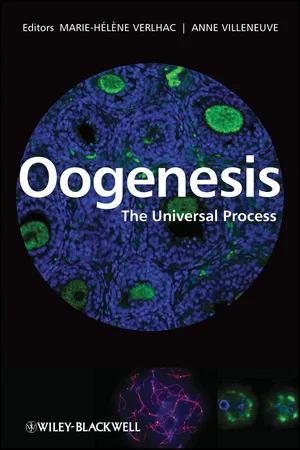 eBook - PDF
Oogenesis
The Universal Process
- Marie-Helene Verlhac, Anne Villeneuve(Authors)
- 2010(Publication Date)
- Wiley(Publisher)
To achieve this, the daughter cell undergoes one further mitotic division to give rise to two primary spermatocytes. Meiosis I is then initiated to yield secondary spermatocytes, which undergo Meiosis II to produce four early spermatids (see Figure 2.6). The final phase of spermatogenesis, termed spermiogenesis, involves extensive morphological modifications. These include the condensation of the nuclear material, and extensive cytoplasmic remodelling in which the round spermatid becomes elongated, comprising a tail/flagellum (for forward movement), midpiece (to house mitochondria) and a head (comprising the acrosome, nucleus, cytoskeletal structures and cytoplasm) (Eddy and O’Brien, 1994). As these elongated cells near the lumen, the supporting Sertoli cells strip them of excess cytoplasm to produce highly differentiated cells known as spermatozoa. This entire process from spermatogonial stem cell proliferation to spermatozoa takes approxi-mately 35 days in the mouse (Cooke and Saunders, 2002) and 64 days in the human (Heller and Clermont, 1963). 2.7.3 Signals for germ cell sex As two different cell states (Meiosis or G1/G0 arrest) are viewed as the first indicators for germ cell sex differentiation, for almost 30 years researchers have tried to identify factor (s) (somatic or intrinsic to the germ cells) that are required to initiate these states in the female and male germ cells respectively. Two theories have dominated this field, one proposing that Meiosis is cell-autonomously regulated, and the other proposing somatic cell induction of this event. Recently a factor originating from the mesonephros has been implicated in Meiosis induction, and will be discussed with regard to the two long-standing theories. Cell-autonomous theory of Meiosis induction and G1/G0 arrest In 1981, Anne McLaren proposed that both XX and XY germ cells are preprogrammed to enter Meiosis at 13.5 dpc, as observed in the female gonad. eBook - PDF
- David Jagiello(Author)
- 2012(Publication Date)
- Academic Press(Publisher)
T h e principal purpose of Meiosis is to effect chromosome reduction, by w h i c h " t h e diploid or so-called 'somatic' n u m b e r must b e r e d u c e d by half to the haploid or gametic. . . . Re- duction results from a regrouping of the chromosomes of the diploid group a n d their segregation into two single or haploid groups corre- sponding in a general way to those that originally came together in the e g g " (1). At the time of Wilson's writing, "the main facts (seemed) well established," but " m a n y intricate and difficult questions of de- tail . . . are still matters of controversy." Many, if not most, of these questions remain unsettled today. T h r e e central events characterize Meiosis: pairing, crossing over, a n d distribution (separation) of parental chromosomes. Pairing (two- by-two association) may b e regarded as a general property of chromo- somes, most often restricted to homologs, b u t not infrequently ex- pressed by nonhomologous chromosomes and chromosomal regions. T h o u g h pairing is usually thought of as a meiotic p h e n o m e n o n , it is also expressed to various extents in somatic chromosomes (the poly- tene "bivalent" of dipteran salivary glands and other tissues is the most familiar, if extreme, example). In Meiosis, pairing in some form is an absolute, though not sufficient, r e q u i r e m e n t for equal segregation of maternal and paternal chromosomes, and their distribution to daughter gametocytes. 187 BIOREGULATORS OF REPRODUCTION Copyright © 1981 by Academic Press, Inc. All rights of reproduction in any form reserved. ISBN 0-12-379980-5 188 MONTROSE J. MOSES S Y N A P S I S A N D T H E S Y N A P T O N E M A L C O M P L E X * Synapsis is a special form of pairing in which chromosomes are closely apposed, so intimately that the bivalent thus formed often ap- pears as a single structure. eBook - PDF
- Carol Bernstein, Harris Bernstein, Carol Bernstein, Harris Bernstein(Authors)
- 2013(Publication Date)
- IntechOpen(Publisher)
Evolutionary Origin and Adaptive Function of Meiosis http://dx.doi.org/10.5772/56557 51 In some protozoans, vitality declines over the course of successive asexual cell divisions by binary fission. However, if sexual interaction (conjugation) occurs, vitality is restored. Evidence indicates that Meiosis leads to rejuvination, and that this rejuvenation is associated with removal of DNA damages. The ciliate protozoan Paramecium tetraurelia has a polyploid macronucleus that contains about 800 to 1500 copies of the genome, and a diploid micronu‐ cleus. The macronuclear DNA expresses cellular functions, and the micronucleus contains the germline DNA. Paramecium tetraurelia is a facultative sexual microorganism that can reproduce asexually by binary fission or by a sexual process involving Meiosis. There are two kinds of meiotic process; the first is a kind of outcrossing sex called conjugation, and the second is a kind of self-fertilization called automixis. In the asexual growth phase, during which cell divisions are by mitosis rather than Meiosis, a gradual loss of vitality occurs that is referred to as clonal aging. If an asexual line of clonally aging paramecia fails to undergo conjugation or automixis it will die out after about 200 fissions. Auferheide (1987) clarified the cause of clonal aging in Paramecium tetraurelia by the use of transplantation experiments. When macronuclei of clonally young paramecia were injected into clonally older paramecia, the lifespan of the older recipients was prolonged. In contrast, when cytoplasm, rather than macronuclei, was transplanted from young to older paramecia the lifespan of the recipients was not prolonged. These experiments suggested that clonal lifespan is determined by the macronucleus rather than the cytoplasm. Subsequent experi‐ ments by Smith-Sonneborn (1979), Holmes and Holmes (1986) and Gilley and Blackburn (1994) demonstrated that clonal aging is associated with a dramatic increase in DNA damage.
Index pages curate the most relevant extracts from our library of academic textbooks. They’ve been created using an in-house natural language model (NLM), each adding context and meaning to key research topics.

