Biological Sciences

Types of Fungi
Fungi can be classified into different types based on their mode of reproduction and structure. The main types of fungi include yeasts, molds, and mushrooms. Yeasts are single-celled fungi that reproduce asexually, while molds are multicellular fungi that grow as long filaments called hyphae. Mushrooms are the reproductive structures of certain types of fungi and are often found above ground.
Written by Perlego with AI-assistance
Related key terms
1 of 5
7 Key excerpts on "Types of Fungi"
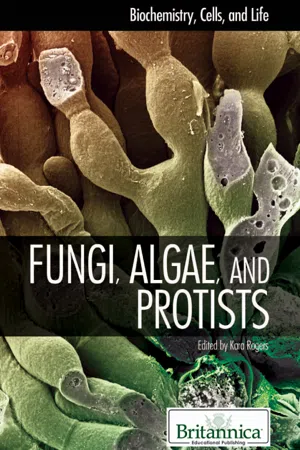 eBook - ePub
- Britannica Educational Publishing, Kara Rogers(Authors)
- 2010(Publication Date)
- Britannica Educational Publishing(Publisher)
CHAPTER 3Types of Fungi and LichensT he many different species of fungi and lichens have long fascinated scientists. By taking into account their unique shapes, sizes, and mechanisms of nutrient acquisition, mycologists have been able to arrange fungi into generalized groups known as phyla. The kingdom Fungi contains seven phyla, which separate the organisms based on broad features, such as the evolutionary histories they share with one another (phylogenetics), the structures they utilize for reproduction, the habitats they thrive within, and the relationships they have with organisms from the other kingdoms of life. For example, whereas fungi in the phylum Basidiomycota are distinguished from organisms in the phylum Ascomycota based on the shape of their spore-bearing organ, fungi in the phyla Neocallimastigomycota are distinguished from other members of the kingdom based primarily on their preferred habitat—the digestive tracts of herbivores.Each phylum of fungi is broken down into classes, orders, families, genera, and species. As one progresses down through the system, each grouping becomes increasingly specific, ultimately separating organisms based on very fine details. The molecular characteristics of fungi, notably their DNA sequences, have been particularly important in enabling scientists to make fine distinctions between fungi. This in turn has led to the discovery of previously unknown evolutionary relationships between fungi as well as between fungi and organisms in other kingdoms.TAXONOMIC FEATURES OF FUNGI
In the first decade of the 21st century, researchers collaborating on a project known as Assembling the Fungal Tree of Life (AFTOL), funded by the U.S. National Science Foundation, expanded upon existing knowledge concerning the evolutionary histories of the different kinds of fungi. The project adopted a phylogenetic arrangement for the kingdom, thereby placing fungi into groups based largely on their evolutionary relationships, rather than solely on their morphological features. AFTOL is a work in progress, and uncertainties remain about the exact relationships of many groups. These uncertain groups are indicated in the AFTOL classification system by the term incertae sedis eBook - PDF
The Dynamical Processes of Biodiversity
Case Studies of Evolution and Spatial Distribution
- Oscar Grillo, Gianfranco Venora, Oscar Grillo, Gianfranco Venora(Authors)
- 2011(Publication Date)
- IntechOpen(Publisher)
9 Fungal Diversity – An Overview Sara Branco 1 Biodiversity and Climate Research Center 2 Mountain Research Center (CIMO), ESA – Polytechnic Institute of Braganca 1 Germany 2 Portugal 1. Introduction Fungi are cryptic, understudied and hyperdiverse organisms. In this chapter I address the wonders of fungal diversity, including recent advances on the understanding of the evolution of the kingdom Fungi , approaches to documenting and interpreting fungal diversity, and current efforts concerning fungal conservation. Fungi are eukaryotic organisms that cannot produce their own energy and depend on enzymatic processes to break down biopolymers that are then absorbed for nutrition. The kingdom Fungi encompasses tremendous biological diversity, with members spanning a wide array of lifestyles, forms, habitats, and sizes. Fungi are sister to animals (fig. 1) and include thousands of lineages, from the mushroom forming fungi, to yeasts, rusts, smuts, molds, and more or less conspicuous critters with interesting morphologies. Fungi complete indispensable ecological roles, most notably decomposition processes, but are also involved in important symbiotic associations and are known to include noteworthy parasites (Alexopoulus, 1996). Fungi have been known and used by humans for centuries, but mycology (the scientific study of fungi) traces ist beginnings to the 18 th century, with the development of the microscope (Ainsworth, 1976). While much has been discovered since then, fungi remain today a cryptic and understudied group of organisms. Recent estimates point to 1.5 million fungal species on the planet (Hawksworth, 2001) of which only ~7% have been described (Kirk et al, 2008). Furthermore, fungi assemble in very species-rich communities, making the full documentation of fungal diversity in targeted sites a particularly challenging task. eBook - PDF
- Mary Ann Clark, Jung Choi, Matthew Douglas(Authors)
- 2018(Publication Date)
- Openstax(Publisher)
24 | FUNGI Figure 24.1 Many species of fungus produce the familiar mushroom (a) which is a reproductive structure. This (b) coral fungus displays brightly colored fruiting bodies. This electron micrograph shows (c) the spore-bearing structures of Aspergillus, a type of toxic fungus found mostly in soil and plants. (credit “mushroom”: modification of work by Chris Wee; credit “coral fungus”: modification of work by Cory Zanker; credit “Aspergillus”: modification of work by Janice Haney Carr, Robert Simmons, CDC; scale-bar data from Matt Russell) Chapter Outline 24.1: Characteristics of Fungi 24.2: Classifications of Fungi 24.3: Ecology of Fungi 24.4: Fungal Parasites and Pathogens 24.5: Importance of Fungi in Human Life Introduction The word fungus comes from the Latin word for mushrooms. Indeed, the familiar mushroom is a reproductive structure used by many Types of Fungi. However, there are also many fungus species that don't produce mushrooms at all. Being eukaryotes, a typical fungal cell contains a true nucleus and many membrane-bound organelles. The kingdom Fungi includes an enormous variety of living organisms collectively referred to as Eucomycota, or true Fungi. While scientists have identified about 100,000 species of fungi, this is only a fraction of the 1.5 million species of fungus likely present on Earth. Edible mushrooms, yeasts, black mold, and the producer of the antibiotic penicillin, Penicillium notatum, are all members of the kingdom Fungi, which belongs to the domain Eukarya. Fungi, once considered plant-like organisms, are more closely related to animals than plants. Fungi are not capable of photosynthesis: they are heterotrophic because they use complex organic compounds as sources of energy and carbon. Fungi share a few other traits with animals. Their cell walls are composed of chitin, which is found in the exoskeletons of arthropods. Fungi produce a number of pigments, including melanin,also found in the hair and skin of animals.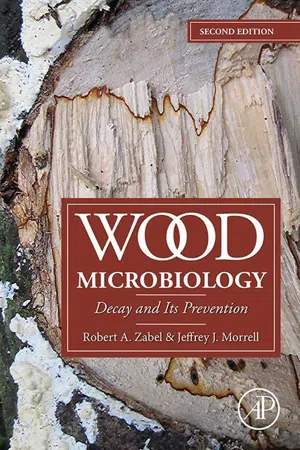 eBook - ePub
Wood Microbiology
Decay and Its Prevention
- Robert A. Zabel, Jeffrey J. Morrell(Authors)
- 2020(Publication Date)
- Academic Press(Publisher)
Chapter ThreeThe characteristics and classification of fungi and bacteria
Abstract
This chapter discusses the classification of fungi and bacteria in related to the classic approach using morphology vs more recent developments using DNA sequencing methods.Keywords
Fungi; Bacteria; White rot; Brown rotFungi and bacteria are the principal microorganisms that invade wood during its growth, processing, storage, or use, causing decay or other property changes.Contents
Outline- Fungi in relation to other life forms 56
- Bacteria 58
- Fungi 59
- Macroscopic appearances of fungi 60
- Microscopic features of fungi 62
- Hyphal wall structure 64
- Fungal ultrastructure 67
- Specialized hyphae 68
- Cultural characteristics 70
- DNA sequencing methods 71
- Classic fungal identification by culturing 71
- Fungal reproduction 73
- Life cycles 76
- Reproductive capacity 79
- Fungal variability 79
- Growth requirements 81
- A classification of fungi 81
- Basidiomycota 84
- Agaricales 85
- Hymenochaetales 86
- Gloeophyllales 86
- Boletales 86
- Polyporales 87
- Russulales 87
- Cantharellales 88
- Deuteromycetes or fungi imperfectii 88
- A classification of bacteria 89
- Cytophagales 90
- Gram-negative facultatively anaerobic rods 90
- Gram-negative, aerobic rods, and cocci 91
- Endospore-forming rods and cocci 91
- Actinobacteria 91
- The roles of fungi and bacteria in ecosystems and human affairs 92
- Summary 93
- References 95
- Further reading 97
An understanding of the decay process and its prevention or control depends, in part, on understanding the features and capabilities of these decay agents. This chapter emphasizes the unique nature of fungi and their relationship to the other major life forms. It reviews fungal structures, growth patterns, life cycles, reproductive modes, and variable features of fungi, placing emphasis on the wood-inhabitors. Classification systems are presented to facilitate the taxonomic placement and recognition of some of the major wood-inhabiting microorganisms. Since bacteria cause only minor damage to structural wood in most environments, they are only briefly covered. eBook - PDF
- J. W. Deacon(Author)
- 2009(Publication Date)
- Wiley-Blackwell(Publisher)
In other words, both of these groups have a common ancestor. Three major sub-groups are recognized within the Phylum Basidiomycota: 1 Urediniomycetes, including the rust fungi (Uredinales) which are economically significant plant pathogens of many crops and wild plants. 2 Ustilaginomycetes, including the smut fungi (Ustilaginales) some of which again are significant plant pathogens, and gain their name from their black, sooty spores. 3 Hymenomycetes, including mushrooms, puffballs, and jelly fungi. However, the phylogenetic relationships between and within these three groups are still unclear. Significant features in the life-cycle of Basidiomycota We will begin by considering the generalized life-cycle of a typical mushroom (Fig. 2.18). Basidiospores, each containing a single haploid nucleus, germinate and grow into hyphal colonies that have a single nucleus in each hyphal compartment. This phase is termed a monokaryon (meaning that it has one nuclear type in each hyphal compartment). The monokaryon can pro- duce small oidia that either act as fertilizing elements or they can germinate to produce further monokaryotic colonies. The next stage of development occurs when the hyphae of two monokaryons of different mating compatibility groups fuse with one another, or when an oidium of one mating compatibility group attracts a hypha of a different mating compatibility group. This causes a strong “homing response” but the chemical attractants causing it have not been identified. Once the two compatible strains have fused by the process termed plasmogamy, all subsequent growth occurs by dikaryotic hyphae (with two nuclei – one of each com- patibility group – in each hyphal compartment). The fungus can grow for many weeks, months or even years in this form, producing an extensive network of dikaryotic hyphae, but in response to environmental signals (Chapter 5) it will produce a mushroom or other type of fruitbody. eBook - PDF
Tropical Plant Types
Pergamon International Library of Science, Technology, Engineering and Social Studies
- B. G. M. Jamieson, J. F. Reynolds(Authors)
- 2016(Publication Date)
- Pergamon(Publisher)
These fruiting bodies may be flask-shaped perithecia or cup-like apothecia. Among the simplest of the Ascomycetes is Penicillium (Fig. 28) from which the antibiotic Penicillin is obtained. Some Ascomycetes form attractive, small, often highly coloured club-like fruiting bodies on soil and many are serious plant parasites. We will study a somewhat aberrant Ascomycete of great economic importance, Saccharomyces cerevisiae, brewers' yeast. 4. Basidiomycetes This group lies apart from the rest of the fungi and is believed by some to be of separate origin. Basidiomycetes are characterized by great com-plexity of the fruiting bodies and by the production of basidia, which are club-shaped bodies each of which typically bears four spores (basidio-spores) on projections known as sterigmata. The basidia may be scattered over the entire fructification or grouped in definite regions. The mycelium, which develops from a basidiospore, is composed of uninucleate cells, but secondary mycelia, with binucleate cells, commonly develop by confluence of two mycelia and give rise to the fructifications, nuclear union occurring in the production of each basidium. Asexual reproduction when present is by the production of conidiospores. Basidiomycetes of immense economic importance are the two orders of plant parasites the Uredinales or rusts, of which the grain rust, Puccinia graminins, will be dealt with in a further volume, and the Ustilaginales or smuts. We will study in this chapter a saprophytic member, Psalliota, the mushroom, which belongs to the large order Agaricales. 5. Fungi Imperfecti This is a group in which only asexual stages, which are often referable to the Ascomycetes, are known. They are plant parasites. 66 TROPICAL PLANT TYPES FIG. 28. Penicillium. Conidia borne on branched conidiophore.
- Srinivasulu, B(Authors)
- 2018(Publication Date)
- Daya Publishing House(Publisher)
5 : Classifcation of Fungi Numerous schemes of classifcation have been proposed and some have been adopted. A generally accepted scheme for fungal classifcation has been published by the Commonwealth Mycological Institute (1983) and is reproduced here. The scheme is based on common ending for order, class, divisions, names etc. These are Division: -mycota; Sub-division: -mycotina; Class: -mycetes; Sub-class: -mycetidae; Order: -ales; and Family-ceae. Important Characters Division 1: Myxomycota Slime moulds Plasmodial forms Thallus is plasmodium True mycelium is absent. This ebook is exclusively for this university only. Cannot be resold/distributed. Class I: Plasmodiophoromycetes Endoparasitic slime moulds. Obligate parasites of vascular plants Thallus is plasmodium a) Sporangiogenous Plasmodium - Sporangial zoospores b) Cystogenous plasmodium - Cyst Zoospores ik Bifagellate Zoospores - Heterocont zoospores. Sexual reproduction - Isogamous planogametic copulation. ik Cause hypertrophy and hyperplasia of host tissue. Division 2: Eumycota True fungi. Non-plasmodial flamentous forms with cell wall. Well-developed flamentous thallus. Sub-Division a) Mastigomycotina Motile spores (Zoospores) are present. Flagellate zoospores Sexual spores - Oospore Sexual reproduction - gametangial contact (or) gametangial copulation b) Zygomycotina No motile spores. Produce non-motile spores - Aplanospores Well-developed coenocytic mycelium This ebook is exclusively for this university only. Cannot be resold/distributed. Sexual reproduction - gametangial copulation c) Ascomycotina They are called ‘sac fungi’.
Index pages curate the most relevant extracts from our library of academic textbooks. They’ve been created using an in-house natural language model (NLM), each adding context and meaning to key research topics.

