Business

Conflict Process
The conflict process refers to the series of stages that occur when disagreements or disputes arise within an organization. It typically involves five stages: potential opposition or incompatibility, cognition and personalization, intentions, behavior, and outcomes. Understanding and managing the conflict process is crucial for maintaining a healthy and productive work environment.
Written by Perlego with AI-assistance
Related key terms
1 of 5
6 Key excerpts on "Conflict Process"
 eBook - ePub
- Sydney Finkelstein, Cary L. Cooper, Sydney Finkelstein, Cary L. Cooper(Authors)
- 2017(Publication Date)
- Emerald Publishing Limited(Publisher)
Conflicts between subgroups in organizations often result from functional specialization leading to conflicting demands on scarce resources (Lawrence & Lorsch, 1967). Indeed, Sherif, Harvey, Hood, and Sherif (1961) found that when two groups are brought into functional relationship under conditions of competition, attitudes and hostile actions in relation to the outgroup and its members will arise. These intergroup conflicts could be resolved through the process of negotiating with coalitions according to the organization’s structure, rules, and procedures (Cyert & March, 1963). As we consider mergers as the process of integrating two distinct entities, it is deemed useful to also adopt a process approach to studying conflict in mergers. The conceptualization of conflict as a process can be traced back to Pondy’s attempt to synthesize the relationships among structural and personality variables affecting conflict, by seeing them as elements of a conflict episode composed of five stages: antecedent conditions, latent conflict, perceived conflict, manifest conflict, and conflict aftermath (Pondy, 1967). A number of approaches to the study of conflict in organizations, such as bargaining, negotiation, and third-party dispute resolution, consider highly formalized and institutional ways of handling conflict and conceptualize conflicts as “bracketed off from the ongoing stream of daily life” (Barley, 1991, p. 165). As organizations became less hierarchical, political models of organizing, allowing the inclusion of conflict in day-to-day management of the organizations in the form of continual negotiations and power struggles, became more relevant (Mintzberg, 1983). This development gave rise to the disputing perspective on conflict management which considers “disputes and their ongoing management [to be] embedded in the interactions among organisation members as they go about their daily activities” (Kolb & Putnam, 1992, p. 312) eBook - PDF
Business Practice NQF3 SB
TVET FIRST
- A Suresh, M Ronaldson, A Berman, TL Krul(Authors)
- 2013(Publication Date)
- Macmillan(Publisher)
A conflict or conflict situation usually involves the following dynamics: • It is an interaction between two or more people. • It is a constantly changing process. • It is competitive by nature. • It could have negative and/or positive elements. • It involves emotions. • It can be verbal or non-verbal. • It is not always undesirable. • It can be managed and controlled. Module 21 179 Module 21: Understanding different conflict situations in the workplace In the workplace Despite the best management skills and communication channels available, conflict between employees and employers will occur. The absence of conflict would be boring, unbelievable and a good indication that problems are being hidden or ignored. (Individual) On your own, complete the following: 1. Identify any conflict that you have been involved in or seen recently at college, at home, or at work, if you are working. 2. Describe the conflict situation to your class, using the details below as a guideline. a) Tell the class why the conflict happened. b) How did the conflict end? c) How did each person act in the situation? d) How did you feel during the conflict? e) Did you do anything to help bring the conflict to and end? If yes, what was it? f) How did you feel when the conflict was resolved? Assessment activity 21.1 The stages in conflict development Now that you understand what conflict is, you might wish to know how conflict comes about. It does not just happen, it develops through clearly identifiable stages. Those involved in the conflict situation, however, do not always recognise these stages. The stages of conflict development can be labelled as follows: 1. No conflict : At this stage, conflict does not exist. The two parties either have no differences yet, or are afraid to express any differences that they may feel. The parties may be avoiding conflict and there is a potential for conflict. eBook - ePub
Making Collaboratives Work
How Complex Organizational Partnerships Succeed
- Susan Meyers Chandler(Author)
- 2018(Publication Date)
- Routledge(Publisher)
before any conflict occurs. If the group has a facilitator, s/he will go over the conflict-resolution process prior to the beginning of the collaborative’s work and get agreement to it as the group develops its ground rules. Knowing that a system is in place designed to resolve conflicts establishes an atmosphere or environment for a successful problem-solving dialog. A facilitated collaborative helps people work together to accomplish successfully both their individual and collective goals, and a conflict-free environment is beneficial for the group members to do their work. All members need to feel a sense of ownership for the group to achieve its goals and for the members to want to participate and continue working toward that outcome. If these goals reflect the basic core values of the group, accomplishing this outcome will be easier.Conflicts often emerge when some of the group members feel that others in the group do not share, understand, or appreciate their values, perspectives, ideas, or concerns. A well-designed conflict-resolution system is a process that avoids, or at least manages, disputes that may evolve. Such a system may include group-process activities such as teaching active-listening skills to the members, group agenda-setting exercises, working in small task groups, bringing in substantive experts, conducting joint fact-finding experiences, and/or having the leader or facilitator demonstrate and practice interpersonal sensitivity and skill in managing conflict within the group’s dynamics.Campbell and O’Leary (2015) suggest that the earlier a conflict is managed (any type of conflict), the better. They support Carpenter and Kennedy’s (1988) conceptualization that there is an upward spiral to unmanaged conflict if not attended to. An initial problem can fester, resulting in a hardening of positions; communication may totally stop; conflict can spread outside of the organization; and perceptions can become distorted. If these things occur, then a much larger crisis is likely to emerge, and be hard to resolve.Positions and InterestsFisher and Ury (1991) identify two common approaches when parties attempt to negotiate in order to solve a problem or disagreement. One is the positional approach to negotiation (sometimes called distributive) and the other is interest-based (also called integrative) negotiation. In positional negotiation, a person has a single, particular solution in mind (a position) and the negotiation will move only when this side concedes to a new position. This is usually problematic, since the final result may not be reflective of the interests of either party. Furthermore, the party conceding may feel that the agreement is not really fair and resentment may linger. eBook - ePub
Working Through Conflict
Strategies for Relationships, Groups, and Organizations
- Joseph P. Folger, Marshall Scott Poole, Randall K. Stutman(Authors)
- 2017(Publication Date)
- Routledge(Publisher)
1Communication and Conflict
We have argued that conflicts are best understood if we view them as a form of interaction. But interaction is an extraordinarily complicated phenomenon. How can we get a grasp on what happens in conflicts? How can we use that knowledge to turn conflict interaction in productive directions?This chapter provides an introduction to conflict interaction. First, we describe a model of conflict interaction as a “balancing act.” The model proposes that in order to manage a conflict effectively, parties must first articulate and understand the differences in their positions and interests. Only after this has been done can they move toward a mutually acceptable, integrative solution. However, this is a precarious process, fraught with difficulties. If parties make the wrong moves, their differentiation may spiral into uncontrollable escalation or, alternatively, to rigid suppression and avoidance of a conflict that they should be able to face and manage. Walking the tightrope to productive conflict management requires insight into the forces that push conflict in negative directions and the appropriate actions required to control them.The second part of this chapter presents four basic properties of conflict interaction which suggest a number of factors that are important in conflicts. These factors, discussed in subsequent chapters, can move conflict in productive and destructive directions and suggest various levers parties can use to manage conflict effectively.1.1 A Model of Effective Conflict Management
At the outset it is a good idea to consider effective conflict management, the type of interaction that will lead to productive conflict. In his book, Interpersonal Peacemaking, Richard Walton (1969) described a simple yet powerful model of effective conflict management that reflects insights echoed by a number of other influential writers (Fisher & Ury, 1981; Pruitt & Carnevale, 1993; Putnam, 2010). The model views conflict in terms of two broad phases: a differentiation phase followed by an integration phase. In differentiation, parties raise the issues underlying the conflict and spend time and energy clarifying positions, pursuing the reasons behind those positions, and acknowledging their differences. As Putnam suggests, “Differentiation refers to the pattern of interaction that sharply distinguishes opposing positions” (2010, p. 327).This first phase is sometimes uncomfortable and tense, and it may evoke unpleasant emotions, but it is valuable because it helps parties to become more knowledgeable about the issues and the different goals and points of view they have (Wageman & Donnenfeld, 2007). After some time differentiating, the process reaches a “tipping point,” and an integration eBook - PDF
- Ana Alice Vilas Boas(Author)
- 2018(Publication Date)
- IntechOpen(Publisher)
Value conflicts are conflicts in which the parties strive for incompatible ideals of what they consider to be valuable. Interest conflicts occur when the parties seek to realize inconsistent aims at personal or group level. Role conflicts are conflicts in which there is lack of clarity or disagreement about formal or informal roles. The final cat -egory, personal conflicts, involves disagreement that is grounded in perceptions of unaccept -able personality traits or attitudes. After explaining how these conflict types are relevant in organizational contexts, I clarify how knowledge of the conflict types can be used in conflict resolution at management levels. The fundamental idea is that the conflict types are logically related to each other, and that there is, for each conflict type, a core methodological principle for concept resolution that manag -ers should focus on. In the last part of the chapter, I categorize these principles in an overall model for practical conflict resolution in organizations. 2. Background In order to understand the importance of managers’ conflict resolution practices in orga -nizations, it is necessary to have a more precise understanding of the concept of conflict. Theorists differ somewhat in their definitions of the concept, but there is widespread consensus that a conflict involves more than disagreement: conflicts involve use of power and means to realize interests [ 4 , 7 , 9 ]. This means, as Sibana ([ 16 ], p. 11) observes, that conflicts are ‘derived from social beliefs and involve two or more parties who share incompatible objectives.’ Note that this definition of a conflict is neutral with respect to whether conflicts may be good or bad for an organization. In conflict theory, the potential positive and negative dimensions of conflicts have often been connected to the distinction between productive and destructive conflicts [ 2–4 , 6 ].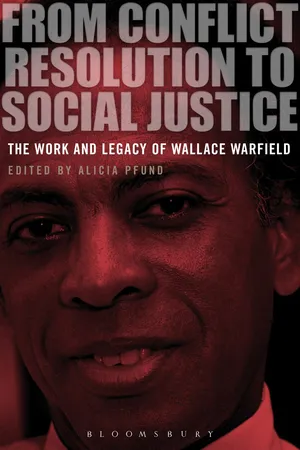 eBook - PDF
From Conflict Resolution to Social Justice
The Work and Legacy of Wallace Warfield
- Alicia Pfund(Author)
- 2013(Publication Date)
- Bloomsbury Academic(Publisher)
4 A Model for Policy Negotiations. Public Policy Conflict Resolution The Nexus Between Culture and Process Wallace Warfield, 1993 Introduction V arious efforts have been made to describe the manifestations of conflict when public policy runs counter to some element of the public interest (e.g. Susskind and Cruikshank 1987; Carpenter and Kennedy 1988). But not a lot has been said about the organizations which initiate the policy. What do we know, for instance, about the culture of these organizations and how it contributes to the generation and perpetuation of policy conflict? Are organiza-tional client groups who function as stakeholders in policy conflict responding to the policy decision or the culture-driven process behind the decision? These questions are made more complex because different client groups and affected classes have their own cultural perspectives of the policy conflict. Culture provides an interpretational lens for the origins of conflict, shapes the contours of how conflict will be processed and the expectations concerning outcomes. As will be noted later in this chapter, culture, 1 as a determinant of conflict resolution, confounds popular notions concerning the 74 FROM CONFLICT RESOLUTION TO SOCIAL JUSTICE roles of parties in conflict, the role of the so-called neutral, and the concept of neutrality. There are, of course, many definitions of organizational culture (e.g. Schein 1985: 9). For the sake of simplicity, I describe it as the paradigm of behavior, knowledge, shared experiences, and decision-making styles of an organization. This chapter will examine how organizational culture frequently “conflicts” with the culture(s) of the organization’s clients and affected classes as that organization creates and attempts to implement policy.
Index pages curate the most relevant extracts from our library of academic textbooks. They’ve been created using an in-house natural language model (NLM), each adding context and meaning to key research topics.

