Business

Conflict Management
Conflict management involves the process of identifying and addressing conflicts within an organization to minimize their negative impact. It includes strategies for resolving disputes, fostering open communication, and promoting collaboration among team members. Effective conflict management can lead to improved relationships, increased productivity, and a more positive work environment.
Written by Perlego with AI-assistance
Related key terms
1 of 5

10 Key excerpts on "Conflict Management"
 eBook - PDF
- John R. Walker(Author)
- 2020(Publication Date)
- Wiley(Publisher)
Everyone wants to be valued. Showing a genuine interest in your employees fosters a positive workplace with open communication. Conflict Management LEARNING OBJECTIVE: Explain the key principles of Conflict Management. We might wrongly assume that all conflict is bad for individuals and the organization. This is simply not so—some conflict is not only natural but also productive, experts say. Every relation- ship and every conflict has a past, present, and future, and resolving conflicts effectively requires that we deal with all three. 2 Conflict Management is the application of strategies to settle opposing ideas, goals, and/ or objectives in a positive manner. Managers are often put in the middle of conflicts. They must know how to manage themselves, as well as the situation, positively and delicately. Managers must be able to separate their own emotions and feelings from the situation at hand. They need to be able to act, not react! There are many ways to manage conflict. For the pur- pose of this chapter, we use a five-step approach to Conflict Management, which is illustrated in Figure 11.2. Conflict Management The application of strategies to settle opposing ideas/ goals. Step 3: Prenegotiate Step 4: Negotiate Step 5: Implement Step 2: Strategy Step 1: Analyze FIGURE 11.2: Five-step Conflict Management process. Conflict Management 281 ANALYZE THE CONFLICT The first step is to analyze what is at the center of the conflict. To do this the supervisors need to ask themselves questions, as well as ask those involved in the conflict. eBook - ePub
Managing Conflict at Work
Understanding and Resolving Conflict for Productive Working Relationships
- Clive Johnson, Jackie Keddy(Authors)
- 2010(Publication Date)
- Kogan Page(Publisher)
2 Deciphering Conflict Management WHAT IS Conflict Management? We turn now to consider some basic principles for managing conflict. We start by defining what Conflict Management is, as well as what it isn’t.Mention of the term ‘Conflict Management’ (or ‘CM’ as we prefer to abbreviate it throughout the text) may suggest that we’re only concerned with disputes that have already taken hold, whether they’ve developed into full-blown arguments or are still at an early stage. Of course we are concerned with how to deal with live disputes; however, we take a broader view of the subject, both as a management discipline and as a vital concern for any organization.Rather than just being about resolving the existing disputes, we suggest that a challenge for managers is to create the conditions that will minimize the risk of unhelpful conflict occurring in the first place. This requires an ability to recognize and quickly defuse potential triggers for dispute when they first arise. Preventing conflict from arising in the first place may not always be possible: however, in many cases, painful and prolonged disputes can be avoided.To manage conflict effectively means being not only able to limit or remove altogether potential triggers for dispute, but also quickly recognizing when an individual or group of individuals show possible signs of a disagreement. The task of managing conflict is therefore closely integrated with managing people in a more general sense, for example in the way they are motivated and the style of leadership being used. The scope of Conflict Management is shown in Figure 2.1 .Figure 2.1 The scope of Conflict ManagementHowever, the scope of CM shouldn’t stop here. Many conflicts between individuals and teams aren’t only healthy but may be valuable – for example in deciding how to resolve a problem, tackle a project task or simply when sounding out ideas. To be able to exploit this type of constructive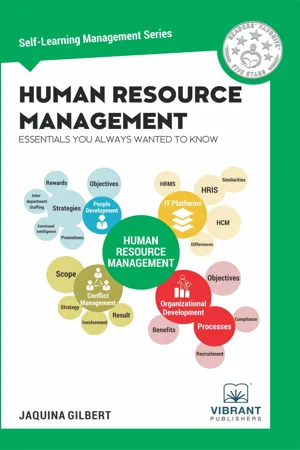 eBook - ePub
Human Resource Management Essentials You Always Wanted To Know
A Comprehensive Guide to HRM, Performance Management, Conflict Resolution, and HR Strategies
- Vibrant Publishers, Jaquina Gilbert(Authors)
- 2020(Publication Date)
- Vibrant Publishers(Publisher)
5 Conflict ManagementConflict is an unavoidable happening in any organization and may be initiated by an individual or group. Chapter five focuses on highlighting conflict and the various approaches that could dissolve it.This chapter provides readers with competency to explain the following: ● Definition and examples of conflict● Characteristics of conflict● The effects of conflict and the need to avoid it● Different classifications of conflict● Conflict resolution approaches and strategies● Factors engendering conflict within an organizationAn organization relies on the peaceful coexistence of human resources, management, and the employer to do well. When there is a conflict between these groups, it forces the effect of underperformance, which leads to a low yield. A conflict could also be initiated by or involve other stakeholders such as customers, clients, boards, or volunteers. Therefore, a conflict must be avoided like a plague in any business setting or organization for any planned target to be possible.Conflict is anything that attracts unrest in an organized system. It is often a reaction to unfavorable policies. In a managerial sense, conflict is simply a deliberate agitating measure taken towards a plan of action or action in a company. It is often notable among human resources but prevalent in other faculties of an organization as well.Definition and Difficulties of Conflict ManagementConflict Management is a reactive measure taken to weigh down the effects of conflict on a company’s general performance. The concept identifies the source of a problem, proffer, and implements a solution. Could conflict have a connection with compliance? Many human resource persons have at a time, wondered about the connection between conflict and regulatory compliance. The simple response is that as long as the laws of jurisdiction are against conflict, it applies to managerial, employee, and employer conflicts in organizations. eBook - ePub
Reframing Resolution
Innovation and Change in the Management of Workplace Conflict
- Richard Saundry, Paul Latreille, Ian Ashman, Richard Saundry, Paul Latreille, Ian Ashman(Authors)
- 2016(Publication Date)
- Palgrave Macmillan(Publisher)
The management of conflict is, therefore, viewed by many academics and practitioners as an essential organizational activity that can have transformational effects on firms, their employees, and other stakeholders. Over the past three decades, scholars have documented the potential organizational benefits associated with the planned and deliberate management of workplace conflict (Avgar 2010 ; Lipsky et al. 2003 ; Lipsky and Avgar 2008). Nevertheless, although all organizations deal with conflict in one way or another, not all organizations deal with conflict in a proactive manner (Lipsky et al. 2003). On the one hand, some organizations deal with conflict by ignoring its presence, while on the other hand, other firms set up elaborate and sophisticated systems designed to manage and resolve conflicts and disputes (Avgar 2008 ; Lipsky et al. 2003). One of the key questions motivating our recent research is the extent to which organizations address conflict in a deliberate and strategic manner. Do organizations have clear and defined strategic orientations toward conflict and its management? Do organizations adopt specific ADR and Conflict Management policies in an effort to advance a defined set of goals and objectives? On the one hand, quantitative and qualitative research has indicated that a growing proportion of large firms have adopted a variety of different Conflict Management practices (Colvin 2013 ; Lipsky et al. 2003, 2014 ; Teague et al. 2012). This evidence suggests that an increasing number of firms have recognized the need for and the potential of practices tailored for the resolution of conflict, such as mediation, arbitration, or an ombuds office eBook - PDF
The Israeli-Palestinian Conflict
From Conflict Resolution to Conflict Management
- Y. Bar-Siman-Tov(Author)
- 2007(Publication Date)
- Palgrave Macmillan(Publisher)
The phenomenon of Conflict Management as a default option where conflict resolution has failed. 2. Various strategies of Conflict Management, focusing on a case of conflict involving a state actor and a non-state actor, as in the Israeli-Palestinian conflict. 3. The prospects of a renewed transition from Conflict Management to conflict moderation and the renewal of the political process. Conflict Management We can distinguish between different levels of Conflict Management involving different types of “actors” (between two nation-states, between a nation-state and non-state actors, including terrorist or guerrilla organizations) with the aim of achieving different goals (vio- lence prevention, violence control, violence termination) utilizing dif- ferent management strategies. In general, a distinction can be drawn between two principal levels of management. The first and most basic level treats Conflict Management like the totality of the efforts aimed at forestalling violence in a conflict. Management at this level refers mainly to conflict prevention or preventive diplomacy. Conflict preven- tion aims at preventing a conflict from becoming violent; thus, the eruption of violence indicates a failure of Conflict Management. The second level is controlled management of the violence (preven- tion having failed) in order to contain it and keep it from escalating, with the goal of terminating it rapidly, leading to moderation or reso- lution of the conflict. 2 That is, although some researchers view the very outbreak of violence as failure, others ascribe the term controlled management to efforts aimed at controlling the violent aspect of the conflict. 3 A further distinction is customarily drawn between three types of management: unilateral, joint, and external. Unilateral management refers to the totality of the efforts made by each side separately to pre- vent the other side from initiating violence or escalating it. eBook - PDF
Construction Supervision NQF4 SB
TVET FIRST
- M Engelbrecht, T Coetsee, M Ronaldson Jowaheer Consulting and Technologies(Authors)
- 2013(Publication Date)
- Macmillan(Publisher)
Conflict resolution must aim to resolve the conflict, maintain peaceful relations in the workplace, prevent further conflict, and control any potential conflict situations. Generally speaking, supervisors who successfully manage conflicts in their organisations will experience lower rates of complaints than those who fail to do so. Also, discourage gossip, and do not put workers in a position where they spy or report on each other. Think about it Ombudsman: an official who investigates complaints Isolated: standing alone or separated Interpersonal: between two or more people Words & Terms 220 Module 11: Conflict Management Assessment activity 11.8 Work in pairs Role play a situation where one of you is employed as the counsellor in a construction company, and the other a worker who has a complaint. Complete the following activities: 1. Make up a scenario that covers the roles, the problem, the complaint and the conflict situation. 2. Discuss the problem and find a solution. 3. Make up your own dialogue. 4. Present your role play to your class. Summative assessment 1. Define conflict in your own words. [2] 2. List three causes of conflict in the workplace. [3] 3. Briefly explain the effects of conflict on productivity in the workplace. [7] 4. What is the objective of Conflict Management? [4] 5. Give three examples of conflict indicators. [3] 6. What are the aims of conflict resolution? [2] 7. Read through the following suggestions that may be used when handling a conflict situation. Indicate whether they will have a positive or negative effect. The first one has been done for you as an example. [7] a) Strive for a win-win situation. (Positive) b) Consider personnel changes as soon as conflict develops. c) Hurry the process along. d) Consider your own feelings about the conflict situation. e) Avoid feedback. f) Look for the root cause of the problem. g) Set up a competitive situation. h) Do not really listen to what is being said.
- Charles Wankel, Charles B. Wankel(Authors)
- 2007(Publication Date)
- SAGE Publications, Inc(Publisher)
Team members’ approach and the actual ways they handle internal conflicts have a consider-able impact on the attributes of their internal bonds. Hence, thorough understanding of orientations, approaches, and actual Conflict Management behaviors in work teams is deemed to be essential. In an attempt to elucidate the dynamics of conflict in work teams, we first delineate several prevailing conceptual frameworks analyzing Conflict Management and stressing their application in research on work teams. Then we pro-ceed to explicate the factors governing the choice of various conflict handling patterns, highlighting the antecedents of constructive in contrast with destructive conflict manage-ment processes. Approaches to Conflict Management Conflict Management refers to behaviors team members employ to deal with their real and perceived differences, some relating to emotionally driven conflicts (relationship conflicts) and others addressing the more substantive ele-ments of their discords (task conflicts). Most studies on interpersonal Conflict Management patterns have adopted the Dual Concern Model , originally proposed by Blake and Mouton (1964) later adopted with some modifications by several scholars: Pruitt and Rubin (1986), Rahim (1983), and Thomas (1976). The basic tenet of this model postu-lates that the Conflict Management mode employed by an individual emanates from two underlying motives: concern for self and concern for the other party. eBook - ePub
- Heather Falconer, Mike Bagshaw(Authors)
- 2009(Publication Date)
- Routledge(Publisher)
Chapter SevenConflict Management Training Mike Bagshaw IntroductionConflicts in the workplace are increasing in number and intensity. This has a huge cost in terms of emotions, lost business, time, and straight demands for money from litigation. Arbitration goes some way to easing this, but is still timeconsuming and costly. Accepting an arbitrator also means you have to accept his or her decision, so there is a loss of control over the outcome. Mediation keeps those involved in the arena. The mediator does not draw conclusions on their behalf, but assists in the struggle towards resolution. This may bring a good solution to the current problems, but does not necessarily have any impact on future problems.It is too much to hope that no more contentious issues will arise, so the longterm solution has to be to empower everyone to ‘nip things in the bud’ by resolving their own disputes and differences as they emerge. It is like teaching someone to drive, rather than giving them a lift.Reactions and Attitudes to ConflictConflict exists on many levels, from friendly banter to vicious sniping. There’s a difference between the inevitable differences about how people see things, and bitter raging of battles and mutual hatred. Disagreement will happen, but if it is well managed it need not develop into warfare.People at work often find it particularly hard to deal with difficult issues arising from differences in opinion or needs. We tend to either avoid or ignore the conflict, ‘brushing it under the carpet’ or go in blazing. Neither approach is helpful.A divergence in views can create friction, as it’s uncomfortable having someone contradict what you say. However, if you suppress the friction by keeping quiet, your ideas never get heard. You can’t have creativity without new ideas. You can’t have new ideas without disagreement of some sort. Positive conflict occurs when two or more people with differing views say what they think, with their ears wide open to discover what the others can add. ‘Add’ is important here. In negative conflict, admitting the other person’s view will subtract from your own. In positive conflict, extra views are a bonus. eBook - PDF
Engaging Communication in Conflict
Systemic Practice
- Stephen W. Littlejohn, Kathy Domenici(Authors)
- 2000(Publication Date)
- SAGE Publications, Inc(Publisher)
These cubicles are all centered in the middle of large rooms and surrounded by very nice conference rooms around the perimeter (eat your heart out, Dilbert!). All of the employ-ees, including top management, are encouraged to meet often in these confer-ence rooms to make decisions, work on projects, or discuss conflicts. A sign Constructing Conflict Management Systems 133 on the wall of each room reminds them FIRST to discuss the process they will use for their meeting before continuing on to the business at hand. When we construct systems to manage conflict, we are reminded to keep the system simple. A funny reminder from Constantino and Merchant (1996) tells us, To make Alternative Dispute Resolution difficult to use and impossible to access,... require multiple levels of approval to use ADR... make people write numerous memos to justify their use of ADR... make it difficult to get approval to use ADR fand]... send messages that make it clear that the organization does not support ADR, that it is to be regarded as an anomaly, and that it is risky behavior to recommend use of ADR in any particular case. (pp. 130-131) Process management is important at all levels of system design. When you first enter a system, the beginning question can be How will we work to-gether? When we begin work on any project, we begin by establishing a pro-cess to work in, raising the umbrella under which we will work. Face Management One of the three teenagers mentioned at the beginning of this chapter is a particularly skilled face manager. Lucy, a 14-year-old, was baby-sitting two boys, ages 10 and 7, and they were all swimming in the backyard pool. The 10-year-old boy, Trevor, thought he might be too old for a baby-sitter but was enjoying himself nonetheless. Trevor accidentally kicked a ball over the fence into a yard that was difficult to access. Lucy came to her mother and said, The ball was kicked over the fence. eBook - ePub
Developing Skills for Business Leadership
Building Personal Effectiveness and Business Acumen
- Gillian Watson, Stefanie Reissner(Authors)
- 2023(Publication Date)
- CIPD - Kogan Page(Publisher)
Delays on product or project delivery: possible fines and more litigation. Workforce moral damaged. Damage to employee brand. Regulation and compliance issues: can incur fines, an extreme response would be a cancelation of contracts. Productivity can be hampered. Damage to the company finances, added stressors for the employees.In other words, conflict is draining on organisational resources. Yet, the true costs of conflict can only be measured if all these types of costs are systematically captured and measured (Saundry et al, 2016) – as much as this is possible with regard to intangible costs – to make a business case for effective Conflict Management. This will involve both collection and analysis of quantitative and qualitative data (e.g. from interviews or focus groups) and detailed analyses of how the business might benefit from investment in Conflict Management methods that deter escalation, such as mediation, discussed later in the chapter. In any case, organisations would do well to take Conflict Management very seriously. Managers, professionals and employees negotiate on a daily basis in relation to their roles, training and development, over-time, work–life balance, etc. These negotiations can break down easily and conflict can occur. To that end, conflict between individuals and groups should be managed constructively and consistently to gain and maintain employees’ commitment, loyalty and support for the benefit of the organisation. Therefore, CIPD (2020b) argue that although intervention in conflict can be difficult, it is a fundamental managerial duty both to safeguard organisational performance and maintain the health and wellbeing of staff. If conflict is ignored, it can easily escalate to disciplinary or grievance action or turn an organisation into a toxic environment.Toxic work environments are characterised by workplace incivility, bullying and harassment, which make an organisation an unpleasant and damaging place to work, resulting in low morale and high employee turnover. According to CIPD (2022k) workplace incivility is characterised by ‘low-intensity deviant acts, such as rude verbal and non-verbal behaviours, characterised by ambiguous intent to harm’ that undermine the work and reputation of others (see also Hershcovis, 2011). It can induce stress, anxiety and low self-esteem, impact job performance and satisfaction, and may even lead to depression and burnout (CIPD, 2022k; see Chapter 2 for a more detailed discussion). Importantly, it can easily lead to bullying and harassment and spread across the organisation as shown in Figure 11.2
Index pages curate the most relevant extracts from our library of academic textbooks. They’ve been created using an in-house natural language model (NLM), each adding context and meaning to key research topics.

