Business

Human Resources
Human resources refers to the department within an organization that is responsible for managing the workforce. This includes activities such as recruitment, training, performance management, and employee relations. The primary goal of human resources is to ensure that the organization has the right people with the right skills in the right positions to achieve its objectives.
Written by Perlego with AI-assistance
Related key terms
1 of 5

12 Key excerpts on "Human Resources"
 eBook - PDF
- Sara Cheung, Alma Whiteley, Shi Quan Zhang(Authors)
- 2000(Publication Date)
- World Scientific(Publisher)
3. Human Resources in the Context of Business Strategy Human Resources in the Context of Business Strategy The identifying features of the human resource managerial role are considered by management writers (Torrington, 1985; Tyson, 1995), to include: • Having a position of centrality in the organization, usually conveyed by a presence in the boardroom as a part of the business strategy formulation team; • Creating, through activities such as the ability to attract, maintain and reward appropriate people for the present and the future; • Harmonizing the human resource strategy with the business strategy in such a way that a set of integrated functional activities blend to complement each other. • Promoting consideration of the human resource as an asset rather than a cost; associated with long-term as opposed to short-term strategies; • Fostering the perception of Human Resources as necessary to successful business performance (not only through productivity enhancement but through the strategic use of the human as opposed to technical resource); • Being a major strategist of organizational change and transformation This definition is attached to the Western orthodoxy. 'Typically HRM refers to those functions undertaken by an organization to effectively utilize 55 56 Human Resource Strategies in China Human Resources. These functions would include at least the following: Human resource planning, Staffing, Performance evaluation, Training and development, Compensation, Labor relations, Benefits and in-house communication (Dowling, 1994:2,3). The linguistic boundary around orthodox human resource management is often functional, even when strategic status is achieved. Connections in human resource management are usually made to in-work issues such as strategies, structures, organizational context and the business environment interface. eBook - PDF
- Thumar, V M(Authors)
- 2018(Publication Date)
- Daya Publishing House(Publisher)
Human resource management (HRM) is the strategic and coherent approach to the management of an organisation’s most valued assets - the employees, who contribute towards the achievement of business objectives individually as well as in teams. The terms “human resource management” and “Human Resources” (HR) have largely replaced the term “personnel management” as a description of the processes involved in managing people in organisations. Human Resource management is evolving rapidly. Human resource management is both an academic theory and a business practice that addresses the techniques of managing workforce. 1.4 Importance The HR department is fast gaining recognition of being an integral part in the strategic management process. The importance of HRM can well be understood by the growing demand for HR professionals in the industry. HR plays an important role in creating jobs, providing unending supply of manpower, using manpower talent at the right place and creating conclusive environment for employees from all quarters of the society. Thus, it can be concluded that overall, HRM is considered important from the following viewpoints: 1. Organizational 2. Personal 3. Societal 4. National 1. Organizational Human Resources are the medium through which an organization fulfills its objectives. There management is an important function for effective performance. For an organization HRM is essential to keep a check on the costs, to get uninterrupted manpower supply etc. This ebook is exclusively for this university only. Cannot be resold/distributed. 1. Talent management: HRM is responsible for keeping an up-to-date skills inventory by managing the recruitments and performance management of employees. 2. Cost Optimization: HRM also helps the management in reducing costs by designing appropriate compensation policies that links rewards to performance. The trainings and development helps in enhancing employees capabilities thereby leading to raising the ROI of employees.
- Surbhi Jain(Author)
- 2023(Publication Date)
- Society Publishing(Publisher)
In return, they are paid a wage, salary, bonuses, commissions, and a host of other benefits. Human Resources pertain to firms, sectors, industries, the civil service, and the economy. Actualizing human potential (Figure 4.1) is the goal of human resource managers. Figure 4.1. Process of transitioning from administration and towards actual- izing human potential. Source: Wikimedia Commons. Understanding and Appreciating Human Resources 93 Human capital has emerged as a narrower concept that focuses on the skills and knowledge that people have (Adebisi, 2013; Aguinis and Kraiger, 2009; Ahmad and Schroeder, 2003; Alshallah, 2004; Anyim et al., 2011; Araujo and Sofield, 2011). Similar concepts include labor, manpower, associates, personnel, and people. An effective organization values people. Most advanced organizations will deploy a Human Resources department which is responsible for various aspects of employment and human resource management. Examples of key tasks include employment standards, compliance, benefits, administration, interviewing, filing, offboarding, and talent acquisition. In performing this rule, the human resource managers will act as a key link between the executive team and frontline staff. Given the technical demands of employment law and industrial relations, organizations require competent and experienced people to undertake the role of human resource management. There is an employment life cycle that is marked by key events and processes (Leggett, 2007; Lengnick-Hall et al., 2009; Li et al., 2006; Loundes, 2001; Manzoor, 2011; Martin and LaVan, 2010). In turn, these events and processes are overseen by the human resource management team. Sometimes, there is tension between the goals and methods of the line manager and those of the human resource management team. Because the human resource managers are experts in the law and employment relations, they will often be given credence.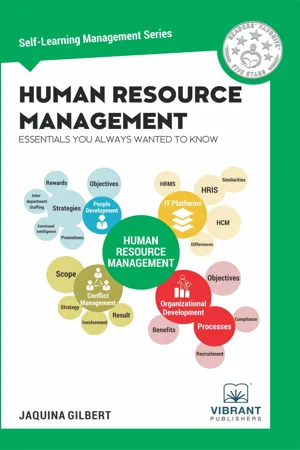 eBook - ePub
Human Resource Management Essentials You Always Wanted To Know
A Comprehensive Guide to HRM, Performance Management, Conflict Resolution, and HR Strategies
- Vibrant Publishers, Jaquina Gilbert(Authors)
- 2020(Publication Date)
- Vibrant Publishers(Publisher)
The operative functions are more widely suggested as various individuals have contributed to their idea of a comprehensive list. Most familiar, the operative functions are characterized as:▪ Recruitment or hiring▪ Job analysis and design▪ Performance appraisal▪ Training and development▪ Compensation▪ Wage and salary administration▪ Benefits administration▪ Employee health and welfare▪ Maintenance and retention▪ Labor and employee relations▪ Research▪ Legal compliance▪ Records managementFigure 1.3 Recruitment of Skilled EmployeesIt is ideal for maintaining an intelligent and skillful workforce by employing the best talent to complement the roles, the culture and the vision of the company. Human Resource Management is responsible for the intake of persons they perceive would be of a great addition and purpose to the company. Recruitment of otherwise unfit persons would mean a decline in the productivity and competitive prowess of the organization.Directing A company’s Human Resources or workers may, at some point,not know what or what not to do. Human Resource Management then attempts to set objectives and put the Human Resources on a course to success. Without that, productive activities might be approaching the wrong course.The Utility of Available ResourcesBoth human and nonHuman Resources are necessary to yield the best efficiency and progress for an organization. The idea of the establishment of Human Resource Management then bolsters the chances of being able to utilize what is available. This could involve apportioning duties to the available workforce/nonhuman resource to achieve a goal or maintain a relatively strong competitive advantage.Ensuring a Healthy Employer-Employee RelationshipHuman Resource Management ensures fluidity in the dealings between employers and employees. John Kennedy also said, “The human mind is our fundamental resource.”
- Charles Wankel, Charles B. Wankel(Authors)
- 2007(Publication Date)
- SAGE Publications, Inc(Publisher)
The quantity and quality of such goods and services are constrained by (operate within the context of) an organi-zation’s strategic objectives. In companies, these objectives typically include rate of return on invested capital, revenue growth, market share and, if publicly traded, share price. As with other inputs or assets, therefore, Human Resources must be managed strategically for the longer term and not just operationally for the short term or on a day-to-day basis. This view of human resource management clearly in-dicates that those who lead and manage business (and non-business) enterprises as well as component units and depart-ments must be skilled in the management of people. At the same time and as organizations grow larger, they usually establish a formal Human Resources function (that is, a department) staffed by executives and professionals who specialize and assist the organization in managing its em-ployees. An “HR department” typically develops, specifies, and monitors operating policies and practices regarding hiring, job placement, pay and fringe benefits, performance appraisal, promotion, training and development, work-life balance, and discipline and due process. However, because of the large amount of human resource/employment legisla-tion, an HR department typically also specifies and moni-tors operating policies and practices regarding payroll de-ductions, workplace safety, equal employment opportunity, employee leave plans, employee savings and benefit plans, and employee health care and wellness plans (Jackson & Schuler, 2003). Contemporary human resource management occurs in a world that is much different from that which existed only a relatively short time ago. A leading development in this regard is the change in employment contracting, specifi-cally, from permanent or continuous employment to em-ployability. During the 40-year period dating from the end eBook - PDF
Human Resource Management in Project-Based Organizations
The HR Quadriad Framework
- K. Bredin, J. Söderlund(Authors)
- 2011(Publication Date)
- Palgrave Macmillan(Publisher)
Human Resource Management in Context 51 development of HRM research generally reflects a large spectrum of definitions and approaches. In the following, we will discuss the partic- ular approach and definition of HRM adopted in this book. We consider HRM to include all activities directly linked to the management of the relationship between people and the organization in which they work. This definition puts a great emphasis not only on the “HRM system” as such but also on the organizational context in which it operates and on the people who offer their services to the organization. We believe there is an important distinction between HRM and other areas of manage- ment, although HRM, to some extent, will be affected by other manage- ment decisions, such as strategy, technology, and innovation; the reverse is also true – that purely HRM-oriented decisions, such as recruitment and competence development, will influence strategy, technology, and innovation. This, again, points to the relationship between the two sets of capabilities mentioned in the first chapter of the book. As discussed, some of the initial considerations about the definition of HRM concerned whether it was a new “management philosophy” or just another label for personnel management (see Guest, 1987; Legge, 2005; Sisson and Storey, 2003). In fact, did not HRM basically cover the same activities as traditional personnel management, even though it had been renamed to capture new trends and the modernization needed due to a changing environment? Many proponents of HRM had argued that the concept and idea of HRM actually implied a new management philosophy that could offer an alternative approach to management, which departed to a much greater extent from the strategic importance of matching the needs and wishes of the individual worker to the needs of the organization. eBook - ePub
Solutions
Business Problem Solving
- Frank Fletcher, Eric Bolland(Authors)
- 2016(Publication Date)
- Routledge(Publisher)
CHAPTER 7 Human Resource Management SAL MIRZA and CORINNE FARNETIThe phrase human resource management (HRM) brings about a diverse array of thoughts, emotions and reactions. For many, these can be negative. What have I done wrong? What new policy will I have to adopt? What data do I need to provide? Or even, what now? The human resource department historically has been viewed by employees as nothing more than an administrative bureaucracy that contributes little to the organization’s productivity. However, these impressions and the role of HRM have been shifting over the past several decades.Changes in the business environment, such as the adoption of the innovative workplace, the increasing diversity of the labor force, work-life balance issues and globalization have resulted in a shift away from traditional human resource management. The focus has moved from employee advocacy to a strategic partner. HRM concerns and concepts are integrated into the strategic plan of the organization. HRM is now primarily concerned with developing human resource practices that enhance a firm’s competitive advantage through its most valued asset, its people.The Human Resources (HR) function can provide significant support and advice to management. The attraction, development, and retention of high caliber people are a source of competitive advantage for your business, and are the joint responsibility of HR and management. HRM is no longer just the responsibility of the human resource department. CEOs, directors, department heads, middle managers and line managers are also increasingly concerned with these tasks. Managers now have increased accountability for their direct reports in the areas of hiring, development, succession planning and performance management.You as a manager will have to align your Human Resources through integration of decisions about your employees with decisions about specific organizational goals. This chapter offers HR professionals and organization managers processes, tools and resources to make informed HR decisions. No longer available |Learn more
- (Author)
- 2014(Publication Date)
- College Publishing House(Publisher)
____________________ WORLD TECHNOLOGIES ____________________ Chapter- 7 Human Resource Management Human resource management (HRM) is the strategic and coherent approach to the management of an organization's most valued assets - the people working there who individually and collectively contribute to the achievement of the objectives of the business. The terms human resource management and Human Resources (HR) have largely replaced the term personnel management as a description of the processes involved in managing people in organizations. In simple words, HRM means employing people, developing their capacities, utilizing, maintaining and compensating their services in tune with the job and organizational requirement. Features Its features include: • Organizational management • Personnel administration • Manpower management • Industrial management ____________________ WORLD TECHNOLOGIES ____________________ But these traditional expressions are becoming less common for the theoretical discipline. Sometimes even employee and industrial relations are confusingly listed as synonyms, although these normally refer to the relationship between management and workers and the behavior of workers in companies. The theoretical discipline is based primarily on the assumption that employees are individuals with varying goals and needs, and as such should not be thought of as basic business resources, such as trucks and filing cabinets. The field takes a positive view of workers, assuming that virtually all wish to contribute to the enterprise productively, and that the main obstacles to their endeavors are lack of knowledge, insufficient training, and failures of process. Human Resource Management(HRM) is seen by practitioners in the field as a more innovative view of workplace management than the traditional approach.
- Frank Bott(Author)
- 2014(Publication Date)
- BCS, The Chartered Institute for IT(Publisher)
9 Human Resources ISSUES The purpose of this chapter is to explain some of the most important Human Resources issues that affect companies in the IT sector. After studying it, you should: y appreciate the complexity of the law in this area; y understand the constraints under which management and Human Resources staff act; y understand why and to what extent managers need to be aware of general Human Resources issue. 9.1 WHAT ARE Human Resources? The term ‘Human Resources’ (HR) emphasises the fact that the people who work for an organisation are an indispensable part of the organisation’s resources and, very often, the most important part. For this reason, the organisation will try to ensure that it always has available the appropriately skilled, qualified and experienced staff that it needs in order to exploit its other assets. This must be done without wasteful over- staffing and within the constraints of what is lawful. The cost of recruiting new staff is high and the loss of continuity when staff leave can also be very expensive. Accordingly the organisation will want to keep staff turnover low. Many organisations (though by no means all) want to behave as a ‘good’ employer and will therefore try to follow the best of current employment practice. Any organisation that employs staff will be faced with the need to handle administrative issues relating to their employment. When the number of employees grows to, say, a dozen, one person will have to devote a significant proportion of their time to this. By the time the number of employees reaches around 30, a full-time personnel officer or HR manager will be required. However, managers cannot hand over all responsibility for personnel matters to specialists. This is especially the case in the information systems industry, where staff have high expectations and staff turnover is particularly high. 9.2 THE LEGAL CONTEXT HR management is practised in an environment beset by legislation. eBook - ePub
- Chris Hendry(Author)
- 2012(Publication Date)
- Routledge(Publisher)
1 Human resource management: an overview
DOI: 10.4324/9780080517872-1Introduction
Human resource management (HRM) has gained rapid and widespread acceptance as a new term for managing employment. It remains, however, an ambiguous concept. People question whether it is any different from traditional personnel management, nor is it altogether clear what it consists of in practice.This chapter sets out the background of ideas on which HRM is based. Three common interpretations are identified. HRM is then compared with personnel management, identifying the special shortcomings of personnel management and those it shares with HRM.The chapter concludes by setting out the approach adopted in this book. This combines a view of organizations as employment systems set against the requirement to manage organizations in accordance with current business strategy.What do we mean by HRM?
Our starting point is that HRM has different connotations for different people and does not yet constitute a unified theory. We are all familiar with such statements as ‘our Human Resources are our most important asset’. In some cases, acceptance of the principles of HRM goes no further than this. Others emphasize that it is about matching employment practices to an organization's strategy. A corollary of this is that, taken as a whole, employment practices should combine together to reinforce one another. Part of this is that employment decisions should not be conceived in isolation, but ideally should be integrated through mechanisms such as personnel planning. At the same time, reward systems, the way promotions are made, who gets trained and why, all have effects on motivation and say something about what kind of organization it is and what behaviours it wants to promote. HRM is about making sure such personnel practices convey a consistent message.A third connotation is to present HRM as having a distinctive philosophy underpinning it, not just any set of values. This philosophy emphasizes securing employee commitment and motivation in organizations characterized by high-trust relations, with scope for employees to exercise influence. Management style and organizational culture then become an important focus for action in their own right. It is not enough that employment practices cohere, nor even that they should express the values of the organization. These values are of a particular kind. eBook - ePub
Creating Person-Centred Organisations
Strategies and Tools for Managing Change in Health, Social Care and the Voluntary Sector
- Stephen Stirk, Helen Sanderson(Authors)
- 2012(Publication Date)
- Jessica Kingsley Publishers(Publisher)
Chapter 8
Human Resource Management
I believe in the adage: ‘hire people smarter than you and get out of their way’.Howard Schultze, CEO of coffee chain Starbucks (1994)85Introduction
Our success in living our values and fulfilling our mission requires working closely together. Human Resources (HR) is about bringing the best out of the organisation’s most valued assets – the people who work there – and ensuring that their individual and collective contributions come together to achieve the mission.86 This combination of tools and techniques also goes under the names of personnel management, people management or people development, but essentially makes up all the ways that we have of dealing with the relationship between an organisation and the people who work for it.One simple definition is that human resource management is the process of matching individual staff and their contributions to the people supported and the organisation. The person-centred thinking Matching tool has a powerful contribution to make here. Getting the right staff to support people, well matched in relation to the support the person needs, their personality characteristics and ideally shared interests, is key to great human resource management.This chapter demonstrates how an integrated approach using person-centred practices with established Human Resources approaches can ensure that the talents and commitment of staff make a difference to the people supported.What does human resource management mean in a person-centred organisation?
The soft stuff is always harder than the hard stuff. (Roger Enrico, Vice Chairman of PepsiCo, referring to areas such as HRM as opposed to quantitative factors in Fortune , 27 November 1995)87It depends on what you define as hard and soft, but we would tend to agree that dealing with the myriad of diverse people we come into contact with is much harder than measuring widgets, and just as hard to know when you are actually getting it right. Too often we stifle talent and creativity, or even just contribution, by being too prescriptive about what we do and how we do it. When we talk about Human Resources management (HRM) in this chapter, we mean both what first-line and other managers do, as well as what an HR team may be responsible for. In keeping with the value of decision making happening as close to the person supported as possible, most of the recruiting process and certainly the selection decision for new staff would take place at an individual level – with the person and the manager of their service, not done by a central HR team. The HR team’s role here is in establishing a flexible, person-centred framework and processes that reflect the values of the organisation, and in taking the administrative and transactional burden away from managers so that they can focus on the quality of the selection decision. eBook - PDF
- Chris Newbold, Jennie Jordan, Paul Kelly, Kristy Diaz(Authors)
- 2019(Publication Date)
- Goodfellow Publishers(Publisher)
8 Managing Human Resources by Jennie Jordan After reading this chapter you should Have an overview of the principles of human resource management as it relates to festivals Understand and be able to design an organisational structure and job roles and have a grounding in basic legal responsibilities relating to staffing Decide when and how to use team-working, and how to best motivate people Be confident about your approach to equality and diversity Recognise development needs Understand the strategic role of HRM within a festival organisation Introduction It used to be called ‘personnel’, or ‘personnel management’, and now has the title ‘Human Resources management’, usually shortened to HRM. Within large organisations it can be the least visible until people problems arise. It has to undertake the dull but vitally necessary tasks of ensuring that an organisation’s ‘people management’ complies with the law and that the com -pany gets the best out of the people it employs. So, what’s this got to do with the comparatively small, lively, friendly, funky, chaotic world of festivals? No matter how small and cuddly your festival is, the management of people, whether full time or very occasional, will be crucial to your success. This chapter sets out the principles which will increasingly apply as your festival develops and grows. What is HRM? Definitions of HRM vary, but generally include some reference to processes such are recruitment, training and development, incentives, pay, staff con -tracts, equality and diversity issues, and performance management. Where companies have dedicated HR managers, they are also involved in develop -ing long-term strategies related to people management that help the organi - 8: Managing Human Resources 167 sation get the most out of its staff and for staff to feel fulfilled and to achieve at work.
Index pages curate the most relevant extracts from our library of academic textbooks. They’ve been created using an in-house natural language model (NLM), each adding context and meaning to key research topics.

