Business

Power Tactics
Power tactics refer to the strategies used by individuals or groups to gain and maintain power in a business setting. These tactics can include persuasion, manipulation, coercion, and negotiation, among others. Understanding power tactics can help individuals navigate complex power dynamics and achieve their goals in the workplace.
Written by Perlego with AI-assistance
Related key terms
1 of 5

7 Key excerpts on "Power Tactics"
 eBook - PDF
Organizational Power Politics
Tactics in Organizational Leadership
- Gilbert W. Fairholm(Author)
- 2009(Publication Date)
- Praeger(Publisher)
Sensitivity to this changed environment may mean the difference between the successful institution of corrective action or a worsening of the problem. To meet these challenges, organizations and individuals are developing coping strategies that employ power in all of its forms and which use various, specific Power Tactics. The starting point for engaging in power use in organizational or office politics is the delineation of an overall power strategy (Hughes & Beatty, 2005). The specific relationship with the target, as well as the organizational climate, influences the selection of specific Power Tactics. These strategic orientations, which aim at improving individual and organizational effectiveness, are also relationship-specific. Another factor to consider in strategy selection is second- order consequences. This refers to the indirect or deferred results coming from the immediate impact of power use on individuals, organizations, and situations. A change in one aspect of the situation resulting from power use can impact other, indirectly concerned, parts of the organization. This can create new problems or other situations where power must be employed. Strategy involves the overall planning and direction of power action programs. Tactics are techniques or the specific means by which people attain their power goals. For a power strategy to be successful, the user must consider the interdependencies that exist among the various subelements of the organization. Effective power tactic use assumes the user exercises power from the perspective of an overall strategy within which to guide present and future actions. And, too, the user must be alert to the special factors in the situation and select a tactic appropri- ate to the situation, rather than rely on a “favorite” tactic to the exclusion of others. Typically, attempts to collapse power use into a few discrete strategies have used resources or bases of power as the desideratum. eBook - PDF
- Jerry W. Gilley(Author)
- 2005(Publication Date)
- Praeger(Publisher)
In fact, individuals and people engage in political behavior as a way of in- fluencing the perceptions or behaviors of other individuals and groups. Accordingly, there are specific tactics used to influence individuals within the organization. Cecilia M. Falbe and Gary A. Yukl identified nine influ- ence tactics in their classic article published in the Journal of Applied Psy- chology in 1990. Understanding Power, Politics, and Influence in Organizations / 29 1. Inspirational appeals—making emotional requests that appeal to people's feelings and values or increase others' confidence that the desired course of action will be successful 2. Consultation—seeking advice or participation in planning or decision- making, which is used to support your efforts, positions, or course of action 3. Personal appeals—using feelings of loyalty and friendship, as well as relationships, to gain support for your efforts, positions, or course of action 4. Exchange—negotiating cooperation to gain support by promising that others will receive a reward or benefit if they support your efforts, positions, or course of action 5. Integration—doing nice things voluntarily for others now with the expectation that in the future they will feel they owe you something in return 6. Rational persuasion—convincing others that your efforts, positions, or course of action is more logical; they will be better off under your approach 7. Coalition—forming a group of allies who have common interests in your efforts, positions, or course of action 8. Pressure tactics—using demands, intimidation, or threats to gain sup- port for your efforts, positions, or course of action 9. Legitimizing—asking higher authorities to convince others to support your efforts, positions, or course of action Each of these influence tactics can lead to several outcomes. The three most common include commitment, compliance, and resistance. eBook - ePub
- James T. Tedeschi(Author)
- 2017(Publication Date)
- Routledge(Publisher)
Employing such tactics, an individual may attain valued outcomes from another person or remain independent of the other’s demands. This chapter’s fundamental concern lies with these strategic behaviors, which are termed Power Tactics, and with the determinants of their use and effectiveness. This chapter, therefore, has two objectives: to present an exchange model of Power Tactics and to review recent experimental research treating issues raised by the model. To begin the chapter, we explicate the model of power relationships and demonstrate how it systematizes a perplexing array of Power Tactics discussed by various writers. A subsequent discussion of research questions applicable to the model substantiates its merit as a conceptual framework. Next, we review some of the recent experimental studies bearing on these research questions, thereby indicating which questions have been (partially) answered and which have not. Finally, this chapter explores some relations between Power Tactics and the emergence of norms and status in groups. Our goal is the understanding of Power Tactics in social interaction. Our route toward that goal takes us through a discussion of social interaction as an exchange process. Social Relationships as Exchanges People in interaction often control the flow of valued outcomes to one another. These valued outcomes may be tangible, as in an exchange of money for food or clothing, or they may be intangible, as in the requital of conformity to group expectations for expressions of approval from other group members. Social exchange theory, as explicated by Homans (1961) and Gergen (1969), specifies conditions under which persons will reciprocate valued outcomes. In general terms, the value of a behavioral outcome to others and the scarcity of the outcome are the primary determinants of its exchangeability No longer available |Learn more
Leadership
Research Findings, Practice, and Skills
- Andrew DuBrin(Author)
- 2018(Publication Date)
- Cengage Learning EMEA(Publisher)
194 CHAPTER 7 • POWER, POLITICS, AND LEADERSHIP READER’S ROADMAP So far in this book, we have examined the nature of leaders, their ethics, and how they acquire power. The next chapter explains influence tactics, or ways of converting power into action. continues to shift in a positive, constructive direction. Contributing factors to organizational politics include the pyramidal shape of organizations, subjective per-formance standards, environmental uncertainty, emotional insecurity, Machiavellian tendencies, and encouraging admiration from subordinates. To make effective use of organizational politics, leaders must be aware of specific political tactics and strategies. Ethical methods can be divided into those aimed directly at gaining power, those aimed at build-ing relationships, and those aimed at avoiding politi-cal blunders. Unethical and devious tactics, such as the embrace or demolish strategy, constitute another cate-gory of political behavior. Carried to extremes, organizational politics can hurt an organization and its members. Being aware of the causes and types of political behavior can help leaders deal with the problem. Setting good examples of nonpolitical behavior is helpful, as is achieving goal congruence and threatening to publicly expose devi-ous politicking. It is also good to hire people who have integrity. Emphasizing that success can mean a lateral move as well as a promotion might work. SUMMARY Organizational power is derived from many sources, including position power (legitimate, reward, and coer-cive) and personal power (expert, reference, and pres-tige). Power also stems from ownership, dependencies, capitalizing on opportunity, managing critical problems, and being close to power. A problem with leadership power is that it can be self-serving. People with a strong moral identity are less likely to use power for self-interest. eBook - ePub
Principles of Organizational Behavior
The Handbook of Evidence-Based Management
- Craig L. Pearce, Edwin A. Locke(Authors)
- 2023(Publication Date)
- Wiley(Publisher)
15 Effective Use of Power and Influence Tactics in Organizations GARY YUKL State University of New York at Albany INTRODUCTION The concept of “power” has been very useful for understanding how people in organizations are able to influence each other (Mintzberg, 1983 ; Pfeffer, 1981, 1992 ; Yukl, 2013). Power is usually defined as potential influence over people and events. In this chapter, the focus is on the potential influence of one person (the “agent”) on the work-related attitudes and behavior of one or more members of an organization (“target persons”). There are different types of power, and an agent usually has more of some types than of other types. This chapter will describe each type of power and how it is relevant for effective job performance in organizations. Proactive influence tactics are specific behaviors used in organizations to influence a target person to carry out a work-related request or to support a proposed change. This chapter describes 11 different types of proactive influence tactics that may be used by a leader or other member of an organization. The relevance, feasibility, and effectiveness of each type of proactive tactic depend in part on several aspects of the situation, including the influence objective and the agent's power over the target person. SOURCES OF INDIVIDUAL POWER Social scientists usually differentiate between position power and personal power (French and Raven, 1959 ; Yukl and Falbe, 1991). Position power is the potential influence derived from the agent's position and role in the organization, and it is determined by organizational policies, rules, and regulations, formal reward systems, legal constraints, and labor union contracts. The specific types of position power include legitimate authority, reward power, coercive power, and information power. Personal power is potential influence derived from agent characteristics and some aspects of the relationship between the agent and a target person eBook - ePub
- Robert W. Allen, Lyman W. Porter, H.L. Angle(Authors)
- 2016(Publication Date)
- Routledge(Publisher)
This reading makes salient the idea that power acquisition often involves the possession of “real” resources and means, but it can involve more symbolic or impressionistic “resources” as well. To the extent that a subunit is deficient in its control over more tangible means, it may well be faced with the necessity to attempt to make up for such deficits through impression-management and similar tactics. (It should be noted, that the data presented in this reading are not very supportive of the efficacy of symbolic action.)One additional aspect of the Galang and Ferris reading bears mention. The authors make a cogent argument that gaining an understanding of the dynamics of power requires us to find some consensual definition of the power construct. Without that, the task of building a coherent and informative stream of research on power becomes the proverbial exercise in futility. As the authors point out, the recent state of scholarship on power has simply not yielded a consensus in this respect. Further, the authors’ own research data, in which they analyze the antecedents of five different components of power, lends further emphasis to the point that what we know about power—and therefore organizational influence processes—depends on how we conceive of power in the first place.The final offering in Part 1 is “Consequences of Influence Tactics Used with Subordinates, Peers, and the Boss,” by Gary Yukl and J. Bruce Tracey. The reading extends our consideration of the gamut of influence tactics to a specific focus on the effectiveness of the various tactics. The article presents a research study in which managers’ use of nine different influence tactics were related to the influence targets’ task commitment, as well as to measures of managerial effectiveness. These nine tactics (rational persuasion, inspirational appeal, consultation, ingratiation, exchange, personal appeal, coalition, legitimating, and pressure)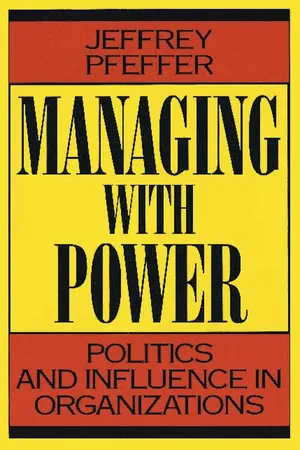 eBook - ePub
Managing With Power
Politics and Influence in Organizations
- Jeffrey Pfeffer(Author)
- 1993(Publication Date)
- Harvard Business Review Press(Publisher)
PART IIIStrategies and Tactics for Employing Power Effectively
This section, which examines how power is used, begins with the topic of framing and the simple point that how we see things depends upon the context in which they are seen.We need to know more than where power comes from—we need to know how to use it effectively to get things done. The effective use of power involves understanding the social psychology of interpersonal influence. All of us practice influence, and are influenced by others, every day as we go about our lives. Those who are particularly effective in getting things accomplished—for instance, successful salespeople—may have used trial and error to develop informal strategies, which rely implicitly on basic social psychological principles. We learn rules of thumb as we encounter different situations, and are successful in some and less successful in others. Some of this learning may be invalid, in that we may have reached incorrect generalizations based on limited experience. But to the extent that our knowledge of how to employ power effectively can become conscious, we can develop a wider range of behaviors and a better understanding of social interactions, which will enhance our effectiveness in organizations.How we look at things is affected by the principles of contrast, commitment, and scarcity, which emphasize the order in which proposals are presented and their relative availability and abundance. The next chapter continues the consideration of interpersonal influence by examining the impact of what others are saying or doing, the effects of liking, and the use of emotional contrast.
Index pages curate the most relevant extracts from our library of academic textbooks. They’ve been created using an in-house natural language model (NLM), each adding context and meaning to key research topics.

