Geography

Political Power
Political power refers to the ability of a group or individual to influence and control the decision-making processes within a geographical area. It encompasses the authority to make and enforce laws, allocate resources, and shape public policies. Political power is often exercised through government institutions, but it can also be wielded by non-state actors such as interest groups and multinational corporations.
Written by Perlego with AI-assistance
Related key terms
1 of 5
11 Key excerpts on "Political Power"
 eBook - PDF
- Kevin R Cox, Murray Low, Jennifer Robinson, Kevin R Cox, Murray Low, Jennifer Robinson(Authors)
- 2007(Publication Date)
- SAGE Publications Ltd(Publisher)
POWER, SPACE AND POLITICAL GEOGRAPHY What are the implications for political geography of thinking power in a fully spatialized way, and giv-ing full weight to its multiple modalities? World events at the beginning of the twenty-first cen-tury have undoubtedly prompted renewed interest in the exercise of Political Power. The conflicts in Palestine, Iraq and Afghanistan, the so-called ‘war on terror’, flows of migrants and refugees, lack of progress on slowing climate change, national liberation struggles, the emergence of new forms of territorial governance, such as those associated with the growth of the European Union, and the relentless push by economically dominant states – especially the US – to open new markets for investment, production and consumption (called ‘free’ trade by its proponents, though the free-doms involved are rarely equally distributed); all these developments focus attention on practices of power, and they all, of course, have distinctive geographies. The challenge for political geography, then, is not only to write those geographies, but also to consider how space and place are implicated in the ‘hows’ and ‘whys’ of power in ways that do not just reproduce familiar assumptions about power being a resource that is held or transmitted – or the newer assumption that power is immanently everywhere. One approach that has begun to inform recent work in political geography adopts a topologi-cal understanding of space. Topology allows us to understand spatial relations not in terms of fixed distances over a flat surface, but in terms of simultaneous or real-time connections in which the distant is drawn near and the near is made dis-tant (Allen, 2003: 191–3). In a topological view of the world, then, Washington is much closer to Baghdad than it is to Tripoli, even though Tripoli appears nearer to Washington on a conventional map. Technologies of war, surveillance and com-munication have all functioned to render Baghdad close at hand. eBook - PDF
- John A. Agnew, Katharyne Mitchell, Gerard Toal, John A. Agnew, Katharyne Mitchell, Gerard Toal(Authors)
- 2008(Publication Date)
- Wiley-Blackwell(Publisher)
Yet despite this problematization of ``centered'' accounts of Political Power in each of the above adaptations, geography, arguably, is still assumed to have less to do with the way that power works over space than does politics. Ultimately, it seems that notions of sovereignty, hegemony, domination, coercion, discipline, authority, surveillance, as well as political rule, organization, and administration, comprise the core vocabulary of power for many within political geography . Whereas distance and proximity, diffusion, and distanciation, or even territory and scale, make up the supporting glossary ± if not the backcloth to power, then part of its rich texture ± as if space makes little difference to the way that power works (see Allen, 2002). This is obviously a contentious claim and one likely to be disputed, whereas the claim that an instrumental conception of power predominates in much of the political geography literature is likely to prove less controversial. For the sense in which power acts as a constraint, an instrument of domination rather than an enabling force, runs through a great number of international relations, world systems, critical geopolitics, and political geography tracts. This is neither altogether surprising, nor wrong in essence, but it is partial. From the work of Hannah Arendt, but also from Michel Foucault, it is possible to see how an alternative understanding of power, one based upon enablement and association, can help us understand the political landscape in different ways. Such an understanding may lend itself to an explanation of the mobilizing actions of NGOs or protest movements in general, but it is by no means restricted to such accounts. BIBLIOGRAPHY Agnew, J. 1994. The territorial trap: the geographical assumptions of international relations theory. Review of International Political Economy , 1(1), 53±80. Agnew, J. 1999. Mapping Political Power beyond state boundaries: territory, identity, and movement in world politics. No longer available |Learn more
- (Author)
- 2014(Publication Date)
- Learning Press(Publisher)
________________________ WORLD TECHNOLOGIES ________________________ Chapter-5 Political and Population Geography Political Geography Political geography is the field of human geography that is concerned with the study of both the spatially uneven outcomes of political processes and the ways in which political processes are themselves affected by spatial structures. Conventionally political geo-graphy adopts a three-scale structure for the purposes of analysis with the study of the state at the centre, above this is the study of international relations (or geopolitics), and below it is the study of localities. The primary concerns of the sub-discipline can be summarised as the inter-relationships between people, state, and territory. History The origins of political geography lie in the origins of human geography itself and the early practitioners were concerned mainly with the military and political consequences of the relationships between physical geography, state territories, and state power. In particular there was a close association with regional geography, with its focus on the unique characteristics of regions, and environmental determinism with its emphasis on the influence of the physical environment on human activities. This association found expression in the work of the German geographer Friedrich Ratzel who, in 1897 in his book Politische Geographie , developed the concept of Lebensraum (living space) which explicitly linked the cultural growth of a nation with territorial expansion, and which was later used to provide academic legitimation for the imperialist expansion of the German Third Reich in the 1930s. eBook - PDF
Visualizing Human Geography
At Home in a Diverse World
- Alyson L. Greiner(Author)
- 2017(Publication Date)
- Wiley(Publisher)
Thinking about the variations from one country to another in terms of voting and electoral practices is just one dimension of political geography. We will say more about electoral geography later in the chapter; first we want to introduce you to the development of our political map, its states, and contemporary geopolitics. AFP/Getty Images GLOBALLOCATOR 1. Define sovereignty. 2. Distinguish between a state and a nation. 3. Identify some of the impacts of colonialism on the political geography of Africa. I t is sometimes said that political geography exists because people are territorial. Most political geographers consider human territoriality to be more than an instinctive, Key Concepts in Political Geography LEARNING OBJECTIVES biological response. Instead, they see it as a complex form of behavior that is shaped by diverse social and cultural factors related to human identity. Territoriality can be expressed by individuals and by groups. The concept of personal space helps us understand territoriality on an individual level. Personal space is 174 CHAPTER 7 Political Geographies political geography The study of the spatial aspects of political affairs. territoriality Strong attachment to or defensive control of a place or an area. Ask Yourself 1. What is an advantage of using a map of this scale to depict the world’s countries? A disadvantage? 2. What six territories on this map are not independent countries? Political map of the world • Figure 7.1 The 195 countries shown on this map provide one powerful expression of human territoriality. The use of such territorially defined political units has become the dominant mode of political organization around the world only within the past four centuries. Throughout most of human history, people organized themselves in different ways, for example, according to class, kinship, or as subjects owing allegiance to a king, an emperor, or other ruler. (Source: NG Maps.)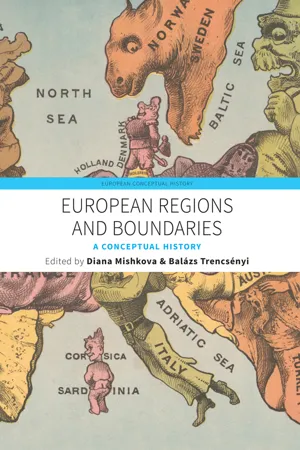 eBook - PDF
European Regions and Boundaries
A Conceptual History
- Diana Mishkova, Balázs Trencsényi, Diana Mishkova, Balázs Trencsényi(Authors)
- 2017(Publication Date)
- Berghahn Books(Publisher)
As far as political geography is concerned, regions are important as politi-cal constructs, as arenas of political engagement, and as terrains of the projec-tion of power. Regional identities are mobilized at different scales and provide Political Geography and Geopolitics 259 matter for the perception, performance, and representation of politics. Still, political geographers have studied one scale much more than others: that of the (sovereign national) state. The territory of modern nation-states has been the object of much of the analysis of the classic works in political geography, covering issues as diverse as state borders, capital cities, administrative and electoral geographies, and international relations. The state territory is seen as such a specific region that the term “region” has generally been used in political geography to label regions other than the state, either subnational regions (i.e., regions inside the territory of the state) or supranational regions (i.e., regions as groupings of states). In this contribution, we want to engage with the latter types of regions and discuss how Europe has been subdivided in regions in political geography and geopolitics. We emphasize explicit re-gionalization—that is, studies in which delineating regions was a central goal—as opposed to implicit regionalization, in which assumptions about re-gions are made in the context of other research goals. Geopolitics can be considered a subfield of political geography. Originally it was primarily concerned with the impact of physical geographical features, such as topography, orography, climate, and vegetation, on power politics (i.e., relations between the most powerful states) and closely connected to the imperialist and nationalist practices of statehood of the first half of the twen-tieth century.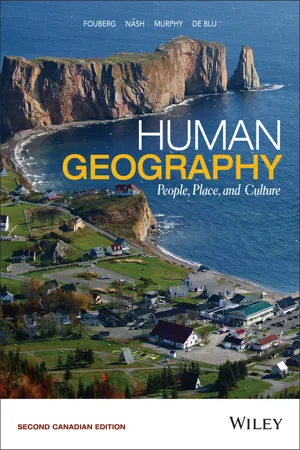 eBook - PDF
Human Geography
People, Place, and Culture
- Erin H. Fouberg, Alexander B. Nash, Alexander B. Murphy, Harm J. de Blij(Authors)
- 2015(Publication Date)
- Wiley(Publisher)
THE MODERN STATE At the global scale, we have a world divided into individual countries or, more properly, states. A state is a politically organized entity with a perma- nent population, a defined ter- ritory, and a government. To achieve statehood, an entity must be recognized as such by other states. Article 2 of the United Nations’ Charter enshrines the principle that all member states must uphold the territorial integrity of other member states and not interfere in their internal domestic affairs. While states and international relations are an important focus for political geographers, many work at the microscale, studying smaller administrative units such as regions, urban areas, provinces, or electoral districts. The present-day division of the world into states is the result of endless contests and accommodations within and between human societies. On the conventional political map, a mosaic of colours represents more than 200 countries and ter- ritories, a visualization that accentuates the separation of these countries by boundaries (see Figure 3.4). The political map is the world map most of us learn first. We look at it, memorize it, and name the countries and perhaps each country’s capital. It hangs in the front of our classrooms, is used to organize maps in Ideology A set of shared ideas or beliefs that serve to justify the interests of dominant groups. In political geography, often understood as a world view about how societies do and should work. Political geography A sub- division of human geography focused on the nature and implications of the evolving spatial organization of political governance and formal political practice on the Earth’s surface. It is concerned with why political spaces emerge in the places that they do and with how the character of those spaces affects social, political, economic, and environmental understandings and practices. eBook - ePub
Spaces of Capital
Towards a Critical Geography
- David Harvey(Author)
- 2002(Publication Date)
- Routledge(Publisher)
Geopolitical struggles between territories and regions have therefore been of considerable importance in geographical understandings. The division of the world into distinctive spheres of influence by the main capitalist powers at the end of the nineteenth century, for example, raised serious geopolitical issues. The struggle for control over access to raw materials, labor supplies and markets was a struggle for command over territory. Geographers like Friedrich Ratzel and Sir Halford Mackinder confronted the question of the political ordering of space and its consequences head on, but did so from the standpoint of survival, control and domination. They sought to define useful geographical strategies in the context of political, economic and military struggles between the major capitalist powers, or against peoples resisting the incursions of empire or neocolonial domination. This line of work reached its nadir with Karl Haushofer, the German geopolitician, who actively supported and helped shape Nazi expansionist struggles. But geopolitical thinking continues to be fundamental within the contemporary era particularly in the pentagons of military power and amongst those concerned with foreign policy. By force of historical circumstance, all national liberation movements must also define themselves geopolitically if they are to succeed, turning the geography of liberation into geopolitical struggles.But it is not only the interactions between geographical entities that need to be treated in a dynamic way. The processes of region formation are perpetually in flux as social and natural processes reconfigure the earth’s surface and its spatially-distributed qualities. New urban regions form rapidly as urban growth accelerates, climate change generates shifts in biotic conditions, water regimes, and the like. Populations shift their perceptions and allegiances, reinvent traditions and declare new regional formations or radically transform the qualitative attributes of the old. Like space-time and the cartographic imagination, the dynamics of the process are by far the most interesting.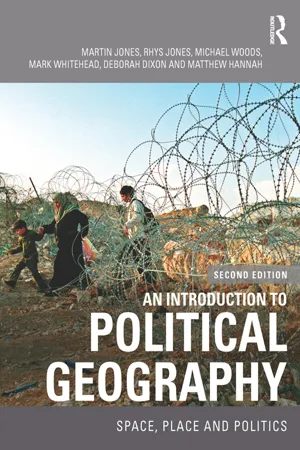 eBook - ePub
An Introduction to Political Geography
Space, Place and Politics
- Martin Jones, Rhys Jones, Michael Woods, Mark Whitehead, Deborah Dixon, Matthew Hannah(Authors)
- 2014(Publication Date)
- Routledge(Publisher)
This research has also extended the scope of political geography in considering non-human entities as both objects of governance and as potential political actants, including animals (Hobson 2007) and even carbon molecules (Whitehead 2009). Much of this work has drawn on theoretical perspectives from political ecology, an interdisciplinary approach that emphasises the embedding of environmental processes and issues within structures of power and politics, which had previously tended to co-exist with, rather than interact with, political geography (Robbins 2003). The political geographies of the environment are discussed further in Chapter 10. Finally, there has also been a rise in a more activist political geography, which seeks not just to analyse the political world, but also to put geographical knowledge to use in challenging and shaping political actions and structures. In some ways this echoes the framing of early political geography and the ambitions of political geographers such as Mackinder, and as such it radically departs from attempts to de-politicise political geography in the post-war period. However, in stark contrast to Mackinder and Haushofer, contemporary activist political geographers aim not to assist the state, but rather to aid subordinate and marginalised populations in challenging power (see also Chapter 12 for more on the broader engagement of political geography in public policy). This has been a core agenda for feminist geopolitics, with Koopman (2011), for example, proposing an ‘alter-geopolitics’ that proactively engages with grassroots movements resisting state violence and constructing political alternatives on the ground. Similarly, the growth of political geography research on social movements is entwined with the active involvement of political geographers in environmental, global justice and peace movements – generating auto-ethnographic accounts from the ‘inside’ (Clough 2012; Routledge 2012) eBook - ePub
- Vincent J. Del Casino, Mary Thomas, Paul Cloke, Ruth Panelli, Vincent J. Del Casino, Jr., Mary Thomas, Paul Cloke, Ruth Panelli(Authors)
- 2011(Publication Date)
- Wiley-Blackwell(Publisher)
A Companion to Social Geography may initially wonder why a chapter on geopolitics would be included in this volume. However, as the personal anecdote above shows, contemporary geopolitical questions and research demonstrate a growth in opportunities for intersections between geopolitics and social geography. Indeed, it is becoming clear that geopolitical processes are permeated with and indeed frame sociospatial phenomena.In order to provide a platform for more conversation between geopolitical inquiry and social geography, this chapter defines the field of geopolitics and then traces its development as various interventions have been made over the years. In the sections that follow, we first offer a brief definition and history of the term and the associated field of “geopolitics.” In the second section, we discuss the contributions made by the subdiscipline of critical geopolitics to geopolitical inquiry. The third section reviews critiques of critical geopolitics that essentially stemmed from geopolitics’ roots in imperialism. Fourth, we examine a number of feminist interventions into the field. Finally, we illustrate how there is growing room for intersection between geopolitics and social geography with illustrative examples from research by contemporary human geographers.Definition and Brief History of “Geopolitics”Outside the discipline of geography, geopolitics is generally understood as the political machinations played out between countries around the world, and more specifically the ways in which geography influences the relationships between states (ÓTuathail 2006; Dahlman 2009). Modern geopolitics came into being as a consequence of the Eurocentric drawing of boundaries around the globe in the nineteenth century, and the partitioning of blank spaces into specific domains of power, resulting in a new order of closed space and associated realms of control (ÓTuathail 1996; Gilmartin and Kofman 2004). Indeed, from its early stages, geopolitics drew on behavioral practices and socio-spatial relationships associated with states. The assumptions held that “natural” aspects of geographical location influenced the roles of states (Dahlman 2009: 89). eBook - PDF
Human Geography
People, Place, and Culture
- Erin H. Fouberg, Alexander B. Murphy(Authors)
- 2020(Publication Date)
- Wiley(Publisher)
In the process, the city became a center of architectural innovation where major streets are lined with impressive buildings—many with intricate stone façades. Photo by A.B. Murphy. © 2020 John Wiley & Sons, Inc. 240 CHAPTER 8 Political Geography independent Hawai’ian state. At present, the native Hawai’ian separatists do not have the numbers, resources, or influence to achieve their aims. The potential for some form of separation between Hawai’i and the mainland United States does, how- ever, exist. Electoral Geography Another important aspect of the internal political geography of states is the division of state territory into electoral districts. Electoral geographers examine how and where these electoral districts emerge and then consider how the voting patterns in particular elections reflect and influence social and political affairs. Various countries use different voting systems to elect their governments, with impacts on who is represented and who is not. For example, in the 1994 South African election, government leaders introduced a system of majority rule while awarding some power to each of nine newly formed regions. The overall effect was to protect, to some extent, the rights of minorities in those regions. The geographic study of voting behavior is especially inter- esting because it helps us assess whether people’s voting ten- dencies are influenced by their geographic situation. Maps of voting patterns often produce surprises that can be explained by other maps, and geographic information systems (GIS) have raised districting analysis to new levels. Political geographers study church affiliation, income level, ethnic background, edu- cation attainment, and numerous other social and economic factors to learn why voters in a certain region might vote the way they do. Electoral geographers can have the most influence in the drawing of electoral districts. eBook - PDF
Political Geography
Territory, State and Society
- Kevin R. Cox(Author)
- 2008(Publication Date)
- Wiley-Blackwell(Publisher)
But that autonomy is always limited. It has to be consistent with the logic of making money to make more money. Spaces can be set aside as (e.g.) Arctic Wildlife Refuges or National Parks. But if there is a sense that oil lurks underneath then nothing will be sacred. FUNDAMENTAL CONCEPTS OF POLITICAL GEOGRAPHY 15 Any approach to political geography that has aspirations to balance has to consider the cultural alongside the economic, the moral alongside the mater-ial: struggles that are seemingly more cultural, like the women’s movement – struggling against the marginalization of women in social life – and struggles that are seemingly more economic, like the labor movement. But the relation between the two always has to be borne in mind. They never exist indepen-dent of one another. They are intertwined. But it is through understanding the logic of capitalist development, its attempt to subordinate everything to its logic, how it exploits particular configurations of power that may appear either cultural or economic, that we can ultimately bring the two into a fruitful and illuminating relationship. Case Studies We have seen that movement and fixity are central to political geography. As far as the fixed are concerned movement can be both fact and possibility. As such it can be both threatening and enabling. And it can be threatening to some and enabling to others: in which case the precise form that territori-ality will take will depend on who is able to prevail, who is able to mobilize the powers of the state on their respective behalves. If it is those for whom movements are enabling, then the attempts to influence what happens in particular areas will be more inclusionary than exclusionary and vice versa.
Index pages curate the most relevant extracts from our library of academic textbooks. They’ve been created using an in-house natural language model (NLM), each adding context and meaning to key research topics.

