Geography

Economic Power
Economic power refers to the ability of a country or region to influence and control the global economy through its production, trade, and financial resources. It is often measured by indicators such as GDP, trade volume, and foreign investment. Economic power can shape geopolitical relationships and impact the distribution of wealth and resources on a global scale.
Written by Perlego with AI-assistance
Related key terms
1 of 5

8 Key excerpts on "Economic Power"
 eBook - ePub
- Nadine Godehardt, Dirk Nabers(Authors)
- 2011(Publication Date)
- Routledge(Publisher)
Size alone (of a country or of a company) is not adequate; also necessary are ‘intelligence, readiness to respond, and efficiency in translating decisions into action’ (Kindleberger 1970 : 56). Based on this, Kindleberger defines power as follows: ‘Power is the strength plus the capacity to use it effectively’ (Kindleberger 1970 : 65). According to Kindleberger, the exercise of power includes a nation’s display of economic productivity and mobility. The advantage for the leadership is being the first to enjoy the fruits of research, which in turn gives the leader the capacity to transform. Kindleberger’s contribution on regional power is therefore characterized by the terms public goods and capacity to transform, with which the relational dynamics of these interconnections are highlighted. Susan Strange (1975) bases her structural power concept on the heterodox perspective of international political economy. She assumes the power of states and the role of transnationally active Non-Governmental Organizations. According to her concept, Economic Power is exercised on four levels (Strange 1975 : 222). Rich countries and their governments influence the structure of the global economy through the pattern of their investments, production, trade and consumption. They establish the framework for minimum standards for the maintenance of stability, order and law in the global market economy. National governments exercise Economic Power through the formulation of national laws (for factors of production, credit and markets). The government with the biggest domestic market and the largest number of multinational businesses (that are important in the driving of global production) possesses the greatest Economic Power. Buyers and sellers, creditors, and debtors affect economic transactions at the operational level. Economic Power is thus always the result of a bargaining process; that is, it is relational. Technology and hegemony According to Richard R eBook - ePub
Geo-economics and Power Politics in the 21st Century
The Revival of Economic Statecraft
- Mikael Wigell, Sören Scholvin, Mika Aaltola, Mikael Wigell, Sören Scholvin, Mika Aaltola(Authors)
- 2018(Publication Date)
- Routledge(Publisher)
Blackwill and Harris fail to properly explain the geo-dimension, too. They try to distinguish between geo-economics and geopolitics, arguing that the latter ‘explain[s] and predict[s] state power by reference to a host of geographic factors (territory, population, economic performance, natural resources, military capabilities, etc.)’. Geo-economics, meanwhile, is ‘a parallel account of how a state builds and exercises power by reference to economic factors’ (2016, p. 24). First, economic factors somewhat confusingly appear in both definitions. What is more, economic performance and military capabilities are not geographical factors. Unless one maintains that everything is geographical because everything is located somewhere, geographical factors are limited to place-specific features – a mountain range that serves as a natural barrier against military invasions, or vast energy resources that constitute the fundament for economic prosperity, for instance. Whenever such factors are taken into consideration in explanations of foreign policy and international relations, it can reasonably be argued that geo-economics and geopolitics (instead of economics and politics) are analysed. Before returning to these thoughts, the next section provides an overview of approaches to geo-economics that do not stand in the Luttwakian tradition.Non-Luttwakian approaches to geo-economics
Some publications that may run under the label of geo-economics are much less related to power politics than Luttwak’s own work, or not at all. Scholvin and Draper (2012), as well as Scholvin and Malamud (2014), concentrate on the impact of material structures in the geographical space on Brazil’s and South Africa’s respective regional economic relations. Käpylä and Mikkola (2016) explain that geographical conditions induce states to cooperate in the Arctic, because open confrontation would risk everyone’s economic objectives. As a side note, this concept of geo-economics – geographical conditions shaping economic outcomes – equals the understanding of geopolitics historically held by geographers, who thought of geopolitics as political outcomes shaped by geographical conditions (Scholvin 2016).Others relate geo-economics to the rise of new actors that matter for economic and political dynamics beyond the national scale. For instance, Barton (1999) argues that while the era of geopolitics was about hegemonic states and stability in international relations, the era of geo-economics is marked by highly flexible non-state actors and borderless transnational relations. Mercille (2008) suggests that while businesspeople act according to a geo-economic logic, the logic behind the actions of politicians is geopolitical. From a slightly different perspective, Cowen and Smith (2009) suggest that the assemblage of territory, economy and people under the authority of nation-states – key criteria of the era of geopolitics – is being recast, mainly because territorial borders have lost the defining role they used to play for the economy and society. The era of geo-economics is marked by global production being more and more segmented, which comes along with the rise of transnational enterprises as key actors. Security threats such as terrorism are also not bound to territorial borders. eBook - ePub
- James T. Tedeschi(Author)
- 2017(Publication Date)
- Routledge(Publisher)
Economic activity includes all activity rationally designed to achieve human objectives when faced by the niggardliness of nature, that is, by the scarcity of material or human resources. It is therefore contrasted with political activity which includes all activity designed to achieve group objectives when faced by the opposition of other groups. Scarcity is the essence of economics as opposition is of politics. In economics, the problem is to overcome obstructions to achievement arising from physical nature, in politics to overcome obstructions arising from human nature(Wright 1955, p. 237).Wright's definition of the two spheres not only distinguishes between them, but also makes it clear that both are concerned with overcoming resistance. Wright goes on to spell out the interdependency between politics and economics:A shortage of resources leads to competition between different persons or groups to obtain them and this may lead to rivalry, conflict, and political activity by each to overcome the obstruction offered by others to attaining its objectives. Conversely, a group may persuade an opposing group to yield to its demands by offering economic rewards or withholding economic advantages. Economics may therefore be an instrument of politics.(Wright 1955, p. 239).Alternative Concepts of Economic Power
The term Economic Power tends to be used rather loosely, as is indicated by a review of some common meanings.(1) Productive power. Perhaps the most common meaning of Economic Power is ability to produce goods and services in a given time period. For a nation gross national product (GNP) would be the equivalent term, while for an individual the equivalent term would be earning power.(2) Productive power relative to need. A refinement of the above concept relates productive capacity to need. Thus, one might encounter the statement that John, with two children and a $15,000 annual income, has more Economic Power than Tom, who has the same income but eight children. In international relations per capita GNP would be the counterpart of this example. Although India and Canada have about the same GNP, Canada has only 20 million mouths to feed, while India has 500 nillion. Therefore, many people would not regard them as equal in Economic Power.(3) Growth rate. eBook - ePub
- B. W. Hodder, Roger Lee(Authors)
- 2015(Publication Date)
- Routledge(Publisher)
Finally, the concept of the economy underlies the logic of the discussion in the sections that follow. The next chapter presents a selective review of literature in the field of economic geography against the background of the concept of the economy developed so far. Then follows the second and longer section of the book in which there is a discussion of the mechanisms of decision making and control. This involves a study of demand, supply, price and the market mechanisms; the alternative or complementary role of government control; and the decision-making activities of consumers, firms and resource owners. The third section of the book takes a closer look at the physical expression of integration within and between economies in the form of flows of goods, people and ideas, and the spatial structure of market centres and transport networks. The final section is devoted to a brief review of the geography of economic growth and development. This is a rapidly growing field of applied economic geography and demonstrates the apparent inability or unwillingness of the world economy to redistribute Economic Power or wealth from the rich to the poor. Intolerable economic inequalities, whether structural or spatial, and the associated ecological implications of the great but highly concentrated productive power of the world economy are perhaps the two major problems facing mankind. Passage contains an image
2 Geographical studies of economic activityThe concept of the economy has rarely been used explicitly in geographical studies of economic activity; economic geography, in general, has been concerned with matters other than the operation of economies, the behaviour and interaction of their elements or the implications of the prevailing distribution of Economic Power. Within the existing literature in economic geography it is possible to distinguish two overlapping approaches to the study of economic activity. Systematic approaches are normally defined in terms of specific products (e.g. wheat), sectors (e.g. energy) or processes (e.g. trade), and are concerned with the spatial structure of these phenomena. Spatial approaches are defined in terms of specific two-dimensional, abstract, national or regional space and are concerned with the spatial structure of economic activity within these areas and with the effects of economic activity upon their economic and regional character.
Passage contains an image
2 Geographical studies of economic activityThe concept of the economy has rarely been used explicitly in geographical studies of economic activity; economic geography, in general, has been concerned with matters other than the operation of economies, the behaviour and interaction of their elements or the implications of the prevailing distribution of Economic Power. Within the existing literature in economic geography it is possible to distinguish two overlapping approaches to the study of economic activity. Systematic approaches are normally defined in terms of specific products (e.g. wheat), sectors (e.g. energy) or processes (e.g. trade), and are concerned with the spatial structure of these phenomena. Spatial approaches are defined in terms of specific two-dimensional, abstract, national or regional space and are concerned with the spatial structure of economic activity within these areas and with the effects of economic activity upon their economic and regional character.Systematic approaches
An early emphasis in economic geography was upon the scientific study of world areas in their direct influence upon the production of goods (Götz 1882). This approach sought to lay bare the influence of the natural environment upon the occupations, products and lives of people in different regions of the world (Wooldridge and East 1966). The best-known example of this approach is Chisholm’s handbook of commercial geography eBook - PDF
- Ashley Kent(Author)
- 2000(Publication Date)
- SAGE Publications Ltd(Publisher)
INTRODUCTION This chapter introduces two lively areas of contemporary human geography – economic and political geography – and provides an outline of recent research which seeks to understand processes of globalisation from a geographical perspective. The chapter begins by introducing economic geography and political geography, identifying key areas of research, and detailing the commonalities in the recent development of these important subdisciplines. In the second part of the chapter I briefly review recent research around the theme of globalisation and cross-border activities and introduce the approach of geopolitical economy, an approach which seeks to understand the changing organisation of power (politics) and wealth (economics) by focusing on their geographies. ECONOMIC GEOGRAPHY The development of contemporary economic geography Economic geography has, over the decades, been one of the most dynamic subdisciplines within human geography. In the late nineteenth century, British economic geography, for better or worse, helped to catalogue the worldwide distribution of resources and in particular the resources available for commercial exploitation throughout the British Empire. In the first half of the twenthieth century, economic geographers concentrated their efforts at the regional level, contributing to rich but undertheorised descriptions of particular regions – the cotton industry in Lancashire, the steel industry around Sheffield, shipbuilding in Clydeside. From the 1960s, with the advent of computers and the desire to become more scientific, economic geographers such as Michael Chisholm, Peter Haggett and David Harvey (in his earlier positivist non-Marxist guise) were at the forefront of the so-called quantitative revolution. During this period economic geographers sought to produce mathematical models to better explain and predict the spatial organisation of economic activity.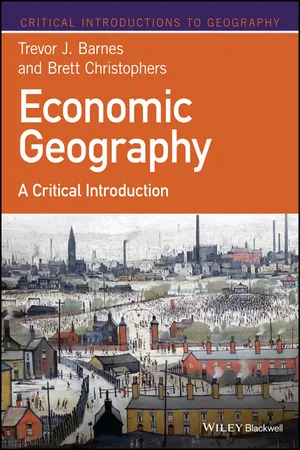 eBook - ePub
Economic Geography
A Critical Introduction
- Trevor J. Barnes, Brett Christophers, Trevor J. Barnes(Authors)
- 2017(Publication Date)
- Wiley-Blackwell(Publisher)
emphasizes that geography matters, knowing others are less wont to do so.This notion of the “materiality of geography” is what we refer to as the implication of space, place, scale, landscape, and environment in economic processes. By “implicated” we mean that the geographies in question affect the processes in question. Whether it is inflation, globalization, raw material extraction, industrial waste disposal, or whatever else, geography is integral rather than peripheral or incidental to the form and outcomes of the process. It is an active ingredient. We add the word “substantive” to make a key further point. This is, that the effects of the geographic are not trivial or marginal. They are significant to the degree of being necessary to explanation. Or, to look at things from an alternative perspective, one might say that the form and outcomes of economic processes in which space and other factors are substantively implicated would be significantly different were it not for those factors. Geography makes a (big) difference. As such, meaningful understanding and explanation of such processes requires explicit attention to and consideration of their geographical dimensions.This leaves just one final component of our definition to be elucidated: the nature of the “space, place, scale, landscape, and environment” upon the implications of which economic geography focuses. What are these things? This question, unsurprisingly, has no simple answer beyond saying that they constitute collectively the essential “stuff” of human geography. Probably at least as much ink has been spilled on each such concept and its meaning as on “economy.”At this point we provide no attempt at definitions or identification of general usages of these terms in economic geography. Definitions would be impossible. And usage in economic geography is in many respects what this book as a whole is about. The meaning of a term like “place” only really becomes apparent and consequential in the context of its utilization. How economic geography understands and invokes each key geographic term will become clearer in the following chapters. For now, therefore, we limit ourselves to a preliminary sketch of each term’s basic contours, which we think is a helpful foundation from which to proceed (Box 2.2 eBook - ePub
- Kathleen E Braden, Fred M Shelley, Kathleen Braden, F.M. Shelley(Authors)
- 2014(Publication Date)
- Routledge(Publisher)
During the late nineteenth and early twentieth centuries, the European colonial powers attempted to integrate residents of their colonies into their European-centered economies. European languages, educational systems, industries, economic activities and political institutions were superimposed on local cultures. As the Europeans integrated their colonies into the global economy, the indigenous people became increasingly torn between national loyalty and obligations to the European-defined colony. Once the former colonies achieved independence, not only were members of different national groups divided in their political loyalties, but each state consisted of a diverse set of national groups, making the achievement of national unity difficult. Tension between competing national groups remains characteristic of many West African countries even today.2.3 Power and territory
The study of geopolitics involves considerations of territory, power and conflict between nations and states. In international relations, control of territory usually increases power, while increased power can expand control of territory. More powerful states exercise direct or indirect territorial control over weaker ones. In many cases, power implies direct, formal political sovereignty over designated territories. Throughout history, many wars have been fought for control of specific territories, and the foreign policies of inany countries have been influenced by the desire to control additional territory for economic, military or political purposes. Countries that have been defeated in wartime have often been obliged to cede control of territory to their victorious opponents. Following World War I, for example, the defeated Germans ceded East Prussia to Poland and the Alsace–Lorraine region to France.Relationships between power and territory can be observed at all geographical scales. Power implies the opportunity to exercise control or influence over others, and control of territory is at times an objective of the exercise of power and at other times a result of its exercise. In the house-hold, for example, a parent controls territory by placing gates or other barriers in order to deny toddlers access to hot stoves, fireplaces, and medicine cabinets. Older children, although not subject to territorial control through physical restraint, are admonished to remain within designated areas when not supervised by parents directly. For example, a ten-year-old may be told, “You may ride your bicycle on this block, but may not cross Main Street by yourself.” Transgression of territorial limits on the part of the child brings swift punishment. Punishment reinforces the parent’s power over the child – power exercised through territorial control, which, in most cases, is undertaken for the child’s long-run benefit. eBook - ePub
Japan's Economic Power and Security
Japan and North Korea
- Christopher W. Hughes(Author)
- 2013(Publication Date)
- Routledge(Publisher)
If a state is to conform to the model of global civilian power, arguably it needs to possess three indispensable qualities which are discussed next: conception, capacity, and policy-making will. The first quality of conception is concerned with the ability of a state to look beyond military power and to perceive the opportunities presented to it to handle a particular security threat by means of Economic Power. The second quality of capacity is the possession by a state of the necessary Economic Power resources that provide it with the potential to follow one of the economic security policy options. Finally, the third quality of global civilian power can be termed as the policy-making will to pursue consistently and instrumentalise economic security policy options.Economic security policy conceptions
States can conceive of two types of security policy which utilise primarily Economic Power in order to deal with economic, political, and military threats. The first can be termed as economic security policy to prevent or minimise the occurrence of conflict between states. Given that general economic hardship or economic friction between states can generate domestic and international instability which can then feed through into inter-state economic and even military conflict, the basic objective of this type of policy is to eliminate within and between states the sources of conflict that originate from economic problems. Hence, this policy is characterised by efforts to promote cooperation and wealth creation, and to stabilise both the international economic system and the economies of individual countries.
Index pages curate the most relevant extracts from our library of academic textbooks. They’ve been created using an in-house natural language model (NLM), each adding context and meaning to key research topics.

