History

Economic Imperialism
Economic imperialism refers to the economic dominance and control exerted by one country or group over others, often through trade, investment, or resource exploitation. This can lead to unequal power dynamics and economic dependency, impacting the social, political, and cultural aspects of the dominated regions. It has been a significant force in shaping global economic relationships and historical developments.
Written by Perlego with AI-assistance
Related key terms
1 of 5

9 Key excerpts on "Economic Imperialism"
 eBook - PDF
- Chester Alexis C. Buama(Author)
- 2023(Publication Date)
- Society Publishing(Publisher)
Imperialism without the need for a demographic conquest does have a long and geographically diverse history, such as when nations were obliged to pay homage to foreign rulers. However, two significant subcategories may be recognized in the research on “Economic Imperialism.” The first is informal: using force to secure or open foreign markets. This relates to the formation of military seaborne commercial networks by the Portuguese (from the fourteenth century), throughout most of Africa’s and Asia’s coastlines, with supporting shore bases. Wherever practicable, the naval force was utilized to create commercial hegemony over existing Asiatic networks; in each national situation, a royal or chartered business monopoly was founded to export products to Europe, while European company personnel were free to engage in intra-Asian commerce. History of Economic Imperialism 59 The concept of “informal empire” also relates to what Gallagher and Robinson refer to as “free trade imperialism,” the use of political and military coercion to force politically weak and economically lesser competitive nations into exposing their market to foreign products. This campaign’s significant period was the mid-nineteenth century. It was allegedly performed by the British throughout Latin America and East Asia. Notable instances include the Opium Wars, which the United Kingdom waged partly to force China to accept unfettered drug imports from British India, and U.S. Commodore Matthew Perry’s 1854 dictate to Japan to break its self-imposed commercial isolation from the West. Colonial control over largely indigenous populations was the “formal” type of imperialism without demographic conquest. The primary phase may be traced back to 1765 when the British East India Company took control of Bengal’s land revenue. The trend was at its peak when tropical Africa and portions of Southeast Asia were partitioned among European powers in the late nineteenth century. eBook - ePub
Empire and Commerce in Africa
A Study in Economic Imperialism
- Leonard Woolf(Author)
- 2018(Publication Date)
- Routledge(Publisher)
What I propose to do in this book is to examine the results of this view that the power and organization of the State should be used upon the world outside the State in order to promote the economic interests of the world inside the State. For that purpose it is unnecessary at present to say anything more about the ends of this international economic policy. In the modern world there is little, if any, difference of opinion over those ends. Where men have during the last fifty years been divided is in the question of the best means for realizing the ends of international economic policy. The means advocated and employed fall roughly into three classes, and for the purposes of enquiry it is necessary to keep distinct the three different spheres in which these three classes of means are and can be used. The three classes may be shortly defined as follows: 1. Economic Imperialism.—Under this term I include the international economic policy of the European States, of the U.S.A., and latterly of Japan, in the unexploited and non-Europeanized territories of the world. The policy of Economic Imperialism includes colonial policy and the acquisition by the Europeanized State of exploitable territory, the policy of spheres of influence, and the policy of obtaining economic control through other political means. These various kinds of policy are all distinguished by one important characteristic; they all aim at using the power and organization of the European form of State in the economic interests of its inhabitants in lands where the European form of State has not developed. I call it imperialism because the policy always implies either the extension of the State’s territory by conquest or occupation, or the application of its dominion or some form of political control to peoples who are not its citizens eBook - PDF
Unmasking Social Science Imperialism
Globalization Theory As A Phase Of Academic Colonialism
- Tatah Mentan(Author)
- 2015(Publication Date)
- Langaa RPCIG(Publisher)
Each one defends itself. Imperialism needs to be defined scrupulously if it is to make any sense at all. The imperialism we all face today can be seen as part of the world of empires, which go back as far as history will take us. This new imperialism is special and unlike any empire that has gone before. There is one key component of imperialism that does need to be identified separately and yet is often used in the same breath, i.e. Colonialism. Colonialism is the process of invasion by a hegemonic power, which either rules the country in its own interests or lets it be ruled by the indigenous population as a proxy government, but again in its own interests. During the last two centuries, the imperial powers established Colonialism for their own ends, first in the 1880s and, more recently, it is happening again with the invasion of Iraq and Afghanistan. Colonial invasions are therefore part of the Imperial expansion that exists everywhere, but they need to be understood as a part of the total process. Over the last two hundred years Imperialism has been the system of world power used by dominant states with the purpose of controlling resources in their own interests. These interests vary from raw materials to markets, and cover a wide range of factors, which have altered considerably over time. Whether we are talking of today’s Imperialism or of that of the last two hundred years, it is worth elucidating briefly some of its key components: The system of Imperial rules has changed and is changing all the time. Although the hegemonic power has now changed hands from Britain to the US – in itself not a minor matter – Imperial rule is still deeply imbedded in Capitalism. So far as the hegemonic power is concerned, Imperial expansion and Capitalism are part and parcel of the same system. Capitalism, as shall later be defined, is a rapidly changing and dynamic system. 18 eBook - ePub
- Robert J. C. Young(Author)
- 2015(Publication Date)
- Wiley-Blackwell(Publisher)
Initially this was effected by setting up infrastructure and encouraging exploitation of natural resources and industrialization by private enterprise, but in later years colonial bureaucrats and economists moved to planning and direct investment by the colonial government in areas that included social welfare and ecology. Whereas earlier analysts, such as Benjamin Kidd (1898), had considered tropical countries only in terms of the commodities that they made available to Europe and the United States, from the 1930s economists saw the advantages of the colonies developing their own economies by increasing their productivity and therefore becoming less of a drain on imperial resources (Meredith and Havinden 2002; Hansen and Jonsson 2013). Imperialism without Colonies In response to the cost and the increasing impracticality of empire, around the end of the nineteenth century a different and more efficient kind of imperialism emerged that reestablished unashamedly economic priorities. As mentioned in the introduction to this chapter, whereas imperialism originally meant conquest and military occupation, directed from the center, by the end of the nineteenth century a new meaning had developed in which imperialism was linked to economic power reinforced by military strength, diplomatic pressure, and cultural influence, without necessarily involving territorial acquisition and physical occupation. This second kind of imperialism, of imperialism without colonies, was and still is often used in relation to the United States, and is associated with US policy in the Caribbean and South America. Although the United States began to acquire colonies in the Pacific from the mid-nineteenth century, it found that, having established South America as its sphere of influence with the Monroe Doctrine, it was able to exert economic pressure through trade alone eBook - ePub
US Capitalist Development Since 1776
Of, by and for Which People?
- Douglas Dowd(Author)
- 2016(Publication Date)
- Routledge(Publisher)
at all, let alone as the world's leading imperialist nation. Yet we are that nation, and have become so in the very processes that made it possible and necessary for the United States to organize the integrated world economy of the last few decades—in the absence of which, it is fair to say, the history of those decades (and, of course, of capitalism itself) would have been vastly different—if unknowably so.One reason our people so quickly deny the imperial status of the United States is the almost universal lack of understanding of what imperialism is and does. Preceding chapters have sought to shed light on the meaning of capitalism; now we must explore the development and the nature of imperialism.Like capitalism, imperialism is a histoncal process. To attempt a oneline definition of it is to promote more confusion than enlightenment. Our attempt to clarify the concept and the reality will move analytically and historically within the framework of several related questions: When and why does a society expand its influence and control over other areas? Where is it able and likely to do so? What does the relationship mean to the imperialist and to the imperialized societies? How are the relationships developed and maintained, and how and why do they change in nature and in meaning over time? Who benefits and who pays, at either end of the relationship? In seeking to answer these questions, we shall first set forth a very general statement, and then explore the specific historical developments preceding and accompanying the emergence of the United States as the great power it became.8Imperialism: Becoming and Being
The seeds of both capitalism and nationalism are to be found in the medieval trading cities, such as Florence, Milan, and Venice, London, Bruges, and Cologne. So are the seeds of mercantilism and modern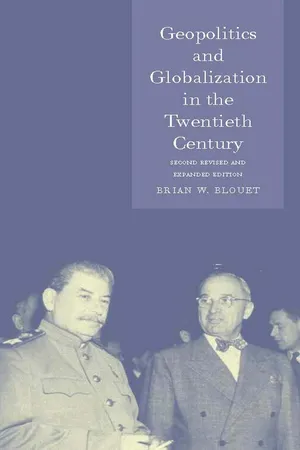
- Brian Blouet, Brian W. Blouet(Authors)
- 2010(Publication Date)
- Reaktion Books(Publisher)
one Imperialism, Globalization, Geopolitics From one perspective imperialism involves globalization. Core countries reach across the world to obtain products and resources unavailable in the home territory and create trans-global linkages. But once imperial powers took possession of territory and controlled access to colonies, they partitioned earth space in ways which prevented free interchange. The European overseas empires, with the exception of the Dutch, used mercantilist policies. Settlers were usually nationals of the colonial power, trade was conducted through designated ports, the colony shipped products to the metropolitan power and received goods from that source in ships flying the national flag. In theory the mercantilist system should break down with industrialization in the core countries of the colonial system. Industries should buy raw materials from the nearest source to cut transport costs. Imported foodstuffs should come from the cheapest producers to keep living costs, and wages, low. Britain, the first major industrializer, began to follow the low-cost path when the repeal of the corn laws ( 1846 ) let in cheap wheat. Shortly sugar was imported more cheaply from Cuba than Barbados or Jamaica. The British adopted free trade. Tariffs were reduced and trading partners treated more equally. British colonies no longer had protected markets in the UK. Few other countries followed a policy of free trade, partly because by the 1840 s free trade with Britain was a trade between unequals. 1 Britain had more products and cheaper manufac-tured goods to sell than any other player. Rather than adopting free trade, countries strengthened nationalist economic policies to protect and encourage home-based industries. Countries like France continued to favour items produced in French colonies, 19 partly because payment was in francs rather than pounds ster-ling. eBook - PDF
- Uskali Mäki, Adrian Walsh, Manuela Fernández Pinto(Authors)
- 2017(Publication Date)
- Routledge(Publisher)
6 Scienti fi c imperialism is here considered as a synonym of academic or disciplinary imperialism. 7 I use the pagination of the 2012 version of the paper, available at www.helsinki. fi / tint/maki, visited on September 14, 2015. 8 Economics is de fi ned as the historical process to build its object of study and its method as a separate science. Hence, economics is neither entirely de fi ned by its object (a substantive de fi nition à la Polanyi), nor by a universal method, nor only by the institutional component ( “ economics is what economists do, ” attrib-uted to Viner). Hence, “ the institution of a rift between that which comes under the heading of economics and that which does not, has evolved over time ” (Cot and Lallement 1994, 55). 9 Imperialism in a general sense is de fi ned as the annexation of territory without a will of integration, annexation to the bene fi t of a minority of investors, aristocrats, and missionaries (Hobson 1938 [1902]). A fundamentally political term, imperialism is the “ the highest stage of capitalism ” in Lenin ’ s theory. See also the works of Rosa Luxemburg. 10 This fi rst criterion is close to that of “ explanatory expansionism ” (Mäki 2009). 11 The sociologist is Everett C. Hughes (Becker, in Swedberg 1990, 30). This appointment did not overcome Becker ’ s disinterest for sociology (Chassonnery-Zaïgouche 2014, 94 – 96) and Becker and Hughes had very little interaction. 12 “ The Sveriges Riksbank Prize in Economic Sciences in Memory of Alfred Nobel 1992, ” Nobelprize.org. Nobel Media AB 2014. Web. September 1, 2015. www. nobelprize.org/nobel_prizes/economic-sciences/laureates/1992/ 13 For which he received the Nobel Prize in 1974, the same year as Friedrich von Hayek. 14 For a detailed history of the project, see Cohen (2004). 15 “ [Discrimination] is de fi ned in relation to the norm of equality of opportunity in the American Creed. In this sense it is, naturally, a ‘ value-loaded ’ term, and rightly so. eBook - PDF
Rethinking Imperialism
A Study of Capitalist Rule
- J. Milios, D. Sotiropoulos(Authors)
- 2009(Publication Date)
- Palgrave Macmillan(Publisher)
In the same line of argumentation, he conceived imperialism as an outcome of ‘pre-capitalist’ structures. He thus believed that ‘a purely capitalistic world could never give rise to the imperialistic impulse’ and that ‘imperialism had its beginning before, not after, the industrial revolution’ (ibid.: 751). Therefore, the content of imperialism is political and not economic. Economic compe- tition is peaceful and ‘co-operative’. Political rivalry, by contrast, takes the form of nationalism, imperialism and militarism. Imperialism is a phenomenon that tends to disappear to the extent that, with the devel- opment of capitalism, pre-industrial political institutions are replaced. It is in the nature of capitalism not to generate phenomena such as imperialism (Winslow 1931, 1972). Similar views are to be found in the more comprehensive exposition by Rostow (1960), who undertook to present a theoretical proposal on his- torical development that could be an alternative to Marxism (or at least to Marxism as he himself had understood it). On the question of imperi- alism the writer accepts that in all their developmental stages, industrial societies have sought to satisfy their economic interests through estab- lishment of overseas territories. Nevertheless, and contrary to the views of the classical theorists of imperialism, imperialist expansion is of slight significance for the development of modern industrial societies. The latter have no need of imperialism for their reproduction. 12 Of course it may frequently be the case, according to Rostow, that the great differ- ences between countries in levels of economic development, which in turn can often be reflected as significant differences in military potential, can give rise to aggressive imperialistic policies (of a regional or global nature). eBook - PDF
At the Expense of Others?
How the imperial mode of living prevents a good life for all
- (Author)
- 2019(Publication Date)
- oekom verlag(Publisher)
and rational ways of dealing with the world. For sub-jugated and exploited peoples, the strength and wealth of their foreign masters were often seen as proof of the ‘objective correctness’ of their worldview and methods. Thus success could only be brought about using the same approach. This devalued non-European cultures and their knowledge — to the benefit of Western con-cepts (see Education and knowledge). Industrialisation and imperialism Europe’s global dominance only developed in the wake of a second wave of colonial expansion in the 18th and 19th centuries, and in the 20th century, this then led to the division of the world into ‘developed’ and ‘under-developed’ nations. 13 For centuries, it was non-Euro-pean countries such as China, India and a few others (today referred to as ‘developing nations’) that held the largest share of global income (Figure 2.1). 14 This, how-ever, changed quickly. Competing European colonial powers expanded their grip on global resources — land (see Food and agriculture), labour (forced ser-vitude or slavery) and raw materials — and violently divided up the world between them. This era, when Europe subjugated and suppressed most of the world, has become known as the Age of Imperialism. Impe-rialism fundamentally altered international relations and its effects continue to be felt in many aspects of life today. Whereas the countries of the Global South still controlled around 63 per cent of global income at the beginning of the 19th century, this share had dropped to a mere 27 per cent by the middle of the 20th century. 15 Industrialisation and its colonial dimension Agriculture had long been the dominant sector, yet over the course of the 18th and 19th centuries, indus-try, business, trade and transport gradually took over. These sectors now drove economic growth and the de-velopment of society.
Index pages curate the most relevant extracts from our library of academic textbooks. They’ve been created using an in-house natural language model (NLM), each adding context and meaning to key research topics.

