Chemistry

Free Radicals
Free radicals are highly reactive molecules with unpaired electrons, making them unstable and capable of damaging other molecules in a process called oxidation. They are involved in various chemical reactions, including those in the human body, and can contribute to aging, disease, and cell damage. Antioxidants help neutralize free radicals by donating electrons to stabilize them.
Written by Perlego with AI-assistance
Related key terms
1 of 5

12 Key excerpts on "Free Radicals"
 eBook - PDF
- A.T. Diplock, M.C.R. Symons, C.A. Rice-Evans(Authors)
- 1991(Publication Date)
- Elsevier Science(Publisher)
CHAPTER 1 Introduction to Free Radicals 1 .I. Introduction This is the introductory chapter which sets the stage for those that fol- low. We start by attempting the definition of the term ‘free radical’ together with a very brief historical background. This is followed by brief overviews of some of the types of radical that might be encoun- tered in biological systems. 1.1.1. What is a free radical? Definitions are odious, difficult to formulate and riddled with loop- holes! A broad definition of a free radical is that it is a molecule or ion containing an unpaired electron. The significance of this can be gauged by considering reaction [ 11 in Scheme 1.1. Here A’ and B’ are radicals, the dots signifying unpaired electrons. These have paired in the bond between the groups in A-B, which is a normal molecule or ion. (It is treated herein as neutral purely for convenience.) Whilst most radicals are reactive and undergo dimerization, or other reac- tions, in which the unpaired electrons have become paired, some are relatively stable and have long life-times. These include nitroxide radi- cals, RzNO, and a range of radicals and radical ions in which the un- paired electron is so delocalized that it is unwilling to participate in a localized electron-pair bond. Thus, although to many people, the unique reactivity of a radical lies in the desire of its characteristic un- paired electron to participate in covalent (electron-pair) bonding, there are many exceptions. Other reactions of great importance which help to characterize radicals and which may accompany reactions of 1 2 TECHNIQUES IN FREE RADICAL RESEARCH type [l] include [2] and [3] (Scheme 1.1) which usually generate new radicals which will ultimately be ‘destroyed’ via reactions of the type in Scheme 1 . 1 . Sometimes one of these new species has a long life-time and becomes readily detectable, especially by ESR spectroscopy (see under ‘spin-trapping’, below). eBook - PDF
- J Hay(Author)
- 2012(Publication Date)
- Academic Press(Publisher)
C H A P T E R 1 INTRODUCTION This chapter takes the form of a brief resume of the chemistry of Free Radicals, what they are and how they are formed, their structure and reactivity. The subsequent chapters add the fine detail to this broad-brush background presenting ultimately, it is hoped, a picture which will explain the continued attraction of this branch of chemistry for so many practical and theoretical chemists. The treatment is fairly general but concentrates on those character-istics of Free Radicals attributable directly to the unpaired electron function. Omitted altogether are the non-radical reactions of Free Radicals which have been described in a recent review. 1 For the purposes of this book, a free radical is a molecule, molecular fragment, complex or atom which incorporates one or more unpaired electrons and the properties of which are controlled by such electron(s). The stability of radicals varies from those like diphenylpicrylhydrazyl (DPPH) (I), which can be synthesized, isolated and crystallized using conventional techniques of organic chemistry and kept indefinitely in a bottle (although reaction with oxygen, which is also a free radical, may cause gradual de-terioration) through those which can be isolated for sufficiently long to be studied by conventional methods of chemical spectroscopy, to those which are so short-lived that, unless trapped in an inert solid matrix, require for their study specially devised techniques. Broadly, the chemical and physical properties of the first two types of radical are covered in ref. 1. While they will not be altogether ignored in the present book, we are here more concerned with the most reactive radicals. The study of reactive radical reactions should ideally involve the generation of the species of interest and their monitoring in situ. Suitable techniques are 1 eBook - PDF
Oxidative Stress and Chronic Degenerative Diseases
A Role for Antioxidants
- José A. Morales-González(Author)
- 2013(Publication Date)
- IntechOpen(Publisher)
Figure 1. Atomic orbitals The atoms arrange their electrons in regions called atomic orbitals in the form of pairs of electrons. The latter confers stability atom, or low chemical reactivity towards its environ‐ ment. However, under certain circumstances, it may lose its parity orbital, either giving or capturing an electron. When this occurs, the resulting orbit exhibits an unpaired electron, making the atom in a free radical. The presence of an unpaired electron in an orbital outer‐ most atom latter confers an increased ability to react with other atoms and / or molecules present in the environment, usually, lipids, proteins and nucleic acids (Figure 2). The inter‐ action between Free Radicals and such substrates results in eventually structural and func‐ tional alterations [4]. Free Radicals cause damage to different levels in the cell: Attack lipids and proteins in the cell membrane so the cell cannot perform its vital functions (transport of nutrients, waste disposal, cell division, etc.). The superoxide radical, O 2 , which is normally in the metabolism cause a chain reaction of lipid peroxidation of the fatty acids of phospholipids of the cell membrane. Free Radicals at‐ tack DNA avoiding cell replication and contributing to cellular aging. Chemistry of Natural Antioxidants and Studies Performed with Different Plants Collected in Mexico http://dx.doi.org/10.5772/52247 61 Figure 2. Unpaired electron in a free radical The normal body processes produce Free Radicals that involve food metabolism, breathing and exercise. We are also exposed to environmental elements that create Free Radicals such as industrial pollution, snuff, radiation, drugs, chemical additives in processed foods and pesticides. Not all Free Radicals are dangerous because, for example, immune cells create Free Radicals to kill bacteria and viruses, but if there is sufficient control by antioxidants, healthy cell can be damaged. eBook - PDF
- William Pryor(Author)
- 2012(Publication Date)
- Academic Press(Publisher)
Where possible, examples from biology will be used as illustrations. II. THE NATURE OF Free Radicals A. Definition Free Radicals are, by definition, species which contain an odd number of electrons. They may be positively charged, negatively charged, or neutral, and all three types are important [la-4,llb]. For example, the thiyl radical is a neutral free radical. It can be produced by hydrogen abstraction from a thiol Q-+ RSH • QH +RS-( 1 ) by an organic radical, as in eq 1. (The symbol Q · will be used throughout this chapter for a general free radical.) The thiyl radical also is produced by one-electron reduction of disulfides, eq 2. These reactions are partially responsible RSSR + e~ • [RSSR ] • RS + RS-(2) for the radiation protective properties of thiols and disulfides [lie]. The radical which results from hydrogen abstraction from a phenol also is neutral, eq 3. Vitamin Ε (α -tocopherol) and coenzyme Q both undoubtedly undergo ArOH + Q-• ArO-+ QH (3) this type of reaction in vivo. Since the ArO- radical generally does not propa-gate autoxidative chains, phenols act as inhibitors in autoxidations of organic compounds [12-14]. Cation radicals occur in many contexts. Pyridinyl cation radicals are discussed by Kosower in Chapter 1, Volume II. There is evidence that cation radicals of polynuclear hydrocarbons may be the proximate carcinogen [15,16]. Anion radicals also are important in biology. Two noteworthy examples are the superoxide radical 0 2 -~ (often merely written as 0 2 ~ ) , and the 1. Free Radical Reactions in Biological Systems 5 solvated electron which is produced by the action of ionizing radiation on matter, e a q - ~ (see Chapter 6; and Chapters 8 and 9, Volume II). Reaction 2 above shows one reaction of solvated electrons. B. Radical Reactivity Radicals vary in reactivity, and their reactivity, like that of other chemical species, is influenced by temperature and by the concentration of molecules in their environment. eBook - PDF
- Edward Bittar(Author)
- 1996(Publication Date)
- Elsevier Science(Publisher)
CHEMICAL BACKGROUND OF Free Radicals Electrons of atoms and molecules occupy spatial volume elements, called orbitals, which are determined by energy and probability ftinctions of quantum mechanics. Each orbital can contain a maximum of two electrons. Unlike most chemical species, which have two electrons in each orbital, with these electrons spinning in opposite directions, Free Radicals are molecules or molecular fragments with an unpaired electron in their outer orbital (Halliwell, 1984; Slater, 1984). This defini-tion of Free Radicals includes transition metal ions, the hydrogen atom, and a few common inorganic compounds, for example, nitrogen oxide (NO) and nitrogen dioxide (NO2). The presence of an unpaired electron in the outer orbital of a free radical is conventionally represented by the superscript dot, R*. A compound becomes a free radical either by gaining an additional electron (e), as in equation (1), which shows the reduction of molecular oxygen to the superoxide anion radical (62^), or when it loses an electron, as in equation (2), which shows the oxidation of ascorbic acid (AH2) to the dehydroascorbic acid (A) through a free radical intermediate (AH*). 02-e->02 (1) AH2 -e -> AH' -e -^ A (2) OXYGEN Free Radicals Molecular oxygen is a biradical with one unpaired electron in each of its two outer orbitals. The reactivity that molecular oxygen might be expected to have as a biradical is, however, decreased because the unpaired electrons spin in the same direction (Taube, 1965) (Figure 1). This decreases the ability of molecular oxygen to simultaneously remove two electrons from a nonradical molecule that has the normal configuration of pairs of electrons spinning in opposite directions. An electron spin inversion has to occur before such an oxidative reaction can occur, and the laws of quantum mechanics stipulate that such a spin-inversion process is eBook - PDF
- Samuel McManus(Author)
- 2012(Publication Date)
- Academic Press(Publisher)
Free Radicals Earl S. Huyser I. Introduction . . . . . . . . . . 1 A. Historical Background and Scope 2 B. Detection of Free Radicals . . . . . . . 3 C. Mechanisms of Free-Radical Reactions . . . . . 7 II. Formation of Free Radicals . . . . . . . 10 A. Thermolysis of Covalent Bonds 10 B. Photochemical Processes . . . . . . . 14 C. Bimolecular Redox Reactions 16 III. Reactions of Free Radicals . . . . . . . 17 A. Bimolecular Radical-Propagating Reactions . . . 17 B. Unimolecular Free-Radical-Propagating Reactions . . . 21 C. Termination Reactions . . . . . . . . 25 IV. Reactivities of Free Radicals . . . . . . . 26 A. Resonance Factors . . . . . . . . 26 B. Polar Effects 32 C. Complexing 40 D. Steric Effects 46 V. Kinetic Aspects of Free-Radical Chain Reactions . . . . 50 A. General Considerations . . . . . . . 50 B. Steady-State-Derived Rate Laws 53 C. Determination of Rate Constants 56 References . . . . . . . . . . 57 I. Introduction Free Radicals are chemical species having one or more unpaired electrons. Although some Free Radicals are stable enough to be isolated or maintained in solution at fairly high concentrations, most are chemically reactive species and encountered only as intermediates in chemical reactions. The purpose of this chapter is to examine the chemistry of Free Radicals as reaction inter-mediates and ascertain the unique aspects of such reactions. HCALS tyser I 2 Earl S. Huyser A. HISTORICAL BACKGROUND AND SCOPE The existence of organic Free Radicals was proposed in the earliest days of the development of organic chemistry. Reductions of simple alkyl halides with zinc or sodium, for example, were thought to yield free alkyl radicals as reaction products. Subsequent investigations, however, showed that stable CH 3 I + Na > CH 3 - + Nal (1) dimeric or disproportionation products having the same empirical formulas as the radicals were the actual products formed in these reactions.
- Alan Rodgman, Thomas A. Perfetti(Authors)
- 2016(Publication Date)
- CRC Press(Publisher)
Apart from polymer chemistry, synthetic organic chemistry, and environmental chemistry, much effort in recent times is expended on research in health and nutrition [Nagendrappa (27A78)]. There are some general features of a free-radical reac-tion. Free-radical reactions take three distinct, identifi-able steps. The first is formation of the free radical that can happen by enzyme catalysis, homolysis, thermolysis, radiation, light induction, combustion, and pyrolysis, or other means. The second step, called propagation, is the heart of a free-radical reaction. In this step, Free Radicals are repeatedly regenerated and can react with neutral mol-ecules to produce new Free Radicals. If there is no interven-tion, two Free Radicals can react to form a neutral molecule, and the reaction is terminated, which represents the third step in the general reaction scheme. Because of this repeti-tive nature of the reaction, free-radical reactions are called “chain reactions” and are often represented as a cyclic pro-cess [Nagendrappa (27A78)]. 27.2 ANALYTICAL METHODS FOR DETERMINATION OF Free Radicals The instrumental method historically used for the detec-tion of Free Radicals is electron spin resonance (ESR) (some-times called electron paramagnetic resonance [ERP]). ESR is a spectroscopic technique which detects species that have unpaired electrons. Free Radicals can be organic compounds that have a free electron on carbon, oxygen or nitrogen, or inorganic compounds or complexes that have a free electron usually residing on a metal [EPR (27A31)]. ESR spectros-copy is the preferred and major analytical technique for the detection and quantification of Free Radicals [Demopoulos (27A28)]. ESR has been used in many fields of science to explore the presence and effects of Free Radicals in chemistry, physics, and biology. Free Radicals can be gases, liquids, or solids and gener-ally exist in very low, and in some cases, steady-state con-centrations.
- Hideo Togo(Author)
- 2004(Publication Date)
- Elsevier Science(Publisher)
1 What are Free Radicals? 1.1 GENERAL ASPECTS OF Free Radicals 1.1.1 Aspects of Free Radicals Generally, molecules bear bonding electron pairs and lone pairs (a non-bonding electron pair or unshared electron pair). Each bonding or non-bonding electron pair has two electrons, which are in opposite spin orientation, þ 1/2 and 2 1/2, in one orbital based on Pauli’s exclusion principle, whereas an unpaired electron is a single electron, alone in one orbital. A molecule that has an unpaired electron is called a free radical and is a paramagnetic species. Three reactive species, a methyl anion, methyl cation, and methyl radical, are shown in Figure 1.1. Ethane is composed of two methyl groups connected by a covalent bond and is a very stable compound. The methyl anion and methyl cation have an ionic bond mainly between carbons and counter ions, respectively, and are not particularly unstable, though there are some rather moisture-sensitive species. However, the methyl radical is an extremely unstable and reactive species, because its octet rule on the carbon is not filled. The carbon atom in the methyl cation adopts sp 2 hybridization and the structure is triangular (120 8 ) and planar. The carbon atom in the methyl anion adopts sp 3 hybridization and the structure is tetrahedral (109.5 8 ). However, the carbon atom in the methyl radical adopts a middle structure between the methyl cation and the methyl anion, and its pyramidal inversion rapidly occurs as shown in Figure 1.1, even at extremely low temperature. From the above, it is apparent that Free Radicals are unique and rare species, and are present only under special and limited conditions. However, some of the Free Radicals are familiar to us in our lives. Thus, molecular oxygen is a typical free radical, a biradical species.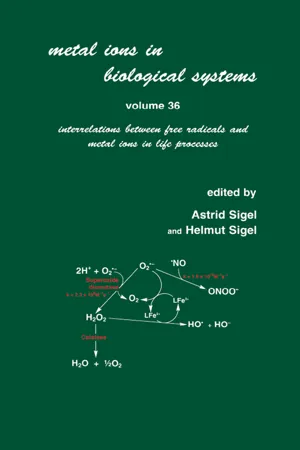 eBook - ePub
Metal Ions in Biological Systems
Volume 36: Interrelations Between Free Radicals and Metal Ions in Life Processes
- Astrid Sigel, Helmut Sigel(Authors)
- 2018(Publication Date)
- Routledge(Publisher)
Free Radicals and transition metal ions are ubiquitous in biological systems. The variable valency of transition metal ions plays a key role in the catalysis of redox processes in which the oxidation states of the metal are inherently unstable and/or have only a transient existence during the reaction sequence. In many cases where the overall reaction involves multiple electron transfer, the detailed mechanism frequently comprises a sequence of one-electron steps. Free Radicals, being atoms or molecules with an unpaired electron, are the archetypal one-electron redox reagents, so that the elementary step in the interaction of Free Radicals with transition metal ions is a one-electron process. The elucidation of the complex mechanisms that take place in nature can be advanced to a great extent if one is able to measure in isolation these individual steps. To achieve this goal use is made of the fast time-resolved methods of pulse radiolysis and flash photolysis to generate the desired Free Radicals and to measure their rates of reaction with the species of interest. Often these species are model compounds rather than the biological systems themselves.Previous surveys of uncommon oxidation states of metal ions can be found in the literature [1 , 2 , 3 ].1.2. Interaction of Free Radicals with Transition Metal IonsA characteristic property of the transition metals in solution is that they are coordinated to ligands, so that one must consider the complete entity—metal center and ligands —in its reaction with Free Radicals. The possible reactions are of two main types: outer-sphere electron transfer, in which an electron is transferred between the free radical and the metal center with the ligands of the latter remaining intact; and inner-sphere electron transfer, whereby the ligands are involved. In the latter case the reaction may occur first at a ligand, turning it into a radical, followed by electron transfer to or from the metal center, or the free radical may itself become bonded to the metal ion, either by exchanging with one of the ligands or by increasing the coordination number of the metal ion by one, before electron transfer takes place. In some cases the free radical remains bound to the metal center and the oxidation number of the metal is not well defined. Examples of each of these kinds of reaction are described in Secs. 5 and 6.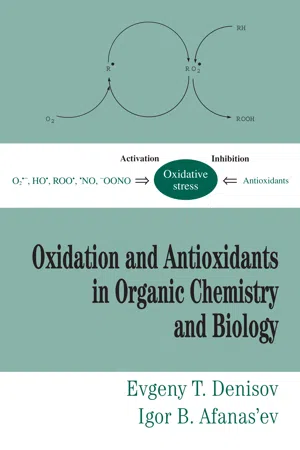
- Evgeny T. Denisov, Igor B. Afanas'ev(Authors)
- 2005(Publication Date)
- CRC Press(Publisher)
21 Initiators of Free Radical-Mediated Processes Numerous initiators of free radical-mediated processes, lipid peroxidation, oxidative destruc-tion of proteins and DNA, cell damage, and others are now well known. Among them are Free Radicals, transition metals, pollutants, drugs, food components, radiation, and even magnetic field. Despite a great number of initiators, all of them are the producers of Free Radicals, such as superoxide, hydroxyl radical, perhydroxyl radical, and nitric oxide. We will discuss many of these species and their major reactions excluding the effects of UV, visible, and high-energy radiation, which are mainly relevant to the field of radiation biology. 21.1 SUPEROXIDE It has already been stressed that the discovery of superoxide as the enzymatically produced diffusion-free dioxygen radical anion [1–3] was a pivotal event in the study of free radical processes in biology. It is not of course that the McCord and Fridovich works were the first ones in free radical biology, but the previous works were more of hypothetical character, and only after the identification of superoxide by physicochemical, spectral, and biochemical analytical methods the enzymatic superoxide production became a proven fact. Chemical and biochemical properties of superoxide have already been considered earlier [4,5]. It is now understood that in spite of its pompous name superoxide is a relatively innocuous free radical and that its main role is to be a precursor of other much more reactive species (see below). At the same time, many new findings have been obtained concerning biological activity of superoxide. Due to its mainly harmless nature, superoxide nonetheless is able to interact with some biological molecules and affect various biological systems. For example, superoxide produced by stimulated neutrophils is able to damage erythrocytes [6]. Shibanuma et al. [7] has shown that superoxide increases intracellular pH of human leukemia cells. eBook - PDF
Frying of Food
Oxidation, Nutrient and Non-Nutrient Antioxidants, Biologically Active Compounds and High Temperatures, Second Edition
- Dimitrios Boskou, Ibrahim Elmadfa(Authors)
- 2016(Publication Date)
- CRC Press(Publisher)
49 3 Free Radicals in Biological and Food Systems Malgorzata Nogala-Kalucka and Aleksander Siger 3.1 INTRODUCTION For most living organisms, oxygen is the crucial element necessary for maintaining their life functions. It is life-giving and widespread, although the wide research on its biological role proves that it can also have adverse effects on living organisms. Different processes and oxygen transformations result in creating Free Radicals (FR) and other reactive species (RS). The in vivo effects exerted by these RS heavily depend on their concentration. These particles that act as signal transmitters and can modify various cellular pathways, take part in gene expression, and influence CONTENTS 3.1 Introduction .................................................................................................... 49 3.2 Types of Free Radicals and Other Reactive Species ...................................... 50 3.2.1 Superoxide Radical Anion (O 2 •− ) ........................................................ 50 3.2.2 Hydrogen Peroxide (H 2 O 2 ) ................................................................. 51 3.2.3 Hydroxyl Radical ( • OH) ...................................................................... 51 3.2.4 Singlet Oxygen ( 1 O 2 ) ........................................................................... 52 3.2.5 Ozone (O 3 ) .......................................................................................... 52 3.2.6 Nitric Oxide and Peroxynitrite (NO • , ONOO − ) .................................. 52 3.2.7 Organic Radicals—Oxidation of Lipids, Proteins, and Carbohydrates ..................................................................................... 53 3.3 Mechanisms of Free Radical Formation ........................................................ 55 3.3.1 The Sources of RS in Biological Systems .......................................... 57 3.4 Sources of Natural Antioxidants and Their Properties ..................................
- Sivakumar Joghi Thatha Gowder(Author)
- 2015(Publication Date)
- IntechOpen(Publisher)
Khlebnikov et al. [3 ] defined antioxi‐ dants as “any substance that directly scavenges ROS or indirectly acts to up-regulate antioxi‐ dant defenses or inhibit ROS production”. In other words, we can define antioxidants as any molecule that inhibits the oxidation of another molecule. A chemical reaction involving the loss of electrons and increase in the oxidative state is termed as “oxidation.” Oxidation results in the formation of Free Radicals that are unstable atoms and molecules deficit in electrons. They have unpaired electrons and are extremely reactive and are capable of initiating chain reactions that destabilize other molecules and generate Free Radicals. These Free Radicals are also termed as reactive oxygen species or ROS and create a homeostatic imbalance that generates oxidative stress and causes cell death and tissue injury. ROS includes: superoxide (O2 ⋅− ), hydroxyl (OH ⋅ ), peroxyl (RO2 ⋅ ), hydroperoxyl (HO2 ⋅ ), alkoxyl (RO ⋅ ), peroxyl © 2015 The Author(s). Licensee InTech. This chapter is distributed under the terms of the Creative Commons Attribution License (http://creativecommons.org/licenses/by/3.0), which permits unrestricted use, distribution, and reproduction in any medium, provided the original work is properly cited. (ROO⋅), nitric oxide (NO⋅), nitrogen dioxide (NO2 ⋅), and lipid peroxyl (LOO⋅) and the non-radicals hydrogen peroxide (H2O2), hypochlorous acid (HOCl), ozone (O3), singlet oxygen (1Δg), and lipid peroxide (LOOH) [ 4 ]. Free Radicals are known to be formed as a result of environmental pollution, stress, cigarette smoke, UV Light, ionizing radiations, and xenobi‐ otics. Toxic effect of the Free Radicals causes oxidative stress and results in the pathogenesis of diseases (Figure 1). Figure 1. Free Radicals: Production and damage (Adapted from [5]).
Index pages curate the most relevant extracts from our library of academic textbooks. They’ve been created using an in-house natural language model (NLM), each adding context and meaning to key research topics.

