Chemistry

Inorganic Chemistry
Inorganic chemistry is the study of inorganic compounds, which are substances that do not contain carbon-hydrogen (C-H) bonds. It focuses on the behavior and properties of elements and their compounds, including metals, minerals, and organometallic compounds. Inorganic chemistry plays a crucial role in various fields such as materials science, environmental science, and bioinorganic chemistry.
Written by Perlego with AI-assistance
Related key terms
1 of 5
7 Key excerpts on "Inorganic Chemistry"
 eBook - ePub
- Michael Matson, Alvin W. Orbaek(Authors)
- 2013(Publication Date)
- For Dummies(Publisher)
Part I Reviewing Some General Chemistry In this part . . .Y ou navigate through some of the basic rules of the road that help guide you as you travel through the science of Inorganic Chemistry. This starts with a definition of Inorganic Chemistry and continues with a description of the foundation upon which this subject stands. Inorganic Chemistry is the study of all the materials known to humankind, and it includes the study of how all the materials interact with one another. Passage contains an image
Chapter 1 Introducing Inorganic Chemistry In This ChapterGetting familiar with basic concepts in chemistryBuilding your knowledge of chemical bondingTraveling across the periodic tableDelving into details with special topicsCounting by tens: products, prizes, instruments, and experimentsI norganic chemistry is a practical science. By studying it, you become familiar with the intricate working of processes and materials — from how silicon works in a semiconductor to the reason why steel is stronger than iron. Inorganic Chemistry is important for civilization and technological development.The science of Inorganic Chemistry covers a great deal of material; in short, it’s the chemistry of everything you see around you. Inorganic Chemistry explores and defines laws that atoms follow when they interact, including trends in how they react, characteristics they possess, and the materials they make. It may seem daunting at first to think about how many possibilities there are in the science of Inorganic Chemistry. Fortunately, each new concept builds on another concept in a very logical way.
Passage contains an image
Chapter 1 Introducing Inorganic Chemistry In This ChapterGetting familiar with basic concepts in chemistryBuilding your knowledge of chemical bondingTraveling across the periodic tableDelving into details with special topicsCounting by tens: products, prizes, instruments, and experimentsI norganic chemistry is a practical science. By studying it, you become familiar with the intricate working of processes and materials — from how silicon works in a semiconductor to the reason why steel is stronger than iron. Inorganic Chemistry is important for civilization and technological development.The science of Inorganic Chemistry covers a great deal of material; in short, it’s the chemistry of everything you see around you. Inorganic Chemistry explores and defines laws that atoms follow when they interact, including trends in how they react, characteristics they possess, and the materials they make. It may seem daunting at first to think about how many possibilities there are in the science of Inorganic Chemistry. Fortunately, each new concept builds on another concept in a very logical way. eBook - ePub
- James G. Speight(Author)
- 2017(Publication Date)
- Butterworth-Heinemann(Publisher)
2 )), which plays a major role in many inorganic compounds. Thus, Inorganic Chemistry is the subcategory of chemistry concerned with the properties and reactions of inorganic compounds, which includes all chemical compounds without the chains or rings of carbon atoms that fall into the subcategory of organic compounds.Fig. 2.1 The periodic table of elements.Fig. 2.2 Periodic table of elements showing the groups and periods including the lanthanide elements and the actinide elements.A common differentiation to help distinguish between inorganic compounds and organic compounds is that inorganic compounds are either the result of natural processes unrelated to any life form or the result of human experimentation in the laboratory, whereas organic compounds result from the activity of living beings. However, caution is advised when using such a definition because organic compounds can be artificially created in the laboratory. Another definition pertains to the salt-making property of inorganic compounds, which is absent in organic compound, but even then, this definition too is not truly correct since organic acids (RCO2 H) sacrosanct can also form salts. There is also the argument that inorganic compounds do not have carbon-hydrogen bonds—a characteristic of organic compounds—but this, also, is not strictly true since perfluorocarbons (carbon-fluorine compounds where all of the hydrogen atoms have been replaced by fluorine atoms) do not have any carbon-hydrogen bonds but are still organic compounds. Another often-quoted difference is that inorganic compounds contain metal atoms, whereas organic compounds do not. Again, this is not true since organometallic compounds contain metal atoms. Thus, caution is advised when accepting any definition that purports to define the differences between inorganic compounds and organic compounds.Organometallic chemistry , a very large and rapidly growing field, bridges both areas by considering compounds containing direct metal-carbon bonds and includes catalysis of many chemical reactions. Organometallic compounds contain at least one bond between a metal atom and a carbon atom. They are named as coordination compounds, using the additive nomenclature system. The name for an organic ligand binding through one carbon atom may be derived either by treating the ligand as an anion or as a neutral substituent group. In addition, bioInorganic Chemistry
- Robert Burke(Author)
- 2013(Publication Date)
- CRC Press(Publisher)
25 © 2010 Taylor & Francis Group, LLC chapter two Basics of chemistry Chemistry is the study of matter. It can be divided into two basic sections: inorganic and organic. Inorganic Chemistry involves acids, bases, salts, elements except carbon-con-taining compounds, and the physical state of matter in which they are found. Important classes of inorganic compounds include the oxides, sulfides, sulfates, carbonates, nitrates, and halides. The study of some carbon-containing compounds such as carbon dioxide, carbonates, and cyanides is also considered part of Inorganic Chemistry. Organic chem-istry involves compounds that contain carbon. Organic chemistry involves the scientific study of the structure, properties, composition, reactions, and preparation of carbon-based compounds, hydrocarbons, and their derivatives. These compounds may contain any number of other elements, including hydrogen, nitrogen, oxygen, the halogens, as well as phosphorus, silicon, and sulfur. The definition of matter is anything that occupies space and has mass. Matter can exist as a solid, liquid, or gas. Temperature and pressure can affect the physical state of a chemical, but not its properties. The hazards presented by a chemical may not be the same, depending on the physical state of the material. For example, only gases burn; solids and liquids do not burn, even though they may be listed as flammable. A solid or liquid must be heated until it produces enough vapors to burn. It is important to understand the states of matter in order to better understand the physical and chemical characteristics of hazardous materials. There can be some inter-mediate steps in the process of classifying solids, liquids, and gases. Some solids may have varying particle sizes, from large blocks to filings, chips, and dusts. Particle sizes of vapors may vary, from vapors that are small enough to be invisible to mists that are readily visible. eBook - PDF
- Rose Marie O. Mendoza(Author)
- 2023(Publication Date)
- Arcler Press(Publisher)
INTRODUCTION TO INORGANIC COMPOUNDS 1 CONTENTS 1.1. Introduction ........................................................................................ 2 1.2. Inorganic Chemistry and Inorganic Compounds ................................. 4 1.3. Classification of Inorganic Compounds ............................................... 6 1.4. Some Subdivisions of Inorganic Chemistry........................................ 14 1.5. Types of Reactions and Examples of Inorganic Compounds............... 16 1.6. Inorganic Chemistry’s Applications ................................................... 16 References ............................................................................................... 17 CHAPTER An Overview of Inorganic Compounds 2 1.1. INTRODUCTION When two or more chemical elements combine (except Carbon to Hydrogen) to form another substance in nearly definite and whole number proportions, the term “inorganic compound” is the thing in mind. Though this universal definition was not so strict since carbon compounds as carbides, carbonates, cyanides as well as graphite, carbon dioxide and carbon monoxide are classified inorganic, there are some exceptions to rules in chemistry that are considered (which will be discussed in the following chapters) as a result of techniques and processes employed to realize the criteria and implement the protocol. One popular technique depends on the presence of specific components. For instance, halides are composed of more than halogen atoms, hydrides are composed of more than one hydrogen atom, and oxides are composed of more than one oxygen atom (Hasenknopf, 2005). Organic complexes are defined as those that contain carbon atoms in their backbone, while all other compounds are categorized as inorganic. As the term implies, organometallic complexes are organic molecules that are covalently linked to metal atoms (Figure 1.1).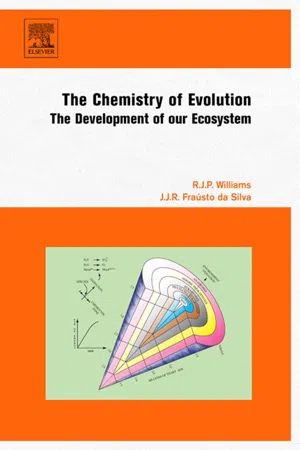 eBook - PDF
The Chemistry of Evolution
The Development of our Ecosystem
- R.J.P Williams, J.J.R Fraústo da Silva(Authors)
- 2005(Publication Date)
- Elsevier Science(Publisher)
Of course, organic as a word implies a relationship to living organisms, and the original organic chemicals of C, H, N, O, S and P were thought to be the only class of chem-ical found in such organisms, but as we shall see this is known to be not so today. In this book, we can only touch on the diversity of organic chemicals, stressing their rel-evance to the ecosystem. Turning to their properties, in general, organic compounds are molecular and do not form continuously bonded lattices in contrast with a large number of such inorganic compounds. They are relatively volatile and many are not soluble in water, for example, N 2 , O 2 , CO, CH 4 . Although stoichiometrically many are complicated compounds, are relatively kinetically stable (see below), only open to slow change at temperatures of our environment and have to be structurally defined for reasons given below. They readily form long-chain, electrical insulating, poly-mers, sometimes cross-linked, of very high molecular weight. Hence they were very difficult to characterise at first and very little was really known about them until after 1850 AD, while inorganic compounds had already been studied, albeit often in a somewhat rough and ready way, for more than 3000 years. Another feature of organic chemistry, as it had been examined until recently, is that its syntheses of compounds were carried out in organic solvents, such as hydrocarbons, alcohols, chloroform and ether since many organic compounds are not soluble in water and some are not even stable in the presence of water. By contrast, inorganic “ions” of salts were examined almost exclusively in water. Today it is known that biological organic chemistry, which will interest us, takes place overwhelmingly in aqueous media too, with and utilising many inorganic elements, which provide another reason for examining organic and inorganic chemistries together (see Section 2.16). eBook - PDF
Inorganic Biochemistry
Volume 1
- H A O Hill(Author)
- 2007(Publication Date)
- Royal Society of Chemistry(Publisher)
Foreword Inorganic Biochemistry is concerned with the function of all metallic and most nonmetallic elements in biology. It can be defined as the biochemistry of those elements whose chemistry normally consititutes the province of inorganic chemists. Its net is cast widely, stretching from chemical physics to clinical medicine. Its influence is all-pervasive. Thus ‘there probably does not exist a single enzyme-catalyzed reaction in which either enzyme, substrate, product or a combination of these is not influenced in a very direct and highly specific manner by the precise nature of the inorganic ions which surround and modify it’.l The subject has developed dramatically during this decade. This is reflected in the number of publications2 and even a journal3 devoted to it. The upsurge of interest coincides with improved analytical methods, less tige-consuming preparative techniques, the successful application of spectroscopy and diffrac- tion, the improved synthesis of simple inorganic complexes used to model or mimic various aspects of biological molecules, the increased concern about the environmental hazards caused by some metal ions, the use of metal ions or complexes as therapeutic agents, and the recognition of the importance of an increasing number of trace elements in plant, animal, and human nutrition. All have contributed towards the growth of a subject which previously attracted only a few lone devotees. I hope that this volume and those to follow will ease the burden of inorganic biochemists as they seek to relate their work to fields far beyond the confines of the traditional disciplines. 1 H. R. Mahler, in ‘Mineral Metabolism’, Vol 1, Part B, ed. C. L. Comas and F. Bronner, Academic Press, New York, 1961, pp. 743-879. 2 (a) B. L. Vallee and W. E. C. Wacker, in ‘The Proteins’, ed. H. Neurath, 2nd. edn., Vo1.5, Academic Press, New York, 1970; (b) M. eBook - PDF
The New Walford Guide to Reference Resources
Volume 1: Science. Technology and Medicine
- R G Lester(Author)
- 2004(Publication Date)
- Facet Publishing(Publisher)
Incorporates important recent developments with an emphasis on advances in the interpretation of structure, bonding, and reactivity. ‘The standard by which all other Inorganic Chemistry books are judged.’ ( Nouveau Journal de Chimie ) 1734 From Coello to Inorganic Chemistry F. Basolo Wolters Kluwer, 2002, 266pp. £42.50. ISBN 0306467747. Autobiography of leading inorganic chemist. ‘Students and chemists with interests in bioInorganic Chemistry, catalysis, nanoscience, new materials research, and organometallics can follow the emergence of Inorganic Chemistry as a rival to organic chemistry through the accomplishments of one of its most influential pioneers.’ Series: Profiles in Inorganic Chemistry. ‘In short, this autobiography should be read by anyone who has experienced the joy of doing chemistry or is contemplating such a career path. You won’t be disappointed.’ ( Journal of Chemical Education ) 1735 Inorganic Chemistry D.F. Shriver and P .W. Atkins 3rd edn, Oxford University Press, 1999, 786pp. CD-ROM, £34.99. ISBN 019850330X. Standard text. CD-ROM enables almost all the numbered molecular structures to be viewed 3-dimensionally, rotatably. Colour images used in the text are downloadable for use in presentations etc. Dictionaries, thesauri, classifications Glossary of terms used in bioInorganic Chemistry International Union of Pure and Applied Chemistry See entry no. 2041 Laws, standards, codes 1736 Inorganic chemical nomenclature: principles and practice B.P . Block, W.H. Powell and W.C. Fernelius, eds; American Chemical Society 1990, 210pp. ISBN 0841216975. Classic guide to correct naming of inorganic compounds according to I NTERNATIONAL U NION OF P URE AND A PPLIED C HEMISTRY and ACS rules. 1737 Nomenclature of Inorganic Chemistry II: recommendations 2000 J.A. McCleverty and N.G. Connelly; International Union of Pure and Applied Chemistry Royal Society of Chemistry, 2000, 130pp. Issued by the Commission on the Nomenclature of Inorganic Chemistry, £49.95.
Index pages curate the most relevant extracts from our library of academic textbooks. They’ve been created using an in-house natural language model (NLM), each adding context and meaning to key research topics.

