Chemistry

Lattice Structures
Lattice structures refer to the arrangement of atoms, ions, or molecules in a crystalline solid. These structures are characterized by repeating units that form a three-dimensional framework. The arrangement of these units determines the physical and chemical properties of the material. Examples of lattice structures include the cubic, hexagonal, and tetragonal lattices.
Written by Perlego with AI-assistance
Related key terms
1 of 5

12 Key excerpts on "Lattice Structures"
 No longer available |Learn more
- William D. Callister, Jr., David G. Rethwisch(Authors)
- 2020(Publication Date)
- Wiley(Publisher)
Sometimes the term lattice is used in the context of crystal structures; in this sense lattice means a three-dimensional array of points coinciding with atom posi- tions (or sphere centers). crystal structure lattice (a) (b) (c) Figure 3.1 For the face-centered cubic crystal structure, (a) a hard-sphere unit cell representation, (b) a reduced- sphere unit cell, and (c) an aggregate of many atoms. [Figure (c) adapted from W. G. Moffatt, G. W. Pearsall, and J. Wulff, The Structure and Properties of Materials, Vol. I, Structure, John Wiley & Sons, 1964. Reproduced with permission of Janet M. Moffatt.] The atomic order in crystalline solids indicates that small groups of atoms form a repeti- tive pattern. Thus, in describing crystal structures, it is often convenient to subdivide the structure into small repeat entities called unit cells. Unit cells for most crystal structures are parallelepipeds or prisms having three sets of parallel faces; one is drawn within the aggregate of spheres (Figure 3.1c), which in this case happens to be a cube. A unit cell is unit cell 3.3 UNIT CELLS 52 • Chapter 3 / The Structure of Crystalline Solids chosen to represent the symmetry of the crystal structure, wherein all the atom positions in the crystal may be generated by translations of the unit cell integral distances along each of its edges. Thus, the unit cell is the basic structural unit or building block of the crystal structure and defines the crystal structure by virtue of its geometry and the atom positions within. Convenience usually dictates that parallelepiped corners coincide with centers of the hard-sphere atoms. Furthermore, more than a single unit cell may be chosen for a particular crystal structure; however, we generally use the unit cell having the high- est level of geometrical symmetry. The atomic bonding in this group of materials is metallic and thus nondirectional in nature.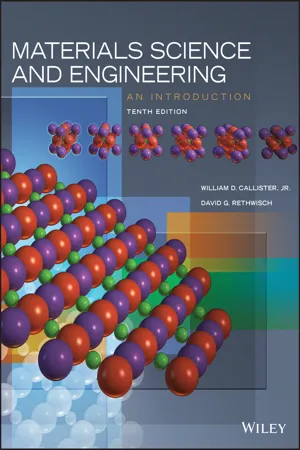 eBook - PDF
Materials Science and Engineering
An Introduction
- William D. Callister, Jr., David G. Rethwisch(Authors)
- 2018(Publication Date)
- Wiley(Publisher)
Sometimes the term lattice is used in the context of crystal structures; in this sense lattice means a three-dimensional array of points coinciding with atom posi- tions (or sphere centers). crystal structure lattice (a) (b) (c) Figure 3.1 For the face-centered cubic crystal structure, (a) a hard-sphere unit cell representation, (b) a reduced- sphere unit cell, and (c) an aggregate of many atoms. [Figure (c) adapted from W. G. Moffatt, G. W. Pearsall, and J. Wulff, The Structure and Properties of Materials, Vol. I, Structure, John Wiley & Sons, 1964. Reproduced with permission of Janet M. Moffatt.] The atomic order in crystalline solids indicates that small groups of atoms form a repeti- tive pattern. Thus, in describing crystal structures, it is often convenient to subdivide the structure into small repeat entities called unit cells. Unit cells for most crystal structures are parallelepipeds or prisms having three sets of parallel faces; one is drawn within the aggregate of spheres (Figure 3.1c), which in this case happens to be a cube. A unit cell is unit cell 3.3 UNIT CELLS 3.4 Metallic Crystal Structures • 51 chosen to represent the symmetry of the crystal structure, wherein all the atom positions in the crystal may be generated by translations of the unit cell integral distances along each of its edges. Thus, the unit cell is the basic structural unit or building block of the crystal structure and defines the crystal structure by virtue of its geometry and the atom positions within. Convenience usually dictates that parallelepiped corners coincide with centers of the hard-sphere atoms. Furthermore, more than a single unit cell may be chosen for a particular crystal structure; however, we generally use the unit cell having the high- est level of geometrical symmetry. The atomic bonding in this group of materials is metallic and thus nondirectional in nature. eBook - PDF
Materials Science and Engineering, P-eBK
An Introduction
- William D. Callister, Jr., David G. Rethwisch, Aaron Blicblau, Kiara Bruggeman, Michael Cortie, John Long, Judy Hart, Ross Marceau, Ryan Mitchell, Reza Parvizi, David Rubin De Celis Leal, Steven Babaniaris, Subrat Das, Thomas Dorin, Ajay Mahato, Julius Orwa(Authors)
- 2020(Publication Date)
- Wiley(Publisher)
Senese, Chemistry: Matter and Its Changes, 4th edition. Copyright © 2004 by John Wiley & Sons, Hoboken, NJ. Reprinted by permission of John Wiley & Sons, Inc. (d) © William D. Callister, Jr. (e) iStockphoto 3.1 Introduction We have previously been concerned primarily with the various types of atomic bonding, which are determined by the electron structures of the individual atoms. The present discussion is devoted to the next level of the structure of materials, specifically, to some of the arrangements that may be assumed by atoms in the solid state. Within this framework, concepts of crystallinity and noncrystallinity are introduced. For crystalline solids, the notion of crystal structure is presented, specified in terms of a unit cell. The three common crystal structures found in metals are then detailed, along with the scheme by which crystallographic points, directions, and planes are expressed. Single crystals, polycrystalline materials, and noncrystalline materials are considered. Another section of this chapter briefly describes how crystal structures are determined experimentally using x‐ray diffraction techniques. CRYSTAL STRUCTURES 3.2 Fundamental concepts Solid materials may be classified according to the regularity with which atoms or ions are arranged with respect to one another. A crystalline material is one in which the atoms are situated in a repeating or periodic array over large atomic distances — that is, long‐range order exists, such that upon solidification, the atoms will position themselves in a repetitive three‐dimensional pattern, in which each atom is bonded to its nearest‐neighbour atoms. All metals, many ceramic materials, and certain polymers form crystalline structures under normal solidification conditions. For those that do not crystallise, this long‐range atomic order is absent; these noncrystalline or amorphous materials are discussed briefly at the end of this chapter.
- Donald Askeland, Wendelin Wright(Authors)
- 2018(Publication Date)
- Cengage Learning EMEA(Publisher)
These concepts rely on the principles of crystallography . In Chapter 2, we discussed the structure of the atom. An atom consists of a nucleus of protons and neutrons surrounded by electrons, but for the purpose of describing the arrangements of atoms in a solid, we will envision the atoms as hard spheres, much like ping-pong balls. We will begin with the lattice and basis concept. A lattice is a collection of points, called lattice points , which are arranged in a periodic pattern so that the surroundings of each point in the lattice are identical. A lattice is a purely mathematical construct and is infinite in extent. A lattice may be one-, two-, or three-dimensional. In one dimension, there is only one possible lattice: it is a line of points with the points separated from each other by an equal distance, as shown in Figure 3-3(a). A group of one or more atoms located in a particular way with respect to each other and associated with each lattice point is known as the basis or motif . The basis must contain at least one atom, but it may contain many atoms of one or more types. A basis of one atom is shown in Figure 3-3(b). We obtain a crystal structure by placing the atoms of the basis on every lattice point (i.e., crystal structure 5 lattice 1 basis), as shown in Figure 3-3(c). A hypothetical one-dimensional crystal that has a basis of two different atoms is shown in Figure 3-3(d). The larger atom is located on every lattice point with the smaller atom located a fixed distance above each lattice point. Note that it is not necessary that one of the basis atoms be located on each lattice point, as shown in Figure 3-3(e). Figures 3-3(d) and (e) represent the same one-dimensional crystal; the atoms are simply shifted relative to one another. Such a shift does not change the atomic arrangements in the crystal.
- Donald Askeland, Wendelin Wright, Donald Askeland(Authors)
- 2020(Publication Date)
- Cengage Learning EMEA(Publisher)
This technique of cooling metals and alloys very fast is known as rapid solidification. Other special compositions require cooling rates of only tens of degrees per second or less. Many metallic glasses have both useful and unusual properties. The mechanical properties of metallic glasses will be discussed in Chapter 6. 3-3 Lattice, Basis, Unit Cells, and Crystal Structures A typical solid contains on the order of 10 23 atoms/cm 3 . In order to communicate the spatial arrangements of atoms in a crystal, it is clearly not necessary or practical to specify the position of each atom. We will discuss two complementary methodologies Copyright 2022 Cengage Learning. All Rights Reserved. May not be copied, scanned, or duplicated, in whole or in part. Due to electronic rights, some third party content may be suppressed from the eBook and/or eChapter(s). Editorial review has deemed that any suppressed content does not materially affect the overall learning experience. Cengage Learning reserves the right to remove additional content at any time if subsequent rights restrictions require it. 55 3-3 Lattice, Basis, Unit Cells, and Crystal Structures for simply describing the three-dimensional arrangements of atoms in a crystal. We will refer to these as the lattice and basis concept and the unit cell concept. These concepts rely on the principles of crystallography. In Chapter 2, we discussed the structure of the atom. An atom consists of a nucleus of protons and neutrons surrounded by electrons, but for the purpose of describing the arrangements of atoms in a solid, we will envision the atoms as hard spheres, much like ping-pong balls. We will begin with the lattice and basis concept. A lattice is a collection of points, called lattice points, which are arranged in a periodic pattern so that the surroundings of each point in the lattice are identical. A lattice is a purely mathematical construct and is infinite in extent. eBook - PDF
- Richard C. Ropp(Author)
- 2003(Publication Date)
- Elsevier Science(Publisher)
32 structure of any given solid in terms of its lattice points, What this means is that by substituting a point for each atom(ion) composing the structure, we find that these points constitute a latticework, i.e.- three-dimensional solid, having certain symmetries (Examples of the symmetries to which we refer are given in 1.3.2. of Chapter 1). A lattice is not a structure per se. A lattice is defined as a set of three- dimensional points, having a certain symmetry. These points may, or may not, be totally occupied by the atoms composing the structure. Consider a cubic structure such as that given in the following diagram: Here, we have a set of points occupied by atoms (ions) arranged in a simple three-dimensional cubic pattern. The lattice directions are defined, by convention, as x, y & z. Note that there are eight (8) cubes in our example. In order to further define our cubic pattern, we need to analyze both the smallest Unit and how it fits into the lattice. We call the smallest Unit a unit-cell and find that the unit-cell is the smallest cube in the diagram. 33 We also need to define how large the unit-cell is in terms of both the length of its sides and its volume. We do so by defining the unit-cell directions in terms of its lattice unit-vectors. That is, we define it in terms of the x, y, & z directions of the unit cell with specific vectors having directions corresponding to: X~X Z-~ ~ with the length of each unit-vector being equal to 1.0. (Our notation for a vector henceforth is a letter which is outlined, e.g.- ~ is defined here as the unit-cell vector in the x direction). As you probably remember, a vector is specified as a line which has both direction and duration from a given point. We can now define a set of vectors called translation vectors, i.e.- a, ~, and ~ in terms of the following: 2.1.2.- a. eBook - PDF
- Brian W. Pfennig(Author)
- 2021(Publication Date)
- Wiley(Publisher)
8 Structure and Bonding in Solids “The important thing in science is not so much to obtain new facts as to discover new ways of thinking about them.” —William Bragg 8.1 CRYSTAL STRUCTURES In the previous chapter, we discussed different ways of thinking about structure and bonding within molecules, where the molecules existed in the gas phase and the emphasis was on covalent bonding. In reality, however, the majority of mate- rials featuring metallic or ionic bonding exist in the solid state at room tempera- ture. A solid is defined by its structural rigidity, having a fixed volume and a specific shape. In order to understand the magnetic, electrical, and optical proper- ties of a solid, we need to first understand its structure. The particles in solids are packed tightly together and are held together by a variety of attractive forces. In general, there are two types of solids—amorphous solids, such as glass and plas- tics, which lack long-range order, and crystalline solids, which have a well-defined, long-range order. Our focus for the remainder of this chapter will be on crystalline solids, whose structure can be readily obtained by X-ray or neutron beam diffrac- tion methods. Crystalline solids consist of atoms, ions, or molecules that are arrayed into a long-range, regularly ordered substance known as a crystal structure. A crystal con- sists of a pattern of objects that repeats itself periodically in three-dimensional space, so that it has the property of translational symmetry. Translational symme- try implies that if the viewer closed their eyes while someone shifted all of the atoms an integral number of places in one of the crystal directions and then opened their eyes, the crystal would appear to be in an equivalent configuration to the original. Crystal structures fall into different categories depending on their lattice. eBook - PDF
Structure of Materials
An Introduction to Crystallography, Diffraction and Symmetry
- Marc De Graef, Michael E. McHenry(Authors)
- 2012(Publication Date)
- Cambridge University Press(Publisher)
3 What is a crystal structure? In mathematics, if a pattern occurs, we can go on to ask, Why does it occur? What does it signify? And we can find answers to these questions. In fact, for every pattern that appears, a mathematician feels he ought to know why it appears. W. W. Sawyer, mathematician At the atomic length scale, most solids can be described as regular arrangements of atoms. In this chapter we take a closer look at the framework that underlies such periodic arrange-ments: the “space lattice.” We will introduce the standard nomenclature to describe lattices in both 2-D and 3-D, as well as some mathematical tools (mostly based on vectors) that are used to provide unambiguous definitions. Then we will answer the question: how many uniquely different lattices are there? This will lead to the concepts of crystal systems and Bravais lattices. We will explore a few other ways to describe the lattice periodicity, and we conclude this chapter with a description of magnetic time-reversal symmetry, and how the presence of magnetic moments complicates the enumeration of all the space lattices. 3.1 Periodic arrangements of atoms • • • • • • • • • • • • • • • • • • • • • • • • • • • • • • • • • • • • • • • • • • • • • • • • • • • • • • • • • • • • • • • • • • • • • • • • • • • • • • • • • • • • • • • • • • • • • • • • • • • • • • In this section, we will analyze the various components that make up a crystal structure . We will proceed in a rather pragmatic way, and begin with a loose “definition” of a crystal structure that most of us could agree on: a crystal structure is a regular arrangement of atoms or molecules. We have some idea of what atoms and molecules are – at least, we think we do . . . And we also have some understanding of the words “regular arrangement.” The word “reg-ular” could imply the existence of something that repeats itself, whereas “arrangement” would imply the presence of a pattern . eBook - PDF
Metals and Materials
Science, Processes, Applications
- R. E. Smallman, R J Bishop(Authors)
- 2013(Publication Date)
- Butterworth-Heinemann(Publisher)
Furthermore, in comparing the two degrees of order-ing of Figures 2.1a and 2.1b, one can appreciate why the structures of comparatively highly-ordered crystalline substances, such as chemical compounds, minerals and metals, have tended to be more amenable to scientific investigation than glasses. 2.2 Crystal lattices and structures We can rationalize the geometry of the simple repre-sentation of a crystal structure shown in Figure 2.1a by adding a two-dimensional frame of reference, or space lattice, with line intersections at atom centres. Extending this process to three dimensions, we can construct a similar imaginary space lattice in which triple intersections of three families of parallel equidistant lines mark the positions of atoms (Figure 2.2a). In this simple case, three reference axes (*, y, z) are oriented at 90° to each other and atoms are 'shrunk', for convenience. The orthogonal lattice of The terms glassy, non-crystalline, vitreous and amorphous are synonymous. Figure 2.2a defines eight unit cells, each having a shared atom at every corner. It follows from our recognition of the inherent order of the lattice that we can express the geometrical characteristics of the whole crystal, containing millions of atoms, in terms of the size, shape and atomic arrangement of the unit cell, the ultimate repeat unit of structure. 2 We can assign the lengths of the three cell param-eters (Λ, b, c) to the reference axes, using an inter-nationally-accepted notation (Figure 2.2b). Thus, for the simple cubic case portrayed in Figure 2.2a, x - y - z -90°; a-b - c. Economizing in symbols, we only need to quote a single cell parameter (a) for the cubic unit cell. By systematically changing the angles (α, β, y) between the reference axes, and the cell parameters (a, b, c), and by four skewing operations, we derive the seven crystal systems (Figure 2.3). Any crystal, whether natural or synthetic, belongs to one or other of these systems. eBook - PDF
- A.K. Macpherson(Author)
- 2012(Publication Date)
- North Holland(Publisher)
Although this theory is, at present, incomplete, it a p p e a r s that the development of this kind of theory will be essential to future research. T w o chapters discussing the most impor-tant numerical m e t h o d s for modelling then follow. T h e concluding chapter gives a brief outline of some of the special experimental techniques used in material studies at the a t o m i c level. 4 Structure of Solids [Ch. 1 In this introductory chapter, the general principles of crystalline structure will be presented. As in all fields of science, a characteristic terminology has developed a n d it is necessary to provide a brief introduction to lattice terminology. A discussion of the type of macroscopic properties which m a y be predictable will follow. A survey of the binding energies in materials is necessary to place the macroscopic, as c o m p a r e d to microscopic, properties in perspective. T h e chapter will conclude with a brief description of the X-ray crystallography which will be useful in C h a p t e r 9. 1.2 Crystal Structures Progress in the study of solids has utilized the fact that m o s t materials are formed in a regular crystal lattice. T h e lattices contain translational sym-metry. This m e a n s that the a r r a n g e m e n t of a t o m s a b o u t each lattice site will be the same. Mathematically, the lattice sites with translational symmetry m a y be expressed in terms of three n o n -c o p l a n a r basic vectors χ γ , x 2 , x$ a n d the integers Z l 5 Z 2 , Z 3 as L = l l X l + l 2 x 2 + hx 3 . (1.1) T h e lattice vector s h o w n in Fig. 1.1 represents the lattice site (2, 1,1). T h e crystal can be represented by a collection of identical three-dimensional shapes which are repeated to fill the whole crystal. This shape is k n o w n as a unit cell. A typical cell would be the volume defined by ΧχΧ 2 χ 3 m Fig. 11· T h e cell can have m a n y different shapes a n d contain m o r e t h a n one a t o m . If the unit cell contains only o n e a t o m a n d t h a t is in the centre of the cell, it is k n o w n as a Bravais lattice. A useful unit cell is the W i g n e r -S e i t z cell. *5 Fig. 1.1. Lattice vector L in a lattice: No longer available |Learn more
Manufacturing Technology
Materials, Processes, and Equipment
- Helmi A. Youssef, Hassan A. El-Hofy, Mahmoud H. Ahmed(Authors)
- 2011(Publication Date)
- CRC Press(Publisher)
33 3 Structure of Metals and Alloys 3.1 INTRODUCTION The.structure.of.materials.influences.their.behavior.and.properties . .Therefore,.understanding.this. structure.helps.to.make.appropriate.selection.of.these.materials.for.specific.applications . .Depending. on.the.manner.of.atomic.grouping,.materials.are.classified.as.having.molecular,.crystal,.or.amor-phous.structures . .In.molecular.structures,.atoms.are.held.together.by.primary.bonds . .They.have. only.weak.attraction . .Typical.examples.of.molecular.structure.include.O 2 ,.H 2 O,.and.C 2 H 4 .(ethylene) . . Each.molecule.is.free.to.act.independently,.so.these.materials.possess.relatively.low.melting.and. boiling.points,.since.their.molecules.can.move.easily.with.respect.to.each.other . .These.materials. tend.to.be.weak . .Solid.metals.and.alloys.and.most.minerals.have.crystalline.structure,.where.atoms. are. arranged. in. a. regular. geometric. array. as. a. lattice. of. a. unit. building. block. that. is. repetitive. throughout.the.space . .In.an.amorphous.structure,.such.as.glass,.atoms.have.a.certain.degree.of.local. order.but.lack.the.periodically.ordered.arrangement.of.the.crystalline.solid . 3.2 LATTICE STRUCTURE OF METALS Metals.and.alloys.are.an.extremely.important.class.of.materials,.since.they.are.frequently.processed. to. manufacture. tools,. machinery,. and. many. metallic. products . . Metals. are. characterized. by. the. metallic.bond.in.three.dimensions,.offering.them.their.distinguishing.characteristics.of.strength,. good.electrical.and.thermal.conductivity,.luster,.the.ability.to.be.plastically.deformed.to.a.fair.degree. without.fracturing,.and.a.relatively.high.density.compared.with.nonmetallic.materials . .When.met-als.and.alloys.solidify.from.their.molten.state,.they.assume.a.crystalline.structure.in.which.atoms. arrange.themselves.in.a.geometric.lattice . 3.2.1 S PACE L ATTICES There.are.three.basic.types.of.crystal.structures.(lattice.cells).found.in.nearly.all.commercially. eBook - PDF
Crystallography and Surface Structure
An Introduction for Surface Scientists and Nanoscientists
- Klaus Hermann(Author)
- 2016(Publication Date)
- Wiley-VCH(Publisher)
7 2 Bulk Crystals: Three-Dimensional Lattices This section deals with the geometric properties of three-dimensional bulk crystals, which are described, in their perfect structure, by atom arrangements that are periodic in three dimensions. As an example, Figure 2.1 shows a section of a tetragonal YBa 2 Cu 3 O 7 crystal, where vectors R 1 , R 2 , R 3 (lattice vectors) indicate the mutually perpendicular directions of periodicity. Further, the basis of the crystal structure consists of 13 atoms (1 × yttrium, 2 × barium, 3 × copper, 7 × oxygen) inside a rectangular block (unit cell) that is repeated periodically inside the crystal. The building unit is shown to the left of the figure. In this section, all basic definitions used for a quantitative description of structural properties of perfect three-dimensionally periodic crystals will be provided. Here, the crystals are considered not only in terms of their translational symmetry, that is, periodicity, but also by their different point symmetry elements, such as inversion points, mirror planes, or rotation axes, which characterize the positions of all atoms inside a crystal. While the definitions and general properties are rather abstract and mathematical, they can be quite relevant for theoretical studies of real three-dimensional crystals. As an example, lattice representations of crystals are required as input to any electronic structure calculation for solid crystalline material. Further, the theoretical treatment of three-dimensional crystals serves as a foundation to study the surfaces of single crystals, as will be discussed in Chapters 4, 5, and 6. 2.1 Basic Definition The basic definition of a perfect three-dimensional bulk crystal becomes quite clear by considering a simple example. Figure 2.2a shows a section of the cubic CsCl crystal, which is periodic in three perpendicular directions.
Index pages curate the most relevant extracts from our library of academic textbooks. They’ve been created using an in-house natural language model (NLM), each adding context and meaning to key research topics.

