Chemistry

Liposome
A liposome is a tiny spherical vesicle composed of a lipid bilayer. It is commonly used as a carrier for drugs and other substances in pharmaceutical and cosmetic applications. Liposomes can encapsulate both hydrophilic and hydrophobic molecules, making them versatile delivery systems for various compounds.
Written by Perlego with AI-assistance
Related key terms
1 of 5

12 Key excerpts on "Liposome"
 eBook - ePub
- Amit Kumar Nayak, Md Saquib Hasnain, Tejraj M. Aminabhavi, Vladimir P. Torchilin(Authors)
- 2022(Publication Date)
- Academic Press(Publisher)
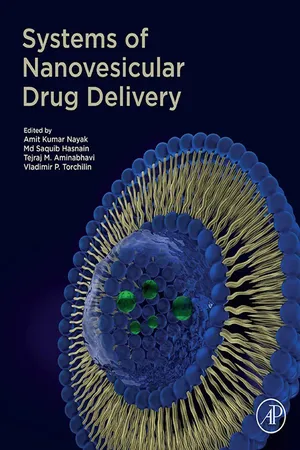
Liposomes are well-known as phospholipid-based self-assembled nanovesicles, which structurally consist of forming a bilayer and/or a concentric series of multiple bilayers enclosing a central aqueous compartment. In the past few years, Liposomes have continued to be explored and exploited for loading as well as delivering either hydrophobic and/or hydrophilic drugs or other therapeutic agents. In addition, Liposomes have already been proved to deliver their payload to the diseased site(s), selectively, through active and/or passive targeting. The current book chapter describes about the Liposomes as efficient lipid nanovesicular systems for drug delivery applications.Keywords
Liposomes; nanovesicles; nanotechnology; drug delivery; drug targeting5.1 Introduction
Liposomes are well-known as phospholipid-based self-assembled nanovesicles, which structurally consist of form a bilayer and/or a concentric series of multiple bilayers enclosing a central aqueous compartment.1 ,2Alec Douglas Bangham (1921–2010) first reported these phospholipid-based nanovesicles in 1964 and in the early days, these were called as “Banghasomes.”2 –5These nanovesicles were also called as “multilamellar smectic mesophases.” Gerald Weissmann first proposed the word- “Liposome” for these phospholipid-based nanovesicles, where “lipos” means fat and “soma” means body.5 ,6Since past few years, Liposomes have been continued to be explored and exploited for loading as well as delivering either hydrophobic and/or hydrophilic drugs and other therapeutic agents with some potential advantageous features like a characteristic structure of bilayer and/or a concentric series of multiple bilayers (enclosing a central aqueous compartment), availability of easy preparation methodologies and good biocompatibility.7 Liposomes have extensively been researched and developed as delivery carriers of nanovesicular systems for a variety of low and high molecular drugs, proteins and peptides, nucleic acids, diagnostic agents, etc.7 –12In addition, drug delivery by Liposomes has been researched for various drug delivery administration routes, like parenteral, oral, nasal, pulmonary, ocular, and transdermal routes to improve therapeutic efficiency as well as patient compliances.13 –22Again, Liposomes have already been proved to deliver their payload to the diseased site(s), selectively, through active and/or passive targeting. These site-specific targeting by Liposomes improves therapeutic efficiency with decreasing systemic side effects.23 –27
- Akhlesh K. Jain, Keerti Mishra, Akhlesh K. Jain, Keerti Mishra(Authors)
- 2003(Publication Date)
- Bentham Science Publishers(Publisher)
Liposomal Drug DeliveryUnnati Batra1,Tejashree Waghule1,Ranendra N. Saha1,Gautam Singhvi1 , *1 Department of Pharmacy, Birla Institute of Technology and Science (BITS), Pilani, Rajasthan, IndiaAbstract
Liposomes are emerging as uni or multilamellar micro particulate phospholipid bilayer sphere vesicles, which can be produced synthetically and have the ability to encapsulate any kind of drug molecule. Either hydrophilic or lipophilic drug substances can be easily entrapped in these vesicles for efficient delivery of a drug. Over the past decades, these have been under investigation to develop novel and revolutionary drug delivery aspects in the pharmaceutical field. Liposomes are based on a simple mechanism of formation of the enclosed sphere formed when amphiphilic lipid comes in contact with the aqueous layer. The advancements in Liposomes have paved pathways towards efficient drug delivery through alteration in the bioavailability and bio-distribution of drugs. Classified into various types, Liposomes can be prepared using various techniques involving mechanical dispersion, solvent dispersion, and detergent removal methods. The development of these Liposomes has profound the advanced delivery characterization. This helps deliver the molecules at the target site, and the number of liposomal products in clinical use has now increased. Recent advances are incorporating the emergence of second-generation Liposomes over conventional Liposomes, which will help modulate the encapsulation efficiency and drug release from Liposomes. This literature briefly focusses on various aspects of Liposomes, which further relates to the growing advances and interest in this field. eBook - PDF
- Martin Malmsten(Author)
- 2002(Publication Date)
- CRC Press(Publisher)
4 Liposomes Liposomes or vesicles have ever since their discovery attracted scientists in the field of physical chemistry, biophysics, and biochemistry, not the least due to their structural similarity to phospholipid membranes in living cells (Figure 4.1). Also in the context of drug delivery, Liposomes have attracted considerable atten-tion due to their capacity to solubilize oil-soluble substances and to encapsulate water-soluble drugs. Although Liposomes may be formed by a range of different surfactants and block copolymers, and although some interest in the context of drug delivery has been placed on Liposomes formed by nonionic surfactants (‘‘ni-osomes’’), Liposomes formed by phospholipids have attracted most interest and found most widespread use in drug delivery applications. 4.1 PREPARATION AND PROPERTIES OF Liposome SYSTEMS The structure of Liposomes can differ widely depending on both composition and process conditions. In particular, the size of the Liposomes generated can range from very small to considerable. They may also contain either one or several bilayer structures. This structural diversity has resulted also in a plethora of names for different types of Liposomes. Some of the names found in the literature on the topic are provided in Table 4.1. 87 88 Chapter 4 (a) (b) F IGURE 4.1 Schematic illustration of (a) the structure of a unilamellar Liposome, and (b) some commonly used preparation methods for Liposomes. [Redrawn from Israelachvili, Intermolecular and Surface Forces, Academic Press, 1992 (a), and Crommelin et al., in Kreuter, ed., Colloidal Drug Delivery Systems, Marcel Dekker, 1994 (b).] There are a numbers of techniques which can be used for generation of liposomal systems (Figure 4.1). Different preparation techniques yield different Liposome type and size, and depending on, e.g., the stability requirements or the administration route, a particular preparation method may therefore be required or preferred. eBook - PDF
- Severian Dumitriu(Author)
- 2001(Publication Date)
- CRC Press(Publisher)
29 Liposomes in Drug Delivery Yuan-Peng Zhang ALZA Corp., Mountain View, California Boris C ˇ eh University of Ljubljana, Ljubljana, Slovenia Danilo D. Lasic Liposome Consultations, Newark, California I. INTRODUCTION Liposomes or (phospho)lipid vesicles are self-assembled colloidal particles that occur in nature or can be prepared artificially. In the beginning, Liposomes were used to study biological membranes, while several practical applica- tions, most notably in drug delivery, emerged in the 1970s. After three decades of research, several products are com- mercially available. They rely on Liposome colloidal, mi- croencapsulating, and surface properties. Products range from drug dosage forms (antifungals, anticancer agents, and vaccines) and cosmetic formulations (skin care prod- ucts, shampoos) to diagnostics and food industry products. However, at present, it seems that drug delivery applica- tions are now the most widely investigated area of their practical applications. A. Properties of Amphiphiles, Bilayers, and Liposomes Amphiphiles are a class of organic molecules that contain both polar (or in most cases charged) and nonpolar seg- ments and are therefore simultaneously hydrophobic and hydrophilic. Typical examples of these molecules are detergents and phospholipids. Due to hydrophobic and hydrophilic interactions, these molecules orient and self- organize in polar and nonpolar solvents. Aqueous systems of amphiphiles exhibit a very rich phase behavior, and 783 some of the structures formed are schematically shown in Fig. 1. The most common structures that most phos- pholipids adopt spontaneously are the concentric bilayer vesicles in excess water (see Fig. 2). In the bilayer struc- ture the lipid hydrophilic head groups orient toward the aqueous phase, and the nonpolar hydrocarbons are asso- ciated at the center, away from water molecules.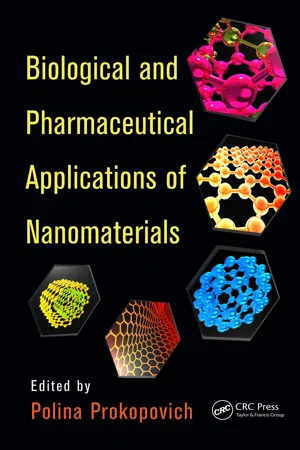
- Polina Prokopovich(Author)
- 2015(Publication Date)
- CRC Press(Publisher)
Liposome bearing hydrophilic and hydrophobic drug Phospholipid molecule Hydrophilic drug Hydrophobic drug FIGURE 3.1 Schematic representation of a Liposome. Liposomes are able to entrap both hydrophilic and hydrophobic drugs, thus making them attractive drug delivery vehicles. 56 Biological and Pharmaceutical Applications of Nanomaterials With the recognition of the biocompatibility, biodegradability, low toxicity and immunogenicity, and the capability to entrap molecules, Liposomes have moved a long way from being just another exotic object of biophysical research to becoming a pharmaceutical carrier of choice for numerous practical applications (Black and Gregoriadis 1976; Gregoriadis 1976; Juliano and McCullough 1980; Neerunjun and Gregoriadis 1976; Torchilin 2005). The initial excitement of Liposomes as drug delivery vehicles was, however, short lived because of insufficient understanding of Liposome disposition and clearance in vivo , inaccurate extrapolation of in vitro Liposome–cell interactions or Liposome targeting data, and pronounced instability and reduced circulation time of Liposome-based drugs in vivo (Lian and Ho 2001). Substantial advances in the late 1980s and early 1990s, including detailed understanding of lipid polymorphisms, physiological mechanisms of in vivo Liposome disposition, and lipid–drug and lipid–protein inter-actions, overcame many of the early disappointments (Torchilin 2005). However, the major breakthrough came with the realization that steric stabilization can sig-nificantly increase Liposome stability and prolong, by several orders of magnitude, their persistence in the blood circulation system after administration (Immordino et al. 2006). These resulted in the development of tailor-made liposomal formulations with increased stability both in vitro and in vivo , improved biodistribution, and opti-mized resident time in systemic (or blood) circulation (Allen et al. 1991; Klibanov et al. 1990). eBook - PDF
- Vasant V. Ranade, John B. Cannon(Authors)
- 2011(Publication Date)
- CRC Press(Publisher)
Liposomes vary in charge and size, ranging from 20 nm to 10 μ m, depending on the method of preparation and the lipids used. Drug molecules can be either encapsulated in the aqueous space or intercalated into the bilayer (see Figures 1.1 and 1.2). 265 The exact location of the drug in the lipo-some depends upon the physiochemical characteristics of the drug and the composi-tion of the constituent lipids. 19 Stable Liposomes from phospholipids are formed only at temperatures above the “gel to liquid-crystalline” phase transition temperature (T c ). This represents the melting point of the acyl chains. All phospholipids have a characteristic T c , which depends upon the nature of the polar head group and on the length and degree of unsaturation of the acyl chains. 19,20 Above the transition temperature, phospholipids form a liquid-crystalline phase that constitutes increased 3 Site-Specific Drug Delivery Using Liposomes and Emulsions as Carriers mobility of the acyl chains. A reduction in temperature below the T c creates a transi-tion to a more rigid gel state. This results in restrained mobility of the tightly packed acyl chains. When the liquid molecules arrange themselves to form closed bilayer structures containing water and solutes, drugs are trapped between the adjacent planes of the polar head groups. This compartmentalization has been discussed in detail by Roerdink et al. 14 C HEMIC AL C HARACTERISTICS OF L IPOSOMES Liposomal affinity for various tissues can be modified by synthesizing Liposomes con-taining phospholipids with various fatty-acid chain configurations. These substances Polar solute in aqueous phase Amphiphatic molecule Polar head of lipid Lipophilic molecule Nonpolar tail of lipid (A) SUV (B) (a) (b) MLV LUV T c MVV FIGURE 1.1 Schematic of a bilayer vesicle or Liposome. (A) Multilamellar Liposome showing interaction with drugs. eBook - ePub
- Vladimir Torchilin, Mansoor M. Amiji, Vladimir Torchilin, Mansoor M. Amiji(Authors)
- 2011(Publication Date)
- Jenny Stanford Publishing(Publisher)
Chapter Eight Liposomal Nanomedicines Vladimir Torchilin Department of Pharmaceutical Sciences and Center for Pharmaceutical, Biotechnology and Nanomedicine, Northeastern University, USAE-mail: [email protected]Liposomes, phospholipid nanosized bubbles with a bilayered membrane structure, have drawn a lot of interest as pharmaceutical carriers for drugs and genes. Current liposomology includes multiple areas, from clinical application of the liposomal drugs to the development of various multifunctional liposomal systems to be used in therapy and diagnostics. This chapter briefly discusses the pharmaceutical application of Liposomes and provides an overview of various liposomal products currently under development at experimental and preclinical level.8.1 INTRODUCTIONFast developing nanotechnology, among other areas, is expected to have a dramatic impact on medicine. The application of nanotechnology for treatment, diagnosis, monitoring, and control of biological systems is now often referred to as nanomedicine. Among many possible application of nanotechnology in medicine, the use of various nanomaterials as pharmaceutical delivery systems for drugs, DNA, and imaging agents is getting our days an increasing attention. Many varieties of nanoparticles are available,1 such as different polymeric and metal nanoparticles, Liposomes, niosomes, solid lipid particles, micelles, quantum dots, dendrimers, microcapsules, cells, cell ghosts, lipoproteins, and many different nanoassemblies.The paradigm of using nanoparticulate pharmaceutical carriers to enhance the in vivo efficiency of many drugs, anti-cancer drugs first of all, well established itself both in pharmaceutical research and clinical setting. The first publications on the clinical potential of pharmaceutical nanocarriers have appeared long before the field of “nanomedicine” has become clearly defined, see for example papers by Gregoriadis on the carrier potential of Liposomes in biology and medicine.2 ,3Numerous nanoparticle-based drug delivery and drug targeting systems have been underdevelopment for quite a long time, and several important monographs on this subject began to publish since 15-to-20 years ago, see for example.4 ,5Recent publications summarize the most important developments in this area and specifically address the issues of nanocarriers designed to deliver drugs into certain individual sites of disease and to perform in the body various functions simultaneously.1 ,7 ,8 ,9 ,10 ,11 ,12 ,13 ,14 ,15 ,16 ,17In general, pharmaceutical drug carriers, especially the ones for parenteral administration, are expected to be biodegradable, easy and reasonably cheap to prepare, have small particle size, possess high loading capacity, demonstrate prolonged circulation, and, ideally, specifically or non-specifically accumulate in required sites in the body, as exemplified.17 eBook - PDF
Liposomes
Advances and Perspectives
- Angel Catala(Author)
- 2019(Publication Date)
- IntechOpen(Publisher)
5.1 Application in drug delivery The use of Liposomes in drug delivery aims at modifying the pharmacokinetics of drugs to improve the therapeutic efficacy while minimizing potential toxicity [6]. Liposomes can alter the spatial and temporal distribution of the entrapped drug molecules in vivo, leading to controlled delivery at the site of interest and reduced off-target adverse effects [63]. The liposomal systems have been extensively investigated for the delivery of existing and emerging drugs at various research levels, from basic stages related to research and development to preclinical and clinical applications. Nowadays, Liposomes represent the most clinically established drug vehicles for human diseases [3, 5]. The efforts invested in liposomal technol-ogy have so far led to the development of several effective liposomal formulations that are currently used in clinics ( Table 5 ). Liposomal formulations have been used to address a wide range of pathological conditions through different administration routes, including dermal, transdermal, oral, pulmonary and parenteral routes. The clinical areas commonly explored in Liposome research encompass skin disorders, cancers and infectious diseases [4]. 45 General Perception of Liposomes: Formation, Manufacturing and Applications DOI: http://dx.doi.org/10.5772/intechopen.84255 Amongst, cancer therapy appears to be in the forefront of Liposome delivery, due to poor bioavailability and side effects of most of the anti-cancer drugs. However, sev-eral infectious diseases, most specially where the pathogen is hosted by the MNPS (i.e., tuberculosis, leishmaniasis, fungal infections), have been reported to be good candidates for Liposome application, taking advantage of the spontaneous lipo-somes uptake by the cells of MNPS [2]. eBook - PDF
- Mathew Sebastian, Neethu Ninan, A. K. Haghi, Mathew Sebastian, Neethu Ninan, A. K. Haghi(Authors)
- 2012(Publication Date)
- Apple Academic Press(Publisher)
Chapter 11 Capsules Based on Lipid Vesicles: Potentiality for Drug Delivery Brigitte P é pin-Donat, Francois Quemeneur, Marguerite Rinaudo, and Cl é ment Campillo INTRODUCTION The method by which a drug is delivered can have a significant effect on its effi-ciency. Therefore, the design and development of advanced drug delivery systems has emerged last four decades in order to improve their biocompatibility (Kocsis et al., 2000), controlled release (Gibbs et al., 1999; Uhrich et al., 1999), active targeting in tissues (Vasir et al., 2005; Yokoyama, 2005), and stimuli response (MacEwan et al., 2010). The strategy used to develop smart drug cargos is based on interdisciplinary approaches that combine polymer science, pharmaceutics and molecular biology. Among a large variety of colloidal drug delivery carriers (e.g., micelles, polymer nanoparticles, vesicles), we focus here on lipid vesicles (also referred as Liposomes), which consist in self-closed lipid bilayers (lipid membranes) (Lipowsky and Sack-mann, 1995). Depending on the method of preparation, it is possible to produce vesi-cles with different sizes ranging from nanometers to tens of micrometers in diameter. Small unilamellar vesicles (SUVs; 20–100 nm) and large unilamellar vesicles (LUVs; 100–500 nm) are generally used as protective capsules in pharmaceutical and cosmetic domains (Barenholz, 2001; Edwards and Baeumner, 2006; Malmsten, 2003) and usu-ally compared to cellular organelles (vesicles of secretion, of transport) (Alberts et al., 2002), while giant unilamellar vesicles (GUVs; 0.5–100 µm) are generally regarded as over-simple models of biological cells (Lim et al., 2006; Liu and Fletcher, 2009; Noireaux and Libchaber, 2004). Nevertheless, the simple structure and poor resistance of vesicles to external stresses limit their applications for drug delivery or their relevance to mimic real cells. eBook - PDF
Microencapsulation
Methods and Industrial Applications, Second Edition
- Simon Benita(Author)
- 2005(Publication Date)
- CRC Press(Publisher)
In consideration of the common ground these Pharmaceutical Aspects of Liposomes 333 properties constitute for investigators from both academia and industry, several comments and proposals are offered below. Efficiency of Drug Encapsulation Throughout the four decades of Liposome research, several definitions have been introduced as measures of this property. For example, the fraction of encapsulated drug from the total in the system, the ratio of drug to lipid, and the volume (per given lipid quantity) of the internal aqueous phase. The most traditional method of drug encapsulation is in the course of Liposome preparation, which carries the risks of compromising drug integrity in the course of the preparation of regular and more-so surface-modified Liposomes. Another drawback of this traditional mode is drug loss during purification and wash procedures that undermine cost-effective production. To counter these risks, methods of remote loading—loading the drug into preformed Liposomes—have been developed. The more veteran approach relies on generating by the use of specific agents, an electrochemical gradient across the liposomal membrane that draws the drug inside (86). In a more recent approach, the drug-free Liposomes are lyophilized (and can be stored as such), and drug encap-sulation is performed in the course of Liposome reconstitution by rehydration—using an aqueous solution of the drug as the rehydration solution (74,75). For molecules serving as models of encapsulated matter, such as carboxy-fluorescein (CF) and similar derivatives, elegant procedures have been devised to determine the efficiency of encapsulation (2,6,17). One of their most favorable features is the elimination of the need to separate the drug-encapsulating Liposomes from the media containing the unencapsulated drug. For most real drugs, irrespec-tive of the efficiency parameter pursued, the experimental process for determination of encapsulated matter will require such a separation step. eBook - PDF
- Jorg Kreuter(Author)
- 2014(Publication Date)
- CRC Press(Publisher)
Liposomes Daan J. A. Crommelin Utrecht University, Utrecht, The Netherlands H. Schreier Vanderbilt University School of Medicine, Nashville, Tennessee INTRODUCTION Liposomes have been intensively studied by scientists from different dis- ciplines since their discovery in the 1960s. Up until the end of 1992, this ac- tivity had resulted in the publication of over 15,000 articles with the word Liposome in the title (source: Chemical Abstracts). Although the Liposome structure as such has not been patented, almost 1000 patents have been issued or filed dealing with specific aspects of the Liposome. Of these, about 500 were filed since 1985. This suggests that the spirit and enthusiasm to explore new research strategies with Liposomes are as alive as in the early days of Liposome research. Part of these activities concentrated on establishing Liposomes as phar- maceutical entities, and the first topical and parenteral Liposome-based drug delivery systems have reached the marketplace already. More Liposome-based delivery systems can be expected soon. The rapid progress made in recent years affected established hypotheses and dogmas considerably. This made writing a chapter devoted to the state of the art in the field of Liposomes, with special emphasis on pharmaceutical and clinical aspects, a worthwhile exercise in the eyes of the authors. 74 Crommelin and Schreier This chapter is divided into three parts. Part I covers pharmaceutical tech- nological aspects of Liposomes; Part I1 deals with potential therapeutic ap- plications and recent and ongoing clinical trials with liposomal pharmaceutical products. In particular, the therapeutically and clinically oriented Part I1 focuses on present activities in selected areas of research, instead of pro- viding a full historical perspective. Part I11 presents conclusions and an out- look to the future.
- Muhammad Raza Shah, Muhammad Imran, Shafi Ullah(Authors)
- 2017(Publication Date)
- William Andrew(Publisher)
Three main factors have been reported to destabilize oral drug delivery. These include bile salts, pH, and pancreatic enzymes in the gastrointestinal tract. Several membrane surface polymerization chemistry methods have been developed for protecting Liposomes and their loaded drugs against the harsh environment of the gastrointestinal tract. But the incomplete polymerization, incomplete removal of toxic reagents and derivatives are the major problems hindering the complete utilization of such techniques. The issue can be better resolved by using Liposomes as a suspension or solubilizing agent for highly insoluble or lipophilic drugs to be delivered as a microemulsion in softgel capsules for oral dosage. This approach has been reported for the encapsulation of cyclosporin A with increased reproducibility and bioavailability results. For stimulate mucosal immune responses, oral Liposome-antigen formulation can also be used to enhance the delivery of antigen to antigen-presenting cells that actively take up particles in gastrointestinal tract. Furthermore, biocompatibility, flexibility in design, targeting of antigens to antigen-presenting cells, protection of antigen and ineffective stimulation of immune responses by oral delivery of soluble antigens can also be achieved by using Liposomes for such applications (James and Anderson, 1998 ; Lian and Ho, 2001). 3.11.1.3 Topical drug delivery Liposomes have found unique applications for delivery of drugs deep into the skin. Liposomes are able to decrease the side effects of the topically applied drugs as they are needed in small doses when carried in liposomal topical formulations. Moreover, they increase the permeability of skin for the loaded drugs. The skin care and cosmetic applications of Liposomes are also very important. For this purpose, the Liposomes are formulated in the form of cosmetic solutions or hydrogels (Gabrijelčič, 1995). Hydrophilic polymers are suitable thickening agents for the gels
Index pages curate the most relevant extracts from our library of academic textbooks. They’ve been created using an in-house natural language model (NLM), each adding context and meaning to key research topics.
