Chemistry

Properties of Water
The properties of water include its high polarity, hydrogen bonding, and ability to act as a solvent. These properties contribute to water's high surface tension, cohesion, and adhesion, as well as its ability to moderate temperature changes. Additionally, water's unique properties make it essential for life and various chemical reactions.
Written by Perlego with AI-assistance
Related key terms
1 of 5

10 Key excerpts on "Properties of Water"
 eBook - ePub
- Gene E. Likens(Author)
- 2010(Publication Date)
- Academic Press(Publisher)
Properties of Water Passage contains an image
 Chemical Properties of Water
J.H. Aldstadt, III; H.A. Bootsma University of Wisconsin-Milwaukee, Milwaukee, WI, USAJ.L. Ammerman SEAL Analytical, Inc., Mequon Technology Center, Mequon, WI, USAWater is H2 O, hydrogen two parts, oxygen one, but there is also a third thing, that makes it water and nobody knows what it is.—D.H. Lawrence (1929)Introduction
Water is the most abundant molecule on Earth. In spite of being so common, water is quite unusual – from its high melting and boiling points to its tremendous solvating power, high surface tension, and the largest dielectric constant of any liquid. In this article, we present an overview of the chemical Properties of Water. The phrase ‘chemical property’ is context dependent, which we define in general as a description of the way that a substance changes its identity in the formation of other substances. A universally accepted set of chemical properties does not exist in the same way that there is, more or less, a standard set of physical properties for a given substance. Whereas a given substance has intrinsic physical properties (such as melting point), by our definition chemical properties are clearly tied to change. In addition to reactivity, a substance’s ‘chemical properties’ also typically include its electronegativity, ionization potential, preferred oxidation state(s), coordination behavior, and the types of bonding (e.g., ionic, covalent) in which it participates. Because these properties are extensively studied in general chemistry courses, we will not further discuss them here. Rather, we move beyond the basic general chemistry concepts and focus upon water in a limnologic context – particularly, its bulk fluid structure and aspects of its chemical reactivity in the hydrosphere.In the following pages, we begin by briefly reviewing the molecular structure of water and then discuss models for its structure in ‘bulk’ solution. We then turn our attention to the hydration of ions and an overview of important reactions that involve water, including acid–base, complexation, precipitation, and electron transfer. We conclude with a look at trends in the chemical composition of freshwater that are fundamental to the field of limnology.
- Martha Mackin(Author)
- 2012(Publication Date)
- Academic Press(Publisher)
TWELVE Water: the properties of a liquid OVERVIEW This chapter is devoted to the study of water and to the liquid state in general. The chapter contrasts the properties of liquids and solids with those of gases, and uses the kinetic molecu-lar theory to explain the differences. The structure of the water molecule determines that the oxygen end has a partial negative charge and the hydrogen end has a partial positive charge. Many of the Properties of Water are due to the hydrogen bonds that form between the polar water molecules. Properties of Water and of other liquids that are described in the chapter include density,. specific gravity, vaporization, heat capacity, specific heat, adhesion, cohesion, surface tension, and hydration. Conversion between the three states of water or of any other substances involves energy changes. The amount of energy given off (exothermic) or absorbed (endothermic) in changes that occur between ice, liquid water, and steam are defined in this chapter. The major sources of water pollution are listed and methods used in water purification and softening are described. **Specifics** 1. Definitions for the following terms should be learned: hydrogen bonding density specific gravity hydrometer vaporization evaporation water vapor equilibrium vapor pressure heat capacity specific heat calorie boiling point heat of vaporization heat of condensation heat of fusion heat of crystallization endothermic exothermic sublimation cohesion adhesion surface tension mefliscus wetting agents surfactant hydration hydrates water of hydration anhydrous dehydration efflorescence hygroscopic deliquescence 278 Overview 279 2. General concepts that should be learned: Number of related textbook objective 12.1 a. General properties of liquids and solids and an explanation of these properties using the kinetic molecular theory. 12.2 b. Structure of the water molecule and an explanation of its pola-rity. eBook - PDF
Aqueous Systems at Elevated Temperatures and Pressures
Physical Chemistry in Water, Steam and Hydrothermal Solutions
- Roberto Fernandez-Prini, A.H. Harvey, D.A. Palmer(Authors)
- 2004(Publication Date)
- Academic Press(Publisher)
Chapter 1 Physical Properties of Water q Allan H. Harvey * and Daniel G. Friend Physical and Chemical Properties Division, National Institute of Standards and Technology, 325 Broadway, Boulder, CO 80305, USA 1.1. Introduction Water is probably the most familiar chemical compound in human experience, and also the most necessary. We encounter water as clouds, rain, snow, ice, rivers, lakes, and oceans. All known life depends on biochemistry that takes place in aqueous solution; our own bodies consist largely of solutions of various chemicals in water. Sciences as diverse as biochemistry, meteorology, and geology require knowledge of Properties of Water and aqueous solutions. In the high-temperature aqueous physical chemistry of interest in this book, water is always present in the background as a medium, and sometimes takes a more active role. In industry, water is an important part of many processes, and understanding of its properties is often necessary for design and optimization, particularly in fluids-based industries such as chemical processing. The industry in which water’s thermodynamic properties have been most important is the steam power genera-tion industry. Because of the large quantities of energy (and therefore, money) involved, the power industry needs properties that are not only accurate but also standardized, so that all parties worldwide can have a uniform basis for design, operation, and contracting. The need for standards for water and steam properties in the power industry was the main driving force behind the conferences that ultimately evolved into the International Association for the Properties of Water and Steam (IAPWS), the organization producing this book. The purpose of this chapter is twofold. First, we want readers to obtain a qualitative understanding of the thermophysical Properties of Water, particularly the way those properties behave at higher temperatures. eBook - PDF
- David A. Ucko(Author)
- 2013(Publication Date)
- Academic Press(Publisher)
TWELVE Water: the properties of a liquid Water is the most abundant chemical compound, both on the surface of the Earth and inside our bodies. The Earth holds over 10 9 km 3 of water, and our bodies are composed of about 60% water. This chapter is devoted to a discussion of this important compound. Because water commonly exists in the liquid state, much of what we say about water is also true of liquids in general. Chapter Twelve describes the prop-erties of water, the energies involved in changes of state, and related topics such as water pollution and treatment. To demonstrate an un-derstanding of Chapter Twelve, you should be able to: 1 Explain the kinetic molecular theory of liquids and solids. 2 Describe the structure of water and the formation of hydrogen bonds. 3 Explain how the density of water varies with temperature, and define specific gravity. 4 Describe the process of vaporization and explain the low vapor pressure of water. 5 Define heat capacity and specific heat. 6 Explain the energy changes involved in conversions between ice, liquid water, and water vapor. 7 Explain surface tension and the formation of a meniscus in terms of cohesion or adhesion. 8 Write the names and formulas for compounds containing water of hydration. 9 Identify the major sources of water pollution. 10 Describe the major methods used in water treatment. 11 Define hard water and ways of converting it to soft water. 372 WATER: THE PROPERTIES OF A LIQUID / 12.1 KINETIC THEORY OF LIQUIDS AND SOLIDS 12.1 KINETIC THEORY OF LIQUIDS AND SOLIDS Liquid Solid Gas FIGURE 12-1 Comparing a gas, a liquid, and a solid. In a gas, the atoms or molecules are far apart and move freely. In a liquid, the atoms or molecules are much closer together, but still move freely. In a solid, the atoms or molecules are still closer together and vibrate in fixed positions. Water can exist as a liquid, a solid (ice), and a gas (steam or water vapor). eBook - PDF
Molecular Theory Of Water And Aqueous Solutions - Part 1: Understanding Water
Part I: Understanding Water
- Arieh Ben-naim(Author)
- 2009(Publication Date)
- World Scientific(Publisher)
Here, we emphasize that the strong interactions between water molecules are more fundamental than HB s. 1 Lemmon et al. (2007). Survey of the Properties of Water 3 The second group consists of properties that are seemingly, as far as it is known, unique to liquid water. 2 Examples are the negative temperature dependence of the volume, the large neg-ative entropy of solvation of inert solute, etc. These properties were traditionally interpreted at a molecular level in terms of the tetrahedral structure of ice — which also persists in liquid water. As we shall see throughout this book, the tetrahedral structure, though an important feature of water, is not essential to the understanding of water. What is essential is the unique corre-lation between low local density, and strong binding energy, as illustrated in the cover design and further elaborated on in Chapter 2. The outstanding properties of liquid water were recog-nized long ago. A compilation of the properties of liquid water was first published in 1940 by Dorsey. Some of the outstand-ing Properties of Water were also discussed by Pauling (1940, 1960), Kavanau (1964), and Samoilov (1957) (the latter two are more concerned with the properties of aqueous solutions). The relevance of water to biology was discussed by Henderson (1913), Edsall and Wyman (1958), and Franks (2000). The modern era in the research on water started in the late 1960s with the publication of the Eisenberg and Kauzmann book in 1969. This was followed by a book on the molecular prop-erties of liquid water (Ben-Naim, 1974). During the 1970s, a series of books were published by Franks (1973–1982) includ-ing chapters on specific topics written by specialized authors. A more recent book by Robinson et al. (1996) summarizes both the experimental and the theoretical advances in the field. An interesting, more descriptive book was also published by Ball (1999). 2 For some exceptions, see Angell et al. (2000). No longer available |Learn more
- (Author)
- 2014(Publication Date)
- Academic Studio(Publisher)
This attraction is known as hydrogen bonding. The molecules of water are constantly moving in relation to each other, and the hydrogen bonds are continually breaking and reforming at timescales faster than 200 femtoseconds. However, this bond is sufficiently strong to create many of the peculiar Properties of Water, such as the those that make it integral to life. Water can be described as a polar liquid that slightly dissociates disproportionately into the hydronium ion (H 3 O + (aq)) and an associated hydroxide ion (OH − (aq)). 2 H 2 O (l) H 3 O + (aq) + OH − (aq) Water, ice and vapor Heat capacity and heats of vaporization and fusion Temperature (°C) Heat of vaporization H v (kJ mol −1 ) 0 45.054 25 43.99 40 43.35 60 42.482 80 41.585 100 40.657 120 39.684 140 38.643 160 37.518 ________________________ WORLD TECHNOLOGIES ________________________ 180 36.304 200 34.962 220 33.468 240 31.809 260 29.93 280 27.795 300 25.3 320 22.297 340 18.502 360 12.966 374 2.066 Water has the second highest specific heat capacity of all known substances, after ammonia, as well as a high heat of vaporization (40.65 kJ·mol −1 or 2257 kJ·kg −1 ), both of which are a result of the extensive hydrogen bonding between its molecules. These two unusual properties allow water to moderate Earth's climate by buffering large fluctuations in temperature. According to Josh Willis, of NASA's Jet Propulsion Laboratory, the oceans absorb one thousand times more heat than the atmosphere (air) and are holding 80 to 90% of global warming heat. The specific enthalpy of fusion of water is 333.55 kJ·kg −1 at 0 °C. Of common sub-stances, only that of ammonia is higher. This property confers resistance to melting on the ice of glaciers and drift ice. Before and since the advent of mechanical refrigeration, ice was and still is in common use for retarding food spoilage.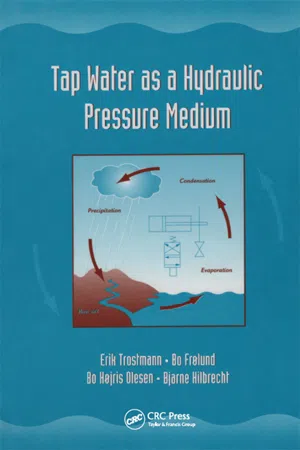 eBook - PDF
- Erik Trostmann(Author)
- 2000(Publication Date)
- CRC Press(Publisher)
The purpose of this chapter is to define and review the most important physical Properties of Water pertaining to the application of pure tap water as a pressure medium for water hydraulic control systems. Although several quantitative data and graphs will be illustrated the presentation cannot be exhaustive. The focus is directed towards the temperature range 0- 100°C and the pressure range 1-300 bar and comprehends mainly fluid water’s bulk properties, i.e. thermodynamic, transport and electric properties. The most significant differences in physical properties between water and mineral oil are summarised and compared in the following sections. Physical Properties of Water 27 3.1.1 Molecular structure of liquid water Water is a unique substance with properties that are quite anomalous to other substances. It is closely associated with cleanliness, freshness and purity. The existence of water in nature in all three phases (i.e. as ice, liquid water and water vapour), and its profusion makes this planet unique. Of all known liquids water is probably the most studied and the least understood. In spite of this, many of its physical properties such as density, mass and viscosity are accepted as international standards at its triple point, at which ice, liquid water and water vapour co-exist at equilibrium. The triple point for water is at 0.01°C and 611 Pa (4.58 mm Hg) [17]. In comparison to other solvents water shows unique properties that are highly sensitive to temperature and pressure changes. These properties stem from its structure and the electrical charge distribution of the water molecule. The exact molecular structure is not known. Many conceptual rather than physical models have been proposed. A popular model theory is the so-called Figure 3.1 A schematic, anatomical view of a water molecule 28 Erik Trostmann free-volume theory, where the excess volume of the water molecules is considered as holes, known as vacancies [2]. No longer available |Learn more
- (Author)
- 2014(Publication Date)
- University Publications(Publisher)
________________________ WORLD TECHNOLOGIES ________________________ Chapter- 1 Properties of Water Water (H 2 O) is the most abundant compound on Earth's surface, covering about 70% of the planet's surface. In nature it exists in liquid, solid, and gaseous states. It is in dynamic equilibrium between the liquid and gas states at standard temperature and pressure. At room temperature, it is a nearly colorless with a hint of blue, tasteless, and odorless liquid. Many substances dissolve in water and it is commonly referred to as the universal solvent . Because of this, water in nature and in use is rarely pure and some of its properties may vary slightly from those of the pure substance. However, there are many compounds that are essentially, if not completely, insoluble in water. Water is the only common substance found naturally in all three common states of matter and it is essential for life on Earth. Water usually makes up 55% to 78% of the human body. Forms of water Like many substances, water can take numerous forms that are broadly categorized by phase of matter. The liquid phase is the most common among water's phases (with in the earth's atmosphere and surface) and is the form that's generally denoted by the word water. The solid phase of water is known as ice and commonly takes the structure of hard, amalgamated crystals, such as ice cubes, or loosely accumulated granular crystals, like snow. The gaseous phase of water is known as water vapor (or steam), and is characterized by water assuming the configuration of a transparent cloud. The fourth state of water, that of a supercritical fluid, is much less common than the other three and only rarely occurs in nature, in extremely uninhabitable conditions. When water achieves a specific critical temperature and a specific critical pressure (647 K and 22.064 MPa), liquid and gas phase merge to one homogeneous fluid phase, with properties of both gas and liquid. No longer available |Learn more
- (Author)
- 2014(Publication Date)
- Research World(Publisher)
The presence of a charge on each of these atoms gives each water molecule a net dipole moment. Electrical attraction between water molecules due to this dipole pulls individual molecules closer together, making it more difficult to separate the molecules and therefore raising the boiling point. This attraction is known as hydrogen bonding. The molecules of water are constantly moving in relation to each other, and the hydrogen bonds are continually breaking and reforming at timescales faster than 200 femtoseconds. However, this bond is sufficiently strong to create many of the peculiar Properties of Water, such as the those that make it integral to life. Water can be de scribed as a polar liquid that slightly dissociates disproportionately into the hydronium ion ( H 3 O + (aq)) and an associated hydroxide ion (OH − (aq)). 2 H 2 O (l) H 3 O + (aq) + OH − (aq) Water, ice and vapor Heat capacity and heats of vaporization and fusion Temperature (°C) Heat of vaporization H v (kJ/mol) 0 45.054 25 43.99 40 43.35 60 42.482 80 41.585 100 40.657 120 39.684 140 38.643 ________________________ WORLD TECHNOLOGIES ________________________ 160 37.518 180 36.304 200 34.962 220 33.468 240 31.809 260 29.93 280 27.795 300 25.3 320 22.297 340 18.502 360 12.966 374 2.066 Water has the second highest specific heat capacity of all known substances, after ammonia, as well as a high heat of vaporization (40.65 kJ/mol or 2257 kJ/kg), both of which are a result of the extensive hydrogen bonding between its molecules. These two unusual properties allow water to moderate Earth's climate by buffering large fluctuations in temperature. According to Josh Willis, of NASA's Jet Propulsion Laboratory, the oceans absorb one thousand times more heat than the atmosphere ( air) and are holding 80 to 90% of global warming heat. ________________________ WORLD TECHNOLOGIES ________________________ The specific enthalpy of fusion of water is 333.55 kJ/kg at 0 °C. No longer available |Learn more
- (Author)
- 2014(Publication Date)
- Library Press(Publisher)
________________________ WORLD TECHNOLOGIES ________________________ molecules of water are constantly moving in relation to each other, and the hydrogen bonds are continually breaking and reforming at timescales faster than 200 femtoseconds. However, this bond is sufficiently strong to create many of the peculiar Properties of Water, such as the those that make it integral to life. Water can be described as a polar liquid that slightly dissociates disproportionately into the hydronium ion (H 3 O + (aq)) and an associated hydroxide ion (OH − (aq)). 2 H 2 O (l) H 3 O + (aq) + OH − (aq) Water, ice and vapor Heat capacity and heats of vaporization and fusion Temperature (°C) Heat of vaporization H v (kJ mol −1 ) 0 45.054 25 43.99 40 43.35 60 42.482 80 41.585 100 40.657 120 39.684 140 38.643 160 37.518 ________________________ WORLD TECHNOLOGIES ________________________ 180 36.304 200 34.962 220 33.468 240 31.809 260 29.93 280 27.795 300 25.3 320 22.297 340 18.502 360 12.966 374 2.066 Water has the second highest specific heat capacity of all known substances, after ammonia, as well as a high heat of vaporization (40.65 kJ·mol −1 or 2257 kJ·kg −1 ), both of which are a result of the extensive hydrogen bonding between its molecules. These two unusual properties allow water to moderate Earth's climate by buffering large fluctuations in temperature. According to Josh Willis, of NASA's Jet Propulsion Laboratory, the oceans absorb one thousand times more heat than the atmosphere (air) and are holding 80 to 90% of global warming heat. The specific enthalpy of fusion of water is 333.55 kJ·kg −1 at 0 °C. Of common substances, only that of ammonia is higher. This property confers resistance to melting on the ice of glaciers and drift ice. Before and since the advent of mechanical refrigeration, ice was and still is in common use for retarding food spoilage.
Index pages curate the most relevant extracts from our library of academic textbooks. They’ve been created using an in-house natural language model (NLM), each adding context and meaning to key research topics.
