Computer Science

Access Modifiers
Access modifiers are keywords in object-oriented programming languages that determine the visibility and accessibility of class members (variables, methods, and inner classes) from other parts of the program. They are used to restrict access to certain parts of the code and ensure data encapsulation and security. The most common access modifiers are public, private, protected, and default.
Written by Perlego with AI-assistance
Related key terms
1 of 5
7 Key excerpts on "Access Modifiers"
 eBook - PDF
- Russel Winder, Graham Roberts(Authors)
- 2014(Publication Date)
- Wiley(Publisher)
21.2 Classes 701 Intention To enable useful encapsulation, we want some class members to be private and inaccessible to anything else, while others need to be public in order to provide the public interface of instance objects. Setting the accessibility needs to be done on an individual basis, so that the programmer can carefully choose the level of accessibility granted to each member of a class. As well as having totally accessible (public) and totally inaccessible (private), we will want to be able to specify accessibility to subclasses (protected) and accessibility to classes in the same package (default). Syntax Any declaration at class scope may be preceded by one of the keywords (also known as Access Modifiers): public, protected, private The use of an access modifier is optional and it can be omitted. Description The keywords have the following meaning: public – a declaration is accessible by any class. protected – a declaration is accessible to any subclass of the declaring class, or to any class in the same package (see Section 22.2.2, page 748). private – a declaration is only accessible from within the class it is declared in. If none of the three keywords are provided, the declaration has default accessibility , meaning that it is accessible to any other class in the same package. Note, however, such a declaration is not accessible to any subclass within a different package, default accessibility is controlled strictly by package scope. Good programming practice dictates that, by default, any method or variable should be explicitly declared as private, to guarantee the maximum level of encapsulation. Further, only the minimum number of methods should be made public, while instance variables should never be made public unless absolutely necessary. Static variables should only be made public if they are also final. The set of public methods declared by a class defines the public interface of instance objects. eBook - ePub
OCP Oracle Certified Professional Java SE 11 Developer Complete Study Guide
Exam 1Z0-815, Exam 1Z0-816, and Exam 1Z0-817
- Jeanne Boyarsky, Scott Selikoff(Authors)
- 2020(Publication Date)
- Sybex(Publisher)
Line 20 calls a varargs method with two parameters. When the method gets called, it sees an array of size 2. Since indexes are 0 based, 22 is printed.Applying Access Modifiers
You already saw that there are four Access Modifiers: public , private , protected , and default access. We are going to discuss them in order from most restrictive to least restrictive:- private : Only accessible within the same class
- Default (package-private) access: private plus other classes in the same package
- protected : Default access plus child classes
- public : protected plus classes in the other packages
We will explore the impact of these four levels of access on members of a class. As you learned in Chapter 1 , “Welcome to Java,” a member is an instance variable or instance method.Private Access
Private access is easy. Only code in the same class can call private methods or access private fields.First, take a look at Figure 7.2 No longer available |Learn more
- (Author)
- 2014(Publication Date)
- Learning Press(Publisher)
Public accessor methods can be used to inspect or alter such private data. The various object-oriented prog-ramming languages enforce this to various degrees. For example, the Java language does not allow client code to access the private data of a class at all, whereas in languages like Objective-C or Perl client code can do whatever it wants. In C++ language, private methods are visible but not accessible in the interface; however, they are commonly made invisible by explicitly declaring fully abstract classes that represent the interfaces of the class. Access specifiers do not necessarily control visibility , in that even private members may be visible to client code. In some languages, an inaccessible but visible member may be referred to at run-time (e.g. pointer to it can be returned from member functions), but all attempts to use it by referring to the name of the member from client code will be prevented by the type checker. Object-oriented design uses the access specifiers in conjunction with careful design of public method implementations to enforce class invariants. Access specifiers are intended to protect against accidental use of members by clients, but are not suitable for run-time protection of object's data. Some languages, such as Ruby, support instance-private and instance-protected access specifiers in lieu of (or in addition to) class-private and class-protected, respectively. They differ in that they restrict access based on the instance itself, rather than the instance's class. In addition, some languages, such as C++, support a mechanism where a function explicitly declared as friend of the class may access the members designated as private or protected. Associations between classes In object-oriented design and in UML, an association between two classes is a type of a link between the corresponding objects.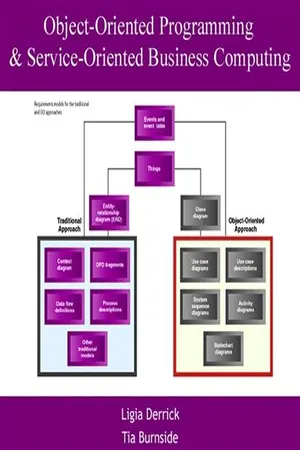 No longer available |Learn more
- (Author)
- 2014(Publication Date)
- College Publishing House(Publisher)
Public accessor methods can be used to inspect or alter such private data. The various object-oriented prog-ramming languages enforce this to various degrees. For example, the Java language does not allow client code to access the private data of a class at all, whereas in languages like Objective-C or Perl client code can do whatever it wants. In C++ language, private methods are visible but not accessible in the interface; however, they are commonly made invisible by explicitly declaring fully abstract classes that represent the interfaces of the class. Access specifiers do not necessarily control visibility , in that even private members may be visible to client code. In some languages, an inaccessible but visible member may be referred to at run-time (e.g. pointer to it can be returned from member functions), but all attempts to use it by referring to the name of the member from client code will be prevented by the type checker. Object-oriented design uses the access specifiers in conjunction with careful design of public method implementations to enforce class invariants. Access specifiers are intended to protect against accidental use of members by clients, but are not suitable for run-time protection of object's data. Some languages, such as Ruby, support instance-private and instance-protected access specifiers in lieu of (or in addition to) class-private and class-protected, respectively. They differ in that they restrict access based on the instance itself, rather than the instance's class. In addition, some languages, such as C++, support a mechanism where a function exp-licitly declared as friend of the class may access the members designated as private or protected. Associations between classes In object-oriented design and in UML, an association between two classes is a type of a link between the corresponding objects. eBook - PDF
Elementary Synchronous Programming
in C++ and Java via algorithms
- Ali S. Janfada(Author)
- 2019(Publication Date)
- De Gruyter Oldenbourg(Publisher)
If it is considered as private , then the data members and methods in its range can be accessed only from inside the same class. The compiler throws an error if we attempt to access pri-vate data from outside of the class. Another access specifier is public , in which case, data members and methods are accessible from anywhere, inside or outside of the class. Moreover, there exists another access specifier named protected in which data members and methods can be accessed in the derived class or within the same class. The protected specifiers are not discussed and used in this book. The public specifier is mainly used in both languages C++ and Java. One of the differences between C++ and Java in the object-oriented programming is that in Java a specifier is a modifier while it is written as a label in C++. This fact can be experienced in the above Test class. Another difference is in the default spec-ifiers. In C++, the access modifier for an element is private if we specify no Access Modifiers by default for that element inside the class. However, the default specifier for Java programs is the private-package which implies that the element is accessible from inside the same package to which the class belongs. The method function1() in the above examples has neither return value (of void type) nor has it any parameter. We may put the void keyword inside the parenthesis only in C++ programs if there is no parameter. Contrarily, the method function2() has float -type return value. Additionally, it has one parameter of int type. In gen-eral, a method can have any data type or it is void. In addition, it can be void of any parameter or it contains one or more parameters. No method can be defined outside the class in Java since it is a class-based programming language. However, in C++, a method can be defined outside the class using the :: (scope resolution) operator, as demonstrated in the following codes.
- Joyce Farrell(Author)
- 2017(Publication Date)
- Cengage Learning EMEA(Publisher)
A class client or class user is a program or class that instantiates objects of another prewritten class. A class header or class definition describes a class; it contains an optional access modifier, the keyword class , and any legal identifier for the name of the class. A class access modifier describes access to a class. The public class access modifier means access to the class is not limited. The protected class access modifier means access to the class is limited to the class and to any classes derived from the class. The internal class access modifier means access is limited to the assembly to which the class belongs. The private class access modifier means access is limited to another class to which the class belongs. In other words, a class can be private if it is contained within another class, and only the containing class should have access to the private class. An assembly is a group of code modules compiled together to create an executable program. Information hiding is a feature found in all object-oriented languages, in which a class’s data is private and changed or manipulated only by its own methods. Composition is the technique of using an object within another object. A has-a relationship is the relationship created using composition, so-called because one class “has an” instance of another. A reference type is a type that holds a memory address. Value types hold a value; they include predefined types such as int , double , and char . Copyright 2016 Cengage Learning. All Rights Reserved. May not be copied, scanned, or duplicated, in whole or in part. Due to electronic rights, some third party content may be suppressed from the eBook and/or eChapter(s). Editorial review has deemed that any suppressed content does not materially affect the overall learning experience. Cengage Learning reserves the right to remove additional content at any time if subsequent rights restrictions require it. eBook - PDF
- Scott Selikoff, Jeanne Boyarsky(Authors)
- 2022(Publication Date)
- Sybex(Publisher)
222 Chapter 5 ■ Methods protected The protected modifier means the method can be called only from a class in the same package or a subclass. public The public modifier means the method can be called from anywhere. For simplicity, we’re primarily concerned with Access Modifiers applied to methods and fields in this chapter. Rules for Access Modifiers are also applicable to classes and other types you learn about in Chapter 7, “Beyond Classes, such as interfaces, enums, and records. We explore the impact of the various Access Modifiers later in this chapter. For now, just master identifying valid syntax of methods. The exam creators like to trick you by putting method elements in the wrong order or using incorrect values. We’ll see practice examples as we go through each of the method elements in this chapter. Make sure you understand why each of these is a valid or invalid method declaration. Pay attention to the Access Modifiers as you figure out what is wrong with the ones that don’t compile when inserted into a class: public class ParkTrip { public void skip1() {} default void skip2() {} // DOES NOT COMPILE void public skip3() {} // DOES NOT COMPILE void skip4() {} } The skip1() method is a valid declaration with public access. The skip4() method is a valid declaration with package access. The skip2() method doesn’t compile because default is not a valid access modifier. There is a default keyword, which is used in switch statements and interfaces, but default is never used as an access modifier. The skip3() method doesn’t compile because the access modifier is specified after the return type. Optional Specifiers There are a number of optional specifiers for methods, shown in Table 5.2. Unlike with Access Modifiers, you can have multiple specifiers in the same method (although not all com-binations are legal). When this happens, you can specify them in any order. And since these specifiers are optional, you are allowed to not have any of them at all.
Index pages curate the most relevant extracts from our library of academic textbooks. They’ve been created using an in-house natural language model (NLM), each adding context and meaning to key research topics.

