Computer Science

Goedel Incompleteness Theorem
The Goedel Incompleteness Theorem, formulated by mathematician Kurt Goedel, states that in any formal system with enough complexity to express arithmetic, there will always be true statements that cannot be proven within that system. This has significant implications for computer science, as it demonstrates the inherent limitations of formal systems and the impossibility of creating a complete and consistent formal system for mathematics.
Written by Perlego with AI-assistance
Related key terms
1 of 5

10 Key excerpts on "Goedel Incompleteness Theorem"
 No longer available |Learn more
- (Author)
- 2014(Publication Date)
- Library Press(Publisher)
Discussion and implications The incompleteness results affect the philosophy of mathematics, particularly versions of formalism, which use a single system formal logic to define their principles. One can paraphrase the first theorem as saying the following: We can never find an all-encompassing axiomatic system which is able to prove all mathematical truths, but no falsehoods. On the other hand, from a strict formalist perspective this paraphrase would be consi-dered meaningless because it presupposes that mathematical truth and falsehood are well-defined in an absolute sense, rather than relative to each formal system. The following rephrasing of the second theorem is even more unsettling to the founda-tions of mathematics: If an axiomatic system can be proven to be consistent from within itself, then it is inconsistent. ________________________ WORLD TECHNOLOGIES ________________________ Therefore, to establish the consistency of a system S, one needs to use some other more powerful system T, but a proof in T is not completely convincing unless T's consistency has already been established without using S. Theories such as Peano arithmetic, for which any computably enumerable consistent extension is incomplete, are called essentially undecidable or essentially incomplete . Minds and machines Authors including J. R. Lucas have debated what, if anything, Gödel's incompleteness theorems imply about human intelligence. Much of the debate centers on whether the human mind is equivalent to a Turing machine, or by the Church–Turing thesis, any finite machine at all. If it is, and if the machine is consistent, then Gödel's incompleteness theorems would apply to it. Hilary Putnam (1960) suggested that while Gödel's theorems cannot be applied to humans, since they make mistakes and are therefore inconsistent, it may be applied to the human faculty of science or mathematics in general. No longer available |Learn more
- (Author)
- 2014(Publication Date)
- White Word Publications(Publisher)
Discussion and implications The incompleteness results affect the philosophy of mathematics, particularly versions of formalism, which use a single system formal logic to define their principles. One can paraphrase the first theorem as saying the following: We can never find an all-encompassing axiomatic system which is able to prove all mathematical truths, but no falsehoods. On the other hand, from a strict formalist perspective this paraphrase would be considered meaningless because it presupposes that mathematical truth and falsehood are well-defined in an absolute sense, rather than relative to each formal system. The following rephrasing of the second theorem is even more unsettling to the foundations of mathematics: If an axiomatic system can be proven to be consistent from within itself, then it is inconsistent. Therefore, to establish the consistency of a system S, one needs to use some other more powerful system T, but a proof in T is not completely convincing unless T's consistency has already been established without using S. Theories such as Peano arithmetic, for which any computably enumerable consistent extension is incomplete, are called essentially undecidable or essentially incomplete . ________________________ WORLD TECHNOLOGIES ________________________ Minds and machines Authors including J. R. Lucas have debated what, if anything, Gödel's incompleteness theorems imply about human intelligence. Much of the debate centers on whether the human mind is equivalent to a Turing machine, or by the Church–Turing thesis, any finite machine at all. If it is, and if the machine is consistent, then Gödel's incompleteness theorems would apply to it. Hilary Putnam (1960) suggested that while Gödel's theorems cannot be applied to humans, since they make mistakes and are therefore inconsistent, it may be applied to the human faculty of science or mathematics in general. No longer available |Learn more
- (Author)
- 2014(Publication Date)
- Learning Press(Publisher)
________________________ WORLD TECHNOLOGIES ________________________ Gödel's theorems only apply to effectively generated (that is, recursively enumerable) theories. If all true statements about natural numbers are taken as axioms for a theory, then this theory is a consistent, complete extension of Peano arithmetic (called true arithmetic) for which none of Gödel's theorems hold, because this theory is not recursively enumerable. The second incompleteness theorem only shows that the consistency of certain theories cannot be proved from the axioms of those theories themselves. It does not show that the consistency cannot be proved from other (consistent) axioms. For example, the con-sistency of the Peano arithmetic can be proved in Zermelo–Fraenkel set theory (ZFC), or in theories of arithmetic augmented with transfinite induction, as in Gentzen's con-sistency proof. Relationship with computability The incompleteness theorem is closely related to several results about undecidable sets in recursion theory. Stephen Cole Kleene (1943) presented a proof of Gödel's incompleteness theorem using basic results of computability theory. One such result shows that the halting problem is unsolvable: there is no computer program that can correctly determine, given a program P as input, whether P eventually halts when run with some given input. Kleene showed that the existence of a complete effective theory of arithmetic with certain consistency properties would force the halting problem to be decidable, a contradiction. This method of proof has also been presented by Shoenfield (1967, p. 132); Charlesworth (1980); and Hopcroft and Ullman (1979). Franzén (2005, p. 73) explains how Matiyasevich's solution to Hilbert's 10th problem can be used to obtain a proof to Gödel's first incompleteness theorem. No longer available |Learn more
- (Author)
- 2014(Publication Date)
- Learning Press(Publisher)
________________________ WORLD TECHNOLOGIES ________________________ Chapter- 6 Gödel's Incompleteness Theorems Gödel's incompleteness theorems are two theorems of mathematical logic that establish inherent limitations of all but the most trivial axiomatic systems for mathematics. The theorems, proven by Kurt Gödel in 1931, are important both in mathematical logic and in the philosophy of mathematics. The two results are widely interpreted as showing that Hilbert's program to find a complete and consistent set of axioms for all of mathematics is impossible, thus giving a negative answer to Hilbert's second problem. The first incompleteness theorem states that no consistent system of axioms whose theorems can be listed by an effective procedure (essentially, a computer program) is capable of proving all facts about the natural numbers. For any such system, there will always be statements about the natural numbers that are true, but that are unprovable within the system. The second incompleteness theorem shows that if such a system is also capable of proving certain basic facts about the natural numbers, then one particular arithmetic truth the system cannot prove is the consistency of the system itself. Background In mathematical logic, a theory is a set of sentences expressed in a formal language. Some statements in a theory are included without proof (these are the axioms of the theory), and others (the theorems) are included because they are implied by the axioms. Because statements of a formal theory are written in symbolic form, it is possible to mechanically verify that a formal proof from a finite set of axioms is valid. This task, known as automatic proof verification, is closely related to automated theorem proving. The difference is that instead of constructing a new proof, the proof verifier simply checks that a provided formal proof (or, in some cases, instructions that can be followed to create a formal proof) is correct. No longer available |Learn more
- (Author)
- 2014(Publication Date)
- Orange Apple(Publisher)
For example, Euclidean geometry without the parallel postulate is incomplete; it is not possible to prove or disprove the parallel postulate from the remaining axioms. Gödel's theorem shows that, in theories that include a small portion of number theory, a complete and consistent finite list of axioms can never be created, nor even an infinite list that can be enumerated by a computer program. Each time a new statement is added as an axiom, there are other true statements that still cannot be proved, even with the new axiom. If an axiom is ever added that makes the system complete, it does so at the cost of making the system inconsistent. There are complete and consistent list of axioms that cannot be enumerated by a computer program. For example, one might take all true statements about the natural numbers to be axioms (and no false statements), which gives the theory known as true ________________________ WORLD TECHNOLOGIES ________________________ arithmetic. The difficulty is that there is no mechanical way to decide, given a statement about the natural numbers, whether it is an axiom of this theory, and thus there is no effective way to verify a formal proof in this theory. Many logicians believe that Gödel's incompleteness theorems struck a fatal blow to David Hilbert's second problem, which asked for a finitary consistency proof for mathematics. The second incompleteness theorem, in particular, is often viewed as ma-king the problem impossible. Not all mathematicians agree with this analysis, however, and the status of Hilbert's second problem is not yet decided. Relation to the liar paradox The liar paradox is the sentence This sentence is false. An analysis of the liar sentence shows that it cannot be true (for then, as it asserts, it is false), nor can it be false (for then, it is true). A Gödel sentence G for a theory T makes a similar assertion to the liar sentence, but with truth replaced by provability: G says G is not provable in the theory T. eBook - PDF
The Great Formal Machinery Works
Theories of Deduction and Computation at the Origins of the Digital Age
- Jan von Plato(Author)
- 2017(Publication Date)
- Princeton University Press(Publisher)
Gödel’s paper on incompleteness was published in early 1931. It con-tains two incompleteness theorems; the first was given in the previous paragraph. The second one says that the unprovability of a contradic-tion, that is, the statement of consistency of the system itself, is among such unprovable propositions. Both theorems were great surprises, and the second one especially completely changed ideas about the founda-tions of mathematics. Today we can see that Gödel’s incompleteness theorems and the methods he invented for their proof belong among the 8.1 How Gödel found his theorem • 233 greatest discoveries of the twentieth century. Their importance in logic and foundations of mathematics is not unlike the role that, say, special relativity and quantum mechanics have had in physics. The incompleteness paper was also important for the development of the notions of formal system and computability: It contains a general scheme for the definition of primitive recursive functions that are used in the arithmetic coding (Gödel numbering) of formal expressions and of proofs of arithmetic and in a result by which not only the system of Principia Mathematica but already the first-order theory of arithmetic is incomplete. Gödel’s other central discoveries include the following. 3. Interpretation of classical arithmetic in intuitionistic arithmetic . In 1932, Gödel found a translation method for arithmetic formulas by which the problem of the consistency of classical arithmetic is reduced to the corresponding problem for a constructive version of arithmetic (Gödel 1933a). 4. The definition of general recursive functions. Gödel gave the “Herbrand-Gödel” definition of general recursive functions, the first definition of such functions, in a series of lectures in 1934. 5. Consistency of the continuum hypothesis. Gödel gave a proof that no contradiction follows from the addition of the axiom of choice and of Cantor’s continuum hypothesis to the axioms of set theory (1938a). eBook - PDF
- Juliette Kennedy(Author)
- 2022(Publication Date)
- Cambridge University Press(Publisher)
136. 103 [38], p. 63. Gödel’s Incompleteness Theorems 35 computation as a special form of deduction, that I am saying I am advocating a logical orientation to the problem . . . I have thus proposed that derivabil- ity from a finite set of instructions statable in a first-order mathematical language be taken to be the basic technical concept of computability. 104 The second ingredient Kripke relies on for his claim that the negative solu- tion of the Entscheidungsproblem is a corollary of Gödel’s Theorem IX is what he calls “Hilbert’s Thesis,” namely the idea that “the steps of any mathematical argument can be given in a language based on first-order logic (with iden- tity).” 105 Kripke will use Hilbert’s Thesis together with Gödel’s Completeness Theorem to infer that any valid computation, if viewed as a valid deduction, is provable in any of the standard first-order formal systems. Now to Gödel’s system we can add the rules governing the operation of the algorithm that purportedly solves the Entscheidungsproblem, which are stata- ble in a first-order language, as above. Then in this enhanced system S 0 , any first-order proposition is decided, contradicting Gödel’s Theorem IX. We reconstruct Kripke’s actual argument as follows. Suppose the algorithm α solves the Entscheidungsproblem. Let Σ be strong enough both to prove Gödel’s Theorem X and to formalize validity. (E.g., Σ can be ZF - , i.e., the theory ZF without the power set axiom.) Applying Kripke’s two principles “computability as a form of deduction” and Hilbert’s Thesis, let A(x) say that the algorithm α halts and says that x is valid. Then for all ψ, Σ ‘ A(ψ) or Σ ‘ ¬A(ψ), because α always gives an answer. We may assume Σ includes ∀x(A(x) ≡ Val(x)). By Gödel’s Theorem IX, together with the First Incom- pleteness Theorem, there is ϕ Σ such that ϕ Σ is satisfiable (has a model) but Σ ⊬ “ϕ Σ is satisfiable”. Then: • Σ ⊬ Sat(ϕ Σ ), by the above. (Σ can express Sat(x), i.e.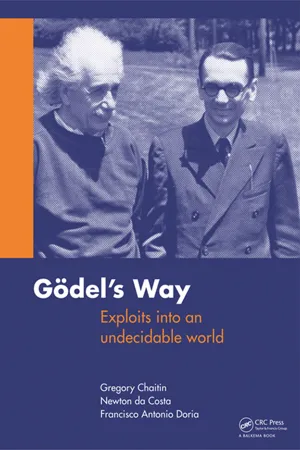 eBook - PDF
Goedel's Way
Exploits into an undecidable world
- Gregory Chaitin, Francisco A Doria, Newton C.A. da Costa(Authors)
- 2011(Publication Date)
- CRC Press(Publisher)
Chomsky asked him what he was currently working on, and received an answer that probably nobody since the seventeenth-century’s Leibniz had given: “I am trying to prove that the laws of nature are a priori.” Three magnificent minds, as at home in the world of pure ideas as anyone on this planet, yet they (and there are more) reported hitting an insur-mountable impasse in discussing ideas with G¨ odel. This is the man. We are now going to take a glimpse at his work. The incompleteness theorems, I G¨ odel’s original argument makes a brief reference to the well-known Epimenides Paradox, “Epimenides the Cretan says: all men are liars.” G¨ odel 6 Chaitin, Costa, Doria builds a formal sentence noted G in some axiomatized version of arithmetic; that sentence is self-referential and translates as: G cannot be proved. (We mean: it cannot be proved in the given axiomatic framework.) Then sup-pose that our system is consistent, and moreover suppose that G is proved. It follows that G cannot be proved, by the very definition of G . A simple argu-ment based on the fact that our system isn’t supposed to prove false assertions shows that not-G also cannot be derived, if we are within a consistent system. The whole argument is impeccable and flawless, but the weirdness of the unprovable sentence exhibited by G¨ odel raised doubts whether that kind of phenomenon might affect more substantial mathematical statements. And yes — it does. Kleene’s version of the first incompleteness theorem Let’s take a close look at Kleene’s version of the first incompleteness theorem, which has a very simple argument behind it. Then we will come back to more, let us say, traditional presentations of the result. Here we have Kleene’s argument in a nutshell: • For our purposes here, a total computable function is a function from the natural numbers 0, 1, 2, 3, . eBook - PDF
Thinking About Godel And Turing: Essays On Complexity, 1970-2007
Essays on Complexity, 1970–2007
- Gregory J Chaitin(Author)
- 2007(Publication Date)
- World Scientific(Publisher)
Such an AI would take the form of an intelligent proof checker. Gottfried Wilhelm Liebnitz and David Hilbert’s dream that disputes could be settled with the words “Gentlemen, let us compute!” and that mathematics could be formalized, should still be a topic for active research. Even though mathematicians and logicians have erroneously dropped this train of thought dissuaded by G¨ odel’s theorem, great advances have in fact been made “covertly,” under the banner of computer science, LISP, and AI (Cole et al., 1981; Dewar et al., 1981; Levin, 1974; Wilf, 1982). To speak in metaphors from Douglas Hofstadter (1979), we shall now stroll through an art gallery of proofs of G¨ odel’s theorem, to the tune of Moussorgsky’s pictures at an exhibition! Let us start with some traditional proofs (Davis, 1978; Hofstadter, 1979; Levin, 1974; Post, 1965). 2. Traditional Proofs of G¨ odel’s Theorem G¨ odel’s original proof of the incompleteness theorem is based on the paradox of the liar: “This statement is false.” He obtains a theorem instead of a paradox by changing this to: “This statement is unprovable.” If this assertion is unprovable, then it is true, and the formalization of number theory in question is incomplete. If this assertion is provable, then it is false, and the formalization of number theory is inconsistent. The original proof was quite intricate, much like a long program in machine language. The famous technique of G¨ odel numbering statements was but one of the many ingenious ideas brought to bear by G¨ odel to construct a number-theoretic assertion which says of itself that it is unprovable. G¨ odel’s original proof applies to a particular formalization of number the-ory, and was to be followed by a paper showing that the same methods applied 50 Thinking about G¨ odel & Turing to a much broader class of formal axiomatic systems. eBook - PDF
Inexhaustibility
A Non-Exhaustive Treatment
- Torkel Franzén(Author)
- 0(Publication Date)
- Cambridge University Press(Publisher)
In the case of (G) and its variants, there simply are no such formal definitions. Whatever confusion a sentence like (G) may engender in the minds of people, it does not serve to indicate any lacuna in our mathematical knowledge or understanding, and indeed has no apparent theoretical significance at all. The inexhaustibility conundrum, as formulated in the introduction to this book, is not tied to any idea that the incompleteness theorem or its proof can sensibly be applied to human beings and their mathematical discourse (or to computers sim- ulating such discourse). In particular, it is not assumed that there is any well- determined range of human arithmetical knowledge, or any well-defined totality of those arithmetical truths that are in principle accessible to human knowledge, to which Gödel’s theorem can be applied. Rather, the significance in this context of the impossibility for a formal theory to consistently assert its own consistency 12 The incompleteness theorems 224 lies in the resulting impossibility for us to come up with any formally defined set of arithmetical sentences which we can assert exhausts our arithmetical knowl- edge. This difficulty remains whether or not there is any such thing as the totality of humanly provable arithmetical truths. At the same time, the inexhaustibility phenomenon does not automatically entail any way in which human beings “transcend Gödel’s theorem” in the sense of having ways of arriving at the truth of arithmetical statements which cannot be simulated by algorithmic procedures. This aspect will be commented on in greater detail in Chapter 15.
Index pages curate the most relevant extracts from our library of academic textbooks. They’ve been created using an in-house natural language model (NLM), each adding context and meaning to key research topics.

