Economics

Dollarization
Dollarization refers to the adoption of the US dollar as the official currency in a country, either alongside or instead of the domestic currency. This can occur due to economic instability, hyperinflation, or a lack of confidence in the domestic currency. Dollarization can have both positive and negative effects on a country's economy, impacting factors such as monetary policy and exchange rate stability.
Written by Perlego with AI-assistance
Related key terms
1 of 5
10 Key excerpts on "Dollarization"
 eBook - ePub
Understanding Dollarization
Causes and Impact of Partial Dollarization on Developing and Emerging Markets
- Emre Ozsoz, Erick W. Rengifo(Authors)
- 2016(Publication Date)
- De Gruyter Oldenbourg(Publisher)
1A Primer on Dollarization1.1Introduction
Traditionally, each country and economic territory has issued and circulated its own currency. By its most common definition, a currency is a form of fiat money issued by a government and used within a certain economic region. Money can be described by its functions as a medium of exchange (to buy and sell goods and services), as a unit of account (to keep track of revenues, costs and profits), and as a store of value (to save, and smooth consumption over time).However, it is important to note that in an increasingly globalized marketplace, where not only goods and services but also people and capital move across borders, governments have lost their monopoly over the currency used among their citizens. This is particularly true for emerging economies.1Currency substitution, or Dollarization , refers to the use of another country’s currency in exchange of or in addition to the local currency. This phenomenon has become widespread in today’s global economy.This definition can be expanded to include the degree by which “real and financial transactions are actually performed in dollars relative to those performed in local currency” (Ortiz, 1983).The term “Dollarization” was coined after the US Dollar, since it has traditionally been the most preferred replacement currency of choice. Nowadays, the term “Dollarization” generically refers to the use of another country’s currency (not necessarily the US Dollar) in addition to or in exchange of a local currency.According to FED’s estimates as of 2011, almost $538 billion of US currency in print was held outside the US, and nearly two-thirds of all $100 bills were in use outside US borders (Judson, 2012). Considering that 6.7 billion people live outside the US, this translates into an average of 80.3 US dollars in every non-American’s pocket worldwide.
- (Author)
- 2012(Publication Date)
- Academic Press(Publisher)
While the recent observed decline in Dollarization in many regions of the world provides some ground for optimism, one needs to remain cautious about the risks associated with Dollarization and the perspectives for a more extensive deDollarization. Dollarization is a complex and multifaceted phenomenon with many possible underlying determinants. Hence, before formulating a policy agenda to deal with it, one needs to be sure of interpreting and understanding it correctly. Fortunately, there has been substantial progress in recent years in the academic literature, both theoretical and empirical, on the roots and policy implications of Dollarization. In addition to reviewing this literature fairly extensively, this chapter takes stock of the most recent Dollarization trends.The chapter is structured as follows: The section ‘Background’ defines the concept of Dollarization, reviews recent trends, and compares the relative magnitudes of different types of Dollarization. The section ‘Determinants’ discusses the factors underpinning Dollarization using a taxonomy derived from a bicurrency lending equilibrium. The section ‘Empirical Evidence’ reviews the corresponding empirical evidence. The section ‘Costs and Risks’ discusses the potential costs and risks of Dollarization and the section ‘The Policy Agenda,’ its policy implications. The section ‘Conclusions’ concludes by briefly pondering over what the future of Dollarization might look like in an increasingly globalized world.Background
Definitions
Dollarization refers to the use of a foreign currency (typically the dollar but also the euro or any other reserve currency) for any of the three basic uses of money, unit of account, store of value, or medium of exchange. Official (or complete) Dollarization occurs when the foreign currency (from now on the ‘dollar’) is adopted as legal tender. De facto (or partial) Dollarization occurs when the local currency (from now on the ‘peso’) remains the exclusive legal tender but some contracts are denominated, prices posted, or payments made in dollars, effectively allowing a bicurrency system to take hold. eBook - PDF
- Brian Kettell(Author)
- 2001(Publication Date)
- Butterworth-Heinemann(Publisher)
The global foreign exchange rate system and the ‘Euroization’ of the currency markets 179 controlled. Fixed exchange rates have helped economies in Latin America to reduce inflation. Capital mobility . The more open an economy to inter-national capital, the harder it is to sustain a fixed rate. Table 8.1 summarizes many of these ideas. Dollarization and the choice of an exchange rate regime Dollarization, the holding by residents of a significant share of their assets in foreign currency-denominated form, in this case the US dollar, is a common feature of developing and transition economies. It is a response to economic instability and high inflation, and to the desire of domestic residents to diversify their asset portfolios. In countries experiencing high inflation Dollarization is typically quite widespread as the public seeks protection from the cost of holding assets denominated in domestic currency. To best understand the role of Dollarization in influencing the choice of exchange rate regime, it is useful to distinguish between two motives for holding foreign currency assets: currency substitution and asset substitution. Currency sub-stitution occurs when assets denominated in foreign currency are used as a means of payment, while asset substitution occurs when assets denominated in foreign currency serve as stores of value. Currency substitution typically arises during high inflation, when the cost of holding domestic currency for transactions purposes is high. Asset substitution results from portfolio allocation decisions and reflects the relative risk and return characteristics of domestic and foreign assets. In many developing countries, assets denominated in foreign currency have often provided residents with the opportunity to insure against major domestic macroeconomic risks. Dollarization introduces additional complications into the choice of exchange rate regime.
- International Monetary Fund(Author)
- 2003(Publication Date)
- INTERNATIONAL MONETARY FUND(Publisher)
III Dollarization in Cambodia
The notion of Dollarization emerged as a novel economic phenomenon in the 1980s in Latin America. Early discussions of this phenomenon in the literature revolved around that region’s experience with the increasing use of the U.S. dollar along with national currencies. Passage contains an image
A Synopsis of the Concepts of Dollarization and of Currency Substitution
Dollarization is described in the early literature as a situation where a foreign currency is used for the same purposes as the national currency—that is, as a medium of exchange, a unit of account, and a store of value. The loss of the domestic currency’s external value and appeal as a store of value prompts Dollarization and the foreign currency assumes the three classic uses of the national currency. According to Ortiz (1983 ), Dollarization is the degree to which real and financial transactions are performed in dollars relative to those performed in domestic currency.Broader notions of Dollarization also exist. Cuddington (1989 ) and Calvo and Végh (1992 ) define currency substitution as the use of cash foreign currency and of foreign currency deposits only as a medium of exchange in the domestic economy. McKinnon (1996) suggests a more extensive definition of currency substitution, distinguishing between direct currency substitution (several currencies compete as means of payment) and indirect currency substitution (several currencies serve as nonmonetary financial assets for stores of value). This distinction between the two motives for the demand for foreign-currency-denominated assets is also known in the literature as currency substitution and asset substitution. 7 Currency substitution occurs when foreign-currency-denominated assets are used as means of payment, while asset substitution occurs when they are primarily used as a store of value. Calvo and Végh (1992 ) point out that asset substitution normally characterizes the late stage of Dollarization and that it appears in a high-inflation environment where a foreign currency becomes the unit of account or a store of value.8 eBook - PDF
- R. Rennhack, E. Offerdal, R. Rennhack, E. Offerdal(Authors)
- 2004(Publication Date)
- Palgrave Macmillan(Publisher)
chapter seeks to make a modest contribution to this debate by pro- viding some pointers as to some of the relevant factors that may need to be considered. As a general background, the chapter starts by briefly reviewing Dollarization types and their possible roots. It then surveys the prudential and monetary implications of Dollarization. Based on this analysis, it suggests possible dynamic linkages between Dollarization and monetary policy. The chapter concludes with a sug- gested (and at this stage quite tentative) reform agenda for countries that wish to reverse Dollarization trends and a warning about some of the challenges that they are likely to face in this endeavor. Dollarization: types and roots Dollarization can take multiple forms. Partial Dollarization occurs when the government maintains the status of the local currency as exclusive legal tender but allows financial or real transactions to be denominated in dollars, effectively allowing a bicurrency system to take hold. Partial Dollarization can, in turn, take three forms: pay- ments Dollarization in residents’ use, for transaction purposes, of for- eign currency in cash, demand deposits, or central bank reserves; financial Dollarization consists of residents’ holding of financial assets or liabilities in foreign currency; real Dollarization is the index- ing, formally or de facto, of local prices and wages to the dollar. Financial Dollarization can be also classified as domestic (e.g. the use of the dollar in claims by residents) or external (e.g. the use of the dollar in claims by nonresidents against residents). This last distinc- tion is important because of home bias effects. As discussed in the classic international finance literature, the demand for financial instruments is a function of the consumption basket of the investor. eBook - PDF
Financial Dollarization
The Policy Agenda
- A. Armas, A. Ize, E. Levy-Yeyati, A. Armas, A. Ize, E. Levy-Yeyati(Authors)
- 2006(Publication Date)
- Palgrave Macmillan(Publisher)
Sections 1.3 and 1.4 survey the main issues faced by the monetary and prudential authorities in a dollarized economy. Section 1.S sums up the discussion on the scope for de-Dollarization and reviews alternative routes towards this end. Section 1.6 concludes by summing up the main steps and challenges looking forward. 1.2 What causes Dollarization? The roots of financial Dollarization are extensively discussed in the general analytical framework presented by Ize in Chapter 2 and the broad survey of the literature by Ize and Levy Yeyati in Chapter 3. The main finding of these chapters is that financial 1 2 An Overview Dollarization is the result of a market equilibrium in which both the suppliers and the demanders of funds choose an optimal currency composition. In this process, three basic drivers emerge: (i) the maximization of return volatility (in the presence of risk aversion) favours the currency that is more stable and credible, particularly over the longer run; (ii) the minimization of credit risk favours the currency that minimizes the probability of default (in the case of a single creditor or perfect information) or the loss-given default (in the case of multiple creditors and imperfect information); and (iii) the maximization of the option value of bail-out or deposit guarantees promotes moral hazard-driven equilibria in which the preferred currency is that which maxi- mizes expected costs to the insurer. Dollarization will therefore tend to prevail in environments where monetary policy is perceived to be weak (increasing the volatil- ity of real returns on local currency assets), and geared towards limiting exchange rate fluctuations (reducing the risk of foreign currency lending relative to local currency lending); and where foreign currency depositors and borrowers expect the govern- ment to come to their rescue in the event that a large devaluation cannot be avoided.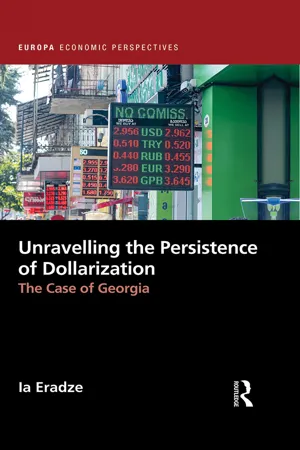 eBook - ePub
Unravelling The Persistence of Dollarization
The Case of Georgia
- Ia Eradze(Author)
- 2023(Publication Date)
- Routledge(Publisher)
11–15). Official Dollarization might cause problems for the US (along with advantages), as the Federal Reserve might be obliged to take into consideration the needs of important trade partner countries. Also, this might trigger anti-Dollarization waves in these countries. Therefore, it is preferable from the US perspective to assign Dollarization-related issues to the IMF (Carchedi, 2002, p. 161). This brief history of US dollar diplomacy and the debates on the benefits and disadvantages of official or unofficial Dollarization for the US demonstrate the complexity of the phenomenon and the politics behind it. Dollar policies have never been related to monetary issues only, but have always been entangled with political, geopolitical, or broad economic interests. Yet, Dollarization cannot be explained only through dollar diplomacy, merely as an externally imposed phenomenon on developing countries. Such complex processes do not occur through a one-way domination and the agency of various interest groups within dollarized countries should not be undervalued. Therefore, the explanation of Dollarization from a dollarized country’s perspective is important. It can shed light on historical conditionalities, socio-political and economic processes, cultural acceptance or resistance to Dollarization. Back to the beginnings: the chaos and euphoria of independence The collapse of the Soviet Union in 1991 marked, on the one hand, the independence of Georgia and, on the other hand, the beginning of chaos, uncertainties, economic hardships, social insecurity, political conflicts, and the search for a way of becoming a state eBook - ePub
- R. Gelos(Author)
- 2014(Publication Date)
- INTERNATIONAL MONETARY FUND(Publisher)
Journal of Banking and Finance , 33, pp. 1860–73.22 Quispe, Z., 2000, “Política Monetaria en una Economía con Dolarización Parcial: el Caso de Perú,” Banco Central Reserva de Perú, Estudios Económicos No. 6.23 Reinhart, C., R. Rogoff, and M. Savastano, 2003, “Addicted to Dollars,” NBER Working Paper No. 10015 (Cambridge, Massachusetts: National Bureau of Economic Research).24Rennhack, R., and M. Nozaki, 2006, “Financial Dollarization in Latin America ,” in Financial Dollarization—The Policy Agenda , ed. by A. Armas, A. Ize, and E. Levy (Washington: International Monetary Fund; New York: Palgrave Macmillan). Passage contains an image
Chapter 8. Interest Rate and Exchange Rate Channels in Dollarized and Non-Dollarized Economies
Santiago Acosta-Ormaechea and David CobleA version of this chapter was published in April 2013 in Revista Economía Chilena (Volume 16, Number 1). Available at: http://www.bcentral.cl/eng/studies/economia-chilena/articles.htm .The study of the transmission of monetary policy in both advanced and developing economies has been the objective of numerous papers in recent years. This monetary transmission is broadly conceived as the analysis of how monetary policy decisions ultimately affect inflation, which is generally the primary objective of central banks.Under an inflation targeting regime, in particular, the economic authorities conduct monetary policy by setting a reference interest rate to achieve a pre-announced inflation target, while leaving other monetary aggregates and the exchange rate to be largely determined by market forces. However, these monetary policy decisions affect inflation with a delay, as they first tend to impact on different variables and only after that, through different channels, the inflation rate.1 eBook - PDF
International Financial Markets
The Challenge of Globalization
- Leonardo Auernheimer(Author)
- 2010(Publication Date)
- University of Chicago Press(Publisher)
Univer-sity of Maryland, Center for International Economics. Mimeograph. Craine, R. 2001. Dollarization: An irreversible decision. Department of Eco-nomics, University of California, Berkeley. Mimeograph. Currie, D. 1992. EMU: Institutional structure and economic performance. Eco-nomic Journal 102 (411): 248–64. De La Torre, A., R. García-Saltos, and Y. Mascaró. 2001. Banking, currency, and debt meltdown: Ecuador crisis in the late 1990s. Washington, D.C.: World Bank. Mimeograph. Eichengreen, B. 1997. One money for Europe? In European monetary unifica-tion: Theory, practice, analysis, ed. B. Eichengreen. Reprinted from Economic Policy (1992). Cambridge: MIT Press. Escudé, G. J., M. E. Grubisic, and V. C. Sabban. 2000. The effect of risk aversion in the evaluation of the default risk reduction due to full Dollarization: Com-ments on “The pros and cons of full Dollarization” (technical note no. 7), by A. Berg and E. Borensztein. Buenos Aires: Central Bank of Argentina. Frankel, F., and A. Rose. 2000. Estimating the effect of currency unions on trade and output. NBER Working Paper no. 7857. Cambridge, Mass.: National Bu-reau of Economic Research, August. Giavazzi, F., and A. Giovannini. 1989. Monetary policy under managed exchange rates. Economica 56 (May): 199–213. Guidotti, P. 1999. From floating exchange rates to full Dollarization: What works The Dollarization Debate in Argentina and Latin America 219 for Latin America. In IABD Annual Meetings Conference Proceedings, 35– 37. New York: Deutsche Bank Research. ———. 2000. On debt management and collective action clauses. In Reforming the international monetary and financial system, ed. P. Kenen and A. Swoboda, 265–76. Washington, D.C.: IMF. Harris, R., and T. Courchene. 1999. Towards a North American common cur-rency: An optimal currency area analysis. Mimeograph. Hausmann, R., M. Gavin, C. Pages-Serra, and E. Stein. 1999. Financial turmoil and the choice of exchange rate regime. eBook - PDF
The Dollarization Discipline
How Smart Companies Create Customer Value...and Profit from It
- Jeffrey J. Fox, Richard C. Gregory(Authors)
- 2004(Publication Date)
- Wiley(Publisher)
Why Dollarize? 25 Because assessing value in monetary terms initially appears to be such a daunting task, most firms in business markets do not even try to do it. Yet, the small but growing number of progressive firms that excel at value assessment find that the more value assessments they do, the easier they become. That is, through experience and learning, they develop this business marketing capability. They also uniformly find that value assessment provides them with superior knowledge about the marketplace that they are able to convert to supe- rior marketplace performance. 3 Companies that become Dollarization disciples find that inside- out decision making gives way to a customer-focused mentality. Every decision that impacts the customer can be tested through a Dollarization filter: How does this impact the value we create for our customers? 26 Introduction to Dollarization Chapter 4 After the Bubble Burst As proponents of Dollarization, we have been intrigued to ob- serve the emergence of so-called tech companies as leading users of this approach to selling and marketing. The events lead- ing up to this moment are instructive. We have been helping companies dollarize and otherwise add discipline to their marketing activities for many years. So as with many other traditionalists, we were appalled (and some- times amused) at the vast amount of marketing dollars shredded during the heady days of the technology bubble of 1998–2000. Driven by the seemingly endless potential of the Internet and e-commerce, businesses were expanding their information tech- nology (IT) expenditures with no end in sight, and every tech company seemed to have the perfect solution searching for a need. Rich with initial public offering (IPO) lucre and promises of contracts from loose-spending customers, the tech world set out on a brand-building stampede like never before seen.
Index pages curate the most relevant extracts from our library of academic textbooks. They’ve been created using an in-house natural language model (NLM), each adding context and meaning to key research topics.

