Economics

Eurobonds
Eurobonds are debt securities issued in a currency different from that of the country or market where they are issued. They are typically issued by a multinational entity or a foreign government. Eurobonds are attractive to investors seeking diversification and can provide a source of funding for the issuing entity.
Written by Perlego with AI-assistance
Related key terms
1 of 5

10 Key excerpts on "Eurobonds"
 eBook - ePub
- Moorad Choudhry(Author)
- 2010(Publication Date)
- Wiley(Publisher)
Chapter 6THE EUROBOND MARKETThe Eurobond market is an important source of funds for many banks and corporates, as well as central governments. The Eurobond market has benefited from many of the advances in financial engineering, and has undergone some innovative changes in the debt capital markets. It continues to develop new structures, in response to the varying demands and requirements of specific groups of investors. The range of innovations have customised the market to a certain extent, and often the market is the only opening for certain types of government and corporate finance. Investors also often look to the Eurobond market due to constraints in their domestic market, and Euro securities have been designed to reproduce the features of instruments that certain investors may be prohibited from investing in in their domestic arena. Other instruments are designed for investors in order to provide tax advantages. The traditional image of the Eurobond investor - the so-called ‘Belgian dentist’ - has changed and the investor base is both varied and geographically dispersed worldwide.The key feature of Eurobonds, which are also known as international securities, is the way they are issued, internationally across borders and by an international underwriting syndicate. The method of issuing Eurobonds reflects the cross-border nature of the transaction, and unlike government markets where the auction is the primary issue method, Eurobonds are typically issued under a ‘fixed price re-offer’ method or a ‘bought deal’. There is also a regulatory distinction as no one central authority is responsible for regulating the market and overseeing its structure. eBook - PDF
- Dileep Mehta, Hung-Gay Fung(Authors)
- 2008(Publication Date)
- Wiley-Blackwell(Publisher)
This is especially true of large loans. 4.6.6 Eurobond market A Eurobond is a bond issued outside the country in whose currency it is denominated. The following characteristics of the Eurobond are noteworthy. ● It is not subject to regulatory requirements of the country in whose currency it is denom-inated. For instance, Eurodollar bonds avoid the Security and Exchange Commission (SEC) requirements of registration and prospectus issuance. ● It is subject to minimal regulatory requirements of the country in which it is physically issued. 10 These two requirements distinguish it from a “foreign” bond issued by a foreign business in a country in whose currency it is denominated; as such, the foreign bond has to meet the regulatory requirements of the country where it is placed. ● Typically it is issued in several countries simultaneously. ● The Eurobond markets are self-regulating. ● For a foreign, private-sector entity desiring dollar-denominated obligation, a Eurobond issue also means that the issuer bypasses the requirements imposed by the Financial Accounting Statement Board (FASB) standards that would have necessitated time-consuming restatement of its financial statements. Such restatement would also have meant unpalatable disclosure of perceived proprietary information. ● Avoidance of the regulatory requirements enables the borrower to cut the lead time (between the decision to issue and receiving funds from the issue placement) for an issue to a matter of days. In contrast, the lead time in the USA can stretch to several months. ● It is a bearer bond; hence, it does not have an ownership record with the issuing firm. ● Investors often forsake the protection afforded by regulations (e.g., veracity of informa-tion) because bearer bonds allow them to avoid or evade taxes on interest income. ● It carries a fixed-rate coupon.Thus even when it is privately placed, it is different from a securitized loan that carries a floating rate coupon. eBook - PDF
- Alan C. Shapiro, Peter Moles(Authors)
- 2014(Publication Date)
- Wiley(Publisher)
2 In addition to the possibility of reduced borrowing costs, the Eurobond issuer may diversify its investor base and funding sources by having access to the international Eurocapital markets of Western Europe, North America, and the Far East. Placement. Issues are arranged through an underwriting group, with often an issue as large as US$1 billion having as few as four underwriters, as with the CEMEX transaction in Figure 13.2. A growing volume of Eurobonds is being placed privately because of the simplicity, speed, and privacy with which private placements can be arranged. 2 The existence of such windows is documented by Yong-Cheol Kim and Rene M. Stulz, “The Eurobond Market and Corporate Finan- cial Policy: A Test of the Clientele Hypothesis”, Journal of Financial Economics 22 (1988): 189–205; and Yong-Cheol Kim and Rene M. Stulz, “Is There a Global Market for Convertible Bonds?”, Journal of Business 65 (1992): 75–91. 446 INTERNATIONAL FINANCIAL MARKETS FIGURE 13.2 Example of Offering Memorandum Courtesy of CEMEX. 13.2 Eurobonds 447 Currency Denomination. Historically, about 75% of Eurobonds have been U.S. dollar denominated. The most important nondollar currencies for Eurobond issues are the euro, the Japanese yen, and the pound sterling. The absence of Swiss franc Eurobonds is due to the Swiss Central Bank’s ban on using the Swiss franc for Eurobond issues. Interest Rates on Fixed-Rate Eurobonds. Fixed-rate Eurobonds ordinarily pay their coupons once a year, in contrast to bonds issued in the U.S. and U.K. domestic markets, in which interest is normally paid on a semiannual basis. Issuers, of course, are interested in their all-in cost —that is, the effective interest rate on the money they have raised. This interest rate is calculated as the discount rate that equates the present value of the future interest and principal payments to the net proceeds received by the issuer. In other words, it is the internal rate of return on the bond. eBook - PDF
How the Global Financial Markets Really Work
The Definitive Guide to Understanding International Investment and Money Flows
- Alexander Davidson(Author)
- 2009(Publication Date)
- Kogan Page(Publisher)
The claim on the issuer is a main advantage that the covered bond has over the asset-backed security. No default on covered bonds has been recorded since they were first issued in the late 18th century, and the bonds offer a yield that is sometimes greater than on govern-ment bonds. 64 H OW THE GLOBAL FINANCIAL MARKETS REALLY WORK ____________________ The Capital Requirements Directive requires a legal framework for cov-ered bonds to be in place in the issuer’s jurisdiction before a lower risk rating on covered bonds can be obtained, which would mean they would not attract high regulatory capital charges. The United Kingdom, like the United States, Italy and the Netherlands, does not yet have a national legal framework in place. Instead it has a structured covered bonds regime in which it uses con-tractual agreements to replicate issuance under a legal framework. International debt securities London has a large market in trading international debt securities, which include Eurobonds and foreign bonds. The Eurobond is a tradable bond with a maturity of at least two years, denominated in a currency neither of the issuer nor of the country where it was issued. It is listed on an exchange, which dis-tinguishes it from a loan. Large companies as well as banks, governments and financial agencies issue international bonds to borrow cheaply in a foreign market. Eurobond issuers need good credit ratings, because this type of bond is unsecured. The Eurobond is sold globally to high-net-worth individuals as well as institutions. Investment banking methods (see Chapter 7) are used to sell Eurobonds, rather than the commercial bank methods used to sell syndicated loans. A lead bank will run a syndicate of banks to underwrite the Eurobond issue. A group of sell-ing banks that need not be underwriters will sell the bonds to investors.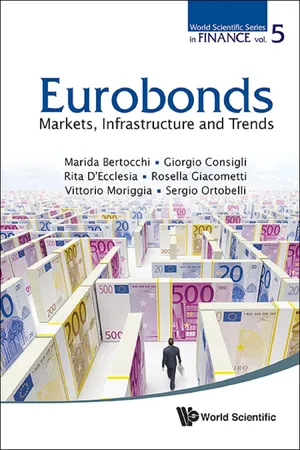 eBook - ePub
Euro Bonds: Markets, Infrastructure And Trends
Markets, Infrastructure and Trends
- Marida Bertocchi, Giorgio Consigli, Rita D'Ecclesia, Rosella Giacometti, Vittorio Moriggia, Sergio Ortobelli(Authors)
- 2013(Publication Date)
- WSPC(Publisher)
Chapter 3 Government Bond Markets (Giorgio Consigli) 3.1 Introduction Individual European countries have been listing Eurobonds before the introduction of the Euro as the legal currency within the European Monetary Union (EMU). Sovereign liabilities were denominated in convertible currencies, primarily USD, and the market size and liquidity was strictly linked to the growth of foreign deposits in the International banking system. Sovereign issuers from Latin America and Central Eastern European Countries had largely used foreign denominated liabilities in USD. The Euro sovereign fixed-income market, from now on and for our purposes the sovereign bond market, includes Euro denominated bonds specifically issued and traded since the introduction of the Euro by sovereign borrowers belonging to the Euro area. As we write and over the last two years the sovereign bond market is undergoing a prolonged crisis in various member countries of the EU, whose government bonds show higher yields, and the increasing risk of a few countries is threatening the stability of the currency, [Abad et al. (2009)]. In August 2012 National and International policy makers started a difficult discussion on the establishement, within the Euro area, of a European Stability Mechanism whose explicit aim will be to help Member States with heavy financial and economic problems, likely to affect the very existence of the common currency. 3.2 The Euro Sovereign Bond Market Evolution Looking at the sovereign debt markets of the Euro area over the past two decades, we can distinguish three main periods; prior to 1999, 1999 to 2008, 2008 to present. The first, before 1999, in which the National Monetary Authorities and Governments acted in order to converge towards the German interest rate term structure. The introduction of the Euro in 1999 eased the convergence in the secondary markets of Member States sovereign bond yields
- Maxwell Watson, Peter Keller, and Donald Mathieson(Authors)
- 1984(Publication Date)
- INTERNATIONAL MONETARY FUND(Publisher)
Issues of Euro-yen bonds declined from $0.6 billion in 1982 to $0.2 billion in 1983, and there was no issuance of such bonds during the second and third quarters of 1983. Euro-yen bonds have been issued by sovereign borrowers, international organizations, and government-guaranteed Japanese entities. Beginning in 1984, the level of activity in the Euro-yen bond market is likely to be affected by a series of measures aimed at broadening the use of the yen as an international currency and liberalizing the Japanese domestic financial markets. Effective on December 1, 1984, non-Japanese private corporations, national, state, and local governments, and government agencies and organizations will be authorized to issue bonds in the Euro-yen market. Initially, these issuers will have to meet the issuance criteria of the foreign (Samurai) bond market. From April 1985, there will be a relaxation of these criteria to allow general participation by borrowers with a credit rating of AA or better, as well as a number of international corporations with A ratings. As of April 1984, the conditions for Euro-yen issues by Japanese residents were also liberalized with the result that 30 Japanese corporations now may make straight debt issues and about 100 corporations may issue convertibles. There are no limits on the size or total number of issues. Withholding tax will continue to apply to interest payments on such issues.In the first half of 1984, there was a sharp expansion in the rate of issuance of Eurobonds with total issues equaling $35 billion (an annual rate of $70 billion—nearly 50 percent higher than the rate experienced in 1983). Eurodollar bonds represented 79 percent of total issues ($27 billion) with much of this issuance taking the form of floating rate notes. Issues denominated in pounds sterling accounted for 5 percent and in deutsche mark for 6 percent of all Eurobonds.Type of Bonds and Other Instruments
Chart 6 and Table 12 indicate the types of bonds utilized in the international bond markets in recent years. While the share of fixed-rate, straight Eurodollar bonds increased from 53 percent in 1980 to 57 percent in 1981 and further to 68 percent in 1982, this type of bond accounted for only 55 percent of Eurodollar issues in 1983. In contrast, the share of floating rate notes increased from 29 percent of Eurodollar bonds in 1982 to 40 percent in 1983. Following the spread of debt servicing problems on international loans since mid-1982, there has been a shift by banks toward purchases of securities (which were regarded as relatively safe and liquid instruments) rather than participation in large syndicated international loans. Banks have regarded floating rate notes issued in large volumes by good credit risks not only as liquid assets but also as offering relatively attractive risk-adjusted returns, even though the nominal yields on these instruments is often as low as ¼ or ⅛ percent over LIBOR. These low spreads have not meant that the total return (interest income plus any capital gains or losses) on floating rate notes has been less than that on other international financial securities. The total returns over the period 1978–83 (in average annual percentage rates) are shown in Table 13 eBook - PDF
- G. Burn(Author)
- 2006(Publication Date)
- Palgrave Macmillan(Publisher)
This, in turn, had the effect of dramatically extending the process by which national capital markets were being homogenised. For the first time since Weimar Germany small European savers had the opportunity to invest in dollar instruments. The establishment of the Eurobond market In 1963, the issuing of bearer securities, prohibited in Britain since 1939, was allowed again, but only so long as they were not designated in The Evolution of the Euromarkets 29 sterling. Consequently a new type of securities market was established, one financed in Eurodollars: the Eurobond market. Such was the phenomenal success of this market that $33 billion worth of Eurobond issues were made in the first ten years (1963–73), and by 1984/85 this had grown to an annual rate of $58 billion (Struthers and Speight, 1986: 123). Unlike the Eurodollar market, which is a short-term wholesale dollar market, the Eurobond market dealt in foreign currency bonds, primarily dollar bonds, and, as such, is a market for long-term capital. Also, unlike the Eurodollar market, the history of the Eurobond is well documented, if nevertheless, contentious. The bulk of literature maintains that the first Eurobond issue was put together and underwritten by S.G. Warburgs, the London merchant bank, and signed on 1 July 1963. 25 This issue amounted to $15 million of 5.5 per cent bearer bonds due in 15 years on behalf of the Italian motor- way operator Autostrade (Concessioni e Costruzioni Autostrade), and guaranteed by the Instituto per la Rivostruzione Industriale (IRI), an Italian state-owned industrial and financial holding company, although, the actual recipient of the money was FINSIDER, another of IRI’s sub- sidiaries. The subscription agreement had been originally made on 14 January, signed on 1 July, in Holland, and the bonds were delivered to the purchasers at the Banque Internationale in Luxembourg after payment, on 17 July. eBook - PDF
European Fixed Income Markets
Money, Bond, and Interest Rate Derivatives
- Jonathan A. Batten, Thomas A. Fetherston, Peter G. Szilagyi, Jonathan A. Batten, Thomas A. Fetherston, Peter G. Szilagyi(Authors)
- 2004(Publication Date)
- Wiley(Publisher)
London Economics (2002) reports that data available on bond subscrip- tions shows a wide investor base for large, liquid Euro issues by governments, agencies, or well-known corporate borrowers. For less-known or small-small issues, which were formerly sold only nationally or even regionally, the investor base has also become more diversified. The introduction of the euro has supported this process in two ways: it removed currency risk as well as certain legal barriers associated with investing in foreign currency. Such legal barriers were typically related to currency-matching requirements imposed on pension funds and insurance companies, but were in effect eliminated overnight with the disappearance of national currencies. The Euro Area Bond Market 33 It nonetheless has to be said that the breakdown of investor home bias has been nowhere near as swift in the Euro area as formerly anticipated. As Santillan et al. (2000) point out, this is because for resident investors the benefits of diversifying into other Euro markets remain rather narrow. Indeed, administrative costs, such as those entailed when acquiring country- specific technical and legal information, are often prohibitive. On the other hand, yields to be potentially earned are generally low and homogeneous, given that all Euro area governments now enjoy very high credit ratings. With the elimination of foreign exchange risk, currency- driven investment strategies are now also impracticable within the Euro area, taking further interest out of the market. These conditions are pushing demand into the higher yielding alternative markets of the immediate EU candidates such as Poland, Hungary, and the Czech Republic, which are now also part of the same yield convergence play that was observed in the Euro area itself in the years preceding Monetary Union. It is this homogeneity of the government bond market that has prompted portfolio managers to increasingly diversify into new, higher yielding asset classes.
- Edmund Kwaw(Author)
- 1996(Publication Date)
- Praeger(Publisher)
Typically, it is possible for the warrants to be stripped from the Eurobonds and traded separately. Synthetic Eurobonds are illiquid fixed rate bonds that are usually packaged with swaps to create floating rate notes with high yielding characteristics. 7.00[3] Euronotes and Eurocommercial Paper Two of the most common eurocurrency market instruments are euronotes and eurocommercial paper. In historical terms, the euronote emerged before eurocommercial paper. 15 7.00[3][i] The Emergence of the Note and Commercial Paper Markets The euronote market emerged as an international money market instru- ment in the mid-1960s when several United States firms began to issue 162 The Law and Practice of Offshore Banking and Finance dollar-denominated commercial paper to dealers in London because they wanted to avoid the domestic restrictions on the export of capital. 16 In 1968, the United States government established the Office of Foreign Direct Investments (OFDI), which was supposed to implement certain regulations aimed at placing restrictions on U.S. businesses making transfers of capital abroad. Those companies which had a 10 percent or greater investment in a foreign company were labeled "direct investors" and were subject to the restrictions. There were, however, certain provisions of the OFDI regulations which permitted U.S. companies to raise long-term borrowing abroad, either directly, or through their finance subsidiaries, which could be used as an offset to direct investment. Long-term borrowing "would not ordinarily be repaid within 12 months of the original date of its being made." Because long-term borrowing was inflexible, most companies preferred to use the short-term finance markets. This meant obtaining domestic bank loans, which were very expensive. Against this background, U.S. companies sought to reproduce in the eurocurrency market, a form of commercial paper which already existed in the domestic money market.
- John Lipsky, Peter Keller, Donald Mathieson, and Richard Williams(Authors)
- 1983(Publication Date)
- INTERNATIONAL MONETARY FUND(Publisher)
The currency composition of international bonds reflected, in part, the expectations of borrowers and lenders regarding the future movements in interest rates, inflation, and exchange rates. Throughout 1981 and 1982, prevailing expectations generally worked to create a strong preference by investors for Eurobonds denominated in U.S. dollars. While the movement toward denominating bonds in U.S. dollars can be observed in the recent data on the issuance of total international bonds, this trend primarily reflects developments in the Eurobond market rather than in the foreign bond markets.In the foreign bond markets, the currency composition was strongly affected by the 20 percent decline in the issuance of foreign (Yankee) bonds in the United States (Table 18 ). In part, this was due to the fact that during the first and fourth quarters of 1982, a number of firms found it somewhat less expensive to issue in the Eurodollar bond market, because of strong investor demand for Eurodollar instruments. As a result, the proportion of foreign bonds denominated in U.S. dollars fell from 36 percent in 1981 to 24 percent in 1982. However, the importance of bonds denominated in Swiss francs in total foreign bond issues rose from 38 percent in 1981 to 49 percent in 1982, and the share of foreign bonds denominated in deutsche mark increased from 6 to 8 percent during the same period.Table 18 . Foreign Bond Issues and Placements by Market Country, 1977-Second Quarter 1983(In millions of U.S. dollars)Sources: World Bank, Borrowing in International Capital Markets; and Organization for Economic Cooperation and Development, Financial Statistics Monthly.In the Eurobond markets, in contrast, new issuance of U.S. dollar-denominated bonds rose from $21.3 billion in 1981 to $38.7 billion in 1982 (Table 19 ). The share of dollar-denominated bonds in total Eurobonds thus increased from 80 to 83 percent between 1981 and 1982. The first year in which issues of Eurodollar bonds surpassed the issue of U.S. domestic corporate bonds was also 1982. Many investors found Eurodollar bonds quite attractive. Aside from high coupon rates, this was prospect of capital gains reflecting expectations of future declines in U.S. interest rates. The prospect of these capital gains allowed borrowers to issue bonds at a somewhat lower relative interest cost in the Eurodollar market than in other bond markets. The general attractiveness of dollar-denominated bonds is illustrated by the fact that, for the sum of foreign and Eurobond issues, the share of dollar-denominated bonds rose from 60 to 62 percent between 1981 and 1982, despite a sharp decline in issuance of Yankee bonds. The share of dollar-denominated bonds in total international bonds thus increased from 37 to 62 percent between 1978 and 1982 (Table 43
Index pages curate the most relevant extracts from our library of academic textbooks. They’ve been created using an in-house natural language model (NLM), each adding context and meaning to key research topics.
