Economics

Policies to Reduce Inflation
Policies to reduce inflation typically involve actions taken by central banks or governments to decrease the rate of inflation in an economy. These policies may include increasing interest rates, reducing government spending, or implementing tighter monetary policies. The goal is to stabilize prices and maintain a healthy level of inflation conducive to economic growth.
Written by Perlego with AI-assistance
Related key terms
1 of 5
7 Key excerpts on "Policies to Reduce Inflation"
 eBook - ePub
- Sergio Rossi(Author)
- 2007(Publication Date)
- Routledge(Publisher)
5 Monetary policy strategies
Monetary policy strategies around the world are increasingly centred on attaining some targeted rate of inflation, which several academics and policy makers assimilate to price level stability when the measured inflation rate is around but below 2 per cent (owing to a number of measurement biases, as reviewed by Rossi (2001: 31–41)). As a matter of fact, targeting inflation has become a fashion. Since the Reserve Bank of New Zealand first adopted this monetary policy strategy in 1990, an increasing number of monetary authorities around the world – first in advanced economies only, later also in developing and emerging market economies – have been abandoning their monetary or exchange rate targeting strategy to follow this new fashion. As with several fashions nevertheless, targeting an inflation rate rather than an exchange rate or a growth rate of a monetary aggregate has been adopted without any fully thought-out analytical investigation of a phenomenon as complex and controversial as inflation. The same may be argued with respect to previous monetary policy strategies, as they all stem from a symptom-based perception of inflation.It is indeed both undisputed and undisputable today that ‘[e]conomists’ perceptions of inflation rest on measurements of the “general price level” and on rates of change of price indexes’ (Gale 1981: 2). In fact, as surveys of inflation theories show, neither a satisfactory nor an exact analytical definition of inflation exists as yet in the literature (see Bronfenbrenner and Holzman 1963, Laidler and Parkin 1975, Frisch 1983, Parkin 1987, McCallum 1990). This is so much so that, to date, the phenomenon of inflation has been grasped merely by considering its most evident symptom, namely the increase of the relevant consumer price index (or some core inflation index), with no analytical thought whatsoever as to its underlying cause. eBook - ePub
Economic and Monetary Union Macroeconomic Policies
Current Practices and Alternatives
- P. Arestis, Kenneth A. Loparo, Malcolm Sawyer(Authors)
- 2013(Publication Date)
- Palgrave Macmillan(Publisher)
interest rate policy should be set so that the real rate of interest is as low as possible in line with the trend rate of growth. In this sense, a real rate of interest in line with the perceived trend rate of growth could be targeted so that the nominal rate is set by the central bank equal to the target rate plus the expected rate of inflation. Further, the operations of the central bank should ultimately be directed towards financial stability and this objective of financial stability should be placed as the most significant one for the central bank, requiring the development of alternative policy instruments alongside the downgrading of interest rate policy and of any notion of inflation targeting;(iii)exchange rate policy is also important. Changes in the exchange rate affect the domestic economy: primarily in terms of the level of demand and hence economic activity and, rather weakly, in terms of inflation. Intervention by the central bank in the foreign exchange market with the specific aim to stabilise the exchange rate may be important in this respect as argued below, where we suggest control and direct manipulation of the exchange rate by the central bank.We elaborate in what follows on these economic policies. The instruments of economic policy summarised above to achieve the objectives, also alluded to above, are discussed in what follows beginning with monetary policy.7.3 Monetary policy We examine two dimensions of monetary policy: Interest rate policy and financial stability. we begin, however, with some general observations before we return to the two dimensions. 7.3.1 General observationsThe EMU policy arrangements discussed earlier in this book suffer from a number of defects. First, if inflation is induced by a demand shock (if, for example, a higher level of demand pushes up inflation) then a policy to influence aggregate demand, and thereby, it is hoped, inflation may have some validity. But such a policy is powerless to deal with cost inflation or supply shock inflation. A supply shock would lower (raise) output whilst raising (lowering) inflation. The experience with inflation in years such as 2007/08 and 2011, when inflation increased in view of higher oil prices and imported raw materials is very telling. Central banks did not use the rate of interest to contain inflation for the very reason just alluded to, namely the supply shock type of inflation. eBook - PDF
Inflation Targeting
Lessons from the International Experience
- Ben S. Bernanke, Thomas Laubach, Frederic S. Mishkin, Adam S. Posen(Authors)
- 2018(Publication Date)
- Princeton University Press(Publisher)
Restraining the economy w i t h tight monetary and fiscal policies curtails inflation but may also "give back" m u c h o f the employment gains, so that often all that has been accomplished i n the l o n g r u n is to increase the instability o f the economy. To put Friedman's p o i n t another way, i n the l o n g r u n the only macroeconomic variable that the central bank can affect systematically is the inflation rate. I t is unlikely that monetary policy can be used to reduce the unemployment rate on average over any substantial period o f time. The t h i r d challenge to activist policy arose f r o m the policy credibility problem (known also i n the technical literature as the "time inconsistency problem"), analyzed i n important work by Kydland and Prescott (1977), Calvo (1978), Barro and G o r d o n (1983), and many subsequent authors. The policy credibility p r o b l e m has to do w i t h the likelihood that, even i f i t wants to keep inflation low, an activist central bank w i l l often have a strong incentive to increase the rate o f inflation above the level expected by the public. The reason is that i n the short r u n wages and many other i n p u t costs are fixed by contract or by informal agreement; hence, by creating more inflation than expected, the central bank can stimulate production, employment, and profits, at least temporarily. Since h i g h rates o f employment and profits are popular, the central bank w i l l be tempted to boost inflation. T H E R A T I O N A L E F O R I N F L A T I O N T A R G E T I N G 15 But w i l l the central bank i n fact be able to achieve these short-run gains? Kydland and Prescott and the authors that followed, i n an argu- ment reminiscent o f Friedman's earlier critique, pointed out that it was unlikely that the central bank could consistently fool workers and firms into expecting inflation lower than what subsequently occurred. eBook - ePub
Judging Economic Policy
Selected Writings Of Gottfried Haberler
- Richard J Sweeney(Author)
- 2021(Publication Date)
- Routledge(Publisher)
3Domestic Macroeconomic PolicyDOI: 10.4324/9780429046858-3Inflation: Causes and CuresExplaining Stagflation1
Introduction. I take it for granted that inflation is a monetary phenomenon in the sense that there has never been a serous inflation without an increase in the quantity of money and that a serious inflation cannot be slowed or stopped without restrictions on monetary growth. Recognition of this fact does not, however, imply the assumption of a strict parallelism between changes in M and P, however these terms may be defined. Nor does it preclude going behind changes in M and analyzing the economic, social and political forces that shape the observed changes in M, in other words, identifying causes of inflation more remote than changes in M. Nor does it mean that anti-inflation policy must be confined to monetary policy, i.e. measures to restrict monetary growth. Changing or eliminating some of the factors which cause excessive monetary growth may be an indispensable ingredient, along with monetary restraint, of an economically effective and politically feasible anti-inflation policy.Monetarists are fully aware that the parallelism between Mand Pis not quite strict. There is in the short-run a sizable and variable lag between changes in M and P, and there are longer-run, structural changes in the correlation. In other words V, the velocity of circulation of money, although neither a volatile nor a plastic magnitude as Keynesians assume, is subject to change. It changes cyclically and it seems to have a secular downward trend; occasionally it displays longer swings. For example, during World War II, price control, rationing and a sharply reduced supply of durable goods induced a sharp increase in consumer savings; and a decrease in consumer credit depressed V to an abnormally low level. This was followed by a longish period of rising V after the war. Prolonged inflation naturally has the effect of speeding up velocity, as recent developments have again demonstrated. The rise in V in an inflation2 eBook - PDF
The Reform of Macroeconomic Policy
From Stagflation to Low or Zero Inflation
- J. Perkins(Author)
- 2016(Publication Date)
- Palgrave Macmillan(Publisher)
This is obviously a more significant matter for high-income groups than for lower-income groups (who, in any event, probably pay little or no capital gains tax). Policy objectives The objective of price stability has hitherto in practice been interpreted as holding down or reducing inflation. This objective has been assigned to central banks in recent years. The terms in which this has been done vary: sometimes it has been as a point figure; sometimes as a range (such as 1–3 per cent annual rise in some price index); sometimes as the only central bank objective; and sometimes with varying degrees of concentra- tion on that objective at the expense of others being written into the understanding with the government, or into the legislation. But what should be the central bank’s approach when inflation becomes very low, or when, if correctly measured, it would be zero or negative (even though the price index used for guidance still shows a positive rate of inflation)? Until inflation come down to the point at which the price level is stable, there appears likely still to be some benefits in terms of resource allocation from reducing inflation. But the likely costs of doing so in terms of the objective of high growth or employment will generally become an increasingly important offset- ting disadvantage, as the marginal resource allocation benefit from further reductions in inflation decline. In any case, past a certain point, the ability of monetary policy to operate in an expansionary direction (as nominal interest rates become very low) becomes small, or even negligible. When inflation is low or negative, that constraint on the operation of monetary policy must be set against whatever benefits may follow from using mone- tary policy to reduce inflation further. When that point is reached, and perhaps before then, it becomes appropriate for a central bank to devote more attention to maintaining an adequate level of demand than when inflation is high or at least positive.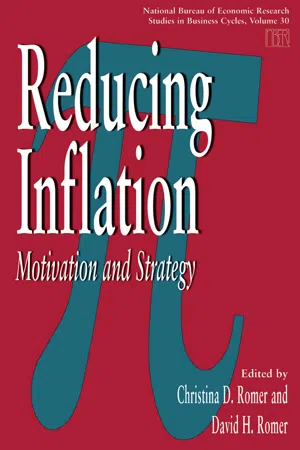 eBook - PDF
Reducing Inflation
Motivation and Strategy
- Christina D. Romer, David H. Romer, Christina D. Romer, David H. Romer(Authors)
- 2007(Publication Date)
- University of Chicago Press(Publisher)
But these reforms do not address the underlying problems that led to the policy failures: they do nothing to give specialists greater control over policy, or to raise those specialists’ average skill levels. As a result, although they reduce the likelihood of repetition of a particular failure of policy, they do nothing to reduce the likelihood of other failures. Suppose that evidence ap- pears that a major change in policy is warranted-evidence, for example, that there are substantial benefits of moderate deflation, or of trying to aggressively stabilize the economy while keeping average inflation low. The recent policy reforms do nothing that will cause such evidence to be reflected in the conduct 5 . Of course, policymakers in almost all countries have put more emphasis on low inflation over the past fifteen years. We focus on the clearest shifts in the goals of policy. 6. One could argue that the fact that these countries have been able to reduce inflation only through high unemployment indicates that their policies were not fully credible, and that binding low-inflation rules would produce a more favorable unemployment-inflation trade-off. But since all of these shifts in the announced goals of policy were followed by large declines in actual inflation, the idea that the policies-particularly the later ones-did not have substantial credibil- ity is implausible. Thus a more reasonable interpretation of the fact that the disinflations had sub- stantial output costs is that inflation has an important inertial component, and thus that any use of monetary policy to disinflate requires a period of high unemployment. 324 Christina D. Romer and David H. Romer of policy any more rapidly than was the evidence about the costs of inflation. Indeed, by emphasizing our current beliefs about desirable policy, the reforms could slow the response to evidence that changes in policy are warranted.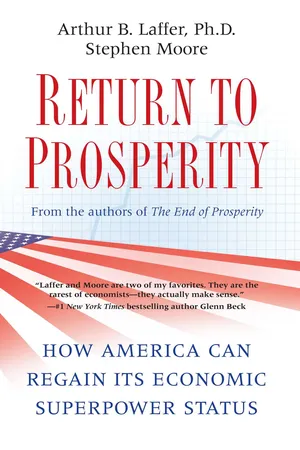 eBook - ePub
Return to Prosperity
How America Can Regain Its Economic Superpower Status
- Arthur B. Laffer, Stephen Moore(Authors)
- 2010(Publication Date)
- Threshold Editions(Publisher)
But all these conceptual issues notwithstanding, one can’t stick with a conceptual definition of money that has no empirical counterpart. Theories, to be meaningful, have to be testable. My preference in today’s economy is to use M1 as the appropriate counterpart to the theoretical concept of money. M1 includes currency in circulation, demand deposits and other checkable deposits, and traveler’s checks. Now back to an optimal monetary policy.The primary objective of monetary policy, as I wrote earlier, is to achieve price stability. But economists are often stuck on a mistaken notion of the cause of inflation. Therefore, my first step in designing such an optimal policy is to dispel some basic monetary policy myths, the most prevalent of which is the idea that growth causes inflation. Consider this recent statement from Fed chairman Ben Bernanke:Even after a recovery gets under way, the rate of growth of real economic activity is likely to remain below its longer-run potential for a while, implying that the current slack in resource utilization will increase further. We expect that the recovery will only gradually gain momentum and that economic slack will diminish slowly. In particular, businesses are likely to be cautious about hiring, and the unemployment rate is likely to rise for a time, even after economic growth resumes.... In this environment, we anticipate that inflation will remain low. The slack in resource utilization remains sizable, and, notwithstanding recent increases in the prices of oil and other commodities, cost pressures generally remain subdued. As a consequence, inflation is likely to move down some over the next year relative to its pace in 2008.3The quotation above illustrates that the governors of the Federal Reserve are firmly wedded to the notion that with strong growth at full resource utilization comes inflation. And as long as the economy performs well below full resource utilization we have little to fear from inflation. The enormous popularity of this view that growth causes inflation notwithstanding, nothing is further from the truth: Growth actually reduces
Index pages curate the most relevant extracts from our library of academic textbooks. They’ve been created using an in-house natural language model (NLM), each adding context and meaning to key research topics.

