Economics

Poverty Line
The poverty line is a threshold used to define the minimum level of income or consumption required to meet basic needs. Individuals or households with income or consumption levels below this threshold are considered to be living in poverty. It is a key measure used in assessing the extent of poverty within a population and in formulating anti-poverty policies.
Written by Perlego with AI-assistance
Related key terms
1 of 5
9 Key excerpts on "Poverty Line"
 eBook - PDF
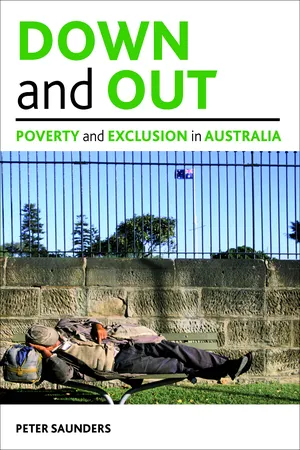
Down and out
Poverty and exclusion in Australia
- Saunders, Peter(Authors)
- 2011(Publication Date)
- Policy Press(Publisher)
This implies a more complex and far-reaching research agenda than one that focuses on comparing incomes with a Poverty Line. It involves adopting a perspective that focuses on the outcomes achieved, rather than on identifying and measuring the resources available, and drawing inferences from them. Such an approach gets the ordering of priorities right from the outset – poverty is bad 25 Income poverty because it has adverse consequences for those affected, for their families and for the communities in which they live. For children in particular, even a short spell in poverty can leave scars that extend well into adulthood (Brooks-Gunn and Duncan, 1997; Bradbury, 2003). Low income may be a factor that increases the risk of poverty, but the link is not inevitable and the existence of poverty must be established in other ways.This shift in emphasis provides the impetus to look beyond measurement to experiences and impacts. This in turn allows the focus to shift away from the statistics that describe poverty to its effects on people’s living conditions and opportunities. Poverty Line studies There are two ways of implementing the definitions of poverty proposed by the Irish Combat Poverty Agency and the European Commission. The first involves conducting Poverty Line studies that compare people’s actual income with an income benchmark (or Poverty Line) that is assumed to reflect how much is needed to support an acceptable standard of living.The second approach involves conducting living standard studies that examine people’s standard of living in order to assess whether or not it meets prevailing standards of acceptability. The rest of this chapter discusses Poverty Line studies, while the living standards approach forms the basis of the material presented in later chapters. eBook - ePub
Economic Inequality and Poverty
International Perspectives
- Lars Osberg(Author)
- 2017(Publication Date)
- Routledge(Publisher)
Garfinkel and Haveman (1977a, 1977b) have described a procedure to estimate the "earnings capacity" of a household, which indicator is closest to this concept of economic status. They point out some of the limitations of such an extended income concept. The underlying assumption of free choice between alternative uses of time may not always be valid, requiring modifications of the indicator in case of, for instance, illness or involuntary unemployment. They also mention the distinction between economic status and utility or welfare: the presence of children, for instance, may convey utility to the parents, which is not included in the measure of economic status. Another example of the difference between the two concepts economic status and utility may be found in the way year-to-year fluctuations in income may be treated. Variability in income may affect utility as a result of risk aversion (Mirer 1974), whereas this may not accurately be reflected by an index of permanent income. If, in spite of these objections, annual cash household income is chosen as the yardstick to be used, one should define a poverty threshold in terms of this income concept.Such a Poverty Line may be relative or absolute. An absolute Poverty Line does not depend on the income distribution in society, but is chosen to reflect some fixed level of resources needed to sustain life and health. The definition of an absolute Poverty Line may be based either on some general notion regarding the minimum amount of money needed to make ends meet, like the $1,500 and $3,000 Poverty Lines used shortly after the declaration of the war on poverty by President Johnson in 1964, or on the results of research on the income level needed to meet basic needs, like food, clothing, housing, etc.4A relative Poverty Line is directly derived from the income distribution in society, reflecting a definition of poverty as a state of relative, rather than absolute deprivation.Poverty is a dynamic, not a static concept. Man is not a Robinson Crusoe living on a desert island. He is a social animal entangled in a web of relationships at work and in family and community which exert complex and changing pressures to which he must respond, as much in his consumption of goods and services as in any other aspect of this behavior....Our general theory, then, should be that individuals and families whose resources over time fall seriously short of the resources commanded by the average individual or family in the community in which they live, whether that community is a local, national or international one, are in poverty. (Townsend 1962, pp. 219,225) No longer available |Learn more
Report on the World Social Situation 2010
Rethinking Poverty
- (Author)
- 2010(Publication Date)
- United Nations Publications(Publisher)
The absolute Poverty Lines have seldom been revised, even in countries where there has been significant economic growth; hence, there has been a steady fall in the share of average per capita income represented by the absolute Poverty Line, a trend evident in India and China, for instance. Instead of a revising of the norms upward, discussions of poverty in de- veloping countries have shown a tendency to move in the opposite direction, as reflected in debates over caloric and nutritional norms, with some arguing in favour of reducing the standard norms in accordance with which Poverty Lines were generally constructed. Absolute Poverty Lines were drawn based on only a fraction of the basal metabolic rate, which refers to the energy required by the human body to survive in a state of inactivity. Distinctions were made between the different types of poor below the Poverty Line, resulting in the notion that redistribution from the poor to the very poor, for instance, would do good, while the imperative of redistributing from the very rich to the poor was not given much consideration. The emphasis on the permanently or the chronically poor again reflects this tendency towards manipulation of the scale and nature of the phenomenon so as to render it manageable. What has finally emerged as the dominant instrument is the dollar-a-day money Poverty Line created by the World Bank for the purpose of measuring and monitoring poverty—but only in developing countries—within an inter- nationally comparable framework. There have been attempts, however, at reconceptualizing deprivation, for ex- ample, the capability approach (Sen, 1999). Capability deprivation goes beyond material wants to include lack of human capabilities, namely, skills and physical abilities, and self-respect in society. eBook - PDF
Measuring Global Poverty
Toward a Pro-Poor Approach
- S. Wisor(Author)
- 2011(Publication Date)
- Palgrave Macmillan(Publisher)
Income poverty is the most common measure of poverty for national governments in devel- oped countries. Many countries use relative income lines, identifying people as poor by reference to the distribution of income in a country. Relative Poverty Lines usually identify as poor either a) those households S. Wisor, Measuring Global Poverty © Scott Wisor 2012 60 Competing Conceptions and Measures of Poverty or individuals who fall below some percentage of the median income in a country (for example, below 50% of median income) or b) those families who fall into the bottom level of income earners (for example, the bottom quintile of income earners). Other countries, most notably the United States, use Poverty Lines that are absolute, measured against an independent inflation-adjusted standard rather than against other members of society. Consumption-expenditure poverty is the deprivation or lack of con- sumption below some minimum threshold. Because consumed goods and services, particularly in poor countries, are not all acquired through market mechanisms, consumption-expenditure is measured by combin- ing the value of purchased goods and services with the imputed value of goods and services that are consumed but not purchased. For example, a poor family may have one member working on a neighbor’s farm, for which he receives cash, while another raises small crops and livestock at home. The consumption from both activities is relevant to assessing the deprivation of this household. Therefore, consumption-expendi- ture approaches impute prices for goods not acquired through market mechanisms using shadow prices. Data on consumption-expenditure is frequently collected through household expenditure surveys, but is also one component of multitopic household surveys such as the Living Standards Measurement Survey. There is no single standardized way to calculate consumption-expenditure. eBook - PDF
Poverty in America
A Handbook
- John Iceland(Author)
- 2013(Publication Date)
- University of California Press(Publisher)
Furthermore, the his-tory of research on standard budgets exemplifies the widely held belief that there is some amount of money we need to survive, and that people making less than that amount face substantial economic hardship. The main disadvantage of absolute poverty measures is that as standards of living change, generally so do people’s perceptions of what poverty means. Fisher describes how Poverty Lines and minimum subsis-tence budgets before World War I were, in constant dollars, generally between 43 and 54 percent of Mollie Orshansky’s poverty threshold for 1963. A U.S. Works Progress Administration “emergency” budget for 1935 was equal to 65 percent of Orshansky’s poverty threshold, and Robert Lampman’s low-income line for 1957 was 88 percent of that threshold. 12 Economists describe this phenomenon as the income elasticity of the Poverty Line—the tendency of successive Poverty Lines to rise in real terms as the real income of the general population rises. Reviewing a number of studies on the issue, Fisher estimates that the amount of money people think it takes to “get along” rises between 0.6 and 26 | Methods of Measuring Poverty 1.0 percent for every 1.0 percent increase in the income of the general population. 13 He finds similar general patterns in Britain, Canada, and Australia. Thus, it could be argued that poverty measures are useful only to the extent that they tell us something meaningful about the con-ditions in a particular society. Poverty is by its nature at least somewhat relative; people are poor when others think of them as poor. 14 The official U.S. poverty measure has some advantages and disadvantages unrelated to the fact that it is an absolute poverty measure. On the positive side, it has achieved a level of consensus that no other poverty measure in the United States can claim. As an analytic tool, it has provided much useful information about trends in economic well-being. eBook - ePub
Urban Poverty in the Global South
Scale and Nature
- Diana Mitlin, David Satterthwaite(Authors)
- 2012(Publication Date)
- Routledge(Publisher)
et al . 2003), yet governments and international agencies still appear to struggle with appropriate adjustments when setting Poverty Lines. In an analysis of how 53 countries approach poverty assessments and Poverty Lines, it appears that 12 use Poverty Lines with no allowance made for spatial differences, 9 use a simple differentiation between urban and rural and 25 follow a more complex differentiation. There were seven countries for which the approach to taking account of cost of living differences could not be ascertained.The nations that apply the same Poverty Line throughout their national territory are basing their approach on an assumption that the income needed to avoid poverty is the same in all locations, from the largest and most prosperous cities to small rural settlements. Over the last 10 to 15 years, examples of this approach have become fewer – so it seems that increasing numbers of national governments are making some adjustment, typically an upward adjustment of the Poverty Line for ‘urban areas’. If the poverty definitions used in recent poverty assessments or poverty reduction strategy papers are compared to the definitions listed in Tabatabai with Fouad (1993), it appears that many more nations are making adjustments for regional variations than in the 1980s or early 1990s. A poverty assessment for Togo notes that,When applied to a country with considerable regional variation, overall Poverty Lines can become meaningless. In Togo, setting a single national Poverty Line that is applied to the population as a whole results in significant over-estimates of the number of poor households in rural communities compared to urban communities, particularly in the north. eBook - PDF
Pakistan
Moving the Economy Forward
- Rashid Amjad, Shahid Javed Burki(Authors)
- 2015(Publication Date)
- Cambridge University Press(Publisher)
In fact, the relationship between consumption levels and deprivation can be weak, as noted by Naveed and Islam (2010) in their analysis of selected districts in Punjab and KP. 1 According to their analysis, the official Poverty Line has missed a large share of those who would be considered among the multidimensional poor. Measuring poverty by the official Poverty Line, only around 18 per cent would be considered poor in these two provinces, but the share of households deprived in either five or six dimensions is 36 or 25 per cent, respectively. 1 The dimensions of deprivation (and cutoff) considered were education (less than primary completed, child not enrolled), health and nutrition (an underweight woman in household, one death under age 5), housing (mud house), electrification, safe drinking water, (no covered sources), sanitation (lack of proper toilet), assets (none), livelihood (household head unemployed or in elementary occupation), child status (not enrolled in school), cooking fuel (dirty fuel used: wood, dung, or coal), land ownership (< 2 acres agricultural or some nonagricultural land), and consumption (less than the official Poverty Line). Beyond the Poverty Line 337 Similarly, McLeod (2006) finds for a larger group of countries including Pakistan that calculations of poverty through household expenditure surveys do not correlate highly with capabilities; rather, national account estimates of consumption growth are better predictors of improvements in wellbeing. Kurosaki (2006) notes that one of the unattractive features of the FGT squared poverty gap measure is that it does not capture that income fluctuations have more serious welfare implications the greater the depth of poverty. eBook - PDF
- A. Khusro(Author)
- 1999(Publication Date)
- Palgrave Macmillan(Publisher)
This latter approach by the advanced countries, to save themselves from poverty, and the necessary conditions required to implement this method, are matters which require the resolution of many a thorny issue but which also have a vast potential for the conquest of the remaining poverty in the industrialized and highly developing economies. Poverty in Highly Developed Market Economies 111 12 Poverty in India INTRODUCTION As one-sixth of the world’s population lives in India and a large percent- age of it is poor, its uplift from poverty is of crucial importance to the world as well as to India, for, as the dictum has it, ‘Poverty anywhere is a danger to prosperity everywhere’. This chapter deals with absolute poverty and percentage poverty in India at different points of time. That is to say, it deals with the absolute number and proportion of people who, on different criteria of poverty, could be classified as poor and non-poor in given years. To be sure, it does not deal with relative poverty, that is, with how poor the poor are relative to the rich; it does not deal with income distribution. All Poverty Lines are arbitrary and change with time and space, not to mention individual ‘inner feelings’. As Peter Cutler (1984) has pointed out, Poverty can be defined as more than just a set of physical requirements for physical efficiency. It may also be defined with reference to the norms for society, and conceived as a set of “basic needs” rather than minimum needs. Basic needs would include those material comforts that give people an element of choice. Obviously, such material basic needs will depend upon the culture of the society in question and upon the general standard of living …. There are many layers of “perceived poverty” and they change for individuals and groups over time. No longer available |Learn more
- Geoffrey Walford, Eric Tucker, Madhu Viswanathan, Geoffrey Walford, Eric Tucker, Madhu Viswanathan(Authors)
- 2010(Publication Date)
- SAGE Publications Ltd(Publisher)
In exploring this issue, we hope to provide insight more generally into methods available to researchers who need to impose a binary threshold on a continuous variable of political or social signficance. There are three broad methods for fixing the poverty threshold: arbitrary determination; normative judgement and attitudinal assessment (Walker, 2005b). The first method is well illustrated by the aforementioned thresholds used by the European Commission and set at 40, 50 or 60 per cent of median household income. While of considerable and growing political significance, any substantive meaning is tenuous and historic. In their seminal work introducing the concept of relative poverty to Britain, Abel Smith and Townsend (1965) set poverty thresholds as multiples of the prevailing level of social assistance, itself long disconnected from its subsistence origins (Mansfield, 1986). The 100 per cent social assistance threshold provided a direct measure of policy effectiveness while the more generous 140 per cent threshold became target promoted by welfare rights activists. The latter was found to equate with approximately 50 per cent of mean earnings and this formulation was subse-quently taken up internationally, but later altered with the median substituted for the mean so that the poverty threshold THE PROBLEM WITH POVERTY: DEFINITION, MEASUREMENT AND INTERPRETATION 371 would be less affected to increases in inequality. Normative thresholds, such as the offi-cial US Poverty Line, typically involve appointed experts determining an appropri-ate level of adequacy. Two variants warrant mention. The first requires experts to define and cost a comprehensive budget that they judge is necessary for families of varying sizes to get by financially; this is the approach used by the German and Swedish governments and the Family Budget Unit in the UK. The second, employed in the US, involves costing a core budget and applying a multiplier to generate a poverty threshold.
Index pages curate the most relevant extracts from our library of academic textbooks. They’ve been created using an in-house natural language model (NLM), each adding context and meaning to key research topics.

