Geography

Energy Storage Technologies
Energy storage technologies refer to various methods and systems used to store energy for later use. These technologies include batteries, pumped hydro storage, compressed air energy storage, flywheels, and thermal energy storage. They play a crucial role in supporting the integration of renewable energy sources, managing peak demand, and enhancing grid stability and reliability.
Written by Perlego with AI-assistance
Related key terms
1 of 5
10 Key excerpts on "Energy Storage Technologies"
 eBook - ePub
Renewable Energy and Sustainability
Prospects in the Developing Economies
- Imran Khan(Author)
- 2022(Publication Date)
- Elsevier(Publisher)
Li et al., 2013 ). However, to sustainably scale up hybrid energy storage deployment in developing countries, associated Energy Storage Technologies, such as maximum power point tracking and battery management system controller need to operate in harsh climatic conditions and sustainably need to manage environmental issues such as reusing and recycling. In addition to that, to open a new market for energy storage systems in developing countries, various barriers need to be resolved beforehand, specifically, (i) the lack of social awareness and reluctance to adopt new technologies; (ii) the lack of knowledge of new technologies and their applications; and (iii) nonproactive regulatory policy and procurement practices that are incapable to pledge cost retrieval.Therefore, this chapter aims to review the available energy storage system options and their representative technologies, including pumped hydro storage (Deane et al., 2010 ), compressed air energy storage (Bullough et al., 2004 ), lead-acid batteries (Hu et al., 2017 ), redox flow batteries (Li et al., 2011 ), sensible and latent heat storage (Alva et al., 2018 ), fuel-cell (A.Kirubakaran and Nema, 2009 ), and their potential applications in the developing world. Thus, this chapter addresses the advantages and disadvantages of various Energy Storage Technologies, assesses their feasibility for sustainable off-grid electricity systems and their implementation based on future deployment scenarios.13.1.1 Role of Energy Storage Technologies in energy transitions
Static energy storage was booming at the beginning of the twenty century due to the subsequent expansion of the electricity transmission and distribution networks (Baker and Collinson, 1999 ). Generally, government policies and public support are crucial to receive benefit from these prospects (Ahuja and Tatsutani, 2009 eBook - PDF
Advances in Energy Storage
Latest Developments from R&D to the Market
- Andreas Hauer(Author)
- 2022(Publication Date)
- Wiley(Publisher)
In the new energy system, prosumers (producers and con-sumers) of renewables can begin operating with new bottom-up control logic. The gap between production and consumption of renewables requires energy management tech-nologies involving different kinds of storage and controls [10]. Energy storage systems will provide flexible solutions to facilitate the transition to a new energy system. 34.2 Energy Storage Technologies Energy can be stored to be retrieved at a later time, a different place and maybe at dif-ferent temperature levels. This is possible based on thermodynamic laws of energy transformations between different energy forms, such as thermal, mechanical, chemi-cal, and magnetic. Transformations can be grouped into Energy Storage Technologies as shown in Figure 34.1. This handbook covers all types of energy storages shown in this figure: Superconducting magnetic energy storage (SMES; see Part I), Pumped Hydro Storage (PHS; see Part II), Compressed Air Energy Storage (CAES; see Part III), Electrochemical (see Part I), Hydrogen and CO 2 (see Part IV), Thermal Energy Storage (TES; see Part V). Each of these energy storages can be used at different steps in the value chain of an energy system or jointly with another kind of storage. System power ratings vary between kWs to GWs and duration of storage may last for seconds or even several months. Figure 34.2 shows possible locations of different energy storages in the energy value chain [11]. SMES Flywheels Pumped Hydro CAES Electrochemical Hydrogen CO 2 Other fuels Magnetic Mechanical Chemical Thermal Sensible Latent Thermochemical Figure 34.1 Energy transformations and Energy Storage Technologies. 34 Energy Storage Can Stop Global Warming 766 34.3 Energy Storage Systems Energy storage presents energy savings and low carbon solutions in energy systems within a sector. ● Buildings – heating, cooling, power, water treatment for residential, service build-ings, and urban energy systems. eBook - ePub
Storage and Scarcity
New practices for food, energy and water
- Giorgio Osti(Author)
- 2016(Publication Date)
- Routledge(Publisher)
socio-technical network. Furthermore, there is a special linkage with the growth of renewable sources of energy: their intermittence requires complementary use of storage devices. Hydro power – the most widespread renewable – usually needs an upstream accumulation basin. Finally, energy storage entails more leeway for the final consumer, which modifies the relationship with grid energy suppliers used to being able to drive the demand side with ease. At first glance, energy storage is a way to sever the link with a network; in fact, off-grid storage systems allow self-sufficient provision of energy for a building, a block or an island. Indeed, the most interesting situations are where there is a mix of energy self-provision, storage and exchange with a grid, in similar ways to food and water storage.4.1 The issueTechnically, an ‘energy storage system [ESS] means commercially available technology that is capable of absorbing energy, storing it for a period of time, and thereafter dispatching the energy’ (Malashenko et al. 2012: 4). This definition has three analytical components: the temporal phases, storage of energy using mechanical, chemical or thermal processes, and availability on the market, which means public accessibility as long as there is money to purchase energy. The market rule also means the possibility of legal possession of storage devices by private subjects. This last point is important in terms of relationships: whereas energy provision and connection imply compliance with a wide array of public rules, energy storage is a freer activity that underlines the final user’s autonomy.There are numerous techniques for storing energy (see Table 4.1 ), although there is a hierarchy in terms of use and maturity. There are natural settings and artificial arrangements in which energy is present in potential form or is expressed in terms of movement/work; the storage of energy refers to the former. The processes for storing energy are usually classified according to how materials or combinations of them can be used to accumulate and then release energy. Hence there are mechanical methods able to discharge movement when necessary, thermal methods able to release heat or cold when needed, and chemical methods with which to isolate substances able to supply thermal or kinetic energy at the appropriate time. Electrical and electrochemical methods use electricity processes combined with certain qualities of materials to accumulate and then deliver electrical energy directly. Finally, biological methods eBook - ePub
- Shady S Refaat, Omar Ellabban, Sertac Bayhan, Haitham Abu-Rub, Frede Blaabjerg, Miroslav Begovic, Shady S. Refaat, Miroslav M. Begovic(Authors)
- 2021(Publication Date)
- Wiley-IEEE Press(Publisher)
IRENA estimates that pumped storage hydropower will rise from 169.557 to 325 GW in 2030. Over the same time period, the available battery electrical storage will rise up to 1.6 GW, [18]. Energy storage is an essential means for allowing an effective implementation of RES and revealing the advantages of SGs. This technology repeatedly proves its worth to grid operators worldwide, moreover, the fast‐decreasing costs and improving capabilities of ESSs technologies, along with growing industry expertise, will swiftly introduce new markets and cost‐effective applications for energy storage [19]. Figure 4.5 Global Grid‐Connected Energy Storage Capacity, by Technology, 2018. 4.5 Techno‐Economic Characteristics of Energy Storage Systems Different Energy Storage Technologies have different applications in the energy system. Capacity, cost, energy density, efficiency level, and technical and economic life are factors that determine in which context the technologies are the most suitable. A number of Energy Storage Technologies are now available in the market and each one of them offers a variety of performance parameters. The key performance parameters for evaluating Energy Storage Technologies are discussed in this section [ 20 – 28 ]. Figure 4.6 demonstrates an overview of Energy Storage Technologies with respect to their relative discharge times, power scale in the order of MW, and their respective efficiencies. Systems located at the right side of Figure 4.6 (shows a relatively high discharge time and energy storage capacity) demonstrate similarities to PHS and CAES, in terms of how perfect they are for product storage, arbitrage, rapid reserve, and area control‐frequency responsive reserve. Systems located on the left side of Figure 4.6 (high power to energy ratio and low discharge time requirements), for instance, flywheels, SCs, and SMES, are applicable for power quality‐reliability and transmission system stability implementations
- M. Kathiresh, A. Mahaboob Subahani, G. R. Kanagachidambaresan, M. Kathiresh, A. Mahaboob Subahani, G. R. Kanagachidambaresan(Authors)
- 2021(Publication Date)
- Wiley-Scrivener(Publisher)
6 Grid Energy Storage TechnologiesChandra Sekhar NalamatiElectrical Engineering Department, Motilal Nehru National Institute of Technology Allahabad, Prayagraj, IndiaAbstractEver increasing world energy consumption, limited global resources for tradition fossil fuel–based power supply networks, deregulated world energy markets, and global environmental concerns have been changed the global energy landscape from centralized power network to green renewable energy integrated distributed power network. Green clean renewable energy sources include solar photovoltaics, wind turbine based, combined heat and power (CHP), micro turbines, and fuel cells system. By 2040, the world will more rely on solar and wind supplies that are together expected to increase their share three times in the global energy. The complementary pattern regimes of the wind and solar PV sources coupled with the energy storage technology support makes them firm energy source. Energy Storage Technologies help in reducing power generation-consumption gap and also in improving grid power quality and stability. Most of the Energy Storage Technologies are deep-rooted. Also, the advances in material and processing technologies and bulk production result in reduction of cost. The specific energy storage technology has been chosen based on need of power density, energy density, and cost for different durations (short-term or long-term) and applications.The main objective of this chapter is to acquaint with overview on various grid electrical Energy Storage Technologies with their detailed characteristics comparison and their applications.Keywords: Grid energy storage, renewable power generation and smart grid6.1 Introduction
The traditional power supply system has been characterized by non-distributed power generation plants, one-way power flow direction from generation to the customers, fossil fuel–based generation, and passive nature. The world population and its growing energy demand generation, concerns regarding environmental pollution of fossil fuel–based power generations, and need of other power generation resources to fulfill the current energy demand have changed the conventional power system paradigm to a new structure. The possible ways to balance the generation and demand are installation of new power generation plants with corresponding transmission, distribution system, and using customer side demand response approaches and adding energy storage with green energy sources. However, first two solutions are not feasible due to economic issues and time-to-time dealing with customers. The viable solution for new power system structure allows the environmental friendly renewable energy resources integration along with the electrical energy storage system to help to fulfill the need of rising energy demand and growing environmental concerns. However, the environmental friendly renewable energy sources (RES) availability depends on their geographical location and also they are uncontrollable in nature. The electrical energy storage systems help RES to improve their efficient usage and make them better power sources [1–7]. Figure 6.1 eBook - PDF
Thermal Energy Storage
Systems and Applications
- Ibrahim Dinçer, Marc A. Rosen, Ibrahim Dincer(Authors)
- 2021(Publication Date)
- Wiley(Publisher)
Nonetheless, progress is being made on automotive batteries for storage of energy for moving vehicles. ES includes heat storage. In thermodynamic terms, such storages hold transferred heat before it is put to useful purposes. A conventional example is hot water storage in residences and industry. Such heat storage smooths out the delivery of hot water or steam, but it is not usually considered for periods longer than one day. Advanced new storage devices are often an integral part of other new technologies, and these sometimes can be made more feasible by innovations in storage. Advances in storage especially benefit wind and solar energy technologies. Also, new storage technologies may facilitate the development of electric-powered automobiles. A wide variety of ES techniques are under development. We shall discuss them by cate-gory, grouping together those techniques that store energy in the following forms: mechan-ical, thermal, chemical, electrochemical, biological, magnetic, and electromagnetic, as shown in Figure 2.1. Of course, ES devices can be classified and categorized in other ways. Here, each category considers the storage of one form of energy. Below, we examine briefly several possible storage options. 2.4.1 Mechanical Energy Storage Mechanical energy may be stored as the kinetic energy of linear or rotational motion, as the potential energy in an elevated object, as the compression or strain energy of an elastic mate-rial, or as the compression energy in a gas. It is difficult to store large quantities of energy in linear motion because one would have to chase after the storage medium continually. How-ever, it is quite simple to store rotational kinetic energy. In fact, the potter ’ s wheel, perhaps the first form of ES used by man, was developed several thousand years ago and is still being used. eBook - PDF
Energy Systems
A Project-Based Approach to Sustainability Thinking for Energy Conversion Systems
- Leon Liebenberg(Author)
- 2024(Publication Date)
- Wiley(Publisher)
• Thermal energy storage systems use thermal energy to store and release heat or to generate elec- tricity, e.g., sensible heat storage, latent heat storage, and thermochemical heat storage. • Electrochemical energy storage refers to the use of chemical batteries which store electricity in electrodes or electrolytes, e.g., aqueous flow batteries, metal-anode batteries, and hybrid flow batteries. • Electrostatic energy storage refers to the use of technology such as ultracapacitors (also called supercapacitors). Of particular importance to our contemporary energy challenges is long-duration energy storage (LDES), which excludes electrostatic energy storage systems as it stores energy only for relatively short periods. 591 Energy Systems: A Project-Based Approach to Sustainability Thinking for Energy Conversion Systems, First Edition. Leon Liebenberg. © 2024 John Wiley & Sons, Inc. Published 2024 by John Wiley & Sons, Inc. Companion website: www.wiley.com/go/liebenberg/energy_systems Figure 27.2 illustrates that the cost performance of long-duration energy storage is expected to improve sharply (by around 60% by 2040), boosting capacity deployment. 27.1 Mechanical Energy Storage 27.1.1 Pumped Hydro Storage Section 25.2 covers pumped hydro storage systems. These storage systems are the most widespread and account for 93% of large-scale energy storage in the United States and 10% of the total Energy Storage Technologies Mechanical - Pumped hydro storage - Flywheel - Falling weight - Compressed air energy storage - Liquified air (or CO 2 ) energy storage - Sensible heat storage - Latent heat storage - Thermochemical energy storage Thermal - Metal anode batteries (lead-acid; nickel-based, sodium-based; lithium-ion) - Flow batteries (redox; hybrid) Electrochemical - Ultracapacitors Electrostatic - Hydrogen (fuel cell) Chemical Figure 27.1 Salient types of long-duration electrical and heat storage systems.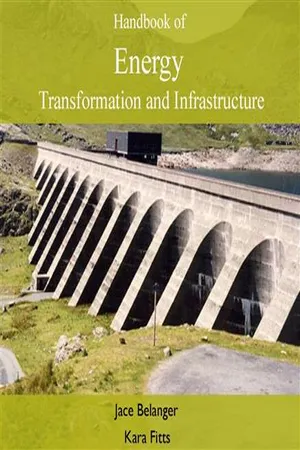 No longer available |Learn more
- (Author)
- 2014(Publication Date)
- Academic Studio(Publisher)
WT ____________________ WORLD TECHNOLOGIES ____________________ Chapter 9 Energy Storage The Llyn Stwlan upper reservoir and dam of the Ffestiniog Pumped Storage Scheme in north Wales. The lower power station has four water turbines which can generate 360 MW of electricity within 60 seconds, an example of artificial energy storage and conversion. Energy storage is accomplished by devices or physical media that store some form of energy to perform some useful operation at a later time. A device that stores energy is sometimes called an accumulator. All forms of energy are either potential energy (e.g. Chemical thermodynamics, gravitational, electrical energy, etc.) or kinetic energy (e.g. thermal energy). A wind-up clock stores potential energy (in this case mechanical, in the spring tension), a battery stores readily convertible chemical energy to operate a mobile phone, and a hydroelectric dam stores energy in a reservoir as gravitational potential energy. Ice storage tanks store ice (thermal energy) at night to meet peak demand for cooling. Fossil fuels such as coal WT ____________________ WORLD TECHNOLOGIES ____________________ and gasoline store ancient energy derived from sunlight by organisms that later died, became buried and over time were then converted into these fuels. Even food (which is made by the same process as fossil fuels) is a form of energy stored in chemical form. Early history Energy storage as a natural process is as old as the universe itself - the energy present at the initial formation of the universe has been stored in stars such as the Sun, and is now being used by humans directly (e.g. through solar heating), or indirectly (e.g. by growing crops or conversion into electricity in solar cells). As a purposeful activity, energy storage has existed since pre-history, though it was often not explicitly recognized as such. eBook - ePub
Understanding Electric Power Systems
An Overview of the Technology, the Marketplace, and Government Regulations
- Frank Delea, Jack Casazza(Authors)
- 2011(Publication Date)
- Wiley-IEEE Press(Publisher)
Additional studies and research necessary are underway to determine the role of the specific types of storage, since each type may have different characteristics, and the amount of storage that is feasible varies in various situations. This requires analysis of the duty cycle required for the storage as increasing amounts of wind and solar power are installed. Key factors in determining the usefulness of energy storage are the shape of the system load requirements and the characteristics of the other generating capacity available. In the future, the time and magnitude of system loads could change. For example, the large-scale development of plug-in hybrid electric vehicles and the electrification of more railroads and rapid transit systems will undoubtedly cause changes in the characteristics that may help improve the capacity value of renewable resources. Research priorities are being reviewed at this time and should be helpful in arriving at these answers.Benefits of Energy Storage to Transmission and DistributionEnergy storage applications offer potential benefits to the transmission and distribution system because of the ability of modern power electronics, and some electrochemistries, to change from full discharge to full charge, or vice versa, extremely rapidly. These characteristics enable energy storage to be considered as a means of improving transmission grid reliability or increasing effective transmission capacity. At the distribution level, energy storage can be used in substation applications to improve system power factors and economics and can also be used as a reliability enhancement tool and a way to defer capital expansion by accommodating peak load conditions.Energy storage can also be used to alleviate diurnal or other congestion patters and, in effect, store energy until the transmission system is capable of delivering the energy to the location where it is needed.Other technical applications of electric energy storage include:- Grid stabilization
- Grid frequency support
- Grid reserves
- Grid voltage support
- Black start
8.2 ENERGY STORAGE CONCEPTS AND TECHNOLOGIESThere are a large range of possible approaches and concepts for storing energy in electric utility systems. These are discussed in the following subsections.Mechanical SystemsHydropumped Storage
- Lucian Mihet-Popa(Author)
- 2016(Publication Date)
- IntechOpen(Publisher)
Section 3 Energy Storage Systems Technology Chapter 7 Energy Storage Systems for Energy Management of Renewables in Distributed Generation Systems Amjed Hina Fathima and Kaliannan Palanisamy Additional information is available at the end of the chapter http://dx.doi.org/10.5772/62766 Abstract Distributed generation (DG) systems are the key for implementation of micro/smart grids of today, and energy storages are becoming an integral part of such systems. Advance‐ ment in technology now ensures power storage and delivery from few seconds to days/ months. But an effective management of the distributed energy resources and its storage systems is essential to ensure efficient operation and long service life. This chapter presents the issues faced in integrating renewables in DG and the growing necessity of energy storages. Types of energy storage systems (ESSs) and their applications have also been detailed. A brief literature study on energy management of ESSs in distributed micro‐ grids has also been included. This is followed by a simple case study to illustrate the need and effect of management of ESSs in distributed systems. Keywords: energy storage, distributed generation, energy management, renewable, battery 1. Introduction Distributed generation (DG) and electricity market liberalization have been the key drivers for the evolution of the concept of small-scale energy sources. Growing concerns about climatic changes further encouraged the use of renewable energy sources to ensure energy conserva‐ tion and sustainability. But integrating renewable energy is turning out to be a real challenge for the smooth operation of DGs. Renewable power especially faces concern regarding power quality. Grid operators face immense issues in scheduling the generated power from the DGs, especially due to renewables and heat-driven energy sources which are difficult to be forecast‐ ed.
Index pages curate the most relevant extracts from our library of academic textbooks. They’ve been created using an in-house natural language model (NLM), each adding context and meaning to key research topics.

