Geography

Food Movements
Food movements refer to collective efforts by individuals, organizations, and communities to advocate for changes in the food system. These movements often focus on issues such as sustainable agriculture, food justice, and access to healthy, locally produced food. They aim to address social, economic, and environmental concerns related to food production, distribution, and consumption.
Written by Perlego with AI-assistance
Related key terms
1 of 5


7 Key excerpts on "Food Movements"
- Peter Andrée, Jill K. Clark, Charles Z. Levkoe, Kristen Lowitt, Peter Andrée, Jill K. Clark, Charles Z. Levkoe, Kristen Lowitt(Authors)
- 2019(Publication Date)
- Routledge(Publisher)
These movements seek to reinforce, build on, and scale-up innovative, place-based initiatives. These initiatives consider food as part of an interrelated system that includes not just its quality and health, but also the broader context of how food moves from the fields, water, and forests to our plates and beyond. These movements, and the initiatives they spearhead, are associated with a range of labels including fair trade, civic agriculture, food justice, food sovereignty, food democracy, agroecology, slow food, and community food security (Schiff & Levkoe, 2014; Friedland, 2010; Hendrickson & Heffernan, 2002). We refer to this collection of actors with related objectives as “Food Movements”, in the plural. This appellation recognizes their diversity while acknowledging overlapping and, at times, conflicting goals. 1 One reason to refer to Food Movements collectively is because, as social movements, they are increasingly connected. For example, Levkoe (2015) describes Canada’s food movement as a “network of networks”, highlighting the collaborations across sectors, scales, and places found in contemporary food activism. This connectivity relates to the growing tendency of food movement actors to adopt an integrated, system-wide perspective that seeks to address multiple elements of food systems, including how decisions are made, and by whom. Two examples from different scales illustrate the increasing connectivity, shared analysis, and shared goals of today’s Food Movements. In Canada, the People’s Food Policy (PFP) project launched a ground-breaking report in 2011 that synthesized food system-related concerns and aspirations from a variety of social movements across the country, including activists from farmers’ unions, Indigenous groups, international development organizations, urban food security organizations, labour unions, environmental groups, and others (Levkoe & Sheedy, 2018) eBook - PDF
More Than Just Food
Food Justice and Community Change
- Garrett Broad(Author)
- 2016(Publication Date)
- University of California Press(Publisher)
In the Global North, Food Movements have tended to be driven by political progressives, who work in pursuit of their own culturally derived visions of sustainability, equity, and justice. As geographer Rachel Slocum has described, the target of progressive activists in the United States has been “the conventional food system that privileges corporate agriculture, com-modity subsidies, trans-continental shipping and foods high in fats, salt and sugars” (522). 49 Recent decades have witnessed the creation of countless initiatives that respond to the varied economic, environmental, and nutrition-related risks of industrialized food in the United States. While some progressive food movement activists have concentrated their attention on advocating for alter-native food policy on national and international scales, a larger number have focused on the entrepreneurial development of alternative food projects and programs. Many of these projects explicitly advance the interests of local farmers, as farmers’ markets, community-supported agriculture arrange-ments, and “buy local” campaigns have become commonplace across much of the nation. Other projects remain attuned primarily to environmental concerns, as advocates champion agro-ecological production initiatives, work to improve soil fertility and plant biodiversity, promote organic foods, and provide alternatives to factory farming. A host of school and other locally focused projects that are committed to using nutrition education, gardening, and farm-to-table initiatives to tackle the challenges of chronic diet-related disease and obesity have been implemented. Gastronomically minded “food-ies,” represented by numerous local groups and national entities like Slow Food USA, have worked to highlight the pleasures of eating gourmet and culturally diverse cuisines.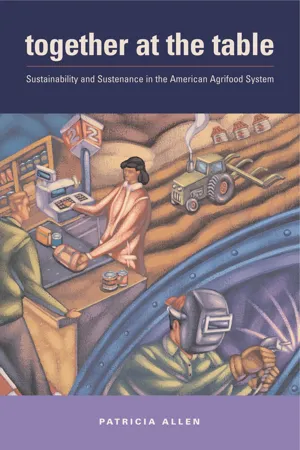 eBook - PDF
Together at the Table
Sustainability and Sustenance in the American Agrifood System
- Patricia Allen(Author)
- 2004(Publication Date)
- Penn State University Press(Publisher)
Throughout human history problems and resulting protests over them have been a feature of agrifood systems, with different issues and social movements rising to prominence at different times. Today people are increasingly aware of the fragile state of America’s agrifood system. Contemporary alternative agriFood Movements did not, of course, burst forth suddenly, like Athena from the head of Zeus. They have roots in or affinities with previous social movements such as the abolitionist, populist, environmental, antihunger, and food safety movements. While there are a number of contemporary alterna- tive agriFood Movements, this book focuses on two of the most comprehen- sive and prominent, the movements for sustainable agriculture and for community food security. These movements have developed both as legacies of and in reaction to traditional conceptualizations and practices in the American agrifood system. This chapter begins with a review of some of the issues and problems that have inspired contemporary alternative agriFood Movements and then highlights some of the agriFood Movements of the past. It then turns specifically to the concepts and development of the movements for sustainable agriculture and community food security. Issues in Sustenance and Sustainability Today’s prominent agrifood concerns are the issues of sustenance and sus- tainability. To better understand the discourses of sustenance and sustain- perspectives of alternative agriFood Movements issues and concepts 2 ability, I categorize these issues as centered around three main themes: food, environment, and livelihood and life chances. Food issues include those of food access and hunger, nutrition, and food safety. Environmental issues span a spectrum from depletion of natural resources such as soil and water to the deleterious effects of agrichemicals such as groundwater contami- nation by fertilizers and pest resistance to pesticides. eBook - ePub
- Mary Rawlinson, Caleb Ward, Mary Rawlinson, Caleb Ward(Authors)
- 2016(Publication Date)
- Routledge(Publisher)
35 Individual and Community Identity in Food Sovereignty The possibilities and pitfalls of translating a rural social movement Ian WerkheiserDOI: 10.4324/9781315745503-35Food sovereignty is a growing, vibrant discourse in food justice. International organizations such as La Vía Campesina connect hundreds of local food sovereignty groups all over the world; food sovereignty as a concept has been included in the Ecuadorian and Venezuelan constitutions; and it has gained increasing currency among academics. However, food sovereignty has its critics. Some argue that the movement, which addresses a wide variety of environmental and social ills, is too diverse to be sensibly described as being about food. Activists respond in part that due to certain characteristics of food, truly reforming the food system without addressing these wider issues is impossible. Further, certain characteristics of food allow it to act as a central boundary object, making it an ideal candidate to provide a frame with which to address a wide range of injustices. Food sovereignty, they argue, must push toward a radical re-imagining of society. Another objection arises in response to this view. Some worry that these connections between food and wider issues might only be natural ones to make for the rural subsistence food producers who started the food sovereignty movement; food sovereignty as it is pursued by activists may be less salient for other peoples in other places. If this is right, then food sovereignty may be an effective social movement in some contexts, but it would not be as promising a candidate for a global movement as it is purported to be.This chapter addresses these concerns by exploring what food sovereignty is, and how it uses an imaginary of food to ground and motivate the movement. It then looks at how and how well food sovereignty translates into contexts other than those in which the discourse first emerged. Ultimately, this chapter argues that food sovereignty can be a global social movement, but the successful translation of food sovereignty into the contexts of communities in wealthy countries will look far different from what is usually supposed by both advocates and critics of the movement. eBook - PDF
Upsetting Food
Three Eras of Food Protests in the United States
- Jeffrey Haydu(Author)
- 2021(Publication Date)
- Temple University Press(Publisher)
In developing this frame-work, I lean most heavily on sociologists who analyze social movements and on scholars, especially historians and humanistic social scientists, in food studies. The latter have published excellent accounts of particular cases, and they are especially sensitive to the cultural contexts that shape food politics, past and present. It has become easier to marry their work to the sociology of social movements because the latter field has come to include in its baili-wick challenges to cultural as well as to political authority, insurgency that relies more on informal networks than on formal organization, and protest that involves little public and collective action. 19 Social movement theory also offers useful categories of analysis. These highlight (for example) the framing of social problems, the identities underlying participation, and the tactics and forms of organization deployed by activists. This book’s case histories are built on this conceptual scaffolding. Last, social movement re-searchers offer some plausible causal suspects in their explanations for why movements’ framing or organization or tactics take the form they do. I do more than borrow freely from social movement scholarship and food studies. I also stake out different ground. My departures turn on re-thinking mobilization around food issues, past and present, as parts of one recurring movement. To begin with, this means organizing the narrative around a single genre of protest over long stretches of time. The analyses published by most social movement researchers focus on short cycles of 8 / Chapter 1 protest (e.g., the ’60s) and on mechanisms of contentious politics (diffusion, scale shift, brokerage) shared by movements of varied types. eBook - ePub
Learning, Food, and Sustainability
Sites for Resistance and Change
- Jennifer Sumner(Author)
- 2016(Publication Date)
- Palgrave Macmillan(Publisher)
© The Author(s) 2016Begin AbstractJennifer Sumner (ed.)Learning, Food, and Sustainability 10.1057/978-1-137-53904-5_77. Learning through Story as Political Praxis: The Role of Narratives in Community Food Work
End AbstractKim L. Niewolny 1 andPhil D’Adamo-Damery 1(1) Department of Agricultural, Leadership and Community Education, Virginia Tech, Blacksburg, VA, USAIntroduction
As Melissa Orlie (2009 ) has noted, the “madness” of the industrial food system is increasingly difficult to deny. The manner in which this dominant system operates has resulted in socioeconomic and ecological excesses that cannot be sustained. For over three decades, there has been a groundswell of academic, policy, and community-based concern and activism around this social, economic, and ecological unsustainability. The academic literature, for instance, is replete with works theorizing and advocating approaches for building alternative food systems that stem from a range of disciplinary perspectives and methodological orientations (e.g., Allen 1993 , 2004 , 2010 ; Alkon and Agyeman 2011 ; Constance et al. 2014 ; Feenstra 2002 ; Goodman et al. 2014 ; Hendrickson and Heffernan 2002 ; Hinrichs 2003 ; Lang 2009 ; Kirschenmann and Falk 2010 ). The grassroots sector has been particularly accredited with the emergence of alternative Food Movements and networks in the Global North and Global South (Allen 2004 ). These movements embrace such expressions as local and regional food systems (Clancy and Ruhf 2010 ), community food work (Slocum 2007 ), community food security (Hamm and Bellows 2003 ), and food sovereignty (Patel 2009 ). Although social purposes, locations, and approaches vary, the work of movement actors can be seen as a massive effort to challenge and transform the pervasive and hegemonic gender-race-class politics of food access and availability (Julier 2015 ). The ways in which food movement sectors variably perform as a response to the wake of globalizing forces fueled by neoliberal conditions and policies is also worthy of note (Guthman 2008 eBook - PDF
The Sociology of Food
Eating and the Place of Food in Society
- Jean-Pierre Poulain, Augusta Dörr(Authors)
- 2017(Publication Date)
- Bloomsbury Academic(Publisher)
To eat is to incorporate a territory: As for our food, it is composed of plant or animal products, all of which have initially occupied a place on the surface of the globe. Furthermore, the animals of this planet that feed man are themselves nourished by plants. . . . Almost all human foods should contain a modicum of the vegetation that covers the earth. The meals eaten by a human being therefore represent, either directly or indirectly, the “cuttings” from a more or less limited area of the earth’s carpet of vegetation, whether natural or cultivated. (Brunhes 1942, 19) In return, the foods favored by a human group, and the techniques it uses to procure or produce such foods, transform and shape the natural environment. “Every time human beings quench their thirst or feed their hunger, they effectively benefit from the surfaces they alter; and through the continual repetitions of their meals, they bring about continual geographical modifications” (Brunhes 1942, 19). Theories relating to man’s connection with nature are central to the study of human geography and developed within the discipline that was to become ecology. Three different approaches were formed. According to “determinist” theories, the forms and methods used to feed the human group depend on the environment and the constraints it imposes, such as the availability of resources, the influence of the seasons, the climate, and so on. Friedrich Razel, the German geographer and ethnographer who promoted a concept known THE SOCIOLOGY OF FOOD 202 as “anthropo-geography,” is a representative example of this perspective. 3 Jacques Barrau gives a very concise definition of this theoretical stance: “A given civilization is determined by the conditions of its physical and natural surroundings” (Barrau 1991). In this case, feeding the group is perceived in terms of a series of adaptations to the environment.
Index pages curate the most relevant extracts from our library of academic textbooks. They’ve been created using an in-house natural language model (NLM), each adding context and meaning to key research topics.
