Biological Sciences

Food Production
Food production refers to the process of growing, harvesting, and processing food for human consumption. It encompasses various activities such as farming, fishing, and livestock rearing, as well as food processing and distribution. The goal of food production is to ensure a sustainable and sufficient supply of nutritious food to meet the needs of the growing global population.
Written by Perlego with AI-assistance
Related key terms
1 of 5

3 Key excerpts on "Food Production"
 eBook - PDF
- Patrícia Alexandra Batista Branco(Author)
- 2019(Publication Date)
- Delve Publishing(Publisher)
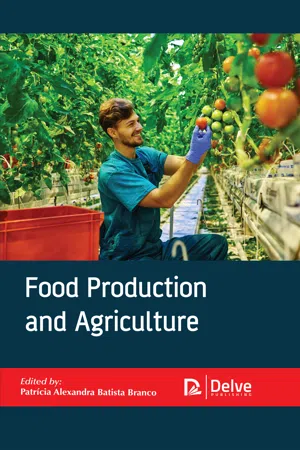
Physical and human background, land utilization Food Production and Agriculture 15 pattern and related constraints pertaining to transportation, marketing, and innovation diffusion among others dynamically affect the pace of agricultural Food Production. Increased agricultural food productivity depends on increased use of resources. These include land, fertilizer, water, and machinery among others. The output will always rise due to improved quality of factors of production, better knowledge, better infrastructure, and institutional arrangements (Duda, 2013). Agricultural inputs: Agricultural production embraces two processes: biological and mechanical. Inputs into biological process include seeds, fertilizers, water, the correct choice of methods, and timing among others; while the mechanical process includes: labor and machinery. It is the sound and rationalized combination of the two that facilitates agricultural productivity. Most farmers normally have problems in obtaining the right seed variety. The reason behind this is because of a shortage of planting seed from the contracted large scale farms. Due to this reason farmers have in some cases resorted to either planting varieties recommended for other areas, or storing seeds from the previous crop and planting them in the succeeding season. The latter practice is not advisable because undesirable traits may prevail on crops. Furthermore, in crop farming, using saved seeds will not have the same genetic traits the same genetic traits as the mother crop and yields will be much lower. Also, the fact that farmers wait until they are paid for their delivered produce so that they can purchase planting seeds is a problem. By the time they are paid, availability of planting seed cannot be ascertained as the more established large scale farmers have already bought large amounts of seed, late payments also result in late land preparation.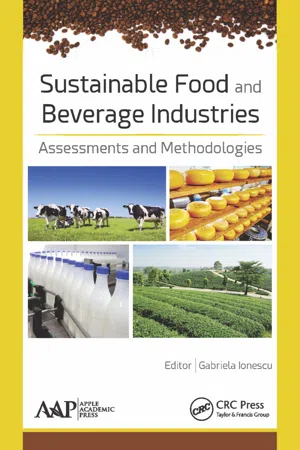 eBook - PDF
Sustainable Food and Beverage Industries
Assessments and Methodologies
- Gabriela Ionescu(Author)
- 2016(Publication Date)
- Apple Academic Press(Publisher)
Ultimately, Food Production and processing must be done with the objective of providing sustainable diets to all. The FAO [24] defines “sustainable diets as those diets with low environmental impacts which contribute to food and nutrition security and to healthy life for present and future generations. Such diets are protective and respectful of biodiver-sity and ecosystems, culturally acceptable, accessible, economically fair and affordable, nutritionally adequate, safe and healthy, while optimiz-ing natural and human resources.” Improving food systems for sustainable diets requires an interdisciplinary effort to address the problems of mal-nutrition, the degradation of ecosystems, and the erosion of biodiversity caused, at least in part, by modern day food systems and dietary patterns [12]. A concerted effort will thus be required to increase the diversity of foods produced in different regions of the world and to incentivize food Current Trends in Green Technologies in Food Production and Processing 37 processors to expand their use of diverse whole foods and food ingredients in food formulation and processing. Intensive research is needed to address these challenges. As reducing cost to consumers will be important, this raises the all-important question of who must bear the cost of R&D. As indicated by the OECD, “green growth policies which place a premium on environmental protection may constrain agricultural and fisheries output, reduce global food supply and entail adjustments in the use of human, financial and natural resources in the short-term, but implications in the longer-term should be mutually reinforcing in terms of environmental sustainability, economic growth and social well-being” [41]. 1.16 CONCLUSION The relationship between food, physical and environmental health, and the economy has become increasingly evident.
- Jennie S. Popp, Molly M. Jahn, Marty D. Matlock, Nathan P. Kemper(Authors)
- 2012(Publication Date)
- Cambridge University Press(Publisher)
4 Biotechnology in Crop Production Eric S. Sachs It took some 10,000 years to expand Food Production to the current level of about 5 billion tons per year . . . . By 2025, we will have to nearly double current production again. This cannot be done unless farmers across the world have access to current high-yielding crop-production methods as well as new biotechnological breakthroughs that can increase the yields, dependability, and nutritional quality of our basic food crops. Borlaug (2000, 21) Crop improvement methods developed during the twentieth century have been essen- tial for improving food quality and abundance. However, increasing productivity through intensification of agricultural systems has contributed to a degradation of natural resources and loss of biodiversity across agricultural landscapes (Evans 1998). Twenty-first-century agriculture has the potential to facilitate more sustain- able development as modern technologies are applied to help meet the food secu- rity needs of a growing population and as farmers implement improved agronomic practices with decreasing impacts on the environment. Breakthroughs in agricul- tural science, modern breeding, and agricultural biotechnology promise to provide farmers with an array of new solutions for reducing crop yield losses caused by weed competition, pest damage, disease, and abiotic stressors, such as drought, heat, and salinity (the role of biotechnology in controlling viral diseases in crops is explored in the next chapter). These breakthroughs also have increased yield gains by improving the efficiency of inputs, such as energy, fertilizer, and water. Plant sci- entists are leveraging traditional and modern approaches in tandem to increase crop yields, quality, and economic returns, while reducing the environmental consequences associated with the consumption of natural resources for producing agricultural commodities.
Index pages curate the most relevant extracts from our library of academic textbooks. They’ve been created using an in-house natural language model (NLM), each adding context and meaning to key research topics.

