Geography

Aquatic Food Production
Aquatic food production refers to the cultivation and harvesting of plants and animals in water environments such as oceans, rivers, and lakes. This includes activities like fish farming, aquaculture, and seaweed cultivation. Aquatic food production plays a significant role in providing food and livelihoods for people around the world, particularly in coastal and island communities.
Written by Perlego with AI-assistance
Related key terms
1 of 5

11 Key excerpts on "Aquatic Food Production"
 eBook - PDF
- Bruno Augusto Amato Borges(Author)
- 2019(Publication Date)
- Delve Publishing(Publisher)
Sustainable capture fisheries and aquaculture assume a basic job in food and food security and in accommodating the occupations of a huge number of individuals. Aquaculture represents a developing offer of the global Aquatic Food Production. Fish additionally gives indispensable amino acids that are frequently ailing in staple foods, for example, rice or cassava. It is thus crucial to the food security of a significant number of the world’s poor, particularly in coastal regions and in small island creating States. Introduction to Aquaculture 19 Through aquaculture, the people can deliver protein and supplement rich food consistently. Low-pay farmers who put resources into fish cultivating will almost certainly produce extra pay and food for their family and possibly for the market. To be effective, an aquaculture task requires much cautious arranging. The accessible regular resources, for example, water and land, but additionally the local temperature and different components impact the decision of the species to be cultivated and the production system to be utilized. Atmosphere does not constrain the size of aquaculture but rather it can decide the species that can be developed. Aquaculture is possible in a pond, a river, a lake, an estuary or in the sea. The accessibility of brilliant water is typically the most significant resource when settling on choices about where, what and how much fish to cultivate. The most widely recognized small-scale aquaculture systems are small lake fish cultivating and fish cultivating in lakes, rivers, dams and supplies. Environmental change may have different negative effects on aquaculture, including sea level and temperature rise, precipitation vacillations, and characteristic perils, for example, floods and dry season (FAO, 2009). Sea level ascent, for instance, may undermine inland freshwater aquaculture by making saltwater and bitter water move further upstream and into rivers. eBook - PDF
Fishery Products
Quality and Safety
- Anjanette S. Tadena(Author)
- 2019(Publication Date)
- Delve Publishing(Publisher)
Specific methods involve integrated multi-trophic aquaculture and aqua phonics, both of which collate aquatic plant farming and fish farming. Aquaculture is defined as farming of aquatic organisms such as crustaceans, mollusks, aquatic plants, and fishes. Aquaculture is also known as aquafarming, which is the farming of various aquatic organisms like aquatic plants, mollusks, crustaceans, and fish. This involves cultivation of saltwater populations and freshwater populations under stagnant conditions and events and may be opposed to the commercial fishing for trading, which involves harvesting of wild fishes. Introduction to Fisheries and Aquaculture 13 Fish is known to be an excellent source and basis of animal protein as well as a broad range of required nutrients. It significantly contributes to the security of the food. In the year 2008, many humans had an intake of nearly 80% of the fish production in the world that is almost 17.1-kilo grams per individual. The researchers have assumed that this consumption will increase to almost 20-kilo grams every year by 2030. The worldwide supply of fish products and fish reached almost 142.3 million tons of fish products and fish in the year 2008 that included a record of 52.5 million tons from the gradually emerging sector of aquaculture and a record of 10 million tons from the inland waters. If the aggregate production is to maintain the pace with an increasing global population. If the capture fisheries may remain stagnant, the subsequent growth can evolve from aquaculture. Indirectly or directly, aquaculture and fisheries play a significant role in the living standard of millions of individuals all over the world, starting from the inland fishers at small scale who harvest the fishes from river and lakes to the women and men who work in huge processing plants.
- Gupta, V K(Authors)
- 2021(Publication Date)
- Daya Publishing House(Publisher)
The aquaculture production has been steadily increasing over the last decade. Aquaculture production was 51.7 million tonnes in 2006. It continues to grow more rapidly than all other animal food producing sectors, with a average global growth rate of 8.8 per cent per year since 1970, compared to 2.8 per cent for terrestrial farmed meat production systems. If growth in aquaculture can be sustained, it is likely to fulfil the increasing demand for aquatic food supplies by supplying more than This ebook is exclusively for this university only. Cannot be resold/distributed. 50 per cent of the total aquatic food consumption by 2015. (FAO, 2008) Marine fisheries constitute a source of valuable food and employment. Marine fish production comes from the coastal resources and progressively, increased by nearly six times, during the last 55 years. Technological progress in boat and gear design, use of new hull material, such as, steel engine and equipment, preservation and processing, acoustic fish detective and other navigational aids including the increasing use of hand help GPS in recent years has facilitated access to the whole range of marine fishery resource in the exclusive economic zone (EEZ). But, after decades of growth, the marine fishery in the country has shown the sign of stagnation, due to overfishing in coastal waters, destructive fishing practices and pollution (Yadava, 2006). Declination in marine fisheries, shifts the fish production, increasing towards inland fisheries, which constitutes about 8 per cent of the world’s total fish production. Such growth has been possible due to impressive developments in aquaculture, such as, genetic improvement, induced breeding techniques, scientific management and commercial farming (Ayyappan, 2006). The Indian Scenario Indian fisheries has diverse resources both in aquatic habitats ranging from glaciers lakes to deep seas and a rich biodiversity of fish and shellfish of more than 10 per cent of global biodiversity. No longer available |Learn more
Fish for Life
Interactive Governance for Fisheries
- Jan Kooiman, Svein Jentoft, Roger Pullin, Maarten Bavinck, Jan Kooiman, Svein Jentoft, Roger Pullin, Maarten Bavinck(Authors)
- 2005(Publication Date)
- Amsterdam University Press(Publisher)
The diversity and complexity of aquaculture inevitably make it a very dynamic sector. Its dy-namics include its rapid growth, as a new frontier for food production in many countries, and its necessary coexistence with other longer established sectors. The intersectoral relationships of aquaculture with agriculture, cap-ture fisheries and other sectors are often areas of conflict and it is a major future challenge for aquaculture and those other sectors to resolve their conflicts and to pursue co-operation, especially in the sharing of land, water, and other natural resources (Sumaila 1999). Aquaculture has great scope for integration with other food production sectors. Fishponds in mixed farming systems and aquaculture integrated with wastewater reuse also have long histories and huge potential (e.g., Edwards 2000; FAO 2000a; Edwards et al. 2002). A governance approach to aquaculture is just beginning (Van der Schans 1999). 93 Global Aquaculture Production and Trade From 1984 to 1998, the contributions of developing countries to global aquaculture production increased from about 73% to 90%; the remainder came from developed countries. In 1998, about 82% of total aquaculture production came from Low-Income Food-Deficit Countries (LIFDCs), and the total production from all developing countries was 35.5 million metric tonnes (mt) Over the same period, aquaculture production in LIFDCs grew five times faster than that of developing countries in general (Tacon 2001). Asia contributes most of global aquaculture production. In 1998, about 90% of total global production by weight was produced in the People ’ s Re-public of China (PRC), by far the leading producer, accounting for nearly 70% of total global production. PRC aquaculture data are often considered separately from those of the rest of the world (e.g., New 2003; Tacon 2003).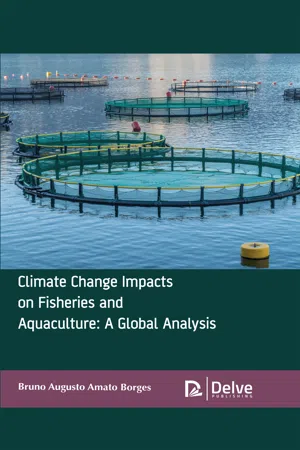 eBook - PDF
Climate Change Impacts on Fisheries and Aquaculture
A Global Analysis
- Bruno Augusto Amato Borges(Author)
- 2019(Publication Date)
- Delve Publishing(Publisher)
Present production of global fisheries of around 160 million tons is increasing due to increase in aquaculture production. A great number of effective threats to aquaculture as well as capture fisheries are recognized. Due to uncertainty of the global aquatic total primary production, it is difficult to predict the future production of fisheries. Recent modifications in the production and distribution of different species of fish can be recognized with high confidence to the regional variability of climate, such as the El Niño–Southern Oscillation. In future, the production may increase in certain regions of high-latitude, reason being decreased ice cover and global warming. On the other hand, distinct processes govern the dynamics in the region of low latitude. The production may be reduced as a consequence of reduced vertical mixing of the water column and, thus, reduced recycling of nutrients. There are potential interactions between the effects if climate and effects of fishing as declines the size, age along with the biodiversity of marine ecosystems and the geographic diversity of the populations, making both of them very sensitive to certain stresses such as climate change. Inland fisheries are further exposed by the modifications in the water management and process of precipitation. The intensity and frequency of extreme climatic events is probable to have great impact on the future production of fisheries in marine and inland systems. Pisciculture or fish farming is an important area on aquaculture. In general, fish farming especially includes growing fish for human feed or restocking of natural areas. Climate Change Impacts on Fisheries and Aquaculture: A Global Analysis 28 2.2. FISH PRODUCTION AND MANAGEMENT 2.2.1. Practical Handling and Care of Fish This is the first step in the process of fish production by using sources of aquaculture, as there cannot be yield without recruitment. eBook - PDF
Food From The Sea
The Economics And Politics Of Ocean Fisheries
- Frederick W. Bell(Author)
- 2019(Publication Date)
- Routledge(Publisher)
7. Aquaculture: A Food Panacea? Aquaculture, the farming and husbandry of freshwater and marine organisms, is a very old and highly productive management practice. The culturing of oysters, to take one prominent example, has been known at least since Roman times, and the culturing of Chinese carp may have a history at least as long as that. The his-tory of aquaculture shows that it originated and developed under different social and economic conditions in various parts of the world. The greatest concentration of aquaculture is in Asia and the Far East, particularly China. Aquaculture currently provides an estimated 10 percent of the world's water-derived protein-a har-vest of between 5 and 6 million metric tons valued in excess of $2.5 billion (Caton, Moss, and Urano 1974). As noted in chapter 4 the F AO estimates that the demand for food fish (excluding industrial demands) will increase to over 107 million metric tons; however, the overexploitation of traditional wild stock species (chapter 3) has created an interest in aquaculture as a source of increased supply of fish protein in this food-starved world. This is especially true for a number of high-priced species, the stocks of which appear to be substantially depleted by overfishing. The heavy concentration of aquaculture in certain areas of the world, principally the Indo-Pacific region, suggests that the practice might be more greatly emphasized in other areas of the world than is now the case. The fact that aquaculture output has approximately doubled over the last five years and the fact that some countries already rely upon aquaculture for up to 50 percent or more of their total fisheries production-both portend an im-portant future for aquaculture. The reasons for the recent and projected rapid growth of aqua-275 eBook - PDF
- Biswas, K P(Authors)
- 2021(Publication Date)
- Daya Publishing House(Publisher)
Awareness of, and sensitivity to environmental and welfare issues is increasing, particularly in developed countries where purchase decisions can be influenced by adverse publicity or a lack of information. As live stock farmers aquaculture, producers are increasingly required to act in a line with standards expected of the live stock industry. At a national level, safety and quality management systems should be put into place to ensure production distribution and sale of aquaculture products are safe and of high quality. Such measures require competent professional associations that work in close association with the legal authority in order to be successful. Integration with Agriculture Various types of aquaculture form an important component with agriculture and farming system development. These can contribute to the alleviation of food in security, malnutrition and poverty through the provision of food of high nutritional value, income and employment generation, decreased risk of monoculture production failure, improved access to water, enhanced aquatic resource management and increased farm sustainability. Global aquaculture is now the fastest growing food-production sub sector in many countries. The production of all cultured aquatic organisms reached almost 43 million metric tonnes (mmt) in 1999 and it is expected that this trend will continue despite several constraints. Starting in 70’s there was a substantial assistance for developing the aquaculture sector in Latin America, Asia, and Africa. The tendency of this development, initiatives was to focus on large infrastructure development technical packages and technical training without paying sufficient attention to the role of these, often new production systems of the livelihood or farming system of the intended beneficiaries. All too often, the result was lack of adoption by one of the intended target groups, the rural poor. As a This ebook is exclusively for this university only. eBook - PDF
- Chaudhuri, Hiralal(Authors)
- 2021(Publication Date)
- Daya Publishing House(Publisher)
Chapter 2 Modern Aquaculture: Professor’s Vision and Modern Concept It’s Contribution to Human Nutrition Aquaculture plays a very important role in food production. World population is increasing at an exponential rate and consequently the demand for food is also increasing. The green revolution in Agriculture has contributed substantially to solve the food problems, but the nutritional standard of the vast majority of people of the developing countries of the world is still much below the average level. There is acute shortage of animal protein in the diet of those poverty-stricken people. The situation would become worse as according to the prediction of U.N. demographers (1986), the world population is expected to rise from 4 billions to 6 billions by the end of the century, which again would exceed 8 billions by 2025 A.D. To feed these additional mouths there would be hardly any arable land left for the expansion of agricultural areas. Hence, in the future, mankind would have to depend more and more on the oceans for food, thus shifting their reliance on the main source of food from AGRICULTURE to AQUACULTURE*. Fish is highly nutritious food and a very important and cheap source of high quality protein. Over 60 per cent people of the developing countries of the world derive 40 per cent of even as high as 70-75 per cent of animal protein intake in their diet from fish. Till the middle of the present century, oceans and seas were the main source of fish supply for human consumption. The belief that the resources of seas are inexhaustible has been proved to be a This ebook is exclusively for this university only. Cannot be resold/distributed. myth as the marine fish catch instead of increasing with the increasing demands of the increased population, dropped down. eBook - PDF
- Julian Cribb(Author)
- 2019(Publication Date)
- Cambridge University Press(Publisher)
It must not pollute surrounding water. These are large technical challenges – but far from insoluble. One answer, for instance, is deepwater aquaculture – carried out in large sunken pens sev- eral miles offshore, thereby avoiding the problems of water fouling with fish waste and parasites, which have plagued coastal and estuarine fish farms, and disruption by bad weather. This type of farming – though costlier – has the support of environmentalists because it dissipates aquaculture’s ecological impact into ocean currents while at the same time helping to protect wild fish stocks by offering an alternative supply of fresh, clean seafood. 23 Furthermore, the WEF argues, aquaculture is ‘pro-poor’, offering a better living to people in poor and malnourished 266 T H E FU T U R E OF F O O D countries along with more protein in the diet. In Bangladesh, for example, the amount of farmed fish sold grew from 80,000 tonnes to over 2 million tonnes in a decade. A similar transform- ation is taking place in other Asian countries and in Africa. 24 The Urban Food Revolution The UN Food and Agriculture Organisation argues that urban food production will be an essential part of the green city of the future, helping to ensure ‘food security, decent work and income, a clean environment and good governance for all citi- zens’. 25 Several hundred million ‘urban farmers’ are already hard at work growing food in Africa and South America, it says, and more than 20 countries have sought help to train future producers. As this and the examples described in Chapter 8 show, urban food production is advancing in a wide range of styles and technologies, from the apartment balcony to the corporate vertical farm, and from high-tech to low. Urban farms : the simplest urban farms use traditional soil culture, with crops grown in beds, planter boxes and pots on spare land, in allotments or on the roofs and sides of buildings.
- Craig S. Tucker, John A. Hargreaves, Craig S. Tucker, John A. Hargreaves(Authors)
- 2009(Publication Date)
- Wiley-Blackwell(Publisher)
Population growth, rising per capita incomes, urbanization, and increased appreciation of the role of seafood in human health will continue to increase the global demand for seafood. Capture fisheries must provide a large part of the world’s supply of fish and shellfish, but dramatic changes are needed to assure that marine resources are managed sustainably. Oceans must be protected from environmental degradation caused by pollu-tion and global climate change, and marine fisheries must be managed intelligently to restore and maintain the oceans’ biodiversity and ecological integrity. Current “best-case” scenarios for fisheries management indicate, however, that it will not be possible to increase marine fisheries landings past levels obtained in the 1980s (Pauly et al. 2003). Aquaculture must therefore continue to expand to meet any increase in demand for fishery products (FAO 2004a). The Changing Face of Aquaculture Aquaculture evolved thousand of years ago as an activity with origins and goals similar to other animal husbandry activities. That is, methods were developed to provide animal protein when local human population growth or overexploitation of accessible wild popu-lations made it difficult to obtain food by hunting—or fishing, in the context of aquacul-ture. Simple but elegant fish culture systems were developed in Asia that in many ways resembled natural aquatic systems in their fundamental ecosystem dynamics. For thou-sands of years aquaculture was practiced as a relatively low-input activity and was seen as a beneficial or, at worst, benign endeavor that provided high-quality animal protein for families or local communities. Much of current aquaculture remains rooted in these ancient practices. eBook - PDF
- Johan Rockström, Malin Falkenmark, Carl Folke, Mats Lannerstad, Jennie Barron, Elin Enfors, Line Gordon, Jens Heinke, Holger Hoff, Claudia Pahl-Wostl(Authors)
- 2014(Publication Date)
- Cambridge University Press(Publisher)
According to FAO estimates, agricultural produc- tion will have to increase by 70% by 2050 to cope with the projected increase in the world population as well as projected rises in average per capita food consump- tion. Nearly 100% of this increase is expected to take place in developing countries. Compared with pro- duction in 2005–07, this projection would mean an additional one billion tonnes of cereals and 200 mil- lion tonnes of meat being produced annually by 2050 (Bruinsma, 2009). Other estimates indicate an increase in food demand of 40–100% (Foley et al., 2011; Tilman et al., 2011). Figure 5.2 a and b show that the current preva- lence of hunger and the future needs of the expected 2.3 billion extra people are correlated to the same countries, many of which are in the least developed countries group (FAO, 2013b). In many of these countries, agricultural production occurs in the often water-scarce savannah and steppe zones. The fact that water is a limiting factor in many of these countries highlights the importance of understanding the links between water availability, water manage- ment and food production. The water used for the cultivation of food crops, feed crops and fodder is thus also directly linked to nutrition. The availability and accessibility of water for agricultural use are therefore also directly linked to food security, which according to the 1996 WFS is ‘a situation that exists when all people, at all times, have physical, social and economic access to sufficient, safe and nutritious food that meets their dietary needs and food preferences for an active and healthy life’. The concept of food security builds on three dimensions: availability, access and utilisation. While food avail- ability refers to the national or international level of supply, including food production, stock levels and net trade, access refers to meeting demand, i.e.
Index pages curate the most relevant extracts from our library of academic textbooks. They’ve been created using an in-house natural language model (NLM), each adding context and meaning to key research topics.
