Geography

Internally Displaced Persons
Internally Displaced Persons (IDPs) are individuals who have been forced to flee their homes due to conflict, violence, natural disasters, or human rights violations, but have not crossed an international border. They remain within their own country and are often in need of humanitarian assistance and protection. IDPs face challenges in accessing basic services and rebuilding their lives.
Written by Perlego with AI-assistance
Related key terms
1 of 5

10 Key excerpts on "Internally Displaced Persons"
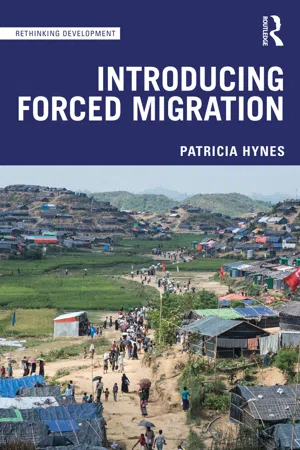 eBook - ePub
- Patricia Hynes(Author)
- 2021(Publication Date)
- Routledge(Publisher)
3 Who is an ‘internally displaced person’?Introduction
This chapter looks at another form of displacement – within countries of origin – for people who are displaced due to armed conflict, generalized violence, violations of human rights natural or human-made disasters. Unlike refugees, Internally Displaced Persons (IDPs) do not have an international legal definition to confer special legal status. Instead, non-binding guidance is available – the 1998 Guiding Principles on Internal Displacement – and this is discussed later, as is its integration into the 2006 Great Lakes IDP Protocol and the 2009 African Convention on Protection and Assistance for Internally Displaced Persons (commonly referred to as the Kampala Convention).This chapter therefore considers the 50.8 million Internally Displaced Persons (IDPs) in the world as at the end of 2019 who are considered to be a category of concern for UNHCR. Causes of internal displacement, where IDPs are located in the world and global trends are outlined. Thereafter, examples of IDP situations are provided with elaboration of the needs and risks inherent in the experience of being internally displaced. Again, short summaries of the work of key thinkers, maps and key concepts are provided along with case studies and points for discussion.Throughout, readers should be alert to protection of IDPs being primarily about national protection mechanisms. In other words, the domestic legislation of a State should mean that IDPs do not lose any rights because they have been displaced (Kalin, 2014:166). IDPs should enjoy all the relevant guarantees of human rights applicable to the wider population. However, in many cases, IDPs may be discriminated against and treated as second-class citizens in their own country (Ibid.). Readers should bear in mind limitations and challenges inherent in providing protection within a State – a sovereign State – without a legal or institutional base for the international community to provide protection or assistance. A short timeline of selected legislation including IDPs is provided in Figure 3.1 eBook - PDF
The Future Faces of War
Population and National Security
- Jennifer Dabbs Sciubba(Author)
- 2010(Publication Date)
- Praeger(Publisher)
Migration and Internally Displaced Persons 89 In addition to refugees, which are designated by the crossing of international borders, Internally Displaced Persons can also change the composition of a sub- national population, and this also has implications for stability. James Fearon and David Laitin have identified what they term “sons of the soil” conflicts between groups that consider themselves “indigenous” and incoming domestic migrants from other ethnic regions. Though their theory is not based on the issue of IDPs, it is relevant to this situation as well. Migration changes the balance of power in a region and leads to competition over scarce resources such as land and jobs. 27 Conflict in Iraq has created huge numbers of IDPs (see Table 5.1). As a result of the scale, in 2007, individual governorates within Iraq began to restrict IDP entry because of concerns that IDPs were creating conflict locally or were collab- orating with insurgents, and because of the strain that the increasing numbers were placing on resources. Even as the security situation improves, many IDPs are unable to return home because of the expense. Many have been unable to file a request to transfer their food ration cards, which also provide fuel. 28 In addition to creating international and civil conflict, the presence of ref- ugees and IDPs can also exacerbate structural and regime insecurity in other ways. One way is through lack of protection for migrants themselves, or their own structural insecurity. In September 2007, there were a total of 4.5 million internally and externally displaced Iraqis, and most were in Syria (1.2–1.4 million) and Jordan (450,000–500,000). 29 Although the outside world would consider Iraqis displaced into neighboring countries as refugees, in their host countries, like Jordan and Syria, they have not been labeled as such, in part for fear that doing so will announce the permanency of their plight and discour- age the possibility of return. eBook - PDF
Forced Displacement
Why Rights Matter
- K. Grabska, L. Mehta, K. Grabska, L. Mehta(Authors)
- 2008(Publication Date)
- Palgrave Macmillan(Publisher)
It is also a question of power differentials and labelling. By way of closing this discussion, let me emphasize two points. First, the question of rights must not be looked at in the abstract. Rights can only be Rights and Decisions to Return 147 thought of and realized in a given context. Hence, the empirical data on IDPs are important. Second, while Sudan’s record on violating rights is impressive, it is precisely for this reason that a rights-based approach is both appropriate and necessary. IDPs in Khartoum: characteristics and main features A precise figure for the total number of IDPs in Sudan does not exist. Apart from the fact that the numbers are constantly fluctuating, there are differ- ences of opinion as to who should be included, and when a person has become or ceases to be internally displaced. Some scholars (Shami 1990) question the very usefulness of operating with a definition, arguing for instance that forced migration, whether cross-border or internal, should be dealt with comprehensively. However, for analytical and practical purposes, it is valuable to have a common perception. The UN defines IDPs as: persons or groups of persons who have been forced to flee or leave their homes or places of habitual residence, in particular, as a result of or in order to avoid the effects of armed conflict, situations of generalized violence, violations of human rights or natural or human-made disasters, and who have not crossed an internationally recognized state border. (Hampton 1998: xv) A lack of consensus over the exact number of IDPs in Sudan affects the way their conditions are understood. And since their conditions are not properly understood, the realization of their rights is also affected. Different reports suggest that until 2002, Sudan had a total of four million IDPs, constituting the highest number of Internally Displaced Persons in the world. eBook - PDF
Pakistan's Quagmire
Security, Strategy, and the Future of the Islamic-nuclear Nation
- Usama Butt, N. Elahi, Usama Butt, N. Elahi(Authors)
- 2010(Publication Date)
- Continuum(Publisher)
It will be refreshing to remember the realist school formulation that politics is indeed “a struggle for power” and it is a continuing contest domestically and internationally. This struggle is directed to achieve “what, when and how” as Harold Lasswell, a noted American Political Scientist asserts. 6 The Term “Internally Displaced Persons” The term “IDPs,” when relating to Pakistan, is understood as a reference to the people driven out of their homes as fallout of the military operation in Swat, Pakistan. Is the term just jargon used by UN bureaucrats along with national bureaucrats for their mutual convenience to operate a project or has it a basis in some international treaty or law? It is worth noting that there is no interna-tional treaty that applies specifically to IDPs. Recognizing this gap, the then UN Secretary General, Boutros Boutros-Ghali, appointed Francis Deng in 1992 as his representative for IDPs. In 1994, at the request of the UN General Assembly, Deng set out to examine and bring together existing international 202 PAKISTAN’S QUAGMIRE laws relating to the protection of the IDPs. 7 This resulting document spells out the responsibilities of status before, during and after displacement. They have been endorsed by the UN General Assembly, the African Commission on Human and Peoples” Rights (ACHPR) and by Sudan, the Democratic Republic of Congo and Uganda. Unfortunately for the IDPs, the “guiding principles” are non-binding. Bahame Tom Nyanduga, Special Rapporteur on Refugees, Asylum Seekers and Internally Displaced Persons in Africa for the ACHPR has stated, “the absence of a binding international legal regime on internal displacement is a grave lacuna in international law.” 8 In September 2004, the then Secretary General of the UN demonstrated the continuing concern of his offi ce by appointing Walter Lain as his representative on the human rights of Internally Displaced Persons. eBook - PDF
Rethinking Internal Displacement
Geo-political Games, Fragile States and the Relief Industry
- Frederick Laker(Author)
- 2021(Publication Date)
- Berghahn Books(Publisher)
44 The stabilising principle, as already noted, was the 1951 Convention and the strong analogies of displacement and movement it produced, which justified the global shift to in-country protection. IDPs now came to assume a legal category entitling them to rights and privileges of refugees. This made them visible and worked to create a strategic distinction between refugees and cit-izens, so as to create the necessary justifications for policies and operations that contained refugees. Indeed, many legal scholars would often ask broad questions that automatically railroaded responses into the creation of similar refugee protection structures. For example, Korn, in his work Exodus within Borders , confirmed such a strategy when he attempted to classify and concep-tualise the IDP problem (see Table 5.4). Table 5.4. • IDP Conceptual Framework. © Frederick Laker Question? Answer Response Who are the internally displaced? People who are similar to refugees but who have not crossed an internationally recognised border. Few would disagree that persons forced from their homes by armed conflict, internal strife, and systematic abuses of human rights and freedoms warrant the sympathetic attention of the interna-tional community. After all, that and more is given to those who escape the borders of their country – refugees. Why should it be denied to those caught within the borders of their country? a Who helps the IDPs? Most internally displaced people find themselves without adequate shelter, food, medical care and sanitation and with little or no protection from abuse by government or insurgent groups. Today most UN and other major inter-national humanitarian organisations take some part in assisting and protect-ing the internally displaced even though none has a specific, legally recognised mandate to do so. b Can the UN do a better job? Yes Creation of newer and more effective structures c Notes : a Korn, Exodus within Borders , 11. Emphasis added. b Ibid., 34. c Ibid., 49. eBook - PDF
Conflict and Housing, Land and Property Rights
A Handbook on Issues, Frameworks and Solutions
- Scott Leckie, Chris Huggins(Authors)
- 2011(Publication Date)
- Cambridge University Press(Publisher)
In several countries, displaced children were particularly at risk of abduction and forced recruitment into armed groups. Displaced women and children were also exposed to serious risks of sexual and gender-based violence and abuses, for which perpetrators gener- ally enjoyed impunity. In addition, many displaced women were unable to access essential reproductive health services, due to prohibitive fees, lack of health care infrastructure or insecurity. Elderly people were among the most vulnerable IDPs and lacked support to assert their rights. Inadequate housing, insufficient access to healthcare and loss of income seriously affected their ability to achieve durable solutions in safety and with dignity. Ethnic minorities were among the main groups affected by internal displacement. In at least 36 countries, ethnic minorities were forcibly displaced, as a mechanism to eliminate them or their claims for recognition or autonomy, to access natural resources in their collective territories or because they were caught up in external conflicts. The very large and sudden population movements caused by conflict have tended to overshadow smaller, usually less visible movements of people. Many countries that have been free of large-scale civil conflict have shockingly high levels of popu- lation displacement. There are a least 451,000 IDPs in Myanmar (Burma) today, for example, largely as a result of the authoritarian government’s policies of forced resettlement. Of the many kinds of population movements that occur worldwide, we can draw particular attention to episodes of forced evictions. Forced evictions are illegal under international law when they contravene due process require- ments (such as adequate notice and genuine consultation before the evictions), and hence contravene the ban on “arbitrary deprivation” and the rights to adequate housing enshrined in the Universal Declaration of Human Rights. eBook - ePub
The International Containment of Displaced Persons
Humanitarian Spaces without Exit
- Cecile Dubernet(Author)
- 2017(Publication Date)
- Routledge(Publisher)
Second, an exposition of the research methodology will clarify the conditions under which policies concerning IDPs can be identified and assessed. Third, the chapter’s conclusion argues that a clear understanding of the objectives underpinning policies regarding IDPs not only deepens academic knowledge but also provides a stepping stone to engage in sensible policy reforms. Jon Bennett, the first director of the Global IDP Survey, made it clear: “We cannot develop good policy without good theory and these are turbulent times for both.” 3 IDP: An Emergent Yet Little-Known Label IDPs are usually understood to be “those forced to leave their home who, because they remain within the borders of their own country, are not officially recognised as refugees.” 4 In 1992, they were granted a “working definition” by the UN which prevailed throughout the 1990s. They were to be persons who have been forced to flee their homes suddenly or unexpectedly in large numbers, as a result of armed conflict, internal strife, systematic violations of human rights or natural or man-made disasters, and who are within the territory of their country. 5 Six years of experience led the UN General Assembly to amend the above definition and this change will be discussed in the last chapter of this book. For the purposes of this research, the author shall also consider some people who have been refugees only briefly, have returned to their native land but remain unable, or unwilling, to go home. For although these persons have crossed a border twice, and thus can be labelled “returnees,” their fate differs little from that of their compatriots who did not cross the frontier in the first place. Besides, in crisis context, border control is often an illusion. Even when local officials know exactly where a border stands, they rarely know how many times it was crossed. Further justifications of this choice will be found later in this chapter eBook - PDF
From the Ground Up
Perspectives on Post-Tsunami and Post-Conflict Aceh
- R. Michael Feener, Anthony J. S. Reid, Patrick Daly(Authors)
- 2012(Publication Date)
- ISEAS Publishing(Publisher)
In Indonesia, for example, the term IDPs is used for people who move because of conflict and natural disaster; people who move both within or across borders are called pengungsi in Bahasa Indonesia, which has only this one word for both IDPs and refugees. In 1999, Inside Indonesia reported that approximately 80,000 Acehnese were displaced from their rural villages in the three most conflict-prone districts (Pidie, North Aceh and East Aceh). 17 Hugo reported that, based on conditions at the beginning of 2002, Indonesia had one of the largest groups of IDPs of any nation in the world, with most located in the outer island provinces, including Aceh. 18 The global IDP Project, established by the Norwegian Refugee Council at the request of the United Nations to monitor conflict-induced internal displacement worldwide, reported that Indonesia (Aceh) has the world’s tenth-worst displacement situation in 2003, which was well before the tsunami. 19 It is important to discuss the nature of conflict IDPs in Aceh, and to isolate some of the main factors determining their movement. confli ct iDps Both GAM and the Indonesian military were responsible for displacements in Aceh during the conflict. During 1999–2000, GAM occasionally used IDPs and refugees to attract international attention: One tactic has been to cultivate the support of international human rights groups. Another approach — employed in mid-1999 — was to empty dozens of villages, and move between 80,000 and 100,000 Acehnese into 61 refugee [IDPs] camps, provoking a refugee [IDPs] crisis. After drawing 138 Saiful Mahdi international media attention, villagers were allowed to return to their villages and these camps were largely closed down. 20 Information compiled by ELSAM, a human rights NGO based in Jakarta, showed that during June–July 1999 there were at least 117,000 IDPs in Pidie, North Aceh and East Aceh. eBook - PDF
Armed Conflict and Displacement
The Protection of Refugees and Displaced Persons under International Humanitarian Law
- Mélanie Jacques(Author)
- 2012(Publication Date)
- Cambridge University Press(Publisher)
6 Internally Displaced Persons as civilians in time of war Internally Displaced Persons constitute a particularly vulnerable category of victims of war. They have been forced to leave their homes, belongings and relatives behind in search of safety. Instead, they often find themselves stranded in refugee or IDP camps, in appalling conditions of living, viewed with suspicion by the local population and regularly exposed to abuses by the parties to the conflict. International humanitarian law does not specifically address the plight of Internally Displaced Persons. Nevertheless, as long as they do not take direct part in the hostilities, 1 Internally Displaced Persons benefit from the general rules of protection of international humanitarian law afforded to the civilian population as a whole. These rules will be complemented by the relevant rules of international human rights law, which applies, in principle, at all times, even in time of war. The purpose of this chapter is to derive, from the cumulative application of international human rights law and international humanitarian law, a basic regime of protection for IDPs caught up in armed conflict. As noted throughout this study, international humanitarian law pri- marily seeks to protect non-nationals in the hands of a party to an armed conflict. Thus, as civilians displaced within their own territory, Internally Displaced Persons are excluded from the scope of protection of humanitar- ian law, unless this territory is subsequently occupied by the enemy. IDPs in non-international armed conflicts are protected as civilians, but the extent of this protection is less detailed and developed than that offered by international humanitarian law in international armed conflicts. Thus, although international humanitarian law specifically provides for the provision of food and other basic subsistence needs in armed conflict, a 1 For a definition of ‘direct participation in hostilities’, see below Chapter 7 below. 185 No longer available |Learn more
Breaking the Impasse
Reducing Protracted Internal Displacement as a Collective Outcome
- United Nations Office for the Coordination of Humanitarian Affairs(Author)
- 2017(Publication Date)
- United Nations Publications(Publisher)
117 In Papua New Guinea, IDPs living in poorly maintained collective centres for more than six years following a volcanic eruption reported that mothers and their babies were dying at a rising rate during childbirth because the mothers were afraid to seek medical attention outside of the IDP camps due to security threats posed by conflicts with the host community. 118 2.5 x In Colombia the percentage of IDPs in extreme poverty is 2.5 times higher than that of the general population 36 assets; (iv) exploitation, particularly in the informal sector of the economy, or negative coping strategies, such as child labour and prostitution; or (v) risk of losing social benefits associated with being internally displaced. For instance, in Serbia/Kosovo, obtaining employment or buying land that could be used to support enhanced livelihood opportunities jeopardized eligibility for benefits, such as social benefits or a small stipend, linked to one’s IDP status. 132 Even when IDPs have found livelihood opportunities, such activities may not be dependable or long lasting, with many IDPs relying on unpredictable informal or casual labour markets or holding insecure land tenure for farming or small businesses. 6. Housing, land and property rights People displaced for extended periods of time often face challenges asserting rights over housing or property left behind, 133 or benefiting from restitution, compensation or reconstruction schemes. These may include the fact that property left behind was taken over by others and restitutions mechanisms do not exist or are ineffective, or customary systems of property ownership eroded during extended periods of displacement. 134 IDPs may also be deemed ineligible for housing schemes in their current locations due to a lack of documentation, or because housing programmes are limited to regular residents, based on the assumption that IDPs will eventually return.
Index pages curate the most relevant extracts from our library of academic textbooks. They’ve been created using an in-house natural language model (NLM), each adding context and meaning to key research topics.

