Geography

Refugees
Refugees are individuals who have been forced to flee their home countries due to persecution, war, or violence. They seek safety and protection in another country. The United Nations High Commissioner for Refugees (UNHCR) is responsible for coordinating international efforts to assist and protect refugees. Refugee movements have significant geographic implications, including impacts on host countries and the spatial distribution of displaced populations.
Written by Perlego with AI-assistance
Related key terms
1 of 5
12 Key excerpts on "Refugees"
 No longer available |Learn more
Global Migration
Patterns, processes, and politics
- Elizabeth Mavroudi, Caroline Nagel(Authors)
- 2016(Publication Date)
- Routledge(Publisher)
The previous chapters have dealt primarily with labour migrations, which we have connected to complex assemblages of employer demands, state policies, and individual and household decision-making, among other factors. In this chapter, we turn to migrations that are tied less clearly to wages and labour markets than to episodes of political upheaval, warfare, and violence. We can speak of these as forced, or involuntary, migrations. It is important to recognize from the outset that in the real world there is no clear dividing line between ‘voluntary’ and ‘involuntary’ migrations, or between economic and political migrations. Many economic migrations involve some element of compulsion—most obviously in the case of slavery and trafficking, but also in the case of ‘ordinary’ migrations where difficult local circumstances make migration necessary for household survival. By the same token, many of those fleeing political instability and violence may also be in search of economic opportunity and may choose their destinations accordingly. All migrations, in this sense, are produced through some combination of economic and political factors and through interactions between human agency and structural forces beyond the immediate control of ordinary people. Yet, it is also apparent that some migrations involve more human agency than others and are motivated more obviously by the immediate threat of violence and conflict than by economic interests. Thus, we can begin to speak in more specialized terms about forced migrations and the specific politics that these migrations produce.Plate 5.1 Syrian boy on a truck Source: Andrew McConnell/PanosThis chapter will examine the phenomenon of forced migration with a focus on Refugees. Many contemporary discussions of Refugees rely on the United Nations definition of a refugee as any individual who,owing to a well-grounded fear of being persecuted for reasons of race, religion, nationality, membership of a particular social group or political opinion, is outside of his country of nationality and is unable or, owing to such fear, is unwilling to avail himself of the protection of that country.As we explain later in this chapter, the UN definition is narrow and individualistic and seems at odds with the reality of large-scale displacement caused by civil conflict and war. We prefer a broader definition, such as that offered by Gibney (2004 , 7), who describes Refugees as ‘those people in need of a new state of residence, either temporarily or permanently’ because returning home or remaining where they are would ‘seriously jeopardize their physical security or vital subsistence needs’.While all migrants are perceived as problematic in a world organized around territorially bounded nation-states, Refugees are particularly troublesome from the perspective of recipient countries. The world of Refugees, some suggest, is almost a separate ‘limbo world’ (Walzer, 1970, cited in Malkki, 1995 eBook - ePub
Global Migration
Patterns, Processes and Politics
- Elizabeth Mavroudi, Caroline Nagel(Authors)
- 2023(Publication Date)
- Routledge(Publisher)
We prefer a broader definition, such as that offered by Gibney (2004, 7), which describes Refugees as ‘those people in need of a new state of residence, either temporarily or permanently’ because returning home or remaining where they are would ‘seriously jeopardize their physical security or vital subsistence needs’. When we refer to Refugees and ‘displaced people’ in this chapter, we have this broader definition in mind. Still, we cannot dispense with the UN definition entirely, given its centrality to international law and national-level refugee policymaking. Rather than taking the official definition at face value, we attempt throughout this chapter to understand how it shapes ideas about the vulnerability and deservingness of certain groups of people and how it informs political responses to conflict-related mobility (Bakewell, 2008). While all migrants are perceived as problematic in a world organized around territorially bounded nation-states, Refugees are seen as particularly troublesome from the perspective of recipient countries. Refugees, some suggest, exist in almost a separate ‘limbo world’ (Walzer, 1970, cited in Malkki, 1995, 9) that exists on the outside of the ‘normal’, legitimate world of territorially bounded nations. Lacking the protection of their own government, Refugees cross borders, often without a formal invitation from their ‘hosts’; in this way, they are rendered fundamentally out of place, if not quite stateless. While at times treated with compassion, they are more often met with wariness or even outright hostility by their hosts, especially if they are seen to be a political liability for ruling elites. It is for this reason that states, while voicing their commitments to humanitarian assistance, seek to control the movement of Refugees. This chapter begins by explaining the phenomenon of refugee flows
- Tahir Zaman(Author)
- 2016(Publication Date)
- Palgrave Macmillan(Publisher)
Conflating the right to asylum with immigration pathways in the global North has seen a rise in policies aimed at restricting and confining the movements of refugee populations to countries neighboring the country of origin—characterized by fortress Europe. The reluctance of neighboring states to fully integrate displaced populations results in neighboring coun- tries being viewed as staging posts or “transit” areas en route to locations where it is imagined and expected that more lasting forms of protection can be secured. Today, there are growing calls for the reform and re-invig- oration of the international protection regime to resolve tensions surround- ing the sharing of burdens and responsibilities toward refugee populations (Hathaway 2007). It is in this context that sociocultural meanings of refuge and the displacement process—in particular religious understandings— take on greater significance. With traditional so-called durable solutions to the Iraqi displacement crisis seemingly unavailable, the protracted nature of the crisis provides the backdrop to which religion as a social and cultural resource emerges as inte- gral to enabling Iraqi Refugees to construct an inhabitable world—in the process Refugees move beyond the management and care of UN agencies, international NGOs and the state—establishing their own mechanisms of self-reliance. The complex and heavily bureaucratized juncture at which ref- ugees are located in social space indicates that the struggle to make homes is contingent on asymmetrical relations of power. The argument put forth Refuge in Religion and Migration ● 7 repeatedly throughout this book is that Iraqi Refugees are prompted to reflect upon their specific experiences of religion and to mobilize their understand- ings of religious traditions in innovative and unforeseen ways. This allows Iraqi Refugees to take positions that contest dominant narratives of the state, religious institutions, and international humanitarian agencies.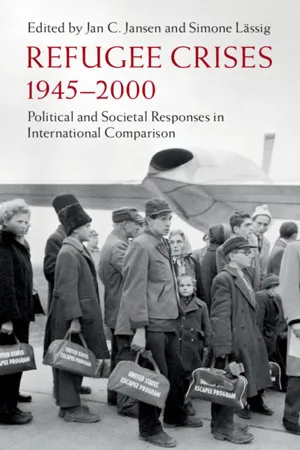 eBook - PDF
Refugee Crises, 1945-2000
Political and Societal Responses in International Comparison
- Jan C. Jansen, Simone Lässig(Authors)
- 2020(Publication Date)
- Cambridge University Press(Publisher)
Without trying to offer hard and fast definitions, we want to clarify the ways the terms “refugee” and “crisis” are used in this volume. Today, many definitions of the term “refugee” go back to the 1951 United Nations Convention Relating to the Status of Refugees, commonly called the Geneva Convention, which recog- nized Refugees as a distinct category of migrant in international law. 8 Centered on individuals fleeing their countries out of fear of political, religious, or ethnic persecution, the Geneva Convention definition excludes several types of forced migrants and displaced persons, such as Refugees from war zones and internally displaced persons. Some of the case studies in this book do deal with Refugees who fell under the Geneva Convention, but this volume covers a much broader array of Refugees and involuntary migrants. It includes several groups of people whose displacement predated the 1951 definition: people who did not, in a strict sense, cross an inter- national border (e.g., the “returnees” from the colonies); war Refugees; and those who were denied refugee status. Deliberately departing from the 1951 Geneva Convention definition, Refugee Crises, 1945–2000 uses the term “refugee” more broadly to designate any person fleeing negative political actions and exclusion, much as the term did in the first half of the twentieth century. 9 A common thread linking the different groups discussed in this volume is coerced migration. All were forcibly driven from their home or felt compelled to flee, and return was not a viable option, at least not in the short term. To be sure, the forms and degree of coercion varied from case to case, ranging from indirect or situational pressure to direct force. 10 8 On the historical connections between “migrants” and “Refugees,” and the problems of the 1951 distinction, see Katy Long, “When Refugees Stopped Being Migrants: Move- ment, Labour and Humanitarian Protection,” Migration Studies 1, no. eBook - PDF
Sudanese Women Refugees
Transformations and Future Imaginings
- J. Edward(Author)
- 2007(Publication Date)
- Palgrave Macmillan(Publisher)
Thus, in 1969 the Organization of African Unity (OAU), now the African Union (AU), in the convention governing specific aspects of refugee problems in Africa negotiated a relatively encompassing definition CONCEPTUALIZING REFUGEE CONDITIONS 41 of a refugee. In addition to the established UN definition centering on individual persecution, the term refugee “shall also apply to every person who, owing to external aggression, occupation, foreign domination or events seriously disturbing public order in either part or the whole of his country of origin or nationality, is compelled to leave his place of habitual residence in order to seek refuge in another place outside his country of origin or nationality.” 28 Similarly, the Central American countries that agreed in 1984 to the nonbinding Cartagena Declaration on Refugees added that “[t]he definition or concept of a refugee to be recommended for use in the region is one which in addition to containing the elements of the 1951 convention and the 1969 protocol, includes among refugee persons who have fled their country because their lives, safety or freedom have been threatened by generalized violation, foreign aggression, internal con- flicts, massive violation of human rights or other circumstances which have seriously disturbed the public order.” 29 Drawing on the above definitions, one can argue that persons who fit the 1951 definition of a refugee are those who have been individually persecuted and forced to cross international borders. As the 1951 definition of a refugee applies only to individual claims to a “well-founded fear of persecution,” it ignores the fact that many factors have affected millions of people collectively, who have suffered similar consequences as Refugees, for example, civil wars, human rights abuses, and systematic political oppres- sions. eBook - PDF
International Organizations
Politics, Law, Practice
- Ian Hurd(Author)
- 2020(Publication Date)
- Cambridge University Press(Publisher)
The definition of refugee is a site of contestation because important political consequences follow from it both for governments and for individuals. Obligations By signing the 1951 Convention or the 1967 Protocol, a government prom-ises to abide by the commitments in the treaty. These are meant to guaran-tee a minimum level of humane treatment for Refugees, who by definition have arrived in the country in a condition of maximum vulnerability. To be a refugee, a person must be outside their country of origin. This is usually understood to mean their country of citizenship, though it is also said to include people who have no citizenship at all (“statelessness”). A person who has been forced from their home but remains within the country is considered an “internally displaced person” (IPD) rather than a refugee. Different international rules and institutions are relevant for IPDs, more deferential to domestic sovereignty, than for Refugees. A refugee must also fear persecution if they return to their country of origin. This is, as Guy Goodwin-Gill of Oxford University has noted, a forward-looking fear rather than one based on persecution in the past: “it is not necessary to have fled for reasons of fear of persecution, or even actually to have been persecuted. The fear of persecution looks to the future, and can … [have] emerged during an individual’s absence from their home country.” 6 What matters is that a person feels that they cannot safely return home. The Convention defines three broad obligations of governments toward Refugees. First, a government cannot return a person against their will to their country of origin. This principle of “non-refoulement” is a central piece of international human rights law. It creates an obligation on the receiving country to provide for the person in need and prevents that government from either refusing entry to the person at the border or forcibly sending them back after they have entered the country. eBook - PDF
Development-induced Displacement
Problems, Policies and People
- Chris de Wet(Author)
- 2005(Publication Date)
- Berghahn Books(Publisher)
It follows that the physical presence of the unprotected person outside her country of origin is not a constitutive element of her refugeehood, but is rather a practical con-dition precedent to placing her within the effective scope of international pro-tection. (Hathaway 1991, quoted in Chimni 2000: 401) The key criterion, then, that is used to distinguish ‘refugee’ from ‘inter-nally displaced person’ – whether or not an international boundary has been crossed – is not based on ‘conceptual principle’ and is not a ‘consti-tutive element’ of refugeehood. It follows that the term ‘refugee’, as used in the language of refugee protection and of refugee studies, does not dis-tinguish a ‘subset’ of displaced people that can be meaningfully com-pared to other subsets. As Malkki has put it, the term refugee is not ‘a label for a special, generalisable “kind” or “type” of person or situation’ but ‘a descriptive rubric that includes within it a world of socio-econom-ic statuses, personal histories, and psychological or spiritual situations’ (1995b: 496). The ‘internally displaced’ make up an even more hazy and imprecise category. They are defined, in the ‘Guiding Principles on Internal Displacement’ of the UN Office for the Coordination of Humanitarian Affairs (OCHA), as persons or groups of persons who have been forced or obliged to flee or to leave their homes or places of habitual residence, in particular as a result of or in order to avoid the effects of armed conflict, situations of generalised violence, violations of human rights or natural disasters, and who have not crossed an internationally recognised State border’. (Quoted in Chimni 2000: 242) Who is a Forced Migrant? | 29 The ‘essential’ purpose of the definition is to ‘help identify persons who should be of concern to the international community because they are basically in refugee-like situations within their own countries’ (Cohen 1996, quoted in Chimni 2000: 407). eBook - PDF
Forced Migration in Eastern Africa
Democratization, Structural Adjustment, and Refugees
- C. Veney(Author)
- 2006(Publication Date)
- Palgrave Macmillan(Publisher)
Moreover, since the status of Refugees falls under international, national, and regional laws, legal perspectives and principles on international and national human rights laws, refugee conventions and instruments, and state sovereignty are invaluable (Aboni 1978; Goodwin-Gill 1995; Melander and Nobel 1978; Eggli 2002; Steiner et al. 2003; Verdirame 1999a). No less important are geographical perceptions on the spatial 12 ● Forced Migration in Eastern Africa dynamics of refugee settlement and encampment, territoriality and reconstruction of identities, and the environmental causes and effects of forced migration (Kulhman 1990; Rogge 1985; 1987; Black 1991; 1998; Black and Robinson 1993; Kibreab 1990; 1996a; Chambers 1979; Daley 1993). Fourth, this study incorporates a gender perspective by examining the experiences and struggles of refugee women and changes in gender rela- tions and identities among the Refugees. It is essential for refugee studies to incorporate gender analysis not only because many of the Refugees, in some cases the vast majority, are women, but also because the refugee experience leads to the reconstruction of gender identities and relations as previous conceptions of masculinity and femininity and family roles and responsibilities come under severe strain in refugee settlements and camps, which are themselves gendered spaces. Until recently many stud- ies of African Refugees did not directly or adequately address gender by assuming that a “migrant” is a man and a “migrant family” consists of a man, his wife, and their children. eBook - PDF
World Crisis and Underdevelopment
A Critical Theory of Poverty, Agency, and Coercion
- David Ingram(Author)
- 2018(Publication Date)
- Cambridge University Press(Publisher)
Children who qualify can obtain Green Cards and eventual citizenship; spouses who qualify can be paroled into the US and receive some benefits. 19 As of 2016 the UNHCR has adopted the expanded definition of refugee contained in the Organization of African Unity’s Convention Governing the Specific Aspects of Refugees in Africa (1974) which includes “every person who, owing to external aggression, occupation, foreign domination or events seriously disturbing public order in either part or the whole of his country of origin or nationality is compelled to leave his place of habitual residence in order to seek refuge in a place outside his country of origin or nationality.” The Cartagena Declaration on Refugees (1984), adopted as a nonbinding resolution by Mexico and other Latin American countries, builds upon this definition to include “persons who have fled their country because their lives, safety or freedom have been threatened by generalized violence, foreign aggression, internal conflicts, massive violation of human rights or other disturbances which have seriously disturbed public order.” Forced Migration 137 consideration in defining refugee status. Many countries already allow entry to persons fleeing natural disasters, civil wars, and threats of vio- lence from which they cannot be protected by their own government. 20 The United States, for example, allows persons fleeing from domestic violence and other forms of endangerment to apply for “temporary pro- tected status” if their own government will not act to remedy the danger. 21 Under this provision, at least some Central American migrants fleeing gang warfare have been granted relief. eBook - PDF
Seeking Asylum and Mental Health
A Practical Guide for Professionals
- Chris Maloney, Julia Nelki, Alison Summers(Authors)
- 2022(Publication Date)
- RCPsych Publications(Publisher)
Levels of involuntary displacement, both within and across borders, have increased since then, and have become a formidable political and economic problem, on a global scale. Con- troversies over legal responsibilities have played out in various fora. There is now a complex web of interested parties: host and neighbouring countries, other individual states, the Unit- ed Nations, donors, humanitarian and non-governmental groups, and, of course, Refugees themselves. • From the end of 2013, approximately 4.3 million people fled their homes due to conflict in South Sudan following its independence, with over 1 million of these in Uganda alone. • Following the start of civil war in 2011, Syrians became the largest group of forcibly displaced people in the world, with approximately 13.2 million people displaced by the end of 2019, and more than 6.6 million of these having left the country. • As a legacy of wars in Iraq in the 1990s and 2000s, by 2014, more than 3 million people had been internally displaced. • Repeated wars and ongoing conflict and insecurity in Afghanistan ever since the 1980s has resulted in millions of Refugees – the largest number of Refugees from any country for the 20 years until 2013. In 2019, there were 2.7 m Refugees, the majority of whom were in Pakistan and Iran. • Between 2015 and 2019, the European ‘refugee crisis’ arose due to the arrival of hundreds of thousands of Refugees and migrants from a range of different countries. Hassan 16 Refugee policy can be both a polarised and a polarising issue, with strong views held by all. The rise of 24-hour mass media has now catapulted once-remote conflicts into Western living-rooms, with emotive images giving rise to conflicting rhetoric of both ‘rescue’ and ‘immigration control’.
- A. Bloch(Author)
- 2002(Publication Date)
- Palgrave Macmillan(Publisher)
4 Theories of Refugee Migration and Migration to Britain Migration refers to the movement of people and in the context of this work, the concern is international migration, which is the movement of people across international borders. International migration is complex and can involve a number of interacting variables both at the individual level and the structural level. In Europe structural barriers, manifested through increased immigration controls, have gathered pace over the past few decades. These barriers affect access to countries of asylum and the actual migration process itself. Restrictions mean that it is more difficult to enter Europe legally as an asylum seeker. The consequence of border controls and visa restrictions has been the growth in the use of illegal migration routes facilitated by smugglers and traffickers. This necessarily limits the choices available to any potential migrant. This chapter reviews the development of migration theory and its current application for Refugees and asylum seekers. The circumstances surrounding any migratory movement are unique and complex, which makes it difficult for any theory to generalize or predict refugee movements. Migration theories derive from a number of academic disciplines including sociology, geography, politics, law and economics. Three of the main approaches used in debates about migration are the neo- classical economic equilibrium perspective, the historical-structuralist approach and migration systems theory (Castles and Miller, 1998). This chapter will first provide an overview of the main theoretical approaches to migration. Second it explores the ways in which the migration experiences of voluntary and forced migrants may differ. Finally, it presents evidence from the case study of Refugees and asylum 64 seekers in Newham as a mechanism for exploring the salience of the theoretical paradigms of migration among Refugees in Britain.
- Jim Whitman(Author)
- 2000(Publication Date)
- Palgrave Macmillan(Publisher)
4 The number of Refugees worldwide steadily increased from 5 million in 1980 to a peak of 21 million in August 1994 falling to Refugees and Migrants 111 approximately 16 million in 1996. 5 Since 1990 alone, more than 10 mil- lion Refugees have been accorded protection and assistance by the inter- national community. While most Refugees are in Africa, the Middle East, and South Asia, there has been a rapid increase in the number of Refugees in Europe since 1990. Almost two million Refugees have been displaced within or have fled the republics of the former Yugoslavia. 6 Wars in the Azerbaijan enclave of Nagorno-Karabakh, ex-Soviet Geor- gia, and the rebellious Russian province of Chechnya have generated more than a million Refugees. Prior to 1990, most of the world’s Refugees fled countries that ranked among the poorest in the world, such as Afghanistan, Cambodia, Mozambique and Ethiopia. However, during this decade, an increasing number of Refugees have originated in relatively more affluent coun- tries, such as Kuwait, Iraq, the former Yugoslavia, and Armenia. Never- theless, the reasons for the flight of Refugees generally remain the same: war, civil strife and persecution. Hunger, while sometimes a primary cause of population movements, is all too frequently only a contribut- ing factor. For example, during 1992, although severe drought in south- ern Africa and the Horn of Africa affected food production in all countries in those regions, only in war-torn Mozambique and Somalia did millions of hungry inhabitants migrate in search of food. While many people fled the generalized violence of war, most fled because they were specifically targeted by one or another armed faction.
Index pages curate the most relevant extracts from our library of academic textbooks. They’ve been created using an in-house natural language model (NLM), each adding context and meaning to key research topics.

