Geography

Pesticide Control
Pesticide control refers to the management and regulation of pesticides to minimize their negative impact on the environment, human health, and non-target organisms. This involves measures such as monitoring pesticide use, promoting alternative pest management strategies, and enforcing laws and regulations to ensure safe and responsible pesticide application.
Written by Perlego with AI-assistance
Related key terms
1 of 5
8 Key excerpts on "Pesticide Control"
 eBook - PDF
Pesticide Policy and Politics in the European Union
Regulatory Assessment, Implementation and Enforcement
- Emanuela Bozzini(Author)
- 2017(Publication Date)
- Palgrave Macmillan(Publisher)
the term identifies pesticides with chemicals sprayed over plants by tractors slowly going up and down cropland puffing a light grey cloud. From a regulatory point of view however, the term ‘pesticide’ is broader and includes ‘any substance or mixture of substances intended for pre- venting, destroying, or controlling any pest . . . causing harm during or otherwise interfering with the production, processing, storage, transport, or marketing of food, agricultural commodities, wood and wood products or animal feedstuffs’ (FAO 2014). This means that first pesticides include a wide range of substances: synthetic chemicals as well as naturally occur- ring toxic substances and microorganisms. They are all part of a group of around 1,500 active substances variously commercialised in tens of thou- sands of products that have been tested for their effectiveness in fighting pests (MacBean 2013). Second, pesticides are used across the entire food chain, from farm to fork, as well as in aquatic farming, timber industries, to clean public spaces like parks and roads and in home gardening. In short, this book is not about chemicals of relevance for a shrinking proportion of the EU workforce that is employed in farming. Rather, we are talking about thousands of active substances whose presence is ubiquitous in daily life for all of us. The use of pesticides grew enormously after World War II, in con- nection with the Green Revolution, the science-led process that made agrochemicals central to modern farming. Indeed, pesticides together with fertilisers and high-yield varieties are part of a package that com- prises the agro-industrial model of farming which is still dominant in Europe and elsewhere in the world. In this context, PPPs are considered essential to protect agricultural production and guarantee stable food supplies. eBook - ePub
- Charles Krebs(Author)
- 2008(Publication Date)
- CSIRO PUBLISHING(Publisher)
control damage and is not used in the engineering sense of regulating the pest population around some equilibrium density. One of the obvious ways of controlling damage is to reduce the average abundance of the pest species, but there are other ways of reducing damage by pests without affecting abundance (such as using insect repellents).Economic Pests and Ecological Pests
In the field of pest control, a pest population is defined as being controlled when it is not causing excessive economic damage, and as uncontrolled when it is. The boundary between these two states will depend on the particular pest. An insect that destroys 4 to 5% of an apple crop may be insignificant biologically, but may destroy the grower’s margin of profit. Conversely, forest insect pests may defoliate whole areas of forest without bankrupting the lumbering industry. The concept of an economic threshold must be applied to all questions of pest control. This includes the cost of the damage caused by the pest, cost of control measures, profit to be gained from the crop, and interactions with other pests and their associated cost. Pest control is an ecological problem as well as a social and economic problem. In this chapter we will discuss mainly the ecological aspects of pest control, but it is important to realize that the economic and social dimensions are equally important when it comes to developing pest-control strategies.Pest control in most agricultural systems is achieved by the use of toxic chemicals, or pesticides . An estimated 2.5 billion kilograms (nearly 5 billion pounds) of toxic chemicals are being used annually throughout the world to control plant and animal pests. Despite the use of these pesticides, about 48% of the world’s crops are lost to pests before and after harvesting. In spite of increasing pesticide use in the last 60 years, crop losses have gone up or remained constant rather than gone down as one would expect (Figure 19.1 ). Pesticides are only a short-term solution to the problem of pest control for several reasons. Firstly, toxic chemicals have strong effects on many species other than pests. Rachel Carson was the first naturalist to point out to the public at large the ecological consequences of toxic chemicals. The effects of DDT on bird populations (Essay 19.1 ), which Rachel Carson highlighted in Silent Spring , is a good example of how pesticides can degrade environmental quality. Secondly, many pest species are becoming genetically resistant to toxic chemicals that formerly killed them. Insects that attack cotton have evolved resistance to so many pesticides that it is no longer possible to grow cotton in parts of Central America, Mexico and southern Texas. Thirdly, the use of toxic chemicals in some situations can actually produce a pest problem where none previously existed. This is perhaps the most surprising effect of toxic chemicals. Rice paddies sprayed with insecticides show more pest individuals after spraying than paddies left unsprayed (Figure 19.2 eBook - PDF
- C.B. Huffaker(Author)
- 2012(Publication Date)
- Academic Press(Publisher)
5. Several programs exist, ready for use, which are technologically successful but which are making no contribution to integrated control because nonentomological obstacles prevent their application. Most pests that man attempts to control consciously are today suppressed solely by chemicals, many of which are administered as preventive sprays, that is by the applica-tion of pesticides according to the calendar and without reference to current pest density. If we are to answer the question that forms the title of this chapter our main objective here must be to examine the likelihood that integrated control (as defined in the preceding section) will, by its progressive adoption, modify this situation to a significant extent. Accordingly we must look at the causes of the present situation, the probability of their changing, and the probability of such changes occurring soon enough to in-fluence trends in agricultural practice. The events and trends that have shaped existing patterns of pest control, at least in regions where intensive cultivation is practiced, are well known. Since man first began to select certain plants for cultivation he has, through the practice of agriculture, been steadily simplifying ecosystems. Working against the normal course of ecological succes-sion, he has been holding ecosystems back in stages that are characterized by a high ratio of productivity to biomass and by an increased susceptibility to wide-amplitude fluctuations of constituent populations (E. P. Odum, 1971). Man's ability to maintain ecosystems in this condition has increased greatly during the last 50 years as he has made increasing use of energy derived from fossil fuels.
- Sardana, H R(Authors)
- 2021(Publication Date)
- Daya Publishing House(Publisher)
Figure 4.7 shows the flow of information from each component to final view over web. This task has been initiated by the Centre to accomplish the task of getting automated pest mapping for major crops in India and this is being tried on pilot regions on the country using GPS enabled PDAs and GIS. This ebook is exclusively for this university only. Cannot be resold/distributed. Figure 4.7 Pest Management in Crop Production through Spatial Technologies A GIS can manage different data types occupying the same geographic This ebook is exclusively for this university only. Cannot be resold/distributed. space. For example, a biological control agent and its prey may be distributed in different abundances across a variety of plant types in an experimental plot. Although predator, prey, and plants occupy the same geographic region, they can be mapped as distinct and separate features. Once patterns and correlations are elucidated, management practices can be modified to optimize yield and production costs, and minimize environmental impacts caused by excessive applications of fertilizers and pesticides. Site-specific applications of fertilizers, pesticides and other applications can be implemented by dividing a field into smaller management zones that are more homogeneous in properties of interest than the field as a whole (Zhang et al., 2002). Importance of Pest Management in Crop Production Pest life cycle, stages, damage nature and parts of plant affected, ETL for specific pest, predator, prey, Soil moisture, temperature, rainfall, humidity, leaf area index, wind speed, sun shine hours, crop stage, variety, utilization of minerals/nutrients etc. Efficient and Economic assessment: Proper appreciation of the relationship of Pest-Soil-Crops-Climate is essential.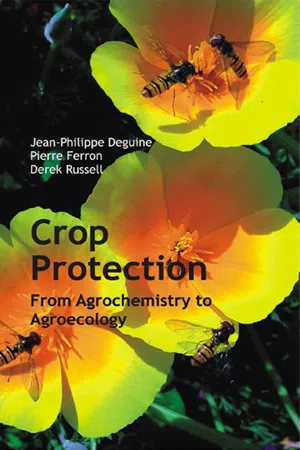 eBook - PDF
Crop Protection
From Agrochemistry to Agroecology
- Jean-Philippe Deguine(Author)
- 2009(Publication Date)
- CRC Press(Publisher)
It is not the simple juxtaposition or superimposition of two control techniques (e.g. chemical control and biological control) but the integration of all appropriate management techniques in tune with natural regulation and with limiting factors in the environment. Expressions in the English speaking world chemical control supervised control biological control integrated control, integrated pest control integrated pest management or IPM integrated plant protection, integrated crop protection (GB) ecologically-based pest management or bio-intensive IPM (USA) area-wide integrated pest management farmscaping (USA) integrated farming (GB) Expressions in the French speaking world lutte chimique lutte raisonnée, lutte dirigée (C, CH) lutte biologique lutte integree protection intégrée gestion spatio-temporelle des populations production intégrée The Concept of Integrated Control 65 TABLE 5 Differences in language and/or culture (2, modified) C: C anada, CH: Switzerland, GB: Great Britain, USA: United States of America protection. In the same period (1987), the first United Nations Conference on the Environment was held in Stockholm, from which emerged the concept of ecodevelopment. This was defined as a mode of harmonious development in a given environment, taking into account nature as well as human needs and introducing the idea of sustainable development which guarantees the needs of the current generation will be met without jeopardising the needs of future generations. In this way environmental issues were officially associated with agronomic and toxicicological constraints in crop protection. What is more, the American Federal Administration received the mandate to make this integrated plant protection the spearhead of its environmental policy, a role reiterated by successive presidents with the goal — which proved to be utopian — of reducing the consumption of pesticides by 50%! One the earliest measures was banning the use of DDT as an agricultural insecticide.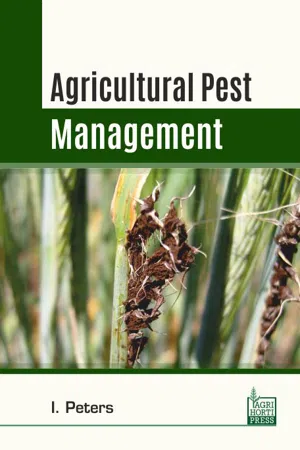 eBook - PDF
- Peters, I(Authors)
- 2018(Publication Date)
- Agri Horti Press(Publisher)
Biological Control Biological control utilizes the natural pathogens, predators, or parasites of a particular pest. One example is encouraging predatory lady beetles to destroy aphids in the garden. A biological approach might include growing certain plants as shelter or nectar sources for other predatory insects. Chemical Control Chemicals have been used for hundreds of years to control pests. Pesticides are chemical compounds formulated to control pests; roach sprays, weed killers, and rat and mouse baits are modern examples. Household and industrial cleaning products that kill germs are also pesticides, as are common bleaches as well as chemicals used to sterilize surgical tools and surfaces in hospitals. Pesticides can consist of one or more active ingredients, and the active ingredients can be either organic or inorganic. Organic compounds are based on carbon chemistry and are formulated from molecules that contain carbon, hydrogen, and oxygen. Some organic compounds used in pesticides occur naturally and are obtained from plants or bacteria; these are called natural, biological, or botanical pesticides. The organic active ingredient in pyrethrin insecticides is obtained from a certain chrysanthemum flower. Pyrethrins often are used to control flying and crawling insects in the home, as well as on pets and garden plants. Inorganic compounds do not contain carbon but are derived from mineral sources. Some inorganic compounds used in pesticides also This ebook is exclusively for this university only. Cannot be resold/distributed. Agricultural Pest Management 8 occur naturally. An example is a copper-based product used for algae control in ponds. Pesticides containing synthetic (manufactured) compounds comprise the largest number of products used to control pests. Most synthetic pesticides consist of organic compounds, and these represent the group that most people consider when contemplating the use of pesticides. eBook - PDF
- Edward H. Smith(Author)
- 2012(Publication Date)
- Academic Press(Publisher)
A recent pest control study Pest Control — A Perspective 5 committee of the National Academy of Sciences concluded ... we believe that the potential for resistance to herbicides by weeds has been underestimated and recommend that weed scientists maintain a careful watch for resistance development (12). Despite efforts taken by the Environmental Protection Agency in the past five years to prohibit or restrict the use of pesticides that pose intolerable risks, the effects of pesticides on human health and the environment remain a continual concern for us all. A study recently completed by the Council on Environmental Quality suggests a general trend toward reduced aquatic contamination by chlorinated hydro-carbon insecticides in several major rivers in the southern United States,, even though low levels of these materials still persist. Difficult to assess are the long-term effects of the less persistent replacements such as organophosphorus insecticides. Finally, the question arises as to how much the growing petroleum shortage will affect the future of American pest control whose petroleum base, organic pesticides, is subject to the same uncertainties as fertilizers and natural gas. During the past five years major steps have been made by the public research and extension agencies to develop and demonstrate the concepts and techniques of integrated pest management (IPM). This approach seeks a combination of pest control agents, as opposed to relying exclusively on any one agent, such as chemical pesticides. Chemical pesticides may be required in IPM programs; however, they are applied only as a last resort to keep the pests from exceeding established threshold levels, and pesticides that pose intolerable risks are avoided. On first impression it would seem that the rapid and wide-scale implementation of this approach is inevitable, because of the spectacular results that recent efforts have produced.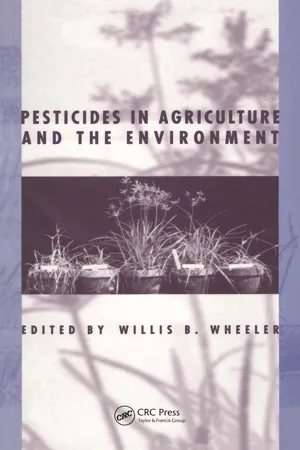
- Willis B. Wheeler(Author)
- 2002(Publication Date)
- CRC Press(Publisher)
Increasing pesticide use may be counterproductive for pest control, resulting in higher pest damages or control costs. 2. Undesirable health or environmental effects of the use of some pesti cides may outweigh production benefits. Increased public concern about the dietary risks of pesticides during the 1980s and 1990s led to a major change in pesticide law. New public concerns about the potential effects of genetically modified crops on pest control, human health, and the environment are emerging. The current focus of pesticide policy is on reducing dietary and other pesticide risks to meet safety standards rather than weighing risks and benefits and on mitigating adverse impacts by finding “safer” alternatives. Integrated pest management (IPM) has become a policy tool for reducing the risks of pesticide use as well as an approach for improving the effectiveness of pest control. This chapter discusses major pesticide use trends in the United States; the effects of such factors as pesticide productivity, farm programs, and pesticide regulations on use; and changing law and policy. 2 PESTICIDE USE TRENDS Effective chemical control of agricultural pests became prevalent in the 1800s [4]. Paris green (copper acetoarsenite) was developed in the United States in the 1870s to combat the potato beetle, and Bordeaux mixture (quicklime and copper sulfate) was developed in France in the 1880s to control disease in grape culture. Prior to World War II, arsenicals, sulfur compounds, and oils were commonly used. However, the development of synthetic organic materials, such as 2,4-D and DDT, during World War II heralded the modem age of chemical pesticides. Pesticide expenses as a portion of farm production expenses (excluding operator dwellings) rose from 0.2% in 1920 to 4.8% in 1997 [5]. 2.1 Aggregate Trends Synthetic organic pesticide use grew rapidly from the late 1940s to the early 1980s as the percentage of crop acreage treated with pesticides increased.
Index pages curate the most relevant extracts from our library of academic textbooks. They’ve been created using an in-house natural language model (NLM), each adding context and meaning to key research topics.

