Technology & Engineering

Project Control
Project control involves the monitoring, tracking, and regulating of a project's progress to ensure it stays on track with its objectives, budget, and timeline. It encompasses activities such as performance measurement, risk management, and change control to maintain the project's quality and efficiency. Effective project control is essential for successful project delivery in the technology and engineering sectors.
Written by Perlego with AI-assistance
Related key terms
1 of 5

11 Key excerpts on "Project Control"
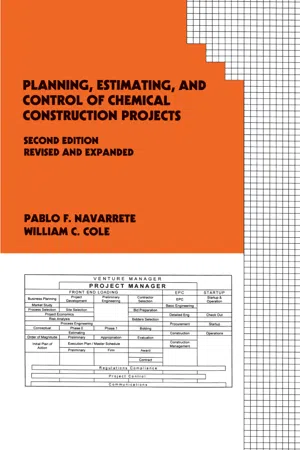
- Pablo F. Navarrete, William C. Cole(Authors)
- 2001(Publication Date)
- CRC Press(Publisher)
CHAPTER 15 Project Control Project Control is about anticipating, avoiding, recognizing, and correcting trouble on tinle 15.1 Thoughts on Project Control 15.2 Project Control and the Project Manager Cost Control. Schedule Control 15.3 Control in the Early Stages Site Selection • Phase O/Phase 1 • Project Execution Plan MPS • Contracting 15.4 Control in the Engineering Office General. Plant Layout. Detailed Engineering. Purchasing and Subcontracting 15.5 Control During Construction 15.6 Control During Project Control 15.7 Anatomy of a Project Control System 15.8 In-House Cost Tracking 15.9 In-House Construction Progress Monitoring System General. Activity Breakdown. Value System. Schedule. Progress Computations 15.10 In-House Engineering Progress Monitoring System Detailed System. Quick System 15.11 Cost and Schedule Forecasts 15.12 Checking Contractors' Schedule and Execution Plan General. Review Criteria 15.13 Avoiding and Correcting Frequent Problems In the Engineering Contractor Office. During Procurement. During Construction 15.14 Work Sampling Guidelines 15.1 Thoughts on Project Control Project Control is the only activity that spans all other project execution phases. 196 Project Control 197 • Project Control is practiced during scoping, process design, and execution planning. • Project Control is exercised when establishing contracting strategy and selecting contractors. • Project Control is also practiced during all· phases of engineering, procurement, and construction. • Project Control is the driving force behind progress monitoring and contract administration. • Project Control entails quality, cost, and schedule controls. Project Control IS INTRINSIC TO GOOD PROJECT MANAGEMENT AND IS ACHIEVED THROUGH THE EFFEC-TIVE EXECUTION OF EVERY PROJECT ACTIVITY. Note: Quality, defined as conformance to established requirements must be . monitored by process and specialist engineers with minimal direct participation from the Project Manager. eBook - PDF
Project Management
Principles, Practice and Scheduling
- Herman Steyn(Author)
- 2023(Publication Date)
- Funda Project Management(Publisher)
(g) Ask questions regarding progress and expenditures in a way that would lead to obtaining accurate information. Chapter 8 Project Management 158 form part of the project manager’s day-to-day activities. Compu- terised information systems play an important role and the status of projects is often visible on reports that can be accessed via the Internet. Project managers perform the control activities of monitoring, evaluation and corrective action in a number of ways: by “walking the halls” (informal discussions with team members), by studying reports, through progress meetings and by re- planning. 8.1 The Control Process Control can be described as the work managers perform to ensure that the project team adheres to an approved plan. Without planning, control would therefore be impossible. While project planning sets objectives, control holds people accountable and ensures that the objectives that have been set are achieved. Control always involves at least the first three of the following five steps: a) Develop a plan (an objective or some standard); b) Determine facts about the actual situation and anticipating future deviations from plan; c) Compare the actual facts - and the anticipated future situa- tion - with the standard (objective or plan), and reporting to stakeholders; d) If necessary, plan how to get back on track, and take the necessary actions to bring the actual situation in line with the standard (objective or plan), get approval for the plans, and report on getting back on track; e) If it is impossible to finish the project according to plan, go back to (a) above; revise the plan and get approval for the revised plan. An air conditioner controls the temperature of a room or building by following the four steps: The system is set to a specific temperature, say 21 Celsius (the objective or standard). The system then measures the actual temperature and compares it with the standard. eBook - PDF
Project Management
A Managerial Approach
- Jack R. Meredith, Scott M. Shafer, Samuel J. Mantel, Jr.(Authors)
- 2021(Publication Date)
- Wiley(Publisher)
433 CHAPTER 11 In the previous chapter, we described the monitoring and information gathering process that would help the project manager (PM), the project owner, and the sponsor control the project. Control is the last element in the implementation cycle of planning–monitoring– controlling. Information is collected about system performance, compared with the desired (or planned) level in the business case (Einhorn et al., 2019), and action taken if actual and desired performance differ enough that the controller (manager) wishes to decrease the difference. Note that reporting performance, comparing the differences between desired and actual performance levels, and accounting for why such differences exist are all parts of the control process. In essence, control is the act of reducing the difference between plan and reality. Of course, it is easier to control something before or as soon as it goes out of control than much later when the damage has already been extensive. Thus, when a project and/ or its environment is unknown or expected to be dynamic, such as with information tech- nology software projects, it is best to stop more frequently and reassess the project, which is the basis for the Agile approach to project management. If, instead, only parts of the project are expected to be dynamic or unknown, a hybrid approach combining the tradi- tional Waterfall approach for the stable portions of the project and Agile for the dynamic portions can be used. Although this chapter is primarily directed to the exercise of control by the PM, we must note that the project owner, or other project overseer reporting to upper management, also has a Project Control function. The aim of the project is to help achieve some strategic objective of the organization as described in the business case; thus, the project owner or project council charged with overseeing the project, must appraise the continuing value of the project in achieving those objectives. eBook - PDF
- Jack R. Meredith, Scott M. Shafer, Samuel J. Mantel, Jr., Margaret M. Sutton(Authors)
- 2020(Publication Date)
- Wiley(Publisher)
In order to manage for overall proj-ect success, control must be exercised at the detailed work level for each aspect of project performance or there is no guarantee that the desired changes will result. Strategic Planning and Scheduling Reporting and Monitoring Review and action as required Prepare and forward management reports as required Distribution to directors and managers Feeder copy Weekly time tickets milestone report Copy Initiate project records Distribute copies Project review and signature approval Administration review, type, and prepare final copies Rough draft of engineering project authorization and project expenditure and control schedule chart Responsible Engineer Administration President and General Manager Director of Engineering Director of Research Director of Manufacturing Feeder copy Distribution to responsible engineer Post to weekly project status reports and project expenditure and control schedule chart FIGURE 7.1 Project authorization and expenditure control system information flow. Source : Dean, B. V. Evaluating, Selecting, and Controlling R&D Projects. New York: American Management Association, 1968. 238 CHAPTER 7 Monitoring and Controlling the Project The project plan identifies what is being done, when, and the planned level of resource usage for each task and subtask in the project, so real-time data must be identified to measure achievement against the plan. Mechanisms to gather and store such data must be designed. In addition to collection systems for hard data, the monitoring system should include telephone logs, change tracking/control systems, documentation processes for both formal (e.g., meetings) and informal communications, and other such softer data collection systems. Once again, moni-toring is the direct connection between project planning and control. One way of linking planning and control is to monitor project progress at each milestone or phase of the project. eBook - ePub
- Peter W. G. Morris, Jeffrey K. Pinto, Peter Morris(Authors)
- 2010(Publication Date)
- Wiley(Publisher)
CHAPTER ONEProject ControlPeter HarpumProject control is about ensuring that the project delivers what it is set up to deliver. Fundamentally, the process of Project Control deals with ensuring that other project processes are operating properly. It is these other processes that will deliver the project’s products, which in turn will create the change desired by the project’s sponsor. This chapter provides an overview of the Project Control processes, in order to provide the conceptual framework for the rest of this section of the book.Introduction
Control is fundamental to all management endeavor. To manage implies that control must be exercised. Peter Checkland connects the two concepts as follows:The management process. . .is concerned with deciding to do or not to do something, with planning, with alternatives, with monitoring performance, with collaborating with other people or achieving ends through others; it is the process of taking decisions in social systems in the face of problems which may not be self generated.Checkland, 1981In short to• plan • monitor • take actionOne may ask what is the difference between Project Control and any other type of management control? Fundamentally there is little that project managers must do to control their work that a line manager does not do. Managers of lines and projects are both concerned with planning work; ensuring it is carried out effectively (the output from the work “does the job”) and efficiently (the work is carried out at minimum effort and cost). Ultimately, managers of lines and projects are concerned with delivering what the customer wants. The line management function is usually focussed on maximizing the efficiency of an existing set of processes—by gradual and incremental change—for as long as the processes are needed. The objective of operations management (or “business-as-usual”) is rarely to create change of significant magnitude. Projects, on the other hand, are trying to reach a predefined end state that is different to the state of affairs currently existing; projects exist to create change. Because of this, projects are almost always time-bound. Hence, the significant difference is not in control per se, but in the processes that are being controlled—and in the focus of that control. eBook - PDF
Empowering Project Teams
Using Project Followership to Improve Performance
- Marco Sampietro, Tiziano Villa(Authors)
- 2014(Publication Date)
- Auerbach Publications(Publisher)
Control and conflict go hand in hand; the difference is in how conflict is interpreted and handled in projects. Some project management experts go on to state that conflict, if handled well, is the propellant that drives the project to success. The value of the conflict in the project economy should therefore be pointed out. In projects conflicts are the order of the day due to the joint presence of several stakeholders with completely different special-izations, organizational placement, and reference cultures. These stakeholders, for a limited amount of time (the project duration), find themselves having to collaborate somewhat forcedly in order to achieve the project objectives, staking their interests. 10.2 Project Control: COMPARING MEANINGS Projects and control are reciprocally linked: on the one hand, the project should be controlled on a regular basis in order to assess how the project is progressing; on the other hand, control should be provided with data and information that the project must be able to supply. The success of a project is based on its capacity to provide feedback. This means going back, reviewing what was previously put down on paper in 202 • Empowering Project Teams relation to the inevitable differences between what was planned and what has actually been done. Monitoring and controlling the project therefore becomes essential, precisely in order to provide feedback. Control is therefore a systematic activity that accompanies the project from the outset until its completion. Control, in fact, provides a measure of the efficiency of our planning work and an indication of the need to review the planning in order to make the necessary adjustments. The term control should be understood as “guiding, directing, driving, orienting.” The project should therefore be controlled as it progresses, great attention should be paid to weak signals, and future trends should be anticipated as far as possible. eBook - PDF
- Forrest Clark, A.B. Lorenzoni(Authors)
- 1996(Publication Date)
- CRC Press(Publisher)
It is project management’s job to see that equilibrium is maintained 145 146 Chapter 13 between quality, schedule, and cost without compromising safety or interfering with the owner’s ongoing operations. Cost and schedule control go hand in hand. They are so intertwined that most large projects have a Controls Manager with cost and scheduling engineers reporting to him. Small projects may have a single cost/schedule engineer. A good Project Controls program provides Total Cost and Schedule Management. OBJECTIVES OF A COST CONTROL PROGRAM A project cost control program has the following four objectives: 1. To focus management attention on potential cost trouble spots in time for corrective or cost-minimizing action (i.e., detect potential budget overruns before, rather than after, they occur). 2. To keep each project supervisor informed of the budget for his area of responsibility and how his expenditure performance compares to the budget. 3. To create a cost-conscious atmosphere so that all persons working on a project will be cost-conscious and aware of how their activities impact on the project cost. 4. To minimize project costs by looking at all activities from the view-point of cost reduction. COST REPORTING VS. COST CONTROL Cost reporting must not be confused with cost control. In the past there has been a tendency for project managers (PMs) to issue a monthly cost report comparing actual expenditures to the initial estimated cost of the project, labeling this cost control. It is not control, but reporting. Reporting actual expenditures is the accountant’s job. Forecasting cost trouble spots before funds are committed and determining corrective action to minimize these expenditures is the CE’s job. In other words, cost control is spotting trouble spots and taking action, and the accountant’s cost report is one of the tools used by the CE. eBook - ePub
Managing Technology-Based Projects
Tools, Techniques, People and Business Processes
- Hans J. Thamhain(Author)
- 2014(Publication Date)
- Wiley(Publisher)
- Driven by business pressures and advances in information technology, many companies have invested heavily in new management tools and techniques, promising more effective alternatives and enhancements to traditional forms of Project Control.
- One of the greatest challenges for management is to seek out tools and techniques that meet the three key conditions: (1) compatible with the business environment, processes, culture and values, (2) conducive to specific problem solving, and (3) useful for tackling and controlling the project according to established plans.
- Project Control has radically departed from its narrow focus of satisfying schedule and budget constraints, shifting to a much broader and more balanced managerial approach that focuses on the effective search for solutions to complex problems.
- Project management tools are underutilized because of insufficient familiarity on the part of project leaders.
- Project Control must be congruent with the business process and the human side of management to work effectively.
- Field research consistently emphasizes the importance of organizational and cultural factors for managerial control, including mutual trust, respect, candor, risk sharing, and the ability to fail safely.
- Self-forcing or self-directed control uses work challenge, personal pride, and commitment as motivators for team self-governance and accountability.
- Project Control requires work processes with effective communication channels and cross-functional linkages, interconnecting people, activities, and support functions.
- Few companies go into a major restructuring of their business processes lightly. At best, the introduction of a new Project Control technique is painful, costly, and disruptive to ongoing operations. At worst, it can destroy existing managerial controls.
- Trish Melton(Author)
- 2011(Publication Date)
- Butterworth-Heinemann(Publisher)
To be in control of cost, scope and time a Project Manager needs to be able to forecast accurately. Control is not just about monitoring. A typical way that a control strategy is developed is shown by the activity tree in Figure 4-20. This diagram also highlights the key deliverables typically generated as a result of control planning. Additional tools are used to combine all three aspects to evaluate progress. 185 Control planning 186 Real Project Planning Cost planning Most projects involve some form of cost planning although this may take different forms depending on the project funding strategy and the project type: Capital engineering projects usually require capital funds (for equipment and services) estimated to within 10%. Business improvement projects usually require funds from operational expense budgets (for external consultants and/or materials) and internal resources and need to be planned at the start of each year. The one thing that all projects will have in common is a cost plan (Table 4-11). Although there are a variety of formats a cost plan should define: What items are included in the cost plan (with links to the previously defined WBS and procurement package breakdown).
- Jack R. Meredith, Scott M. Shafer, Samuel J. Mantel, Jr., Margaret M. Sutton(Authors)
- 2021(Publication Date)
- Wiley(Publisher)
244 CHAPTER 7 7.1 THE PLAN–MONITOR–CONTROL CYCLE Managing a project involves continually planning what to do, checking on progress, comparing progress to plan, taking corrective action to bring progress into agreement with the plan if it is not, and replanning when needed. As noted previously, the fundamental items to be planned, monitored, and controlled are time, cost, and scope so that the project stays on schedule, does not exceed its budget, and meets its specifications. This plan–monitor–control cycle constitutes a “closed-loop” process that continues until the project is completed. Figure 7.1* illustrates the information and authority flows for such a cycle in an engineering project. Note that the information flows up the organization and the authority flows down. Unfortunately, it is often the case that when particularly complex, challenging, or uncertain projects are initiated, the planning–monitoring–controlling effort is minimized so that “the real Monitoring and Controlling the Project P roject monitoring and control are, in some ways, simply the opposite sides of project selec- tion and planning. The bases for selection as described in Chapter 1 dictate what to mon- itor and the details of planning identify the elements to be controlled. PMBOK covers these topics in Chapter 2 on Processes, but more explicitly covers the topic of controlling in Chapter 8 on Quality. Monitoring is the collection, recording, and reporting of project information that is of importance to the project manager, the project owner, the steering committee, and other rele- vant stakeholders. Control uses the monitored data and information to bring actual performance into agreement with the plan. Clearly, the need to exert proper control by the project owner or steering committee mandates the need to monitor the proper activities and elements of the project. eBook - PDF
Project Management Basics
A Step by Step Approach
- Robert L. Kimmons(Author)
- 1990(Publication Date)
- CRC Press(Publisher)
@ Project Control CONTROLLING THE WORK Control of the work can also be expressed as those measures that are necessary to make sure that the expected happens. We can never control the project time, but we can control what is done to achieve the schedule. We don't actually control costs, but we do containttie costs to complete the work within the budget. To effectively control the work, there are several things that must be done: • Establish Baselines: Baselines must be established represent-ing expected or acceptable performance. These baselines come from the budget and the schedule, integrated by means of the work breakdown structure. • Monitor Status: Performance must be measured regularly or monitored against these baselines. Current status is noted both for budget performance and for schedule performance. • Forecasts : Proj ections must be made predicting future perform-ance. These projections, when taken w i t h the actual costs to date, result i n ongoing predictions of the final job costs and the completion date. • Variances: Current and predicted performance variances must be identified and quantified. The sooner a potential variance can be spotted, the easier the resolution will be. • Analysis: The potential effects of variances on final cost and schedule must be analyzed. Priorities can be established based on this analysis. Reasons for variances are also investigated to head off other variances stemming from the same or similar sources. • Alternatives: Alternative courses of corrective action must be conceived, evaluated, and compared. The best is selected to remedy the variance. • Implementation: The chosen course of corrective action is imple-mented by modifying/supplementing the work plan. I l l 112 PROJECT MANAGEMENT BASICS: A Step by Step Approach • Assessment of Remedy: The work associated w i t h the corrective action is carefully monitored to assure its success.
Index pages curate the most relevant extracts from our library of academic textbooks. They’ve been created using an in-house natural language model (NLM), each adding context and meaning to key research topics.
