History

British America
British America refers to the colonies and territories in North America that were under British rule from the 17th to the 19th centuries. These territories included present-day Canada, the eastern United States, and parts of the Caribbean. British America played a significant role in the expansion of the British Empire and the development of transatlantic trade and commerce.
Written by Perlego with AI-assistance
Related key terms
1 of 5
5 Key excerpts on "British America"
 eBook - PDF
- Daniel Vickers(Author)
- 2008(Publication Date)
- Wiley-Blackwell(Publisher)
American historians chronicled the years before the Revolution in terms of a saga of European settlement shaped by the manifest destiny of impending nation-hood. British scholars found empire better defined and defended in its nineteenth-century growth than in its faltering beginnings or its eighteenth-century schism. Moreover, the essential materials for the study of Britain’s government of America remained secluded in London’s archives, with access to them inhibited by the indi-vidual consent needed from British Foreign Secretaries still doubtful of the propriety of allowing all and sundry to read their predecessors’ mail and apprehensive lest re-search rekindle such issues as the status of Canada’s boundary with northern New England. After mid-century, however, a series of publications began to open up the subject. Several American state historical bodies commissioned transcripts of the Lon-don records, and the indefatigable Benjamin Franklin Stevens copied and printed other public documents of the revolutionary era. In England, the appearance after 1860 of a succession of volumes summarizing early colonial materials and published by Lon-don’s Public Record Office – most notably the series extending to the year 1738, of Calendars of State Papers, Colonial Series – provided what is still the greatest single stimulus ever given to scholarly study of early English overseas expansion. A fresh perspective for their use emerged in Sir John Seeley’s breezy and best-selling The Ex-pansion of England , first published in 1883 and repeatedly reprinted on both sides of the Atlantic during an era of Anglo-American rapprochement. Seeley pictured Anglo-American history as a coherent whole before (and even after) 1776 and argued that the Revolution – that “schism in Greater Britain” – was more the consequence of a flawed colonial system than any cosmic contest between liberty and tyranny. eBook - PDF
Colonial America
From Jamestown to Yorktown
- Mary Geiter, William Speck(Authors)
- 2017(Publication Date)
- Red Globe Press(Publisher)
PART I The Imperial Context 9 1 The British Empire in America to 1750 As early as the reign of James I, Britain’s American possessions were already being referred to as the British Empire. For, although the empire only became formally British when the Union of 1707 fused England and Scotland into the United Kingdom of Great Britain, the notion had earlier antecedents. However, while the English and Scottish Parliaments were not merged until then, the accession of James VI of Scotland to the English throne in 1603 had earlier united Great Britain in a composite monarchy. James promoted the idea of a British empire, particularly in the plantation of Ulster in Northern Ireland by subjects who were regarded not as Scots, nor as English, but as Britons. The Irish settlements under Elizabeth and James are generally seen as part of the colonising impulse in their reigns. The Scottish Presbyterians who went to Ulster, known to Americans as Scotch-Irish, were to become a significant element in the later establishment of the Middle Colonies. The Jacobean attempt to project plantations as a British endeavour was however thwarted by the English, who resisted Scottish aspirations to British imperial status. Thus, during the short-lived English Republic following the civil wars, when Parliament passed the Navigation Act in 1651 to protect colonial trade, it specifically excluded Scots. This was upheld when the Act was re-enacted after the Restoration of Charles II in 1660. North America and the West Indies were to constitute an English Empire until the Union of 1707 allowed Scots entry into its commercial system. The idea of empire implies dominion, and, apart from the abortive attempts to settle a colony on Roanoke Island in the 1580s, the Crown was a party to colonisation from the start. Although the colony at Jamestown was planted in 1607 by the Virginia Company as a trading venture, its legal title was a royal charter. eBook - ePub
- H. T. Dickinson(Author)
- 2014(Publication Date)
- Routledge(Publisher)
Britain and the Administration of the American Colonies KEITH MASONThe closing years of the Seven Years War (1756-63) saw Britain's imperial star at its zenith. An impressive run of successes at home and abroad culminated in the Treaty of Paris of 1763, which ratified British possession of a vast new global empire. In North America alone, according to its terms, Britain formally acquired not only Canada, but all the French colonies east of the Mississippi river together with Spanish Florida. These acquisitions were greeted with joy both in the metropolis and in Britain's North American colonies. Benjamin Franklin, for instance, was convinced that the peace was 'the most advantageous for the British nation ... of any your annals have recorded'. With the acquisition of Canada, in particular, a glorious destiny seemed to await the inhabitants of the newly expanded British empire regardless of which side of the Adantic they resided. '[A]ll the Country from St. Laurence to Missis[s]ip[p]i', Franklin declared, 'will in another Century be fill'd with British People; Britain itself will become vastiy more populous by the immense Increase of its Commerce; the Atlantic Sea will be cover'd with your Trading Ships; and your naval Power thence continually increasing, will extend your Influence round the whole Globe, and awe the World!' These reflections even led him to claim that 'the Foundations of the future Grandeur and Stability of the British Empire' now lay in America.11. Quoted in Esmond Wright, Franklin of Philadelphia (Cambridge, MA, 1986), p. 123.Franklin's boast was soon to sound rather hollow, however, for British military success brought in its wake a host of thorny administrative problems that were as much a product of the recent conflict as his optimism. How, for example, should the imperial government handle the defence and government of its newly acquired possessions? What provisions should the authorities make for the settlement of western lands? How could they contain an unprecedented national debt of almost £140 million and still shoulder their new responsibilities? And the trickiest problem of all, as it happened: what contribution should the colonies make to all of this? Taken by themselves, these issues were potentially explosive. Their impact was significantly greater, however, because they fuelled festering resentments on both sides of the Atlantic over the imperial-colonial relationship. In fact, by gaining Canada, the government ironically set in motion a train of events that would end twenty years later with the loss of the rest of British North America. Through an examination of the earlier course of imperial-colonial relations as well as an analysis of the impact that the Seven Years War had upon their dynamics, this chapter explores the reasons why the high hopes expressed by Franklin and others evaporated so quickly. eBook - PDF
The Long Process of Development
Building Markets and States in Pre-industrial England, Spain and their Colonies
- Jerry F. Hough, Robin Grier(Authors)
- 2014(Publication Date)
- Cambridge University Press(Publisher)
243 7 The English Colonies It is difficult for modern Americans to develop a complex understanding of the English colonies. The first problem is generic to the history of all former colonies: historians naturally want to study the colonial antecedents of the independent country as it emerged from the empire. Yet the British did not even speak of the American colonies collectively until the 1730s, and then they had in mind all of their American colonies, not just those that became the United States. Indeed, in the 1600s the Caribbean colonies were economically and strategically far more valuable to England than the mainland colonies. Moreover, the Caribbean colonies were actually more integrated with the mainland colonies than the mainland colonies (or at least regions) were with each other. A free-market trade economy was created in New England and then in New York and Pennsylvania in order to supply food and materi- als to the slaves of Barbados and Jamaica. A second problem in understanding the colonies is that the elite of a post-independence country is naturally more interested in legitimating the new country than in exploring embarrassing aspects of the colonial past. Jamestown was the first permanent English settlement in the New World, 13 years before Plymouth, and it was vastly more important to London than Plymouth. Yet the Thanksgiving holiday focused on Plymouth because acknowledging, let alone celebrating, the real reason for colonization – the introduction of slave-produced tobacco –would have been awkward. Other distortions in colonial history were introduced for more specific political reasons. During the first half of the 20th century, the European Americans called themselves “races,” and they could feel as strongly about American policy toward their homelands as modern Cuban Americans feel about policy toward Cuba. This had a disastrous impact on American foreign policy and domestic politics in World War I, the interwar period,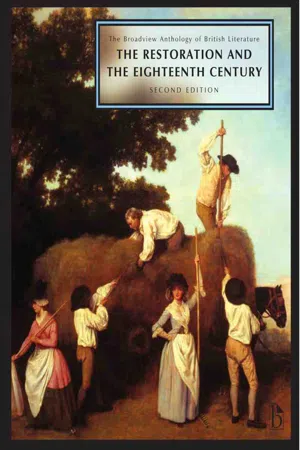
- Joseph Black, Leonard Conolly, Kate Flint, Isobel Grundy, Wendy Lee, Don LePan, Roy Liuzza, Jerome McGann, Anne Lake Prescott, Barry Qualls, Jason Rudy, Claire Waters(Authors)
- 2012(Publication Date)
- Broadview Press(Publisher)
Tribes often defended themselves with violence—both alongside their colonial allies and independently during times of peace between the colonies. As the eighteenth century progressed and the Thirteen Colonies became more self-sufficient economically, they began as well to develop a more distinct sense of political identity. In the last half of the century, when the British government imposed a series of taxes and other legislation on the colonists without consulting local government in the Colonies, American dissenters responded with a cry of “no taxation without representation.” Their argument was that, as Englishmen, they had a right to participate in the decisions of the British Parliament. This disagreement also created turmoil on the opposite side of the Atlantic, with the British pressed to define their political identity as an imperial power. In England, those defending the authority of the crown outnumbered those advocating concessions to the Colonies; although the British were forced to repeal the Stamp Act (the most controversial piece of legislation), they passed the Declaratory Act, a statement of their right to make law for the Colonies unilaterally. Opposition in the Colonies intensified, the British government passed increasingly invasive legislation, and the hostilities escalated into armed conflict; the Revolutionary War, which began in 1775, ended officially with American independence in 1783. This did not, of course, end North America’s relationship with Great Britain. The colonies of British North America (the eastern part of present-day Canada) still belonged to the empire, which continued to expand its territory to the west. And even the newly-formed United States of America remained far more closely tied to Britain, both economically and culturally, than to any other nation. zzz
Index pages curate the most relevant extracts from our library of academic textbooks. They’ve been created using an in-house natural language model (NLM), each adding context and meaning to key research topics.

