History

End of British Empire
The end of the British Empire refers to the period of decolonization and the relinquishment of imperial control by Britain over its colonies and territories. This process occurred primarily in the mid-20th century, with many former colonies gaining independence through peaceful negotiations or, in some cases, through armed struggle. The end of the British Empire marked a significant shift in global power dynamics.
Written by Perlego with AI-assistance
Related key terms
1 of 5
7 Key excerpts on "End of British Empire"
 eBook - PDF
An Anglo-German Dialogue
The Munich Lectures on the History of International Relations
- Adolf M. Birke, Magnus Brechtken, Alaric Searle, Adolf M. Birke, Magnus Brechtken, Alaric Searle(Authors)
- 2015(Publication Date)
- De Gruyter Saur(Publisher)
Robert Holland The End of Empire and British Political Culture In the preceding contribution to this book, John Darwin writes about British policy-making and orientations during the era of decolonization, with an eye chiefly on for-eign policy and the United Kingdom's place in the wider world. This chapter will touch on some of the same ground. The aim, however, in the hope that it may prove complementary, is to focus on Ending the Empire in a narrower sense, that is on the modalities and character of British decolonization as a process. We will say some-thing along the way about the Commonwealth, though the organizational Common-wealth which survives today was never really the heart of the matter. In defence of this approach in a study of foreign policy, one might say that it would be odd in a sur-vey on Britain's overseas dilemmas after 1945 not to dwell at some point on the actual management of decolonization - a decolonization of the United Kingdom, as much as a decolonization of hitherto dependent territories overseas. Acts of decolonization by British Governments were not a steady constant in the decades after 1945 - had it been otherwise, the British body politic would have been under much greater strain. Instead, the end of empire came in concentrated and spo-radic bursts, and with significant intervals. 1 The first rush came in the later 1940s un-der a Labour Government, essentially in South Asia - the ending of the Raj. The sec-ond burst came in the years immediately following 1959 under Prime Minister Mac-millan's Conservatives, the so-called Winds of Change, with an Afro-Caribbean emphasis. The next main phase was the retreat from Aden and the Gulf right at the end of the 1960s. What followed were the loose ends, the odds and the sods.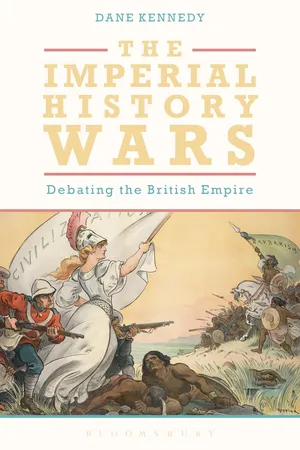 eBook - PDF
The Imperial History Wars
Debating the British Empire
- Dane Kennedy(Author)
- 2018(Publication Date)
- Bloomsbury Academic(Publisher)
2 One attributed the retreat from empire to political pressures at home, another DEBATING THE END OF EMPIRE: EXCEPTIONALISM AND ITS CRITICS 89 to the restructuring of the global economy, a third to international political and ideological forces, and a fourth to the challenge posed by colonial nationalists. Whichever causal forces they credited as the primary ones, these historians agreed on two central points. One was methodological: any explanation of decolonization had to attend first and foremost to the decision-making processes that took place at the highest levels of the British government, characterized in Robinson and Gallagher’s memorable phrase as the “official mind.” How British authorities managed the challenges they faced, whether these were domestic or international, economic or political, was seen as crucial to understanding how the empire came to an end. Some of the impetus for this preoccupation with the “official mind” came from the rolling release of government documents under the thirty-year embargo rule, which was opening up new research opportunities for historians of decolonization. Their investment in the official archive culminated in the publication by Her Majesty’s Stationary Office of the British Documents at the End of Empire series, a dozen volumes of official memoranda, reports, and other records, each of them edited by a leading expert in the field. Series A documented the policies of successive British governments toward the empire from 1927 to 1971, while Series B dealt with the political and diplomatic processes that culminated in independence for particular colonial territories. 3 The other point of agreement was interpretive: British officials’ responses to the growing threats across the empire, while largely ad hoc and incremental, were informed by a determination to cling to key colonial possessions for as long as they possibly could.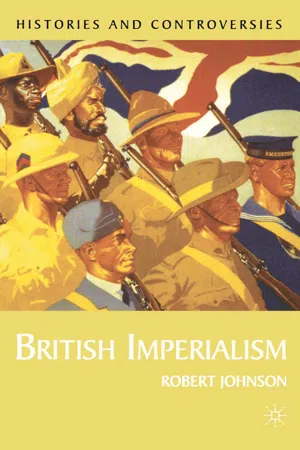 eBook - PDF
- Rob Johnson(Author)
- 2017(Publication Date)
- Bloomsbury Academic(Publisher)
13 Decolonisation after 1945: how did British imperialism end? Decolonisation was a term that came into general use in the 1950s, but it has been challenged since it implies the initiative for the relinquishing of the empire emanated from the metrop-olis. Nationalists have preferred to use ‘liberation struggle’ or ‘resumption of independence’, although the latter claim (imply-ing complete continuity) is tenuous. 1 The date for the origin of decolonisation is also debated. Paul Kennedy argued that the European empires had always contained the seeds of their own destruction. 2 Muriel Chamberlain believes that the loss of India in 1947 marked the turning point for the British Empire, but George Boyce notes that the British had always had a sense of contingency, they had adapted to changing conditions and drew upon these experiences rather than any rigid theories. 3 This flexibility was a strength; it helped them to avoid destructive ideological wars and to withdraw from the imperial experience relatively unscathed. It also provided useful justifications to excuse actions that had been forced upon them. It was easy to see a trend towards eventual self-government in the writings of Liberals and radicals. In 1838, Charles Treveleyan wrote: ‘The existing connection between two such distant countries as England and India cannot, in the nature of things, be perman-ent: no effort of policy can prevent the natives from ultimately regaining their independence.’ 4 The Whig view of history, with its emphasis on linear progress, lent itself perfectly to the idea. However, whilst such liberal views can be criticised as too deter-minist (and in the case of the American colonies clearly mislead-ing), the granting of responsible government to the colonies of settlement does indicate that, in some cases, the realisation of democratic institutions and autonomy within the framework of the Empire was the logical end. 185 eBook - PDF
A History of the British Isles
Prehistory to the Present
- Kenneth L. Campbell(Author)
- 2017(Publication Date)
- Bloomsbury Academic(Publisher)
The colonies in the British Empire helped to define not merely the empire but Britain itself by encouraging its people to become geographically aware of their place in the world and more culturally cognizant of the differences between themselves and their imperial subjects. This had not been the case in the eighteenth century. Although British involvement in India intensified after the collapse of the Mughal dynasty and Robert Clive’s victories at the time of the Seven Years War, the controlling power at the end of the eighteenth century in India was still the East India Company, not the British government. Furthermore, the British defeat in the American War for Independence seemed to suggest that the British Empire was contracting, not expanding. As the empire increasingly became a prominent part of British identity, the British viewed empire building not only as indicative of domestic greatness, but essential to their cachet on the world stage. In our own age, power and imperialism have acquired almost entirely negative connotations among many contemporary historians, but nineteenth-century attitudes towards empire were much more favourable. At the beginning of the nineteenth century, the British government had inherited a diverse and widely dispersed collection of colonies and global interests hardly deserving of the epithet ‘empire’, at least if that term means anything beyond the accumulation of individual territories, because no collective unity or connection among them existed. By the end of the Seven Years War in 1756, Britain had already acquired colonies in the Caribbean and the Mediterranean, while its North American colonies extended from Quebec to Florida. What did the Spanish settlers in Spain have in common with the French settlers in Quebec, or either of them have with the inhabitants of British possessions elsewhere? At this juncture the British thought of the members of their empire as ‘subjects’ who were fundamentally different from them.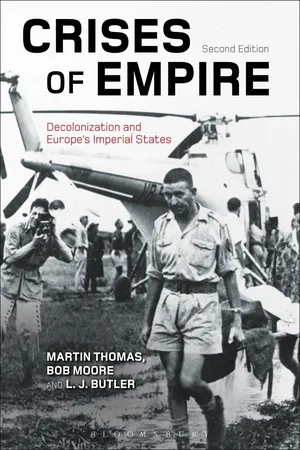 eBook - PDF
Crises of Empire
Decolonization and Europe's Imperial States
- Martin Thomas, Bob Moore, Larry Butler(Authors)
- 2015(Publication Date)
- Bloomsbury Academic(Publisher)
PART I BRITISH DECOLONIZATION Larry Butler 14 INTRODUCTION TO PART I THE BRITISH EMPIRE Because it was the largest of the European overseas empires, the British Empire arguably holds a special place in the history of decolonization. What is particularly striking is that for most of its history the Empire lacked any clear sense of purpose. The Empire fulfilled numerous roles, benefiting a variety of groups, both in Britain and within the individual territories. But the British did not have an avowed ‘mission’, or notion of what the outcome of imperial rule was expected to be. Given the economic, military, and other constraints facing Britain, constraints which intensified as the twentieth century developed, it seemed clear that a global imperial system could only be run if it made minimal demands on the metropole. This meant that, as far as possible, coercion was to be avoided: it was expensive and increasingly likely to attract criticism, both within Britain and in the international arena. The aim of securing cheap, non-controversial rule in the dependent empire involved a search for groups willing to collaborate with the British, groups normally drawn from indigenous elites. In theory, the relationship would be mutually beneficial, with Britain safeguarding the political and social status of such elites in return for guarantees of the protection of its own commercial and strategic interests. Beyond these simple guidelines, it is often difficult to discern any coherent British ‘policy’ for empire. Pragmatic improvisation, rather than detailed and principled planning, seemed to characterize the British approach. After the First World War, this began to change. Firmer commitments were made to ultimate self-government for India, the symbolic heart of the Empire, and its most valued component. And the white Dominions asserted their individuality with increasing assurance, not just culturally, but politically and economically too. eBook - PDF
Nationalizing the Past
Historians as Nation Builders in Modern Europe
- S. Berger, C. Lorenz, S. Berger, C. Lorenz(Authors)
- 2016(Publication Date)
- Palgrave Macmillan(Publisher)
The end of empire brought a decoupling of national and imperial history – a pronounced hesitancy to incorporate empire into the narration of the national story. While there had long been a tacit division of labour between national and imperial historians, the gap seemed to widen with the pace of decolonization from the 1950s to the early 1980s. In the case of Britain, this was partly due to the proliferation of new national histories throughout the former colonial world. The fledgling new nation-states were sustained by new histories, new journals, and new careers for historians who no longer placed Britain in centre frame. While Oxford luminaries like Hugh Trevor-Roper continued to debate whether Africa had a ‘history’ (or merely the ‘unrewarding gyrations of barbarous tribes’ as he infamously put it in 1968), that new history was being written elsewhere. The Journal of African History, founded in 1960, was soon followed by the Journal of Southeast Asian History and the Journal of Pacific History – at the very time that Manning Clark had set out on what he termed ‘the discovery of Australian history’. 2 This fragmentation of focus and expertise, while an understandable and perhaps even necessary corollary to the wider process of decolonization, was ill-suited to preserving a sense of the imperial dimensions of ‘British History’. John Seeley’s 1880 classic The Expansion of England went out of print in 1956 – the same year that Britain’s imperial pretensions were punctured at Suez. While imperial history continued to be written and taught, it became more an enclave on its own than a sub-specialization of national history. Many of its practitioners felt this keenly, and resented the stigma of imperial nostalgia that had become attached to the subject. France shared in the post-imperial amnesia, as post-1945 scholars champi- oned different historiographical priorities. eBook - PDF
Memories of Post-Imperial Nations
The Aftermath of Decolonization, 1945–2013
- Dietmar Rothermund(Author)
- 2015(Publication Date)
- Cambridge University Press(Publisher)
Here the carefully cultivated memory of empire as a liberal, humanitarian and progressive trusteeship – the foundation of Britain’s claim to respect in the non-Western world – was fiercely at odds with a vision of a racially exclusive ‘Little England’. Phase three: After the empire In the late 1970s, Britain was still encumbered with the territorial residues of the empire, including Hong Kong, Gibraltar and the Falkland Islands. Hong Kong was a special case because much of the colony had been leased, not annexed, from China, and the lease would expire in 1997. In both Gibraltar and the Falklands, the population was all but unanimous in its desire to remain under British sovereignty. So far as the British public was concerned, it was encouraged by opinion-formers to regard Britain’s imperial career as a mission more or less satisfactorily accomplished, but no longer of relevance to its present or future. Indeed, the long awaited resolution of the Rhodesian problem, with the achievement of black majority rule and independence (as Zimbabwe) in 1980, seemed to have the seal on London’s emancipation from the most tiresome legacy of African decolonization. Instead, for much of the 1980s, public attention was largely consumed by the economic agenda of Mrs Thatcher’s government – the privatization of state industries, the selling off of public housing and the 30 John Darwin legislative assault on trade union power, culminating in the titanic struggle with the Miners’ Union in 1984. Internationally, Britain’s course was shaped by two dominant influences, neither of which was significantly connected with its imperial past. The first was the uneasy relationship with the European Union, no longer seen as the panacea for Britain’s economic difficulties, and where British governments for long struggled vainly against the dominant Franco-German axis.
Index pages curate the most relevant extracts from our library of academic textbooks. They’ve been created using an in-house natural language model (NLM), each adding context and meaning to key research topics.

