History

Decline Of Empires
The decline of empires refers to the gradual weakening and eventual collapse of powerful political entities. This process is often marked by internal strife, external pressures, economic challenges, and shifts in power dynamics. The decline of empires has been a recurring theme throughout history, with examples including the fall of the Roman Empire, the decline of the Ottoman Empire, and the dissolution of the British Empire.
Written by Perlego with AI-assistance
Related key terms
1 of 5
8 Key excerpts on "Decline Of Empires"
 eBook - PDF
Russian Imperialism
Development and Crisis
- Ariel Cohen(Author)
- 1996(Publication Date)
- Praeger(Publisher)
Parker emphasizes the geopolitics of decline. Similar to the rise, the decline Definitions, Theories, and Methodology 15 results from the change in geopolitical factors—this time an adverse change. The processes of expansion eventually take the dominant state into an unfamiliar and hostile physical environment. This was the nature of the defeat of the Ottomans and the Austrians in the Balkans, the Spaniards in the seas of Northern Europe, and the French and Germans in the frozen Russian steppes. The dominant powers were confronted with physical conditions with which they were unable to cope; native populations that were accustomed to the local environment had an easier time resisting their foreign invaders. Dominant states often expend vast resources trying to defeat a faraway nation and refuse to face the reahty of overextension. As the going gets rough, the rulers of the dominant states increase the centralization of control and attempt to render the population more homogeneous. Elements of the population considered subversive and dangerous to the cohesion of the state—Moors, Jews, Protestants, aristocrats, Armenians—are removed, expelled, or discriminated against. The results of such actions are inevitably the opposite of what was intended—repression leads to widespread dissatisfaction and to resistance to the ruling ehte. Another characteristic of decline is the state's failure to win the final bid for domination or to hold onto its vanishing position of supremacy. As a rule, a combination of opposing powers and internal weakness prove to be overwhelming for the declining empire: As the outlying parts of empire then begin to break away, a resurgence of nationahsm takes place within the core nation itself. There is a nostalgic turning away from the declining empire towards the nation's heroic and semi-mythical past. In both the Ottoman and the Austro-Hungarian empires strong Turkish and German-Austrian nationalism emerged during the period of advanced decline. eBook - ePub
Empires
A Historical and Political Sociology
- Krishan Kumar(Author)
- 2020(Publication Date)
- Polity(Publisher)
It is clear in any case that the post-1945 wave of decolonization, rapid and remarkable as it was, was not the end of the story of empire. The European empires may have gone, at least formally. But not only did that not mean that they did not continue to exercise a formidable degree of informal influence and control over their erstwhile colonies – in many cases, with the willing consent of at least the elites of the newly independent states. There was also the continued existence of the American and Soviet empires, much as they disowned the name of empire. They dominated the international scene after 1945, as global powers that acted frequently as the European empires of old. The Europeans, for their part, came together in a “European Union” that was a kind of substitute for their lost empires, and which in the eyes of some actually had the characteristics of some of the older forms of empire.Empire had, and has, an after-life that continues to affect both the metropolitan societies and the territories over which they formerly ruled. It is to that continuing story of empire that we must now, in conclusion, turn.Notes
- 1. For the role of apocalyptic Christian thought in communicating the “sense of an ending” in a wide variety of contexts in European societies, see Kermode (2000). See also, for the European experience of decline in social and economic terms, Thompson (1998).
- 2. For edited collections and studies of the decline and fall of empires, ancient and modern, see Eisenstadt (1967); Cipolla (1970); Kennedy (1989); Barkey and von Hagen (1997); Dawisha and Parrott (1997); Brix et al. (2001).
- 3. “The collapse of Rome,” says Michael Mann, “is the greatest tragic and moral story of Western culture” (Mann 1986: 283; and see 283–98 for his interesting account of the fall).
- 4. A clear statement of the inevitability thesis is Motyl (2001). See also Parsons (2010).
- 5. Further, as Alexander Motyl says, “if overreach gets empires into trouble after several hundred years of plenitude, surely it cannot be all that alarming” (Motyl 1999: 140).
- 6.
 eBook - PDF
Homo Economicus
The (Lost) Prophet of Modern Times
- Daniel Cohen, Susan Emanuel(Authors)
- 2014(Publication Date)
- Polity(Publisher)
3 The Decline of Empire Late Antiquity The last thirty years mark the swing from a world of restraint towards a world of excess. Yesterday, elites ‘veiled their suc-cesses with old-fashioned decencies’. Now they abandon the middle and working classes to their fates and no longer fear exhibiting their wealth. This rupture can be understood as the passage ‘from an age of equipoise to an age of ambition’. These phrases, which ring true as a way of understanding our era, are in fact used by the historian Peter Brown to characterize Late Antiquity and the beginnings of the slow ‘decline of the Roman Empire’. The transformations at work at that time indeed very much resemble those we are discuss-ing today. 1 The parallel gives an unsuspected depth to the current upheavals. Between the reign of Marcus Aurelius (121–180 CE), an emperor fully planted in the ancient world and its values, and that of Constantine (280–337 CE), who was going to open the doors to the Christianization of the world, the Roman Empire profoundly changed its nature. The idea of a general ‘crisis’ has been mentioned with regard to the third The Decline of Empire 35 century, when scholars talk of a ‘malaise’ of ancient civiliza-tion, ‘a rise in superstition’ or ‘the decline of rationalism’. According to Peter Brown, this malaise is not explained by material causes (economic decline or growing poverty). For him, it is the former model of parity among the elites, with constraints borrowed from the lost past of the ancient pagan city, that broke down. 2 This crisis corresponded to a collapse of the equilibrium in the political and social order. He cau-tions that the transition from the Age of Antonius to the Age of Constantine was not caused by catastrophic crumbling, but rather resulted from a shift from one dominant lifestyle and its forms of expression, to another one, the shift from an age of equilibrium to an age of ambition.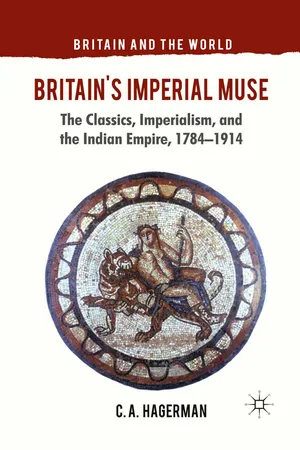 eBook - ePub
Britain's Imperial Muse
The Classics, Imperialism, and the Indian Empire, 1784-1914
- C. Hagerman(Author)
- 2013(Publication Date)
- Palgrave Macmillan(Publisher)
The rather less ‘professional’ realm of imperial discourse, and elite intellectual culture more generally, neither immediately nor completely embraced the philosophical revelation so pithily expressed by J.B. Bury that ‘[o]ne day tells not another day, and history declines to repeat itself.’ 508 Many commentators continued to find useful lessons and examples in classical antiquity. As J.M. Robertson, author of Patriotism and Empire, wrote in 1899, the connection between decline and empire ‘is the lesson read to us in age after age, in civilization after civilization, by empire after empire that has left only its ruins behind to warn us against the errors by which it perished.’ 509 Indeed, the decline–empire link became something of a fetish in imperial discourse during the increasingly intense debate over empire that gathered steam during the closing decades of the century. This debate, which emerged in the 1870s, again highlights the fascinating and fundamental tension in classical discourse’s application to Britain’s imperial present. How did so many members of Britain’s educated elites accommodate their desire and inclination to identify with the ancients in imperial terms, with the disturbing narratives of decline inseparable from empire in antiquity? As we will see below, empire’s enemies had no such issues. They gleefully exploited classical narratives of imperial decline, which provided ready-made arguments from an authoritative source. 510 For many whose material prosperity and perhaps identity depended on the empire, such arguments were profoundly upsetting. Some ignored the uncomfortable consequences of identifying themselves with the ancient archetypes of imperial decay, decline, and fall eBook - PDF
Global Forces and State Restructuring
Dynamics of State Formation and Collapse
- M. Doornbos(Author)
- 2006(Publication Date)
- Palgrave Macmillan(Publisher)
Empires may fall apart into distinct entities, in principle re-combinable in different arrangements. States in contrast supposedly represent core and indivisi- ble units, even though there have been a good number of examples to the contrary. The Ottoman, Austrian-Hungarian and Soviet empires illustrate the point, while the erstwhile Ethiopian empire continues to 93 94 Global Forces and State Restructuring struggle to try and transform itself into a state. Nonetheless, the collapse of an empire may also trigger the breakdown of one or more of its vassal states, as was happening in Tadzjikistan in 1992 (Lieven 2000: 393). Yet understanding the dynamics of state collapse may be no less important than appreciating those at work in state formation. A better grasp of processes leading to collapse should give us additional insights into what makes states work, and what fails to do so. Moreover, although they seem to be situated at opposite ends of a continuum, there are several key connections between the dynamics of state ‘formation’ and state ‘collapse’, which, on closer inspection, may not be as far apart as they first appear. Again, Eisenstadt as already noted in Chapter 1, aptly called for attention to what lies ‘beyond collapse’, as state (and empire) collapse is likely to inaugurate fresh or renewed processes of state formation, thus signifying ‘not the end of social insti- tutions, but almost always the beginning of new ones’ (Eisenstadt 1988: 293). Similarly, Ali Mazrui, referring to the contemporary drama in Africa, asked the cardinal question, ‘Have Somalia, Rwanda, Liberia, Angola, Burundi been experiencing the death pangs of an old order dying and groaning for refuge? Or are we witnessing the birth pangs of a real but devastating birth of a genuinely post-colonial order?’ (Mazrui 1995: 22). eBook - PDF
A Window to the Past?
Tracing Ibn Iy?s's Narrative Ways of Worldmaking
- Anna Kollatz(Author)
- 2022(Publication Date)
- V&R Unipress(Publisher)
© 2022 V&R unipress | Brill Deutschland GmbH ISBN Print: 9783847114482 – ISBN E-Book: 9783847014485 II Stricken with Decline? If there are master narratives in Mamluk studies, the decline paradigm that postulates a quick and overall deterioration of Mamluk rule and culture at the turn of the sixteenth century may rightly be named as a model example. As mentioned in the introduction, decline has been attributed to virtually all the subsystems of Mamluk society during that time. The Ottoman conquest of Egypt and Syria in 921–922/1516–1517 has been interpreted as the necessary con- sequence of said decline from the perspective of Mamluk studies, while the same date marks the beginning of Ottomanists’ interest in the region. 75 From the archaeological point of view, and especially from the perspective of so-called peripheral regions, the decline narrative has been challenged; research has been redirected towards a notion of transition rather than decline. 76 Nevertheless, the paradigm of decline is in no way a purely etic ascription imposed on Middle Eastern history. On the contrary, the emic contemporary sources often guide their readers towards an understanding of the time as one stricken with decline. Modern researchers have taken up the same points of critique the emic sources raised and identified the deterioration of the iqt ˙ a ¯ ʿ system, inflation, internal factional struggles and corruption as both symptoms and motors of decline. Continuing riots from the side of the julba ¯ n and the people have been noted as reactions to and further stimuli of decline. So does Ibn Iya ¯s, cf. his reports on the continuous julba ¯ n riots between 1455 and 1560, including the pillage of the granaries. The year-long insecurity was only ended by a new plague epidemic, which killed many of the rioters, much to Ibn Iya ¯s’s and the population’s relief.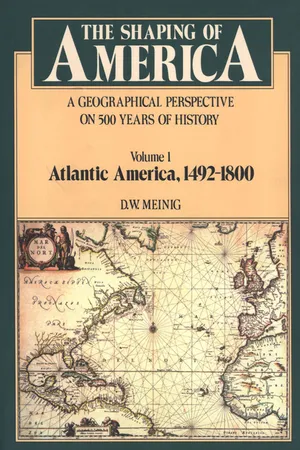 eBook - PDF
The Shaping of America
A Geographical Perspective on 500 Years of History, Volume 1: Atlantic America 1492-1800
- D. W. Meinig(Author)
- 1986(Publication Date)
- Yale University Press(Publisher)
This tendency to resist compromise and to react with force poses a vital threat to the challengers, who will therefore attempt to pressure the provincial population into a unified opposition. Thus an imperial system under stress tends to generate extremism on either side. The outcome of any such threat to the integrity of an empire is obviously affected by many factors. Much depends upon scale and context, upon the relative sizes of populations and resources of the adversaries and upon the larger geopoliti-cal circumstances of the empire. Because we are primarily concerned with a partic-ular case we shall give attention to a particular kind of imperial disintegration, that is, successful revolt initiated in some part of the periphery. We may note in passing two other kinds of disintegration: collapse from within because the center has become so enfeebled as to be unable to serve or to deploy force upon outlying provinces; and dismemberment upon defeat by a rival external power. In any case, because empires are a patchwork they tend to come apart along the seams; that is, because they are geopolitical structures in which the captive, subordinate peoples have territorial identity as outlying provinces each with its own capital city, such units provide the framework of successor states. The victorious revolt of an imperial periphery brings into focus two interdepen-dent topics: the effective mobilization of forces within the periphery and the ineffective application of imperial coercion against that rebellion. The first calls attention to the common fact that in any mature empire revolt is most likely to be 374 REORGANIZATIONS: AN AMERICAN MATRIX initiated and led by those in the periphery who are most familiar with the imperial system. eBook - ePub
Collapse of an Empire
Lessons for Modern Russia
- Yegor Gaidar(Author)
- 2010(Publication Date)
- Brookings Institution Press(Publisher)
CHAPTER ITHE GRANDEUR AND THE FALL OF EMPIRES
You can do anything with a bayonet except sit on it. —TalleyrandIN THE FIRST CENTURY B.C ., the formation of a professional army and the resulting decline of the system of universal military service for free peasants undermined the republican institutions of ancient Rome and prepared the way for a regime in which the army served the ruler in power. The new state structure was called an empire (the term comes from the Latin imperium, power). Since Rome’s power in those days extended over most of the known world, another meaning of the word developed: in Europe “empire” came to mean a multiethnic state created through conquest. After the fall of the western Roman Empire, its mores and traditions continued to influence what happened in the territories that had been part of the empire and were geographically close to the metropolis. These same influences were reflected in the ensuing course of European history.Modern Economic Growth and the Era of EmpiresThe idea of empire—a powerful, authoritarian, multiethnic state, uniting numerous peoples, like the Christian Church—is part of the legacy inherited by medieval Europe from antiquity. James Bryce, a well-known scholar of the Holy Roman Empire, wrote: “Dying antiquity willed two ideas to later centuries: the idea of a universal monarchy and the idea of universal religion.”1 Aphorisms usually oversimplify. That is the case here. The influence of the institutions and Roman law was much more significant for European development than the idea of universal monarchy. However, the connection of the imperial ideal with Roman tradition is indisputable.Many rulers tried to acquire the title of emperor. But through the centuries after the fall of the Roman Empire, only Byzantium was perceived by other European states as the heir to the Roman imperial tradition.2 Byzantium referred to both the eastern and western parts of the Roman Empire. The rulers of Byzantium believed that they had only temporarily lost control over part of the empire’s territory. When Charlemagne was crowned in 800 as emperor of the Holy Roman Empire, gaining recognition by the Byzantine authorities was a serious problem for him.3
Index pages curate the most relevant extracts from our library of academic textbooks. They’ve been created using an in-house natural language model (NLM), each adding context and meaning to key research topics.

