History

From Empire to Nation State
"From Empire to Nation State" refers to the transition of political entities from large, multi-ethnic empires to smaller, more homogeneous nation states. This shift occurred primarily in the 19th and 20th centuries and was driven by factors such as nationalism, self-determination, and the decline of imperial power. It led to the formation of modern nation states based on shared language, culture, and identity.
Written by Perlego with AI-assistance
Related key terms
1 of 5
10 Key excerpts on "From Empire to Nation State"
 eBook - ePub
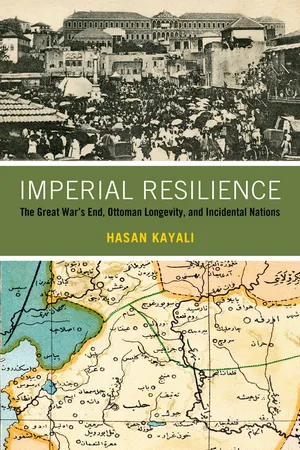
Imperial Resilience
The Great War's End, Ottoman Longevity, and Incidental Nations
- Hasan Kayali(Author)
- 2021(Publication Date)
- University of California Press(Publisher)
IntroductionEMPIRE-TO-NATION TRANSITION AND HISTORICAL REPRESENTATIONS
THE DISSOLUTION OF EMPIRES and their replacement by political formations recognized as nation-states is the paramount transformation of the modern history of the world. The chronological determination of an empire’s end appears straightforward in retrospect, especially if an event with far-reaching repercussions, such as a revolution, military occupation, or defeat in war, is deemed to have marked its exit from the stage of history. Identifying such a landmark inevitably suggests a clear breaking point and concomitant transformation of empire into novel sovereign or sovereignty-seeking entities. This assumption of a clean break from empire to nation-states obscures the dynamics of imperial dissolution, the uncertainties that accompany it, and the alternative paths that present themselves.Empires forfeit their vitality and possessions and vanish after they are reduced to remains in which time-honored practices of rule and social organization lose efficacy and relevance. Both the parts that splinter off and any remaining rump may then reenvision or reconstitute themselves in a different political form, as new or existing leadership cadres within the fragments rechannel ideological, human, and economic resources to internal consolidation. Imperial fragmentation bringing forth nation-states is a familiar process that followed the demise of Europe’s land empires at the beginning of the twentieth century. Secession and shrinkage are not intrinsically sufficient conditions for empire’s devolution or transmutation into nation-states. Nor is significant geopolitical rupture or territorial loss necessary for empire-to-nation transformation, as the modern experience of the “ancient empires” of Iran and China has demonstrated.1Imperial institutions, habits, and practices of governance may persist or modify only gradually for a period of indeterminate length. In Russia, fragmentation occurred after the 1917 Revolution, but the resulting state entities did not crystallize as independent nations until several decades later, notwithstanding the Kremlin’s official rhetoric of “sovereign republics” throughout the Soviet period. eBook - ePub
Changing Europe
Identities, Nations and Citizens
- David Dunkerley, Lesley Hodgson, Stanislaw Konopacki, Tony Spybey, Andrew Thompson(Authors)
- 2003(Publication Date)
- Routledge(Publisher)
The situation in the Balkans indicates that the ideal of the nation-state is one which many groups still consider to be worth fighting for. Elsewhere, numerous movements seek independent nation-states, while national governments continue to speak on behalf of ‘the nation’. Thus the idea of the nation-state arguably remains as appealing as it was two centuries ago. It is nevertheless becoming more difficult now for states to pursue the ideal of the cultural nation as they once did. In western Europe governments have increasingly promoted a civic version of the nation-state, in which citizens hold multiple identities; identifying, for example, with their ethnic group, their nation and/or with the wider polity of which they are citizens. This version of the nation-state has become a necessity in countries that have experienced considerable immigration, as well as perhaps increased demands for autonomy from ethnic and national minorities. In these cases governments have had to search for new ways of maintaining the unity of the nation-state. As we will see, however, in other countries the state has become firmly aligned with one ethnic group. For us, the important questions are whether we will see a movement away from the ethnic nation-state in Europe, and, if so, how will ‘the nation’ be defined in this context? Before considering the current and future prospects of the idea of the nation-state, we must understand the routes this idea has taken.The rise and transformation of the nation-state: 1700s to 1945Searching for the origins of the nation-state is something of a red herring; since pure nation-states do not exist, as noted above, it is not possible to identify when they came into being. As we have said, however, the idea of the nation-state has been enormously powerful in European political history, as governments and political movements have sought to convert the theory into practice. What we need to consider, then, is the nation-state as a process, rather than as an entity. We will therefore focus on three processes: the development of the national territory; the transformation of the state; and the building of popular identification with nation and state.Dimensions of change
With regard to territory there are two points we should make. The first is that it is broadly acknowledged that the significance of national frontiers has developed gradually, since the 1648 Treaty of Westphalia. This Treaty ended the Thirty Years’ Wars that had raged across much of Europe. Among the consequences of the Treaty, arguably the most significant was that it established the principle of sovereignty, thus recognising that sovereigns were the sole source of power within their territory and the representative of that territory in foreign affairs.The second point is that since this period the state has come to increasingly occupy the entire national territory. Until the late eighteenth century, and more particularly the latter part of the nineteenth century, the state made little impact on the mass of the population throughout the national territory. Navari (1981) argues that until the French Revolution monarchs made little attempt to effect centralisation throughout their realm. Indeed, she suggests, if they had it is very likely that various interested parties would have resisted such moves. Significant changes began to happen from the late eighteenth century onwards. The cumulative effect of change in post-Westphalian Europe was that the state increasingly came to occupy and, indeed, create eBook - PDF
- Stefan Berger, Alexei Miller, Stefan Berger, Alexei Miller(Authors)
- 2015(Publication Date)
- Central European University Press(Publisher)
47 See Alfred Stepan, Juan J. Linz, and Yogendra Yadav, Crafting State-Nations: India and Other Multinational Democracies (Baltimore: Johns Hopkins University Press, 2011); idem. “The Rise of ‘State-Nations’,” Journal of Democracy 21, no. 3 (2010): 50–68. 48 Benno Gammerl, Untertanen, Staatsbürger und andere. Der Umgang mit ethnischer Heterogen-ität im britischen Weltreich und im Habsburgerreich 1867–1918 (Göttingen: Vandenhoeck & Ruprecht, 2010); on the intricacies of the relationship between empire and ethnicity, with special reference to the British Empire and the emergence of “imperial ethnicities” within that empire, see also John Darwin, “Empire and Ethnicity,” Nations and Nationalism 16, no. 3 (2010): 383– 401. For recent interesting perspectives on the comparative and transnational history of empire, 18 Stefan Berger and Alexei Miller prominence or lost appeal depending, to a very large extent, on the outcome of the competition between empires. There are many possible continuums where we could locate empires based on various factors which are more or less directly linked to building imperial nations. Overall, we would suggest that it might be possible to group empires according to the combination of factors of imperial nation-building discussed above. We hope that our volume provides reliable foundations for such a classification, which should, among other things, help us avoid the traditional binary oppositions so typical for the existing classifications. Linking Nation and Empire As should be clear by now, it is our conviction that concepts of nation and empire were linked in a variety of ways during the long nineteenth century. These links reflected attempts of elites to make nation fit imperial plans and vice versa. As a matter of fact, the understanding of nation and empire was changing together, as these concepts were strongly entangled.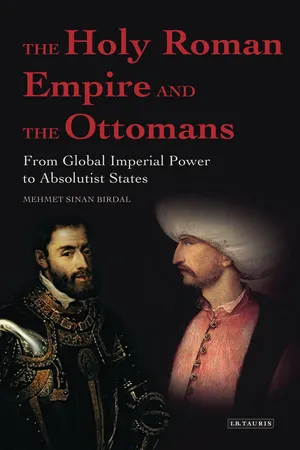 eBook - PDF
The Holy Roman Empire and the Ottomans
From Global Imperial Power to Absolutist States
- Mehmet Sinan Birdal(Author)
- 2011(Publication Date)
- I.B. Tauris(Publisher)
2 FROM EMPIRES TO ABSOLUTIST STATES: POLITICAL CHANGE IN EARLY MODERN EUROPE A major task for a theory of international change is to demonstrate how the rationale for pre-modern states was different from that of modern states and how this difference translated into international politics. The theory should explain how and why the powerful imperial dynasties, Habsburgs and Ottomans, lost their pre-eminence to smaller yet stronger absolutist monarchies. In other words, it should trace the early modern transition from empires that claimed universal suzerainty to absolutist monarchies that recognized the sovereignty of other states. In this regard, international relations theory should first integrate the significant empirical findings and theoretical concepts of the sociology of state formation pertaining to the emergence, maintenance and transformation of pre-modern states. The review of this literature first needs to provide definitions for the different kinds of states in early modern Europe: aristocratic empires and absolutist states, and illustrate why absolutist states were better equipped to compete in the state system than empires. Second, it should delineate what the transition from empire to absolutist state entailed. Empire-states Most studies lump together pre-modern and modern states from different historical periods in a single concept of empire – Athenian, Roman, Mongolian, Inca, Russian, Ottoman, Habsburg and colonial empires of the nineteenth and the twentieth centuries. 1 The definitions in these studies depict the empire as a multiethnic state stretching over vast areas. Generally, an empire denotes ‘a large, composite, multiethnic polity formed by 24 T HE H OLY R OMAN E MPIRE A ND T HE O TTOMANS conquest by a strong center (metropole), and characterized by some form of indirect rule of the subordinate parts.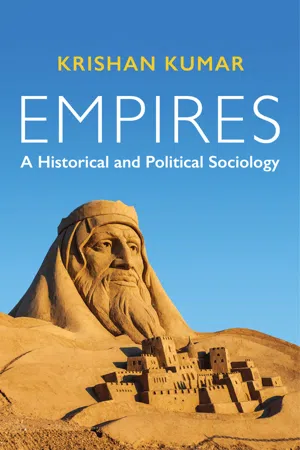 eBook - ePub
Empires
A Historical and Political Sociology
- Krishan Kumar(Author)
- 2020(Publication Date)
- Polity(Publisher)
“We live,” as John Darwin says, “in a world largely made by empires and among ethnic identities as often forged in collaboration with those empires as rallied against them” (2013: 168). It is an understanding frequently lost or distorted in the common habit of pitting nation against empire. Empires make nations, as much as they are, on occasion, opposed by them.Empire Against Nation-State: Divergent Principles
It has been important to show the similarities and overlaps between empires and nation-states because of the persisting tendency to see them as rivals, sworn enemies. Perhaps the strongest underlying feeling, not always made explicit, is that empires are old-fashioned, archaic, part of humanity’s past but not of its present or future. Empires and modernity, it is thought, make awkward bed-fellows. There is no room for empires in the modern world. “This is,” declares Michael Mann (2008: 41, 43), “no longer the age of empires but of nationalism and the nation-state…. Empires are no longer normal.”The preceding account should dispel such an illusion. Empires have been as much a part of modern times as nation-states – arguably, more so. Not only have nations often been made by empires, they have been overseen by them for much of their history. In the twentieth century, empires were the dominant players almost as much as they were in the nineteenth century, supervising, through their directing roles in such organizations as the League of Nations and the United Nations, the emergence and fortunes of nation-states (Mazower 2009a). Nation-states have for much of the time lived in the shadow of empire. Only since the 1960s, perhaps, has it been possible to say that we live in world of nation-states – and, as we have seen, even that statement needs severe qualification.We might go further. Nation-states might seem the norm of the present time. But to many observers, a world of competing nation-states is a recipe for continuing conflict, one that, in the nuclear age, threatens not just the peace but the very existence of humanity. In the wake of the collapse of the “last empire,” the Soviet Union, Charles Maier remarked that “I do believe that we relied on something very like an empire in the postwar period, that it provided an undergirding of peace and prosperity, and that we shall need some equivalent territorial ordering to emerge successfully in the era that has followed 1989” (Maier 2002: 62). eBook - PDF
- Gerard Delanty, Krishan Kumar, Gerard Delanty, Krishan Kumar(Authors)
- 2006(Publication Date)
- SAGE Publications Ltd(Publisher)
Imperial expansion provided the context for a globalizing relation that saw nation-states formed across the world in rela-tion to each other. Each nation-state was ‘unique’, but only made sense in relation to other nation-states. 374 When some writers argue that the earliest cases of territorial nations were in the West – England, France, Spain, the Netherlands and later Russia – there is a further question of ana-lytical anachronism here that needs to be addressed. So far I have argued that though these polities were certainly long-run territorial entities that later became nations, it does not make them continuous nations, or at least it does not make them nations back then. It should however be said that there were ‘nations’ prior to the nineteenth century, but they were not nation-states, and they were not ‘territorial nations’. As a short-hand response to the existence of nations prior to the nation-state, the different ‘stages’ in the history of nations, nationalism and nation-states can be set out as a series of moments. Woven into these moments are practices of imperialism and globalization. The concept of natio existed in the medieval period and earlier, but it meant something completely different from the modern sense of the word ‘nation’: first, in archaic definitions the concept of natio was used as co-extensive with that of ‘tribe’, or what have been referred to as ethnie . Secondly, it referred to traditional communities of erstwhile strangers who found common purpose with each other under conditions of being lifted out of their locales into new settings of face-to-face interaction . This occurred in places such as monasteries, universities and military barracks, places that institutionally marked the traditional imperial extension of states and churches.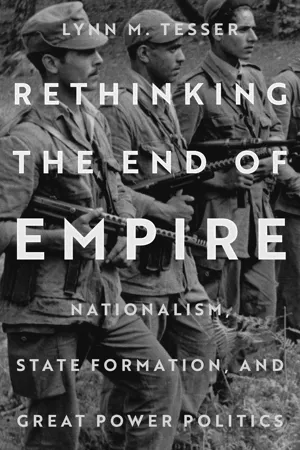 eBook - PDF
Rethinking the End of Empire
Nationalism, State Formation, and Great Power Politics
- Lynn M. Tesser(Author)
- 2024(Publication Date)
- Stanford University Press(Publisher)
7 Such approaches have often been linked with trends in great power problem-framing to- wards unrest, trends that have also been overlooked in these studies. The powers’ multifaceted and intermittent opportunism towards issues of self-determination may be of particular interest to analysts focused on great power competition, as well as idealists striving to elevate justice and equality. For scholars of social mobilization, this book adds interaction with major powers to an already robust explanatory tool kit featuring social network analysis, attention to activists’ framing strategies and host state policies, among other factors (e.g., relative deprivation, alienation). 8 Rethinking Nations and Nationalism Under Empire Analysts who see nationalism as a key catalyst of state birth often portray it as a destabilizing force eroding a government’s power and authority. Nationalism may also be assumed to have a role in the fusion of varied regions and cultures together into a singular entity, or to work in tandem with internal colonialism—when more powerful regions dominate less powerful ones. 9 Such variation suggests the utility of a broad definition of nationalism as the expression of a variety of concepts of nation and of differing goals (e.g., national recognition within a larger imperial formation), whereas nation-statism is a specific demand for a single government for one nation in a contiguous territorial area. 10 Nation refers to a socially, politically, and discursively constructed entity linked with particular populations understood as possessing some degree of shared culture and right to self-rule. 11 The nation-state concept refer- ences thinking central to nationalist ideology: the state serving as a territorial home for a particular nation and allowing its self-determination. Citizens are assumed to be equal in principle, though national or other minorities may be accorded rights on an individual or group basis. eBook - PDF
From Empire to Nation State
Ethnic Politics in China
- Yan Sun(Author)
- 2020(Publication Date)
- Cambridge University Press(Publisher)
conclusion From Empire to Nation State: Lessons and Reforms In concluding, this chapter will draw together the findings and implications from this study. First, it will weigh the feats and faults of the autonomous system in achieving the transition to the nation state for China. Second, it will assess proposals and prospects for improving China’s nation state building. Finally, the chapter will consider the implications of ethnic issues for a rising China. socialist autonomy and transition to nation state Has socialist autonomy allowed the Middle Kingdom to make a successful transition From Empire to Nation State? The official Chinese view is a definitive but not entirely confident yes: China has found the solution in the autonomous system. The findings from this study present a more complicated picture. The socialist system of autonomy did help China to largely inherit the territorial boundaries of the last imperial dynasty and avoided secessionist wars during the transition to a modern nation state. This was a significant achievement. Although China’s imperial system differed from the global expansion of empire in the nineteenth century, its disintegration was spurred by the same forces that impelled the spread of the nation state during the twentieth century. That is, modern nationalism, or the idea that states should be governed by a nationally defined people. As Wimmer and Min argue, insofar as the nationalist doctrine triggers competing projects of state building, the transition From Empire to Nation State has often been associated with secessionist civil war or internal strife against political exclusion by subordinated ethnic groups (2006: 874–7). In other words, the global spread of and transformation to the nation state is itself a major cause of war. The macrohistorical dynamics of nation state formation have applied to the Chinese case as well. There were secessionist moves in China’s outer peripheries 297 eBook - PDF
- Hui Wang, Wang Hui, Michael Gibbs Hill(Authors)
- 2014(Publication Date)
- Harvard University Press(Publisher)
Once we have understood the relationship between Lenin’s The Empire/Nation-State Binary and European “World History” 59 theories of revolution and national self-determination on the one hand and nineteenth-century European political economy on the other— especially the deeply rooted binary between empire and nation-state—it is then possible to understand structural similarities in the problems that occur in interpretations of Chinese modernity made both by Chinese Marxists (who found a theoretical basis for many of their arguments in Leninism) and by the Fairbank school. If we synthesize their analyses of China’s national and social crises, then we can see three broad similari-ties between their arguments. First, China’s crisis is the crisis of an em-pire with vast territory, multiple ethnicities, and major differences in re-gional cultures. Second, governing an empire depends upon a strong and unified central state; this is, in fact, the source of China’s crisis. Third, a unified central state is predicated on a specific political culture, and this political culture is founded upon Confucian culture (and the written Chi-nese language). Thus we can infer the following: the crisis is a crisis of a unified empire, and unified empires always tend toward using central-ized power to govern the state. Methods that lead to the disintegration of despotism, then, will also lead to the disintegration of this empire and its political culture. National self-determination, then, is the main way to resolve the problem of despotism. 42 The empire/nation-state binary in nineteenth- and twentieth-century European thought was produced in a universalist system of knowledge; it spread out across many fields, including political science, economics, law, cultural anthropology, linguistics, archaeology, history, and racial theory. eBook - PDF
Politics in Pacific Asia
An Introduction
- Xiaoming Huang, Jason Young(Authors)
- 2017(Publication Date)
- Red Globe Press(Publisher)
These countries have developed significant experience in managing rela-tions between nations and the state in a multina-tional or divided-nation state environment. In this process, there have been and continue to be great tensions between state and ‘minority’ ethnic groups, and between ethnic groups themselves for control of state institutions or to even break away from the state. Ethnicity is a collective quality of shared history, ancestry, language, culture, religion and/or kinship among a group of people usually in a common ter-ritory and with some sense of collective conscious-ness about their unique collective quality. Box 9.5 Multination states and nation-state building in Pacific Asia There are states in Pacific Asia that have more than one national group claiming nationhood and potentially state-hood. This has been a major challenge for modern nation state building and a significant source of political insta-bility and change in these countries. ● ● Multination states are states in which more than one group seeks equal status and recognition as a constitu-tive member, usually making claims to self-determination. The constitutive members are nations in that they seek a state, or representation within a state, that gives them powers of self-determination either in the form of autonomy or federalism or through power sharing arrangements based on equality with the other constitutive nations. ● ● Multination states face similar structures of conflict. Their existence poses a fundamental challenge to the idea of the homogenous nation state where each state represents a single, relatively cohesive nation. Where this was absent, such a nation needed to be built either on the basis of a common cultural heritage or on the basis of shared political principles. ● ● Nation building and state building are parallel processes.
Index pages curate the most relevant extracts from our library of academic textbooks. They’ve been created using an in-house natural language model (NLM), each adding context and meaning to key research topics.

