History

Fall of the Byzantine Empire
The Fall of the Byzantine Empire refers to the conquest of Constantinople by the Ottoman Turks in 1453, marking the end of the Byzantine Empire. This event had significant implications for the balance of power in Europe and the Mediterranean region, leading to the spread of Renaissance ideas and the influx of Byzantine scholars and texts into Western Europe.
Written by Perlego with AI-assistance
Related key terms
1 of 5
11 Key excerpts on "Fall of the Byzantine Empire"
 eBook - ePub
A History of Europe
From 1378 to 1494
- W.T. Waugh(Author)
- 2016(Publication Date)
- Routledge(Publisher)
CHAPTER XVIIITHE Fall of the Byzantine Empire AND THE TURKISH CONQUEST OF THE BALKAN PENINSULA
T HE capture of Constantinople by the Turks is I one of the most famous catastrophes in history. And it is probable that more important consequences have been erroneously ascribed to it than to any other historical event. It is true that it caused a great shock to the whole of Christendom; but it made very little difference to the relations or prospects of the states of Europe. And though the circumstances attending the fall of the great city lent the catastrophe a certain tragic dignity, the events which led up to it arouse little admiration for any of those concerned. The history of the Balkan Peninsula during the last century of the Middle Ages can scarcely be matched for folly, treachery and cruelty. There was, as we have seen, no lack of brutality and rapine in western and central Europe in those days; but the wars of France or Germany seem chivalrous and humane when compared with the contemporary conflicts of south-eastern Europe. Here and there gleams of heroism relieve the gloom; but too often one finds that the hero is no more than a brave blackguard. Why any of the peoples involved care to dwell on their doings in this period is incomprehensible.The Byzantine Empire in the first part of the fourteenth centuryThe Byzantine Empire had been a magnificent state, and had rendered eminent services to the cause of European civilization, both by the example of its own life and also by its resistance—for long successful—to barbarian or Moslem invaders. But it had been well for its renown if it had never revived after its overthrow by the Fourth Crusade in 1204. For it was never again anything but a quaking ruin, dependent for its continuance more upon the weakness or dissension of its foes than upon its own courage or merits. In the first part of the fourteenth century it held little more on the European mainland than the province of Rumelia—or eastern Thrace—the peninsula of Chalcidice, the city of Salonica, and a small part of the Morea, while in Asia it possessed but a few square miles of land on the shores of the Bosphorus and the Sea of Marmora, together with one or two cities. Its European territories were constantly threatened and often cut short by the Bulgarians and the Serbians, who successively established powerful empires. Central and southern Greece were for the most part under rulers of western origin, Catholic in religion. The republic of Venice had occupied various points on the coast, and many of the Ionian and Ægean islands were held by her or Genoa. And in Asia Minor the Empire was confronted with the rapidly growing power of the Ottoman Turks, who had possessed the ascendancy over their rivals, Christian or Moslem, since the closing years of the previous century. Europeans frequently think of these Turks as though they were ill-disciplined barbarians, formidable through their numbers and ferocity. In reality, the Turkish army had no superior in training, organization, and equipment, and Turkish generalship was quite as good as any with which it was likely to be called upon to cope. eBook - ePub
Coping with Geopolitical Decline
The United States in European Perspective
- Frédéric Mérand(Author)
- 2020(Publication Date)
- McGill-Queen's University Press(Publisher)
The Culture of Decline in Later Byzantium Cecily Hilsdale THE BYZANTINE EMPIRE AND THE PERIODIZATION OF ITS DECLINEAt least since Edward Gibbon, decline has been inevitably associated with fall. Given Gibbon’s focus on the ancient Roman Empire, “New Rome” or Byzantium figures as an empire destined for demise. The later Byzantine period especially is treated as a failed moral, political, and military empire. Chapters 61–8 of his magisterial work cover the period from 1204 to 1453 – that is, from the conquest of Constantinople by the Franks of the Fourth Crusade (1204) to the final conquest of the imperial capital by the Ottomans (1453). The fact that these events are taken most frequently as the main chronological markers of the later Byzantine period is instructive in its own right. How could this period be understood as anything but tragic when bracketed by two cataclysmic moments of destruction and devastation? With its status as final and fleeting, Gibbon understands the later eastern and Christian continuation of ancient Rome as the eve of the empire’s end.1All too often publications devoted to this later Byzantine period, especially art-historical studies, invoke environmental and organic metaphors to encapsulate the mood of immanent ending, and in so doing they suggest that history follows the laws of nature in its cyclical teleology. Title phrases such as the “twilight” of Byzantium, for example, evoke the coming darkness of night; the “final flowering” of culture in this period alludes to the inevitable wilting and decay that prompts a return to primordial earth.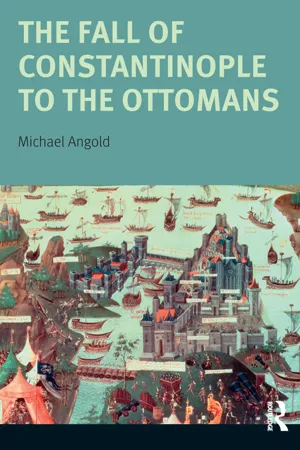 eBook - ePub
The Fall of Constantinople to the Ottomans
Context and Consequences
- Michael Angold(Author)
- 2014(Publication Date)
- Routledge(Publisher)
CHAPTER 1 The fall of Constantinople as a turning pointT he fall of Constantinople is a story that has often been told. It is Sir Steven Runciman who tells the story best in his Fall of Constantinople 1453, which is a consummate example of history as narrative, but even he was beginning to wonder whether the topic merited another book.1 He did not think that over the details of the siege he had much to add to the account given by Sir Edwin Pears in his Destruction of the Greek Empire, which originally appeared in 1903, the year of Runciman’s birth.2 Runciman’s hesitations have not prevented others from undertaking the retelling of the story of the fall of Constantinople. The most recent attempt by M. Philippides and W.K. Hanak is on a massive scale and provides a convincing and detailed reconstruction of the event.3 It is not my intention to provide yet another narrative or to attempt another reconstruction. The focus of my interest will be on the historical significance of the fall of Constantinople to the Ottomans. Was it one of history’s turning points? Such an approach will necessarily highlight its prehistory and its consequences, at the expense of the event itself. But it makes little sense to write about the fall of Constantinople without first providing a brief sketch of those desperate days in April and May 1453.IThe decision taken by the young Sultan Mehmed II (1451–81) to embark on the conquest of Constantinople represented the failure of political arrangements, which for fifty years had allowed Byzantium to survive and to a degree to prosper. He blamed the Byzantine emperor for the political crisis at the heart of the Ottoman ruling institution, which had overshadowed his boyhood. We are never going to know exactly what the forces were which in 1444 persuaded his father Murad II to abdicate in favour of his son, who was not quite thirteen.4 There are, however, pointers, such as rumours that the young Mehmed – or at least the men behind him – were agitating for an attack on Constantinople. There was deep suspicion of the Byzantine emperor, who was blamed for orchestrating a series of Hungarian invasions of the Ottoman Empire, which were only beaten off with great loss of life.5 Some at the Ottoman court were beginning to see an independent Constantinople as a threat to security. They also resented the ascendancy exercised over Murad II by his Grand Vezir Çandarli Halil Pasha, who was an advocate of entente with Byzantium. The conquest of Constantinople will no doubt have appealed to Mehmed II’s youthful bravado nurtured by reading about the exploits of Alexander the Great. Encouraging him was a clique at the Ottoman court, which in the search for preferment had attached itself to the young sultan. From the names that we have they seem to have been predominantly from Christian families, but converts to Islam brought up at the Ottoman court. They were slave administrators and represented a new political force, which emerged as an Ottoman central government began to take clearer shape. They had a vested interest in extending the effective authority of the sultan, but were frustrated by Murad II, who preferred to maintain the status quo, ably seconded by his Grand Vezir. His was always the voice of moderation. When in 1437 Sultan Murad II was contemplating a punitive expedition against Constantinople, there was one dissenting voice, that of Halil Pasha. He argued that any attack on Constantinople would throw the emperor into the arms of the Latins. It was better to let matters take their course, since the Ottomans had little to fear, protected as they were by a series of treaties.6
- Alexander A. Vasiliev(Author)
- 2012(Publication Date)
- University of Wisconsin Press(Publisher)
Byzantine history extends from the accession of Leo the Isaurian in 716, to the conquest of Constantinople by the Crusaders in 1204. (3) After the de- struction of the Eastern Roman Empire, Greek history diverges into many channels. The exiled Roman-Greeks of Constantinople fled to Asia and es- tablished their capital at Nicaea; they prolonged the imperial administration in some provinces on the old model and with the old names. In less than sixty years they recovered possession of Constantinople; but though the government they established retained the proud title of Roman Empire, it was only a very poor replica of even the Byzantine state. This third period Finlay called the Greek Empire of Constantinople. Its feeble existence was terminated by the Ottoman Turks when they took Constantinople in 1453. (4) When the Crusaders conquered the greater part of the Byzantine Empire, they divided their conquest with the Venetians and founded the Latin Em- pire of Romania with feudal principalities in Greece. The domination of the Latins marked the decline of Greek influence in the East and caused a rapid diminution in the wealth and numbers of the Greek nation. This period extends from the conquest of Constantinople in 1204 until the conquest of Naxos by the Ottoman Turks in 1566. (5) The conquest of Constantinople in 1204 caused the foundation of a new Greek state in the eastern provinces of the Byzantine Empire, called the Empire of Trebizond. It represents a curious episode in Greek history. Its government bore a strong resemblance to the Georgian and Armenian monarchies, indicating the influence of Asiatic rather than European manners. For two and a half centuries it exercised considerable influence, based, however, on its commercial position and resources rather than on its political strength or Greek civilization. It had little influence on the fate of Greece, and its conquest in 1461 excited little sympathy. eBook - PDF
- Michael J. Decker(Author)
- 2016(Publication Date)
- Bloomsbury Academic(Publisher)
The Byzantine Dark Ages 42 a decline in access to technologies that arguably made normal activities like eating, drinking, and bathing not only possible but more diverse, stimulating, and pleasurable. This discussion has focused chronologically on the period just prior to that under consideration here, namely the fourth through sixth centuries AD. Nonetheless, the form and content of the debate is of the greatest relevance for the Byzantine East, where it is generally agreed that prosperity continued into the seventh century. The ‘decline’ or ‘transformation’ might be delayed by a century or two, but the same questions demand answers: Did the Byzantine state fail rather suddenly due to military or other pressures or some combination thereof? Did prosperity (whatever that means) fade with the weakening of the state, or before it and thus contribute to the fall? In other words, was there a Byzantine ‘decline and fall’ that ushered in the Dark Ages, a ‘fall and decline’ in the midst of these comparatively poorly chronicled centuries, or something entirely different – a slow transformation or group of changes in society which we have heretofore ignored or been confused about? eBook - ePub
- George Finlay(Author)
- 2018(Publication Date)
- Perennial Press(Publisher)
THE FALL OF THE BYZANTINE EMIRE ~ SECTION I THE REIGN OF ISAAC II (ANGELOS), A.D. 1185-1195. THE BYZANTINE EMPIRE WAS NOW hurrying rapidly to its end, and little is left to record except the progress of its dismemberment and destruction. The despotic power of the emperors was so firmly established, that every executive act emanated directly from the imperial cabinet. But, in perfecting this system of centralization, every tie of interest which had once attached the provincials to the imperial authority had been broken. The adhesion of the distant countries and various nations which composed the empire was destroyed; while, at the same time, the vital energy of the Greek population, which had grown to be the dominant race, was weakened by the immorality which, under the house of Comnenus, had spread through every rank of society. The defensive powers of the empire were consequently rapidly diminishing. The lavish expenditure of the imperial court impelled the government to carry its fiscal exactions so far, that the whole annual profits of the people’s industry were absorbed by taxation, and only the inferior classes of the cultivators of the soil and the day-labourers were able to retain the scanty surplus of wealth necessary to perpetuate their existence. Indeed, it is evident that encroachments were constantly made on the vested capital accumulated in past ages; and the funds appropriated in preceding times to uphold the most indispensable adjuncts of civilization were either annihilated or diverted from their destination. Ports, bridges, roads, aqueducts, and fortifications were seen falling to ruin in every province. Court spectacles and ecclesiastical ceremonies at the capital absorbed the funds which had been accumulated in distant municipalities for local improvements, hospitals, and schools
- Alexander A. Vasiliev(Author)
- 2012(Publication Date)
- University of Wisconsin Press(Publisher)
Disorganization in all parts of the state machinery and decay of the central imperial power are the characteristic traits of the period. The 201 See Travels of V. G. Barsky in the Holy Places of the East from 1723 to 1747, ed. N. Barsukov, I, xxxiii. 292 S. Eustratiades and Arcadios of Vatopedi, Catalogue of the Greek Manuscripts in the Library of the Monastery of Vatopedi on Mt. Athas. 293 See G. Rouillard, "Les Archives de Lavra (Mission Millet)," Byzantion, III (1926),253. G. Rouillard and P. Collomp, Actes de Lavra (1937), I. 294 Eustratiades and Arcadios, Catalogue of Greek Manuscripts, i. 295 Th. I. Uspensky and V. BeneSevic, The Acts of Vazelon. Materials for the History of Peasant and Monastery Landownership in Byzantium from the Thirteenth to the Fif· teenth Century. The Fall of Byzantium long dynastic strife of the two Andronicoi, grandfather and grandson, and of John V Palaeologus and John Cantacuzene; submission to the popes with the view of achieving union and in connection with this, the sometimes hu- miliating voyages to western Europe of the emperors (John V, who was ar- rested at Venice for debt, Manuel II, and John VIII, similar abasement and humiliation before the Turkish sultans in various forms), the of tribute, forced stays at the Turkish court, and the giving of the imperial princesses in marriage-all this weakened and degraded the power of the By- zantine basileus in the eyes of the people. Constantinople itself, which had passed into the hands of the Palaeologi after sack and pillage by the Latins, was a ruin of the city it had been before. Greek writers and various foreign travelers and pilgrims, who visited Con- stantinople at that time, all testify to the decay of the capital. eBook - PDF
The Uses of the Middle Ages in Modern European States
History, Nationhood and the Search for Origins
- R. Evans, G. Marchal, R. Evans, G. Marchal(Authors)
- 2010(Publication Date)
- Palgrave Macmillan(Publisher)
The only topos the emerging nations could derive from this fact was a permanent rhetoric of defeat, with messianic overtones. One outcome of this is the com- plex legend of the battle of Kosovo for Serbia (abused by Slobodan Miloševic´ in his fatal speech in 1989 on the same battlefield); another is the myth of the last Byzantine emperor. 23 Thus, apocalyptic thinking replaced historical narrative. Secondly, the true heir of the Byzantine Empire, and to a certain degree of the Bulgarian tsars, was, as I have said before, the Orthodox Church with the patriarch residing in the new-old centre of power, Constantinople. This Church formed an integral part of the power elite of the Ottoman state, the church hierarchy enjoyed many privileges, and its monasteries were richly provided for by Ottoman officials – Christian and non-Christian alike. This resulted in a confusion of historical identity among the members of the leading Christian elites in the late Ottoman Balkans. The Greek, or Hellenized representatives of the Enlightenment, on whom I will concentrate in what follows, rejected the Byzantine and Ottoman past in toto until well into the nineteenth century. 24 So, Adamantios Korais, in his famous Mémoire sur l´état actuel de la civilisation de la Grèce (1803), depicted the whole span of history from the Roman conquest of Greece up to his own time as a period of permanent alienation and decay. The model for the emerging Greek nation state could only be Ancient Greece. 146 The Uses of the Middle Ages in Modern European States And it was Ancient Greece as dreamt by European classicists, mainly British and German ones. For Greece, this resulted in an almost complete rejection of her medieval past up to the 1880s. Byzantium was a dark stain against which ancient-modern Greece (i oraia Ellas) had to be born/reborn. From this approach followed the attitude of the recently established nation state of Greece – an attitude that in some aspects remains today. eBook - PDF
AETOS
Studies in Honour of Cyril Mango presented to him on April 14, 1998
- Ihor Sevcenko, Irmgard Hutter, Ihor Sevcenko, Irmgard Hutter(Authors)
- 2012(Publication Date)
- De Gruyter(Publisher)
If general surveys have become rare, the reason cannot simply be that they have gone out of style, since any survey that follows trends in the second-ary literature will be fashionable almost by definition 6 . The reason seems rather to be that with the growth of that secondary literature surveys have become increasingly hard to write. To survey the Byzantine field now requires an unusual degree of either perseverance or carelessness, or perhaps both, and invites more criticism than ever, as specialists find errors made in surveying their specialties. Such considerations may also explain why in recent years general reflections on Byzantine studies have become uncommon. If this rarity has had any good effect, it has been to reduce Byzantinists' interest in the unprofitable subject of periodization, and especially in the question of when Byzantium began. I would avoid the matter altogether if I did not disagree with the emerging consensus that the seventh century marked the end of the ancient world and the beginning of Byzantine history 7 . My own view, formed while planning the book and confirmed while writing it, is a more traditional one: that the main breaks in the political and social history of the Greek East were the third-century crisis of the Roman Empire and the Ottoman conquests of the fourteenth to fifteenth centuries. I adopted these as the beginning and end of Byzantine history, even though they led me to in-clude in the Byzantine period the reign of Diocletian, when Byzantium was a town of no special significance. If I were to choose the most important break between Diocletian and the fall of Constantinople, the Fourth Crusade rather than the seventh century seems the event which had the most shattering impact. The invasions of the seventh century — unlike the disasters of the third century, 1204, and 1453 — 4 R. Krautheimer, Early Christian and Byzantine Architecture, Harmondsworth 1986, 11 (preface to the first edition, dated 1963). eBook - PDF
The Balkans
From Constantinople to Communism
- D. Hupchick(Author)
- 2002(Publication Date)
- Palgrave Macmillan(Publisher)
B Y Z ANTI U M DECL IN ES 7 1 venomous cultural animosity. The wholesale raping, pillaging, and plundering inflicted on the stricken city, the largest and wealthiest in the world at the time, were unprecedented. The Orthodox East never forgot or forgave the Catholic West for the sack of Constantinople, and the event sealed the gulf between the two European societies. Illustrating the extent of Byzantium’s internal decline preceding the catastophe was the ease with which Thrace, southern Macedonia, Thessaly, Attica, and the Peloponnese fell to the crusader forces following Constantinople’s fall. In feudal fashion, the victors divided the conquered territories among themselves. Baldwin of Flanders was proclaimed emperor of Constantinople (1204-5), controlling Thrace and a small strip of northwest Anatolian territory. Montferrat received the Kingdom of Thessaloniki, encompassing the region around the city, part of southeastern Macedonia, and Thessaly. The rest of the territorial spoils—the Duchy of Athens (the city and the region of Attica) and the Principality of Achaia (the Peloponnese)— were distributed as vassal fiefs to leading warrior princes. Venice received control over a part of Constantinople, most of the Aegean islands, and small corners of the Peloponnese, Crete, and the cities along the Adriatic coast, while the Venetian Pier Morosini was raised to Latin (Catholic) patriarch of the East. Faced with a fait accompli, Pope Innocent III accepted the destruction of Byzantium as God’s will. The resulting Latin Empire, weakened from inception by Western-style feudal rivalries, sank few roots in the hostile Orthodox East. Three Orthodox states emerged as contenders for expelling the Latins and reestablishing the Orthodox Empire. The first was the so-called Empire of Nicæa, founded in Anatolia by refugees from Constantinople. Under Theodore I Laskaris (1204-22) the Nicæans effectively kept the Latins bottled up in their Anatolian coastal foothold. eBook - PDF
The Collapse of the Eastern Mediterranean
Climate Change and the Decline of the East, 950–1072
- Ronnie Ellenblum(Author)
- 2012(Publication Date)
- Cambridge University Press(Publisher)
The Byzantine Empire without eastern Asia Minor, Armenia and Cappadocia, which were lost forever, was no longer the same empire. The years between the defeat of 1071 and the accession of Alexius Comnenus, in 1081, were a period of internal strife and further penetration of enemies into the heart of the decaying empire. 52 Thus did Attaleiates describe the situation: Under this emperor [Michael VII] almost the whole world, on land and sea occupied by the impious barbarism, has been destroyed and has become empty of population, for all Christians have been slain by them and all houses and settlements with their churches have been devastated by them in the whole East, completely crushed and reduced to nothing. 53 50 For the Turkish penetration into Asia Minor in the eleventh century, see Speros Vryionis, The decline of Medieval Hellenism in Asia Minor and the process of Islamization from the eleventh through the fifteenth century (Berkeley: University of California Press, 1971), pp. 69–117. See also Paul Wittek’s lecture, ‘Turkish Asia Minor up to the Osmanlis’, included in his The rise of the Ottoman Empire (London: Royal Asiatic Society, 1938). 51 The situation in southern Italy is described in a letter written on the 11 November 1064, which was directed to the head of the yeshiva from the great merchant Nehorai b. Nissim, who writes ‘on the business, generally that is, the state of the ships and the people arriving on them, and the news from Sicily and the burning of ships and the impoverishment of our people . . .’ Moshe Gil, Palestine during the first Muslim period, 3 vols. (Tel Aviv University, 1983), vol. III, no. 500, lines 20ff. (Hebrew). 52 For the years 1071–81 see Vryionis, Decline of medieval Hellenism, pp.
Index pages curate the most relevant extracts from our library of academic textbooks. They’ve been created using an in-house natural language model (NLM), each adding context and meaning to key research topics.

