History

Ottoman Empire in the Balkans
The Ottoman Empire's presence in the Balkans, spanning from the late 14th century to the early 20th century, significantly shaped the region's history. The empire's rule brought about cultural, religious, and administrative changes, leaving a lasting impact on the Balkan states. The Ottoman Empire's influence in the Balkans ultimately declined due to a combination of internal strife, external pressures, and nationalist movements.
Written by Perlego with AI-assistance
Related key terms
1 of 5
11 Key excerpts on "Ottoman Empire in the Balkans"
 eBook - ePub
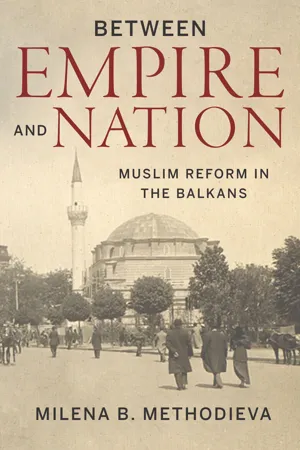
Between Empire and Nation
Muslim Reform in the Balkans
- Milena B. Methodieva(Author)
- 2021(Publication Date)
- Stanford University Press(Publisher)
1 The Ottoman Imperial Context Ottoman Rule in the Balkans and the Formation of Muslim Communities The Balkans had only sporadic contacts with Islam and Muslims prior to the fourteenth century. From the eighth century onward, the Byzantines felt the growing military pressure of Arab armies, which besieged the capital Constantinople twice. In the thirteenth century a group of Seljuk Turks seeking refuge in the Byzantine domains were resettled in the area between the Danube delta and Varna. Those who stayed permanently converted to Christianity, setting the beginning of the Gagauz community. 1 Turkish mercenaries also served in the Byzantine civil wars. Yet, it was the Ottoman conquest of the region that brought it into more extensive contacts with Islam and led to the permanent establishment of Muslim communities. The Ottoman state emerged from a small Turkoman principality, or beylik, in northwestern Anatolia. It was one of many such entities that sprung up in the area following the movement of Turks from Central Asia from the eleventh century onward and the dissolution of the Seljuk Empire that had displaced the centuries-old Byzantine supremacy. The people of these principalities were predominantly nomads-pastoralists, but at the same time they engaged in a particular kind of warfare, gaza, fueled by religious fervor and the prospects of booty. 2 The start of the rule of Osman in 1299 is usually taken as the birth of the Ottoman state, although it would take a while for the modest principality to turn into a large empire. Being conveniently located next to the rump of the Byzantine domains, Osman’s people launched upon steady expansion at the expense of the ailing empire and some of their Muslim gazi neighbors. Along the way they attracted more followers. In 1354 under the leadership of the second ruler, Orhan, the Ottomans gained a foothold on the Gallipoli peninsula; from there they made their way into the Balkans No longer available |Learn more
- Charles Jelavich, Barbara Jelavich(Authors)
- 2012(Publication Date)
- University of Washington Press(Publisher)
CHAPTER 1 The Ottoman Background G e n e r a l C o n d i t i o n s of L ife A t the beginning of the nineteenth century the greater proportion of the Balkan territories formed part of the Ottoman Empire. Stretching over a wide expanse that embraced Asian, African, and European lands, this state occupied a strategic position which made its fate a matter of vital concern to all of the great powers. Within its European territories, comprising about 238,000 square miles and containing approximately 9 million people, the Ottoman government controlled a predominantly Christian population. Although these people were governed under a system, unique in Europe, which divided them according to their re-ligious affiliation, an Ottoman administrative network nevertheless cov-ered the peninsula. The area was divided into five provinces: Rumelia, Bosnia, Silistria, Djezair (including the Peloponnesus and the Greek islands), and Crete. These were in turn organized into nine subdivisions: Rumelia, Bosnia, Belgrade, Shkoder (Scutari), Janina, Negropont, the Morea (Pelopon-nesus), Candia (Crete), and the Archipelago. Certain areas with wide rights of self-government were also attached to the empire: for instance, the two Romanian provinces of Wallachia and Moldavia and some Greek islands. This pattern underwent many changes in the nineteenth cen-tury. Each of these divisions was staffed by Ottoman officials appointed from Constantinople. The administrative head of each was usually sup-ported by a council (divan) of assistants and by a hierarchy of state of-ficials, including judges, tax collectors, police, and military officers. The primary concern of these men was the defense of the empire, the collec-tion of taxes, the maintenance of public order, and the affairs of the Muslim inhabitants. Cities, towns, and villages also had similar officials. Although this Ottoman administration exerted a great deal of direct influence on all of the Balkan people, the Christian communities in fact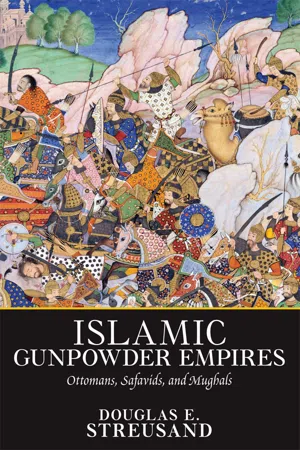 eBook - ePub
Islamic Gunpowder Empires
Ottomans, Safavids, and Mughals
- Douglas E. Streusand(Author)
- 2018(Publication Date)
- Routledge(Publisher)
Chapter 3 The Ottoman EmpireT he Ottoman Empire’s long history, large size, and pivotal location offer multiple angles of approach to historians. Western historians have commonly seen the Ottomans as an alien threat, part of the Turkic third wave of Islamic aggression against Christendom. From the perspective of Islamic history, it was part of the second political and cultural flowering of the Islamic world. From a geographic perspective, it appears as a reassertion of the imperial pattern of the Eastern Roman (Byzantine) Empire. Fernand Braudel considers the Ottomans part of a unified and coherent Mediterranean region. Arab historians, like the Europeans, regard the Ottomans as intruding aliens. Each of these views of the Ottomans has an element of truth. The Ottomans carried the traditions and conflicts of the post-Abbasid Turko-Irano-Islamic political matrix into the fertile ground—literally and figuratively—of western Anatolia and the Balkans. Its geographic setting, the specific circumstances of its development, the quality of its leadership, its institutional development, and its military organization permitted the Ottoman polity to overcome the chronic weaknesses of post-Abbasid political formations and establish an enduring and extensive empire. The Ottomans integrated themselves into the political and economic environments of Europe and the Mediterranean.For more than two generations, most historians have accepted the view of Paul Wittek that the Ottoman state, from beginning to end, had one primary reason for being: ghaza , which Wittek does not distinguish from jihad. Heath Lowry has recently demolished the Wittek thesis and discredited much of the scholarship behind it. As explained in chapter 2 , frontier ghaza did not coincide with the legal concept of jihad. Even after a more formal and legal conception of ghaza eBook - PDF
Rethinking the Late Ottoman Empire
A Comparative Social and Political History of Albania and Yemen, 1878-1918
- Isa Blumi(Author)
- 2010(Publication Date)
- Gorgias Press(Publisher)
A good case in point is the tragic events surrounding the wars in the Balkans during the 1990s. Largely ignored in the cacophony of speculators who pontificated on the origins of the war was the voice of the Ottomanist. Why was it that journalists became the authorities of Balkan conflicts and even published what are considered the most important historical works of the region's Ottoman past? Every single book published on the break-up of Yugoslavia and the war in Kosova paid lip-service to what Maria Todorova and Denis Rusinow called the Ottoman Legacy. The problem however, is substantially more serious than one of acknowledging that the Ottoman ^'Practicing Criticism, in Michel Foucault, Politics, Philosophy, Culture: Interviews and Other Writings 1977-1984, edited by Lawrcnce D. Kritzman, trans. Alan Sheridan, (New York: Routledge, 1988): 154-155. 10 R E T H I N K I N G T H E L A T E O T T O M A N E M P I R E Empire had a role in shaping contemporary political events. 1 The issue is the manner in which the empire and the socio-political processes it created has been categorized by the journalists and political scientists writing on the modern Balkans. Without even the pretense of using Ottoman or for that matter, any other archival material of the period, the last ten years of scholarship on the Balkans has created a monolith of this thing called the Ottoman Empire. The problem has been plain for me to see: Ottoman historiography and its practitioners are at best, marginal in the dialogue about the region's recent history. Worse, they have proven to be utterly incapable of recognizing the opportunity to use their particular expertise to engage in the debates about the Balkans. The consequences have been devastating in the diplomatic and post conflict administration of the region. I have been on a personal crusade of sorts over the past eight years.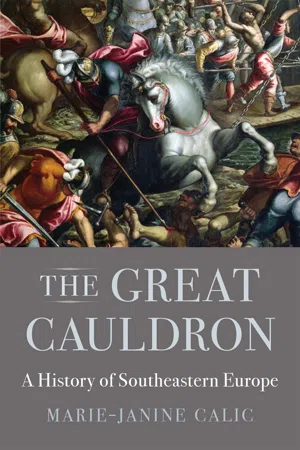 eBook - PDF
The Great Cauldron
A History of Southeastern Europe
- Marie-Janine Calic, Elizabeth Janik(Authors)
- 2019(Publication Date)
- Harvard University Press(Publisher)
Rivalry over access to human and material resources became a driving force of world-wide exploration, and more broadly, historical change. Conceptions of im-perial sovereignty informed not only the mobility of people, goods, and ideas but also the way that the world grew together. As trade relations ex-panded, networks of interdependence became more closely interwoven, and a transcontinental division of labor emerged. 3 The Ottoman Empire’s Rise to Power No other event influenced the world of the Balkan peoples as decisively as the Ottoman conquest. Islamization, imperial rule, and waves of migration touched off groundbreaking sociocultural changes. The first steps in this process commenced around 1300, when “frontline soldiers in holy war” first emerged from the Ottomans’ small emirate in northwest Anatolia. In 1302 Osman, the dynasty’s founder, defeated a Byzantine army of the great cauldron 72 mercenaries. In 1326, after further victories, he moved his capital to the former imperial city of Bursa. Osman’s son Orhan continued the process of expansion on European soil. In 1354 he occupied the Byzantine fortress of Gallipoli along the Dardanelles, allowing the Turks to advance across the Balkan Peninsula nearly unchecked. In less than one century, the sul-tans extended their dominion across the majority of southeastern Europe. In 1361 Murad I captured the city of Adrianople (Edirne) in eastern Thrace, making it the capital of his empire. Turkish armies quickly overran Plovdiv, Ni š , and Sofia. They fought the Serbs on Kosovo Polje, and they overtook Macedonia, Epirus, and Albania. They expanded eastward through Ana-tolia at the same time. By the time Turkish troops captured the imperial city of Constantinople in 1453, the West was in shock. Sovereignty and Governance in Rumelia In the historical memory of the Greeks and the entire Western world, the fall of Constantinople became a source of trauma like the Serbs’ experi-ence of the battle on Kosovo Polje.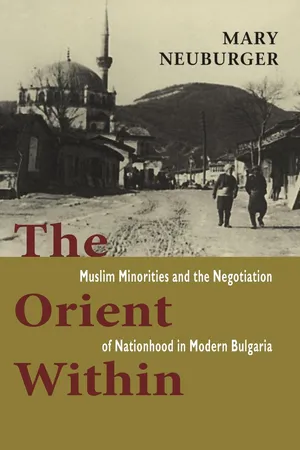 eBook - PDF
The Orient Within
Muslim Minorities and the Negotiation of Nationhood in Modern Bulgaria
- Mary C. Neuburger(Author)
- 2011(Publication Date)
- Cornell University Press(Publisher)
A closer look at the Ottoman period reveals-for historians now as then-the dilemma of imposing clear boundaries and categories onto a society where East and West were often indistinguishable, woven together into a pat-tern of continuous and intermingled difference. Surprisingly, it is only re-cently that scholarship on the Ottoman Empire has begun to challenge the di-chotomous analyses that, as with Bulgarian historiography, present Ottoman history in terms of a grand clash of religions or national cultures. Numerous contemporary sources have revealed that from its inception the Ottoman polity emerged from a synthesis of peoples, cultural influences, and legacies, Roman-Byzantine as well as Islamic. 23 Cemal Kafadar, for example, explores how the complex Ottoman experience had the profound effect of creating a deep cultural synthesis that marked the Ottoman ethnoscape with alliances, interactions, coexistence, and a symbiosis that was both possible and com-mon.24 The emergence of such a synthesis resulted in part from porous and flexible Ottoman administrative practices on the local level that left behind a tangle of cultures and dominions, often without clear boundaries. These 21 Georgi Rakovski, Izbrani Suchineniia (Sofia, 1946), 66. 22 In fact, a critique of Western concepts and practices was imbedded in European influence itself. The writings of self-reflective Russian intellectuals such as Herzen, Bakunin, and Cherni-shevskii, in particular, held sway over Bulgarian nationalist-revolutionary thought. Marin Pund-eff, Bulgarian Nationalism, in Nationalism in Eastern Europe, ed. Peter Sugar and Ivo Lederer (Seattle, 1994), III. 23 See Donald Quataert, The Ottoman Empire, I700-r922 (Cambridge, U.K., 2000), 3-4; and Cerna! Kafadar, Between Two Worlds: The Construction of the Ottoman State (Berkeley, 1995). 19. 2 4 Kafadar, Between Two Worlds, 19.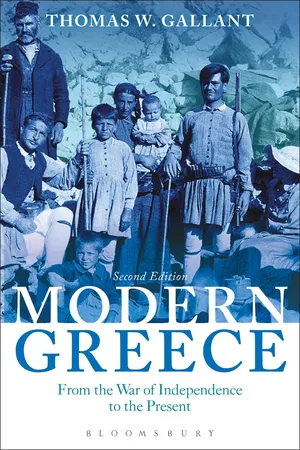 eBook - PDF
Modern Greece
From the War of Independence to the Present
- Thomas W. Gallant(Author)
- 2016(Publication Date)
- Bloomsbury Academic(Publisher)
In addition to change over time, we also have to recognize that there was a diversity of experience. Different people in different places from different sectors of society experienced Ottoman rule differently. What I want to do in this chapter, then, is to sketch out those key elements of society, politics and economy that developed during the period of Ottoman rule and that most deeply shaped Greek society on the eve of the revolution of 1821. There are a number of key turning points in the history of the Empire, and we can divide Imperial history into three main phases: the first one covers the period from 1345, when the Ottomans first established a foothold in Europe, to the reign of Suleiman the Lawgiver in the sixteenth century; the second extends from the period of his rule until the end of the Ottoman–Russian War of 1768–74; and the third covers the era from the end of that conflict until the early nineteenth century. We begin with the entry of the Ottomans into Europe. Building the Empire (1345–1566) By the middle of the fourteenth century, the unity of the once great Byzantine / Eastern Roman Empire had been shattered, and Constantinople repeatedly found itself at war with various other Christian kingdoms in the region, such as the Serbs and the Bulgarians. Moreover, even among the Byzantine ruling elite, there were destructive struggles for power. It was in 1345 in the midst of one THE GREEK WORLD IN ITS OTTOMAN CONTEXT 3 such internecine conflict that the Ottomans entered Europe, having previously established a small polity in northwestern Anatolia. The Ottomans crossed into Europe not as invaders but at the behest of one side in an on-going Byzantine civil war. Once there, they settled in and began to systematically expand their domain in the Balkans. By 1369 all of Thrace was under their control to the extent that Murad I shifted his capital from Bursa to Edirne (Adrianople).
- Justin McCarthy(Author)
- 2010(Publication Date)
- Gorgias Press(Publisher)
As elsewhere, most of the new commerce was in the hands of Christian merchants, who were the preferred partners of the European Christians. All was tied into the Austrian economy. 164 T H E M I D D L E E A S T A N D T H E B A L K A N S HISTORY An Ottoman official looking at a map of Bosnia in 1800 might have despaired. Bosnia was in such a dismal geographic position that any Ottoman leader would have thought twice before committing resources to it that could be spent on more secure places. Geographically, it was far removed from the center of Ottoman authority. Sarajevo was almost twice as far from Istanbul as it was from Vienna, the Austro-Hungarian capital; Belgrade, the Serbian capital, was four times closer than Istanbul; Bosnia's northern districts were closer to Berlin than Istanbul; Bosnia's northern districts were closer to Berlin than they were to Istanbul. This might have had little effect on Ottoman rule of the province if the Ottoman empire had had adequate military power and modern transportation, but it had neither. The Austrian empire, on the other hand, surrounded Bosnia on two sides. If Austria claimed Bosnia, the Ottomans could not save it. Like Albania and Montenegro, Bosnia was an inherently difficult region to rule. Its mountainous terrain made it possible for small groups to resist large armies. The Ottomans had early developed a policy of rule that allowed Bosnian leaders a great degree of autonomy. As long as a satisfactory sum was sent to the central treasury each year, it was less expensive for the government to accept the status quo than to mount a major pacification campaign. This became more and more true as the Ottoman central authority declined in the seventeenth and eighteenth centuries. By 1800, political authority in Bosnia had for some time been held by hereditary Muslim notables, called kapudans (captains).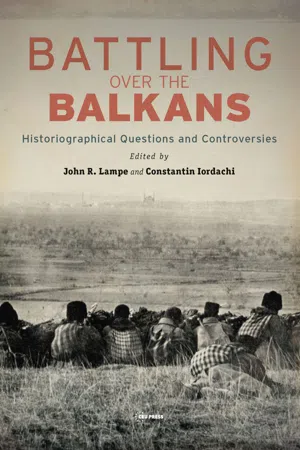 eBook - PDF
Battling over the Balkans
Historiographical Questions and Controversies
- John R. Lampe, Constantin Iordachi, John R. Lampe, Constantin Iordachi, John Lampe, Constantin Iordachi(Authors)
- 2020(Publication Date)
- Central European University Press(Publisher)
14 Translator’s note: nobility. 15 L. Karavelov, Sŭbrani sŭchineniya [Collected works]. vol. 6 (Sofia: Izd-vo Bŭlgarski pisatel, 1966), 156; Vol. 8 (Sofia: Izd-vo Bŭlgarski pisatel, 1967), 350, 528–29. 39 The Ottoman Balkans and Nation-Building a period of despotism and religious fanaticism, and was convinced that the glo-rious era for the Bulgarians was to come in the future. 16 This image of the Ottoman state as an empire of slavery and violence was further reinforced by a number of works produced by Bulgarian authors in Romania such as Vassil Drumev and Vassil Popovich, which spoke of “slavery and tyranny.” During this period, a chronicle attributed to Metodi Draginov and to the seventeenth century, was published in authoritative historical editions. The chronicle narrates the violent conversion of the Rhodope Bulgarians to Islam, blaming the Plovdiv Metropolitan Gavril. Produced to nourish anti-Greek feel-ings, during the nineteenth century and even to this day, this fabrication has func-tioned as a text fuelling anti-Turkish sentiments. 17 […] During the nineteenth century, Bulgarian schools also undertook the con -struction of Bulgarians’ national identity, with textbooks naturally bearing the mark of ethnocentrism. [...] In history textbooks, the period of Ottoman rule is described as a most dramatic period in Bulgarian history; this period is blamed for a number of weaknesses in Bulgarians’ character. The Czech historian Constantin Jireček, who in 1876 published his History of Bulgarians, played a special role in building up the perception of the Ottoman period. 18 Jireček characterized the Ottoman invasion as a “catastrophe” and the Ottoman period as “the most tragic and the darkest one in Bulgarian history” during which the majority of settlements were destroyed and ravaged, while their inhabitants fled to the mountains.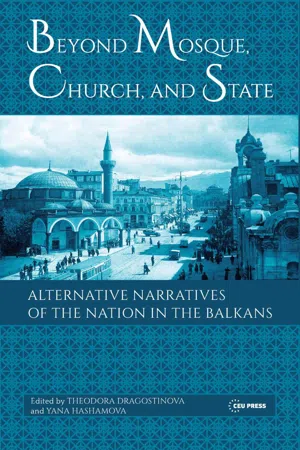 eBook - PDF
Beyond Mosque, Church, and State
Alternative Narratives of the Nation in the Balkans
- Theodora Dragostinova, Yana Hashamova, Theodora Dragostinova, Yana Hashamova(Authors)
- 2016(Publication Date)
- Central European University Press(Publisher)
This was the point at which it became impossible to “sit on the fence” or hedge one’s bets for survival; it was also a prelude to the all out destruction that would be brought on by the Balkan Wars and World War I. Conclusions The history of the Balkans has conventionally been told in a state-centric narrative, and the struggle for territory in Macedonia at the turn of the twentieth century is not an exception. Textbook accounts present a narrative of the period from the eighteenth to the twentieth century as one of national (re)generation movements naturally gaining momentum as they approach the ultimate goal of a nation-state. The Orthodox Church plays a central role in its capacity as a repository of national consciousness and refuge through centuries under the double 75 From Exorcism to Historicism hegemony of the Sultan and the Patriarch. Islam plays a similar role in the definition specifically of Bosnian and Turkish national identity. I do not think this is an entirely obsolete paradigm. Nor do I suggest that we completely throw it away because the relation between state and religion is not something we can simply ignore, particularly in a historical context such as that of the Balkans. Moreover, the emergence of the idea of nationhood and the triumph of nationness as the ulti-mate basis for political legitimacy were the products of a process that cannot be decoupled from state modernization and the ethnicization of religion. I suggest, instead that we update this paradigm to extend historical agency beyond the circle drawn by state actors and political entrepreneurs, and pay more attention to the experience of the people in whose name these states were founded. There are several reasons why such a revision might be helpful beyond its correction of the obvious asymmetry dominant in the histo-riography of the Balkans that presents the state as the main axis of the story.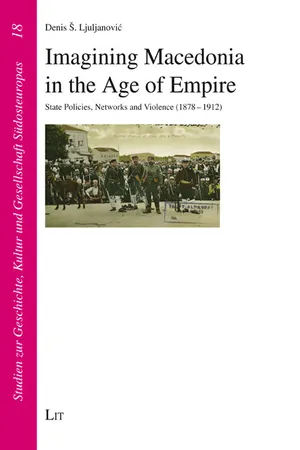 eBook - PDF
Imagining Macedonia in the Age of Empire
State Policies, Networks and Violence (1878–1912)
- Denis Š. Ljuljanović(Author)
- 2023(Publication Date)
- LIT Verlag(Publisher)
Clemens Ruthner et al. (New York: Peter Lang, 2015), pp. 363–366; Edin Hajdarpašić, Whose Bosnia? Nationalism and Political Imagination in the Balkans, 1840–1914 (Ithaca/New York: Cornell University Press, 2015). 12 greater state projects among the Balkan elites. According to Kemal Karpat, these ideas effectively dismantled the pluralist (Ottoman) order and led to the adoption of the concept of a single ethnic and linguistic nation based on European models by the newly independent Balkan states. 25 The transformations that occurred in the Balkans thus serve as a microcosm and localised manifestation of a broader, global phenomenon. This phenomenon is the result of a multifaceted process of knowledge transfer, interconnectedness, and interactions between elites in the Western and Southeastern European regions. In this context, Vesna Goldsworthy’s “Inventing Ruritania: The Imperialism of the Imagination” suggests that expanding the parameters of imperialism, despite the absence of a “conventional” European colonial presence in the Balkans, is nevertheless applicable to this region. 26 Accordingly, the Balkans underwent the process of “colonisation of the mind,” 27 and their intellectuals constructed imperialist narratives and ideological formulations in Macedonia, as a part of the “small state imperialism” projects. 28 Such “colonisation of the mind,” according to Maria Todorova, “was imposed as the hegemonic paradigm in Europe, as the gold standard of ‘civilised’ political organisation.” 29 The uncertain Balkan elites tried to imitate this European 25 Kemal Karpat, “The Social and Political Foundations of Nationalism in South East Europe after 1878: A Reinterpretation,” in Studies on Ottoman Social and Political History: Selected Essays and Articles, ed. Kemal Karpat (Leiden: Brill, 2002), p. 357. 26 Vesna Goldsworthy, Inventing Ruritania: The Imperialism of the Imagination (Oxford: Oxford University Press, 2012), p.
Index pages curate the most relevant extracts from our library of academic textbooks. They’ve been created using an in-house natural language model (NLM), each adding context and meaning to key research topics.

