History

Balkan Wars
The Balkan Wars were two separate conflicts that took place in the Balkan Peninsula in 1912 and 1913. The wars were fought by the Balkan League, consisting of Serbia, Montenegro, Greece, and Bulgaria, against the Ottoman Empire and later against each other over territorial disputes. The wars resulted in significant territorial changes in the region and marked the decline of Ottoman influence in the Balkans.
Written by Perlego with AI-assistance
Related key terms
1 of 5
12 Key excerpts on "Balkan Wars"
 eBook - PDF
The Great Cauldron
A History of Southeastern Europe
- Marie-Janine Calic, Elizabeth Janik(Authors)
- 2019(Publication Date)
- Harvard University Press(Publisher)
T he Balkan Wars of 1912 / 13—followed by the First World War and conflicts over the legacy of the Ottoman Empire that persisted until 1923—brought southeastern Europeans a decade of nearly uninterrupted violence, “ethnic cleansing,” and social misery. For the first time, the re-gion was at the brink of “total war,” fought by technologically advanced armies with vast destructive capabilities and enabled by an unprecedented mass mobilization of manpower. A hitherto unknown level of violence trans-formed the experience of warfare for ordinary soldiers and entire societies. 1 From a regional perspective, the Great War of 1914–1918 was just one of several way stations on the road to the nation-state. The “three Balkan Wars” fundamentally rearranged the international order, but also bred en-demic conflicts over borders and minorities, ideologies and political sys-tems, which ultimately erupted in the violence of the Second World War. From the Balkan Wars to the Treaty of Lausanne, 1912 / 1913 to 1923 In the Balkan Wars of 1912 / 13, the young nation-states first fought side- by-side to free their countrymen from the “Ottoman yoke,” before turning against one another to fight over the division of the spoils. The goal of both Balkan Wars was the political and ethnic reorganization of vast stretches of land. The European public watched the advances of the Balkan armies and subsequent mass expulsions with dismay. The Bulgarian 7 From the Balkan Wars to the Second World War the great cauldron 390 army conquered Adrianople, and Serbian troops took Skopje, Prilep, Bi-tola, and eventually all of Macedonia and Kosovo, pushing toward the Adriatic Sea. While Greece occupied Thessaloniki, Ioannina, and the Ae-gean Islands, Montenegro marched into Scutari (Shkod ë r). Military leaders methodically expelled, persecuted, and in some cases, eliminated entire groups of undesired peoples. eBook - PDF
Consumed by War
European Conflict in the 20th Century
- Richard C. Hall(Author)
- 2014(Publication Date)
- The University Press of Kentucky(Publisher)
The Balkan Wars resulted in huge military casualties. The Bulgar- ians lost around 65,000 men, the Greeks 9,500, the Montenegrins 3,000, and the Serbs at least 36,000. The Ottomans lost as many as 125,000. 5 In addition, tens of thousands of civilians died from diseases and other causes. Deliberate atrocities occurred throughout every theater of war, especially in Kosovo. In military terms, the Balkan Wars were the precur- sor of the First World War. Mass mobilization, large turning movements, Balkan Wars, 1878-1914 15 and trench warfare all occurred during this conflict. New weapons such as airplanes and rapid-fire artillery were utilized. Yet few lessons from the Balkan Wars enlightened the European military establishments that would soon find themselves engaged in conflict. One reason was the brief interval between the end of the Balkan Wars and the beginning of the First World War. Another reason was that the Balkan states did not wel- come foreigners who wanted to observe their operations. Many of those military attaches who did examine the Balkan Wars ignored the tactical lessons that might have had import for the conduct of the First World War. Instead, they focused on issues that tended to confirm preconceived doctrines. The Balkan Wars initiated a period of conflict in Europe that would end only in 1921. The Great Powers struggled to manage this conflict. The Serbs' ambitions in northern Albania and the Adriatic coast and the Montenegrins' in Scutari caused some tension among the Great Powers, particularly between Austria-Hungary, which supported Albania, and Russia, which supported Montenegro and Serbia. The powers themselves coped with these tensions at the London ambassadors' conference. 6 They even cooperated to eject the Montenegrins from Scutari. One important consequence of the Balkan Wars was the alienation of Bulgaria from Russia. Up until 1913, Bulgaria had been Russia's most important connection in the Balkan region. eBook - PDF
The Edinburgh History of the Greeks
20th and Early 21st Centuries
- Antonis Liakos, Nicholas Doumanis(Authors)
- 2023(Publication Date)
- Edinburgh University Press(Publisher)
In a letter to his wife written just before the onset of the Second Balkan War, a Greek officer reported a world that had been set in flames: ‘Everywhere we go, we come across desolation and misery’ (Biondich 2011: 81). The same observations could have been made of any war, but the violence of this one was not limited to conventional battles. The new warfare was aided by modern tech- nologies that killed and maimed much larger numbers of people, most especially civilians. The Balkan Wars anticipated a general crisis era The ‘long First World War’ 33 that enveloped the whole of Europe not just for the period 1914–18 or 1914–22, but for the ensuing decades, when the tensions arising from rapid social, political and economic change produced horrific bursts of revolutionary and counter-revolutionary violence. Millions were killed and traumatised by social engineering schemes (genocide, ethnic cleansing) to create new political geographies and cultural demographies (Mayer 1981: 3; Doumanis 2016: 1–19; Traverso 2016). Late Ottoman Macedonia had suffered in recent years from protracted struggles between rival nationalist militias, during which peoples who had once lived side by side were encouraged or forced to choose sides. Peoples were pitted against each other in order to generate something known at the time as a ‘war of races’, which nowadays is called ethnic conflict (Yosmaoğlu 2014: 1). During the Macedonian struggle of the 1890s and 1900s most rival militias were sponsored by rival states, but during the Balkan Wars it was state armies that perpetrated the violence. The Balkan Wars prefigured a prolonged era that idealised national exclusivity and fostered the persecution of minorities, ethnic cleansing and ultimately genocide. The geographical zone that was most vulner- able to this kind of dystopic engineering contained an intense mixture of populations that had coexisted peaceably for centuries. eBook - ePub
The Roots and Consequences of 20th-Century Warfare
Conflicts That Shaped the Modern World
- Spencer C. Tucker(Author)
- 2016(Publication Date)
- ABC-CLIO(Publisher)
Balkan Wars (1912–1913) CausesThe First Balkan War (1912–1913) was a sharp and bloody conflict in Southeastern Europe that led to World War I. Most of Southeastern Europe had come under Ottoman domination by the end of the 14th century. Afterward, Montenegro maintained a precarious autonomy from Ottoman rule. By the first half of the 19th century, Greece, Serbia, and Romania established independent regimes. After their defeat of the Ottoman Empire in the Russo-Turkish War of 1877–1878, the Russians established a large Bulgarian state in the Treaty of San Stefano of March 3, 1878.Objections from Austria-Hungary and Great Britain caused a revision of the settlement at the Congress of Berlin in July 1878. San Stefano, Bulgaria, was trisected into a Bulgarian principality under the nominal suzerainty of the Ottoman sultan, the Ottoman province of Eastern Rumelia with an Orthodox Christian governor, and Macedonia under the direct rule of the Ottoman sultan. Montenegro, Romania, and Serbia received formal Great Power recognition as states independent of all ties to the Ottoman Empire. Thereafter all the Balkan states sought to overturn the Berlin settlement to realize their nationalist goals within the Ottoman Empire. The political elite of all of these states were convinced that only by attaining their nationalist objectives could they develop as modern states. In this line of thinking, Germany and Italy served as examples.These states, including Bulgaria, Greece, Montenegro, and Serbia, all harbored irredentist aspirations against the Ottomans. Many of these aspirations overlapped, especially in Macedonia. Bulgarian, Greek, and Serbian nationals all claimed Macedonia as a part of their national irredentas. All of the Balkan states sponsored cultural efforts as well as armed bands in Macedonia. For some time these rivalries precluded the formation of a Balkan alliance directed against the Ottomans. The Young Turk Revolution in 1908 and its objective of an Ottoman revival, however, engendered closer cooperation among these Balkan states. eBook - PDF
Researching World War I
A Handbook
- Robin Higham, Dennis Showalter, Robin Higham, Dennis Showalter, Dennis E. Showalter, Robin Higham, Dennis E. Showalter(Authors)
- 2003(Publication Date)
- Greenwood(Publisher)
9 The Balkans: Serbia, Bulgaria, Romania, and Greece Glenn E. Torrey World War I has been called, and not without reason, the Third Balkan War. Not only did an act of Balkan terrorism serve as a catalyst for the larger European conflict, but rivalry over this region had poisoned relations between the Great Powers for decades. The Balkans also posed perplexing problems for the con- duct of the war. Both groups of belligerents sought to bolster their forces by recruiting new allies among the Balkan neutrals. Later, they came to question the price they paid for the assistance of these small powers as they required sub- stantial aid, including the diversion of large contingents from the main battle fronts. Furthermore, the political concessions necessary to win their allegiance created difficulties for the peace conference at Paris in 1919. The consequences of some of these issues persist to the present day. Proper understanding of the Balkans has been handicapped by the paucity of reliable, dispassionate studies. During the past generation, however, the situa- tion has greatly improved. The opening of Western European archives in the 1960s not only stimulated researchers in the West to choose Balkan topics and produce solidly-based accounts, but also it encouraged Balkan scholars to travel to these same repositories to the great benefit of the credibility of their own writ- ings. Perhaps more significant has been the trend among Balkan authorities to open their own archives to foreign scholars and to encourage international sym- posia. The revolutions of 1989 have accelerated these trends and have freed Balkan historians from their earlier dependence on Marxist presuppositions. Consequently, in addition to giving preference to scholarship based on archival research done during the last generation, special attention has been to seek out works published in the last decade. However, important older works have not
- David G. Herrmann(Author)
- 2020(Publication Date)
- Princeton University Press(Publisher)
Chapter 6 THE Balkan Wars AND THE SPIRAL OF ARMAMENTS, 1912-1913 ON 8 OCTOBER 1912, the First Balkan War broke out when Montene-gro declared war on the Ottoman Empire. Serbia, Bulgaria, and Greece joined in nine days later. Linked by a series of alliances concluded in the past year, the Balkan states flung themselves into a struggle to conquer all the lands the Ottoman Empire still controlled in the Balkans (see Map 3). 1 With the Turks weakened by their continuing campaign to hold Libya against the Italians, the autumn of 1912 presented an oppor-tunity for the Balkan states to claim their shares of European Turkey. The Porte hastily concluded its protracted negotiations with the Italian government, signed away its sovereignty over Tripolitania and Cyre-naica, and turned all of its strength to the defense of its possessions in Europe. The Ottoman lands there were the key to the defense of Is-tanbul and the straits, as well as the empire's assurance of a continuing role in European affairs. But the war was a disaster for the Turks. On 24 October the Serbs smashed one Ottoman force in Macedonia at Kumanovo, while the Bulgarians won a simultaneous victory at Kirk Kilise. Within a month of the opening of hostilities the Greek army had occupied Salonika, and the Turks had lost all of their European posses-sions: Albania, Epirus, Macedonia, and Thrace. They retreated to Cha-talja, the last defensive position before Istanbul. There, with the rumble of shellfire audible in the capital, they finally held the Bulgarians, fight-ing them to a standstill until peace negotiations opened in December. There was a renewed outbreak of combat that winter, and a second Bal-kan war in the summer of 1913 as the victors fought among themselves over the distribution of the territorial spoils. The Ottomans managed to regain eastern Thrace as far as Edirne (Adrianople), but their expulsion from the rest of Europe was final. eBook - PDF
The Wars before the Great War
Conflict and International Politics before the Outbreak of the First World War
- Dominik Geppert, William Mulligan, Andreas Rose(Authors)
- 2015(Publication Date)
- Cambridge University Press(Publisher)
Neither the ultimate defeat of the Ottoman Empire, nor the rapid military outcomes, were forecast by the major European states. In many respects, the Balkan Wars demon- strated the perpetually unstable relationship between existing scenarios and ongoing developments. This explains the high number of ‘surprises’ that bombarded the European scene during the course of the war (from 22 Mir, 3955, 29 July 1913. 23 Semov, Obrecheni pobedi, p. 32; see Bormann’s contribution to this volume (Chapter 14, pp. 256–61). The great expectations 147 the military battles, through the prospect of Bulgaria’s capture of Istan- bul, to protracted and ambiguous Russian arbitration). It also illustrates the various fears, such as racial conflict, that seeped into international relations at the time. The failure of most expectations was, however, a testimony both to the unpredictable nature of the emerging conflict and to the extent to which illusions and fears blurred the dangers that these regional struggles would lead to. In view of general European planning and expectations of the Balkan Wars, Bulgaria and the other Balkan states appeared not only as major actors and nation-states that mobilized their military forces against a common enemy, but also as channels and targets of propaganda, emitted from diplomatic corps, foreign offices or royal circles. Parallel to that, however, these states were gradually gaining autonomy on their own and asserting their rights in making coalitions, holding military activities and pursuing territorial pretensions, key factors in reshaping the Euro- pean state system. These nations were seeking to affirm their capacity to defend their claims and to achieve recognition through military might. In many respects, they demonstrated much more confidence in military capacity and patriotic enthusiasm than in long-term speculative predic- tions. This turned out to be an important disadvantage both for defeated Bulgaria and for its victorious neighbours. eBook - PDF
British Public Opinion Towards the Ottoman Empire During the Two Crises
Bosnia-Herzegovina (1908-1909) and the Balkan Wars (1912-1913)
- Sevtap Demirci(Author)
- 2010(Publication Date)
- Gorgias Press(Publisher)
2 THE Balkan Wars, 1912-1913 PRELUDE TO THE CRISIS No other area in the Balkans has been the subject of so much dispute and the cause of so much bloodshed than Macedonia. To a very considerable degree, Balkan diplomacy since 1878 has revolved around the explosive question of how Macedonia should be divided among the three neighbouring countries, Bulgaria, Greece and Serbia. 1 As important as the strategic and economic considerations in explaining the struggle for Macedonia was the ethnic complexity of the area which gave the all neighbouring countries a basis for their aspirations and claims. The Austrian annexation of Bosnia ended the cooperation between Austria and Russia and also stimulated aggressive desires of the Balkan states to gain territory if not compensation from the Ottoman Empire. The Italian attack on Tripoli convinced the Balkan states that their rivalries in Macedonia had to be subordinated to take advantage of the Ottoman preoccupation across the Mediterranean. The national movements made steady progress, usually with the support of one or of all the European governments. The British view of the Macedonia problem was that the Turks ought to be compelled to govern the region fairly and that, if they failed to do so, the Balkan nationalists ought to be allowed to realise their ambitions. The Gladstonian (even Salisburian) principle of support for liberal nationalism in the Turkish Empire, which had earlier shown itself in relation to Bulgarians and Armenians had at last became the open policy of the British government, (though not yet for all Turkey's Asian and African provinces). 2 Although the Balkan revolts were commenced by the Balkan people, the Great Powers made the financial decision over the establishment of the new states, their boundaries, and their forms of government. The European leaders were far from altruistic in their actions. Their own interests and the maintenance of the balance of power came first. eBook - ePub
- Charles Hazen(Author)
- 2017(Publication Date)
- Jovian Press(Publisher)
We must now examine the reaction of all these profound and astonishing changes in the Balkans upon Europe in general. In other words, we must study the causes of the war of 1914. For the Balkan Wars of 1912 and 1913 were a prelude to the European War. The sequence of events from the Turkish Revolution of July, 1908, to the Austrian declaration of war upon Serbia in July, 1914, is direct, unmistakable, disastrous. Each year added a link to the lengthening chain of iron. The map of Europe was thrown into the flames. What the new map would be no one could foresee.It may be said in passing that the new Albanian state proved a fiasco from the start and that it disappeared completely when the war began in August, 1914, the powers that had created it withdrawing their support and its German prince, William of Wied, leaving for Germany, where he joined the army that was fighting France. He had meanwhile announced his abdication in a high-flown manifesto. eBook - PDF
World War One
The Global Revolution
- Lawrence Sondhaus(Author)
- 2020(Publication Date)
- Cambridge University Press(Publisher)
At the time of the Young Turk coup, the Balkans had been stable since the Congress of Berlin (1878), which had left Serbia, Montenegro, and Romania independent, Bulgaria autonomous but still under Ottoman suzerainty, and Bosnia-Herzegovina still techni- cally Ottoman but occupied by Austria-Hungary. Fearing a change for the worse under the Young Turks, in 1908 Austria-Hungary annexed Bosnia-Herzegovina and Bulgaria declared its independence. Thereafter the Turks faced the loss of their remaining Balkan territories – Albania, Macedonia, and Thrace – which were coveted in whole or in part by Bulgaria, Serbia, Montenegro, and Greece. After the Turks became embroiled in the Italo-Turkish War (1911–12), these four states formed the Balkan League and mobilized for war. In October 1912, just as the Turks made peace with the Italians by relinquishing Libya, the Balkan League declared war on the Ottoman Empire, initiat- ing the First Balkan War. Russia supported the Balkan League and Austria-Hungary the Ottomans, and tensions between them became serious enough for each to partially mobilize its army. When the war ended in May 1913, the great powers allowed Serbia to keep Kosovo and Greece to retain Epirus, but assigned the rest of Albanian territory to a new independent state. Greece also received Crete and, with Serbia, partitioned Macedonia, limiting Bulgaria’s gains to Thrace. Public outrage over the meager spoils serbia and the balkan states on the eve of wa r 17 prompted Bulgaria to go to war with Serbia and Greece just one month later, in the hope of securing a share of Macedonia. In the brief Second Balkan War the Turks resumed hostilities against the Bulgarians and Montenegro also intervened, but the entry of Romania (neutral in the First Balkan War) proved decisive as Bulgaria aban- doned some of its earlier Thracian gains in order to defend itself against Romanians invading from the north. eBook - ePub
The Balkan Wars
1912-1913
- Jacob Gould Schurman(Author)
- 2004(Publication Date)
- Perlego(Publisher)
THE Balkan Wars
1912-1913JACOB GOULD SCHURMAN
THIRD EDITION
1916PREFACE TO THE SECOND EDITION
The interest in the Balkan Wars of 1912-1913 has exceeded the expectations of the publishers of this volume. The first edition, which was published five months ago, is already exhausted and a second is now called for. Meanwhile there has broken out and is now in progress a war which is generally regarded as the greatest of all time—a war already involving five of the six Great Powers and three of the smaller nations of Europe as well as Japan and Turkey and likely at any time to embroil other countries in Europe, Asia, and Africa, which are already embraced in the area of military operations.This War of Many Nations had its origin in Balkan situation. It began on July 28 with the declaration of the Dual Monarchy to the effect that from that moment Austria-Hungary was in a state of war with Servia. And the fundamental reason for this declaration as given in the note or ultimatum to Servia was the charge that the Servian authorities had encouraged the Pan-Serb agitation which seriously menaced the integrity of Austria-Hungary and had already caused the assassination at Serajevo of the Heir to the Throne.No one could have observed at close range the Balkan Wars of 1912-1913 without perceiving, always in the background and occasionally in the foreground, the colossal rival figures of Russia and Austria-Hungary. Attention was called to the phenomenon at various points in this volume and especially in the concluding pages.The issue of the Balkan struggles of 1912-1913 was undoubtedly favorable to Russia. By her constant diplomatic support she retained the friendship and earned the gratitude of Greece, Montenegro, and Servia; and through her championship, belated though it was, of the claims of Roumania to territorial compensation for benevolent neutrality during the war of the Allies against Turkey, she won the friendship of the predominant Balkan power which had hitherto been regarded as the immovable eastern outpost of the Triple Alliance. But while Russia was victorious she did not gain all that she had planned and hoped for. Her very triumph at Bukarest was a proof that she had lost her influence over Bulgaria. This Slav state after the war against Turkey came under the influence of Austria-Hungary, by whom she was undoubtedly incited to strife with Servia and her other partners in the late war against Turkey. Russia was unable to prevent the second Balkan war between the Allies. The Czar's summons to the Kings of Bulgaria and Servia on June 9, 1913, to submit, in the name of Pan-Slavism, their disputes to his decision failed to produce the desired effect, while this assumption of Russian hegemony in Balkan affairs greatly exacerbated Austro-Hungarian sentiment. That action of the Czar, however, was clear notification and proof to all the world that Russia regarded the Slav States in the Balkans as objects of her peculiar concern and protection.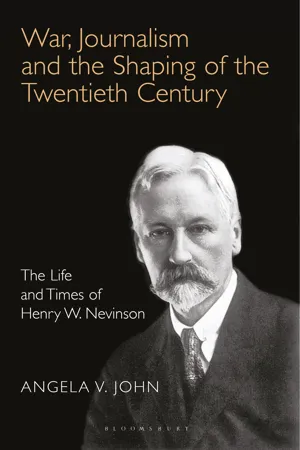 eBook - PDF
War, Journalism and the Shaping of the Twentieth Century
The Life and Times of Henry W. Nevinson
- Angela V. John(Author)
- 2006(Publication Date)
- I.B. Tauris(Publisher)
But the opportunity to capitalize on the Ottoman Empire being diverted and weakened by war with Italy led to the First Balkan War beginning in October 1912. The two short but devastating wars in the Balkans in 1912–13 can be seen as ‘the first phase of the First World War’. 26 Just before the First Balkan War started, Henry was strategically placed in Bulgaria. He was reporting for both the Manchester Guardian and Daily Chronicle (receiving £16 weekly in peace and £100 monthly in wartime). He had slight misgivings about his age, health and suffrage commitments but could not resist ‘the most difficult & insane of my From the Balkans to World War 129 adventures, except, perhaps, Angola’. In the novel The Miracle (1908) Bulgaria declares war on Turkey. Its author, the correspondent Arthur Moore, first secretary to the MRC, had woven Henry into the story as Henry Anderson, champion of the underdog and lover of Greek poetry. Unofficially connected with a legion of British volunteers, Anderson explores worlds ‘which the city clerk could never hope to enter’ and maintains that ‘compromise is the curse of progress’. Yet, although the Turkish army was routed and ‘the dawn of freedom flushed the skies’, Anderson is bayoneted. 27 Having read of his fictional death, Henry boarded the Orient Express for Sofia. The direct annexation of Bosnia-Herzegovina by Austria-Hungary in 1908 had prompted Bulgaria’s formal declaration of independence from the Ottoman Empire. Troops were being mobilized in Bulgaria and Serbia. On 9 October 1912 Montenegro declared war on Turkey. On the same day Henry and two other journalists interviewed Prime Minister Gueshoff. He appealed for British aid. Henry watched battalions march to the front and feared the worst.
Index pages curate the most relevant extracts from our library of academic textbooks. They’ve been created using an in-house natural language model (NLM), each adding context and meaning to key research topics.

