History

WWI
WWI, or World War I, was a global conflict that lasted from 1914 to 1918. It involved many of the world's great powers and their alliances, and was primarily centered in Europe. The war had a profound impact on the political, social, and economic landscape of the 20th century, leading to significant changes in international relations and the emergence of new nations.
Written by Perlego with AI-assistance
Related key terms
1 of 5
11 Key excerpts on "WWI"
 No longer available |Learn more
- (Author)
- 2014(Publication Date)
- College Publishing House(Publisher)
________________________ WORLD TECHNOLOGIES ________________________ Chapter 4 World War I World War I (also known as the First World War , Great War or War of Wars , abbreviated WWI ) was a military conflict centered on Europe that began in the summer of 1914. The fighting ended in late 1918. This conflict involved all of the world's great powers, assembled in two opposing alliances: the Allies (centred around the Triple Entente) and the Central Powers. More than 70 million military personnel, including 60 million Europeans, were mobilized in one of the largest wars in history. More than 9 million combatants were killed, due largely to great technological advances in firepower without corresponding ones in mobility. It was the second deadliest conflict in history. ________________________ WORLD TECHNOLOGIES ________________________ The term World War One is particularly common in American English, whereas in Britain and the The Commonwealth, it is more commonly called the First World War . This term was first coined in 1920 as the title of Charles à Court Repington's book, but references to it being the first war did not become popular until World War II. The terms World War One and Two were first used in Time magazine in 1938. During and in the aftermath of the conflict it was called the Great War , particularly in British newspapers, whereas US media preferred simply the World War . It was also known as the War to End All Wars . The assassination on 28 June 1914 of Archduke Franz Ferdinand of Austria, the heir to the throne of Austria-Hungary, is seen as the immediate trigger of the war. Long-term causes, such as imperialistic foreign policies of the great powers of Europe, such as the German Empire, the Austro-Hungarian Empire, the Ottoman Empire, the Russian Empire, the British Empire, France, and Italy, played a major role. Ferdinand's assassination by a Yugoslav nationalist resulted in a Habsburg ultimatum against the Kingdom of Serbia. eBook - PDF
Justifying War
Propaganda, Politics and the Modern Age
- D. Welch, J. Fox, D. Welch, J. Fox(Authors)
- 2012(Publication Date)
- Palgrave Macmillan(Publisher)
Part II The First World War: Conflict and Aftermath 71 When Sir Edward Grey stared out of the windows of the Foreign Office on the evening of 3 August and remarked, ‘The lamps are going out all over Europe: we shall not see them lit again in our lifetime’, he was reflecting wistfully – but prophetically, as it turned out – on the illusions that governed his diplomacy and his futile attempts to mediate between the continental powers in the July crisis of 1914. For Grey, a political diplomat of the tra- ditional school, it marked a significant turning point from an old to a new world. The following day, The Times on its front page declared: ‘The die is cast. The great European struggle which nations have so long struggled to avert has begun.’ 1 But the proclamation of war for many Europeans, in contrast to the British Foreign Secretary, represented a major turning point and proved to be an exhilarating experience. The German industrialist and statesman Walter Rathenau recalled ‘It was the ringing opening chord for an immortal song of sacrifice, loyalty and heroism … great and unforgettable.’ 2 The First World War holds a unique position as the milestone by which the heroism, brutality and futility of industrialized modern warfare has come to be measured. Having begun with the promise of individual honour and nationalistic glory, it ended after four bloody years of trench, air and naval warfare with much doubt as to whether the sacrifices had been justi- fied and worthwhile. As Philip Taylor has observed, it is often viewed by the victorious powers as an ‘end of innocence’ or a ‘rite of passage ‘into the modern world’. 3 Surprisingly, however, the War had seemed to creep up, unexpectedly, on the people of Europe in July 1914. Following the assassina- tion of Archduke Ferdinand on 28 June, a few signs of a looming crisis can be discerned. eBook - PDF
American Military History
A Guide to Reference and Information Sources
- Daniel K. Blewett(Author)
- 2008(Publication Date)
- Libraries Unlimited(Publisher)
Chapter 9 The First World War (1914–1918) ALMANACS Burg, David F. and L. Edward Purcell. Almanac of World War I. Lexington, KY: University Press of Kentucky, 1998. 320p. illus. maps. bib. index. $24.95. LC 98-26625. ISBN 0-8131-2072-1. Reprinted: University Press of Kentucky; London: Eurospan, 2004. $22.00. ISBN 0-8131-9087-8pa. This work includes biographical sketches of leading individuals, excerpts from contemporary written accounts, definitions of terms, and explanations of important events. Gregory, Ross and Richard Balkin. Modern America: 1914–1945. New York: Facts on File, 1995. 455p. illus. maps. bib. index. (Almanacs of American Life Series) $70.00. LC 94-4168. ISBN 0-8160-2532-0. This reference volume covers both world wars and the turbulent period in- between. There are biographies, entries about various issues and events, social trends, military activities, all accompanied by a multitude of statistics. Ross Gregory also wrote The Origins of American Intervention in the First World War (New York: Norton, 1971. 162p. bib. (Norton Essays in American History Series) LC 70-141588. ISBN 0393054381; 0393099806pa). Heyman, Neil M. World War I. Westport, CT: Greenwood Press, 1997. 257p. illus. maps. chron. bib. index. (Greenwood Press Guides to Historic Events of the Twentieth Century Series). $46.95. LC 97-1686. ISSN 1092-177X. ISBN 0-313-29880-7. Within these pages one can find a general overview of the war, the U.S. role, what happened on the home front, biographies of important people, a discussion on the consequences of the war, and the text of primary documents. Neil M. Heyman also wrote the Daily Life during World War I (Westport, CT: Greenwood Press, 2002. 285p. illus. bib. index. (Greenwood Press Daily Life through History Series) $51.95. LC 2001-58341. ISSN 1080-4749. ISBN 0-313-31500-0). Readers 109 eBook - ePub
- John Mueller(Author)
- 2013(Publication Date)
- Cornell University Press(Publisher)
CHAPTER 3
WORLD WAR I AS A WATERSHED EVENT
European attitudes toward war changed profoundly at the time of World War I. There is no way to quantify this change except perhaps through a rough sort of content analysis. Before the First World War it was very easy, as documented in the previous chapter, to find serious writers, analysts, and politicians in Europe and the United States exalting war as desirable, inevitable, natural, progressive, and necessary. After the First World War, such pronouncements become extremely rare, although the excitement of the combat experience continued (and continues) to have its fascination to some.1This suggests that the appeal of war, both as a desirable exercise in itself and as a sensible method for resolving international disagreements, diminished markedly on that once war-racked continent. In an area in which war had been accepted as a standard and permanent fixture, the idea suddenly gained substantial currency that war there was no longer an inevitable or necessary fact of life and that major efforts should be made to abandon it.This change has often been noted by historians and political scientists. Arnold Toynbee points out that World War I marked the end of a “span of five thousand years during which war had been one of mankind’s master institutions.” In his study of wars since 1400, Evan Luard observes that “the First World War transformed traditional attitudes toward war. For the first time there was an almost universal sense that the deliberate launching of a war could now no longer be justified.” Bernard Brodie points out that “a basic historical change had taken place in the attitudes of the European (and American) peoples toward war.” Eric Hobsbawm concludes that “in 1914 the peoples of Europe, for however brief a moment, went lightheartedly to slaughter and to be slaughtered. After the First World War they never did so again.” And K. J. Holsti observes, “When it was all over, few remained to be convinced that such a war must never happen again.”2 eBook - PDF
- Frank W. Thackeray, John E. Findling, Frank W. Thackeray, John E. Findling(Authors)
- 2002(Publication Date)
- Greenwood(Publisher)
The war tormented literally millions of peo- ple while also opening doors of opportunity, innovation, and liberation, World War I 139 and dramatically altering Britain's place in the world. The Great War ended one era and initiated its successor. Before 1914 war was a common topic of discussion and widely antici- pated. Public figures had long declaimed the virtues of war: it ennobled men and made the empire. War would sustain Great Britain's honor and distract the population from the divisive issues of the day. Most young men had been nurtured on tales of the glory of the wars against Napoleon, in the Crimea, in the Indian subcontinent, or in some other part of the empire. War offered the promise of adventure, career advancement, or simple escape from everyday routine. Great Britain's recent war experiences had been limited to conflicts in the colonies, small affairs in distant lands. The last major war had ended in 1815 with the defeat of Napoleon. Recent wars (the South African, or Boer, War [1899-1902], the Spanish-American War [1898], and the Russo- Japanese War [1904-1905]) demonstrated the changing face of war, al- though most saw these conflicts as aberrations. New technologies such as the machine gun and the "flying machine" pitted men against machines in ways disadvantageous to men. Enthusiasm for war persisted, but few people realized that the war they yearned for existed primarily in their imaginations. Initially in Great Britain, as elsewhere across the European continent, people exhibited an enthusiasm for the onset of war in August 1914 that with hindsight is difficult to understand. They poured into the streets in largely spontaneous demonstrations of patriotic fervor. Since many assumed the war would be brief—"Home by Christmas" was the widely repeated cliche— young men rushed to enlist. They did not want to miss the spectacle. Two factors brought Great Britain into the war. eBook - PDF
Collision of Empires
Britain in Three World Wars, 1793-1945
- A. D. Harvey(Author)
- 1993(Publication Date)
- Hambledon Continuum(Publisher)
PART TWO THE FIRST WORLD WAR 1914-1918 This page intentionally left blank Outline: 1914-1918 In a sense Britain went to war in 1914 to defend the position of European leadership attained in 1815. Despite fears of German expansionism there were those who felt in August 1914 that the war which had flared up in Europe was not Britain's concern, and the degree to which the British government was bound by treaty to support victims of German aggression was debatable. But it was assumed that if there was to be a great European conflagration, Britain would have to take a part in it. It was assumed also - and this probably helped facilitate the decision to join in -that the war would be very short. The war lasted four and a quarter years, by comparison with the twenty-two years (with a couple of brief pauses) of the French Revolutionary and Napoleonic Wars: but it was much more intense. Twice as many British soldiers died on the first day of the Somme as in nearly six years of campaigning under Wellington in Portugal, Spain and southern France. The initial assumptions that the war could be fought on the same organizational and economic basis as the French Wars gave way gradually to the almost complete mobilization of the national economy for war. Vast manpower, backed by vast quantities of artillery and other specialist machinery, confronted the generals with the near impossibility of effectively deploying their available strength against an enemy who could always use railways to bring up unlimited forces against an troops advancing on foot. New technological developments such as the aeroplane and the tank were welcomed almost as a distraction from the insoluble problems of mass warfare. Military stalemate, in Britain as in most other belligerent countries, fuelled the mutual antagonism of civilian ministers and military leaders, and resulted in power struggles between insecurely placed governments and the armed forces. eBook - PDF
- Paul Boyer, Clifford Clark, Karen Halttunen, Joseph Kett(Authors)
- 2017(Publication Date)
- Cengage Learning EMEA(Publisher)
Global Involvements and World War I, 1902–1920 Defining America’s World Role, 1902–1914 (622) What goals underlay America’s early-twentieth-century involvements in Asia and Latin America? The “Open Door”: Competing for the China Market The Panama Canal: Hardball Diplomacy Roosevelt and Taft Assert U.S. Power in Latin America and Asia Wilson and Latin America War in Europe, 1914–1917 (626) Considering both immediate and long-term factors, why did the United States go to war in 1917? The Coming of War The Perils of Neutrality The United States Enters the War Mobilizing at Home, Fighting in France, 1917–1918 (629) How did Washington mobilize the nation for war, and what role did U.S. troops play in the war? Raising, Training, and Testing an Army Organizing the Economy for War With the American Expeditionary Force in France Turning the Tide Promoting the War and Suppressing Dissent (635) How did Americans respond to propaganda and suppression of dissent? Advertising the War Wartime Intolerance and Dissent Suppressing Dissent by Law Economic and Social Trends in Wartime America (638) What was the war’s economic, political, and social impact on the American home front? Boom Times in Industry and Agriculture Blacks Migrate Northward amid New Activist Energies Women in Wartime Public-Health Crisis: The 1918 Influenza Pandemic The War and Progressivism Joyous Armistice, Bitter Aftermath, 1918–1920 (644) How did the League of Nations begin, and why did the Senate reject U.S. membership in the League? Wilson’s Fourteen Points; The Armistice The Versailles Peace Conference, 1919 The Fight over the League of Nations Racism and Red Scare, 1919–1920 The Election of 1920 The Whole Vision (649) 22 WORLD WAR I POSTER URGING FOOD CONSERVATION, BY ILLUSTRATOR JAMES MONTGOMERY FLAGG Home-front propaganda played a key role in mobilizing Americans in support of the war effort in 1917–1918. eBook - PDF
The Great War in History
Debates and Controversies, 1914 to the Present
- Jay Winter, Antoine Prost(Authors)
- 2020(Publication Date)
- Cambridge University Press(Publisher)
Continuities While a number of historians have widened the geographical and tem- poral definitions of the Great War, the majority of works published since 2000 have continued to deepen our understanding of the military, the political, the economic, the social, and the cultural history of the war. Most adopt the national framework which still dominates First World War studies as a whole. Military history No one has advanced the military history of the First World War more than Hew Strachan, whose first volume of the new Oxford history of the war, To arms!, was published in 2000. In this work he set a new standard 222 The Great War in History for the weaving together of the political, strategic, and operational histo- ry of the war, through the use of German, English, and French sources. This part of his multi-volume history covers 1914. Given the sheer size of the literature and archives related to the rest of the war, it is not sur- prising that Strachan’s project remains incomplete. Military historians have made major contributions to our understand- ing of the fate of individual campaigns. Robin Prior (2009) established the hopelessness of the plan to force the Dardanelles and then to seize the heights commanding the Straits through an amphibious landing in April 1915. Paul Jankowski in 2013 and Antoine Prost and Gerd Krumeich in 2015 broke new ground in the literature about Verdun. Jankowski sug- gested that Falkenhayn never saw Verdun as a breakthrough battle, but a violent prelude to what would have been a later attempt to breach Al- lied lines. Prost and Krumeich showed why the French withstood Falk- enhayn’s assault at Verdun in 1916, through an original analysis of the workings of the French general staff. William Philpott (2009) provided the first full account of all three armies engaged in the Battle of the Somme later that year.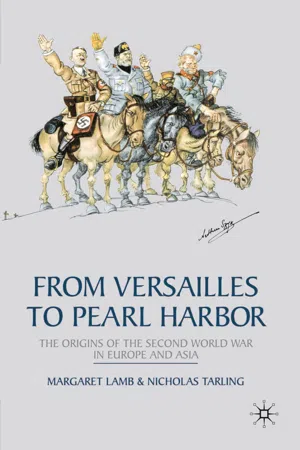 eBook - PDF
From Versailles to Pearl Harbor
The Origins of the Second World War in Europe and Asia
- Margaret Lamb, Nicholas Tarling(Authors)
- 2017(Publication Date)
- Bloomsbury Academic(Publisher)
The end of a war which had cost so much in human lives and economic resources evoked mixed reactions. In Britain and France many The First World War 9 looked for compensation for the great sacrifices that the war had demanded, which was reflected in the simple slogan ‘Germany will pay’. In Germany itself, on the other hand, after so much effort and sacrifice, many had difficulty in believing that the country had been defeated while others quickly set to work to try to counter any claim that Germany had been responsible for the conflict. 11 President Wilson and his supporters believed that they should learn lessons from the recent past and remove what they perceived to have been the causes of the war – the build-up of armaments, the existence of alliances, the grievances of subject nationalities and the lack of a formal mechanism for the settlement of international disputes. His solution was to be the establishment of a League of Nations through which disputes could be debated, mediated and resolved. The first task, however, was to draw up a peace settlement which would have to provide the basis for any new international system and reflect the changes which the war had brought to Europe and to the other parts of the world. Asia before the war Unprecedented in scale and duration, the war came to involve not only the USA but also the colonial territories of the Europeans from which they drew wealth and manpower. It also came to involve states that were becoming independent, like the Dominions, and states that were still independent, like China and Japan. In the Second World War China and Japan were to be major combatants. But even in the First World War their actions were not simply reactions to the actions of the Europeans. Japan in particular had become a player on the international scene, though the Europeans had a poor understanding of it.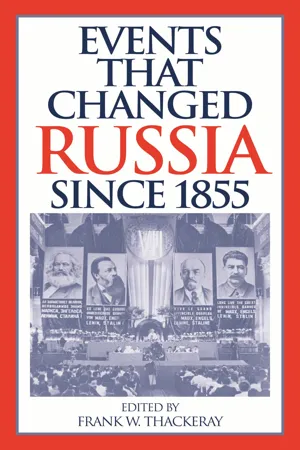 eBook - PDF
- Frank W. Thackeray(Author)
- 2007(Publication Date)
- Greenwood(Publisher)
5 World War I, 1914–1918 INTRODUCTION Beginning in August 1914, the catastrophic World War I engulfed Europe’s Great Powers, including Russia. Although most historians have deter- mined that Europe accidentally slid into war, few will disagree that Russia played a large and irresponsible role in the coming of the conflict. In 1871 Germany was unified under the guidance of Otto von Bismarck, who then turned his considerable talents to the task of maintaining Europe’s stability. All the major nations, including Russia, enjoyed close relations with a dominant Germany, except for Great Britain, which then practiced Splendid Isolation, and a revengeful France that Bismarck kept isolated. When William II ascended to the German throne in 1888, and Bismarck resigned two years later, Europe’s constancy came to an end. Russia was the first to experience the changed circumstances when in 1890 Germany shockingly refused to renew the Russo-German Reinsurance Treaty, thereby setting the tsarist state adrift. However, by 1894 Russia had found a friend. In one of the stranger alliances of recent history, autocratic, reactionary, backward Russia now stood side by side with republican, progressive, modern France. One wonders how many tsars turned in their graves when Alexander III, the Autocrat of All the Russias, stood bareheaded at attention as the band played the “Marseillaise.” Thus, Russia was part of Europe’s division into two armed camps. The Franco-Russian alliance added a third friend, if not formal partner, at the start of the twentieth century when Britain abandoned Splendid Isolation and joined what was called the Triple Entente. The Triple Alliance, composed of Germany, Austria-Hungary, and Italy, stood opposed to the Triple Entente. Russian dead litter the road after yet another World War I defeat. The long and bloody conflict sealed the Russian Empire’s fate as its leadership and resources proved inadequate to the task of fighting a modern war. eBook - PDF
Systems, Stability, and Statecraft
Essays on the International History of Modern Europe
- P. Schroeder(Author)
- 2016(Publication Date)
- Palgrave Macmillan(Publisher)
II WORLD WAR I 7 WORLD WAR I AS GALLOPING GERTIE: A REPLY TO JOACHIM REMAK In a recent article, Joachim Remak argues that modern research on the origins of World War I, led by Fritz Fischer and his students, has distorted our view while expanding our knowledge. The search for more profound causes of the war has tended, in Remale's phrase, to malee us miss the forest for the roots. World War I was really the Third Balkan War. It arose from the last of a long series of local Austro-Serbian quarrels, none of which had led to war before; it involved a series of political maneuvers and gambles typical of the great power politics of that time, maneuvers that previously had not issued in general conflict. Only the particular events of 1914 caused this par- ticular quarrel and this diplomatic gamble to end in world war. l There is much truth in this familiar view, and considerable point to Remale's criticism of an overly determinist interpretation of 1914. Yet his ver- sion appears to me as unsatisfactory as those he criticizes. This essay, without claiming to exhaust the literature or to say anything brand new,2 will suggest another way to look at the origins of the war, and propose a view different from Remale's, Fischer's,3 Arno Mayer's,4 and others now current. To start with Fischer: most of what he says about Germany and her bid for world power is true. Many of his formulations and emphases are open to challenge. He is too hard on Bethmann- Hollweg and misinterprets the motives of his crucial decision in 1914. 5 He often underestimates the impor- tance and persistence of concerns other than Weltpolitik in German policy, and he tends to blur the difference between Germany's prewar and wartime goals in emphasizing their continuity. But these points do not destroy his main argument. From 1890 on, Germany did pursue world power. This bid arose from deep roots within Germany's economic, political, and social structures.
Index pages curate the most relevant extracts from our library of academic textbooks. They’ve been created using an in-house natural language model (NLM), each adding context and meaning to key research topics.

