History

Germany WW1
Germany played a significant role in World War 1, which lasted from 1914 to 1918. The country was part of the Central Powers and engaged in major battles on the Western and Eastern Fronts. Germany's defeat in the war led to the signing of the Treaty of Versailles in 1919, which imposed heavy penalties and territorial losses on the nation.
Written by Perlego with AI-assistance
Related key terms
1 of 5
7 Key excerpts on "Germany WW1"
 eBook - PDF
Researching World War I
A Handbook
- Robin Higham, Dennis Showalter, Robin Higham, Dennis Showalter, Dennis E. Showalter, Robin Higham, Dennis E. Showalter(Authors)
- 2003(Publication Date)
- Greenwood(Publisher)
A general plea must also be made on behalf of comparative history, the universal solvent for all myths of national exceptionalism—in which German history has always been fertile—and the only way to be sure which elements of a nation's experience are indeed unique. Among specific problems that could clearly do with additional attention, some goods ones are: all aspects of the conduct of the war on the Eastern Front, far less well served than the war in the West; the reality, or lack of if, of the so- called Burgfrieden; the social history of rural groups and the countryside; Ger- man relations with the Ottoman Empire; and the problem of sustaining social mobilization once the initial excitement of 1914 had worn off (an issue central 34 RESEARCHING WORLD WAR I to the question of why the war managed to go on so long). If there is a unifying thread linking the best current work on Germany during the war, even in the mil- itary sphere, it is a shared concern with cultural issues, a trend that seems likely to continue for a while longer. BIBLIOGRAPHY 1. Afflerbach, Holger. Falkenhayn: Politisches Denken und Handeln im Kaiserreich. Munich: Oldenbourg, 1996. 2. Albrecht, Willy. Landtag und Regierung in Bay em am Vorabend der Revolution von 1918 [Parliament and Government in Bavaria on the Eve of the Revolution of 1918]. Berlin: Duncker undHumblot, 1968. 3. Angress, Werner T. "Das deutsche Militar und die Juden im Ersten Weltkrieg." Mil- itargeschichtliche Mitteilungen 19 (1976): 77-146. 4. Angress, Werner T. "The German Army's ' ' Judenzahlung' of 1916." Leo Baeck Institute Yearbooks [\91%)\ 117-35. 5. Armeson, Robert B. Total War and Compulsory Labor: A Study of the Military-Industrial Complex in Germany during World War I. The Hague: M. Nijhoff, 1964. 6. Ay, Karl-Ludwig. Die Entstehung einer Revolution: Die Volksstimmung in Bayern wdhrend des Ersten Weltkrieges [Origins of a Revolution: Popular Opinion in Bavaria during the First World War]. eBook - PDF
World War One
The Global Revolution
- Lawrence Sondhaus(Author)
- 2020(Publication Date)
- Cambridge University Press(Publisher)
1 The World in 1914 and the Origins of the War 1878 Congress of Berlin alters Balkan borders; Ottoman Empire weakened. 1882 Triple Alliance formed (Germany, Austria-Hungary, Italy). 1889–1914 Second Socialist International provides leading forum against militarism. 1892–94 France and Russia conclude military convention and treaty of alliance. 1898 German Reichstag approves “Tirpitz Plan” for naval expansion. 1898 Spanish-American War signals emergence of the United States as an imperial power. 1899–1902 Anglo-Boer War exposes Britain’s isolation; Anglo-Japanese alliance (1902). 1903 Coup in Serbia installs pro-Russian Karageorgevic ´ dynasty. 1904–05 Entente Cordiale links France with Britain. Russo-Japanese War foreshadows trench warfare. 1906 HMS Dreadnought commissioned; Anglo-German naval race accelerates. 1907 Anglo-Russian Entente completes Triple Entente. 1908 Austria-Hungary annexes Bosnia (occupied since 1878). 1911–12 Italo-Turkish War features first combat use of airplanes. 1912–13 Balkan Wars further weaken Ottoman Empire, destabilize region. the world in 1914 and the origins of the wa r 8 The controversy over the origins of World War I began in the summer of 1914, as soon as the declarations of war were exchanged. The decision of the victors to include a war-guilt clause in the Treaty of Versailles reflected their conviction, unanimous as of 1919, that Germany had been responsible for the war. Their verdict was rejected by virtually all German academicians and, during the 1920s, by a broad spectrum of revisionist historians who blamed the alliance system, the great powers collectively, or one or more of the great powers other than Germany. While the experience of World War II refocused the lion’s share of the responsibility on Germany, the scholarship of subsequent decades further explored the roles of all of the belligerents, their domes- tic politics, diplomatic alignments, and war aims as of 1914. eBook - PDF
Re-visiting World War I
Interpretations and Perspectives of the Great Conflict
- Jaroslaw Suchoples, Stephanie James(Authors)
- 2016(Publication Date)
- Peter Lang Group(Publisher)
Arnd Bauerkämper 194 Layers of memory. The Place of World War I in European nation-states and non-European regions Memories of World War I took up the immediate experiences of the conflict, and they were strongly influenced by wartime propaganda. 17 However, differ- ent groups strove for hegemony in discourses within the various nation-states. Memory conflicts also emerged between European countries and their govern- ments, as contrasting editions of documents on World War I clearly demonstrated. The German Foreign Office, for example, started to publish documents on World War I from 1922 onwards. The forty volumes of the Deutsche Dokumente zum Kriegsausbruch as well as the documentation on the Große Politik der Europäis- chen Kabinette 1871–1914 rejected Allied accusations of war guilt. By contrast, the ‘British Documents of the Origins of the War 1898 to 1914’ (published from 1926 to 1938) assigned the major responsibility for the outbreak of war to the Austro-Hungarian Empire and its German ally. This interpretation also charac- terized the French edition of the Documents Diplomatiques Français. The conflict about war guilt, which was at the cradle of modern contemporary history, gave rise to acrimony, especially in Germany where the campaign against the Versailles Treaty was based on a broad political consensus about German harassment and victimization in the Weimar Republic. 18 World War I has occupied a central position in the memory cultures of many European states. In fact, a ‘cultural landscape of grieving for mourners’ emerged from the bloody confrontation. 19 Heroic tales of soldiers fighting and dying for 17 ‘Experience is a highly subjective representation of internal and external stimuli, and memory is an abstract recording and reordering of select experiences’ (Richard Ned Lebow, “The Memory of Politics in Postwar Europe,” in The Politics of Memory in Post- war Europe, ed. Richard Ned Lebow [Durham, NC: Duke University Press, 2006], 11). eBook - PDF
The Great War in History
Debates and Controversies, 1914 to the Present
- Jay Winter, Antoine Prost(Authors)
- 2020(Publication Date)
- Cambridge University Press(Publisher)
Continuities While a number of historians have widened the geographical and tem- poral definitions of the Great War, the majority of works published since 2000 have continued to deepen our understanding of the military, the political, the economic, the social, and the cultural history of the war. Most adopt the national framework which still dominates First World War studies as a whole. Military history No one has advanced the military history of the First World War more than Hew Strachan, whose first volume of the new Oxford history of the war, To arms!, was published in 2000. In this work he set a new standard 222 The Great War in History for the weaving together of the political, strategic, and operational histo- ry of the war, through the use of German, English, and French sources. This part of his multi-volume history covers 1914. Given the sheer size of the literature and archives related to the rest of the war, it is not sur- prising that Strachan’s project remains incomplete. Military historians have made major contributions to our understand- ing of the fate of individual campaigns. Robin Prior (2009) established the hopelessness of the plan to force the Dardanelles and then to seize the heights commanding the Straits through an amphibious landing in April 1915. Paul Jankowski in 2013 and Antoine Prost and Gerd Krumeich in 2015 broke new ground in the literature about Verdun. Jankowski sug- gested that Falkenhayn never saw Verdun as a breakthrough battle, but a violent prelude to what would have been a later attempt to breach Al- lied lines. Prost and Krumeich showed why the French withstood Falk- enhayn’s assault at Verdun in 1916, through an original analysis of the workings of the French general staff. William Philpott (2009) provided the first full account of all three armies engaged in the Battle of the Somme later that year. eBook - PDF
Systems, Stability, and Statecraft
Essays on the International History of Modern Europe
- P. Schroeder(Author)
- 2016(Publication Date)
- Palgrave Macmillan(Publisher)
II WORLD WAR I 7 WORLD WAR I AS GALLOPING GERTIE: A REPLY TO JOACHIM REMAK In a recent article, Joachim Remak argues that modern research on the origins of World War I, led by Fritz Fischer and his students, has distorted our view while expanding our knowledge. The search for more profound causes of the war has tended, in Remale's phrase, to malee us miss the forest for the roots. World War I was really the Third Balkan War. It arose from the last of a long series of local Austro-Serbian quarrels, none of which had led to war before; it involved a series of political maneuvers and gambles typical of the great power politics of that time, maneuvers that previously had not issued in general conflict. Only the particular events of 1914 caused this par- ticular quarrel and this diplomatic gamble to end in world war. l There is much truth in this familiar view, and considerable point to Remale's criticism of an overly determinist interpretation of 1914. Yet his ver- sion appears to me as unsatisfactory as those he criticizes. This essay, without claiming to exhaust the literature or to say anything brand new,2 will suggest another way to look at the origins of the war, and propose a view different from Remale's, Fischer's,3 Arno Mayer's,4 and others now current. To start with Fischer: most of what he says about Germany and her bid for world power is true. Many of his formulations and emphases are open to challenge. He is too hard on Bethmann- Hollweg and misinterprets the motives of his crucial decision in 1914. 5 He often underestimates the impor- tance and persistence of concerns other than Weltpolitik in German policy, and he tends to blur the difference between Germany's prewar and wartime goals in emphasizing their continuity. But these points do not destroy his main argument. From 1890 on, Germany did pursue world power. This bid arose from deep roots within Germany's economic, political, and social structures.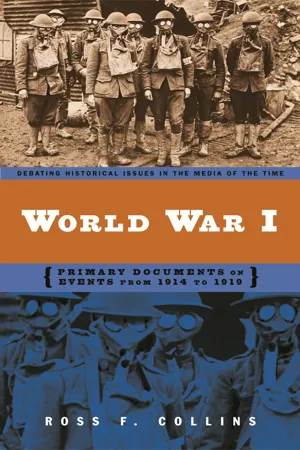 eBook - PDF
World War I
Primary Documents on Events from 1914 to 1919
- Ross F. Collins(Author)
- 2007(Publication Date)
- Greenwood(Publisher)
By the eve of World War I, Germany, a latecomer to colonialism, had man- aged to secure several minor colonies in Africa and the Pacific, all of which it lost after the war. Germany acquired a reputation for colonial brutality, par- ticularly after conflicts in 1904 between German settlers and native people in German Southwest Africa (Namibia) resulted in Berlin dispatching troops to a war that killed about 1,700 Germans and at least 25,000 native Herero. A growing international reputation for German cruelty and bellicose diplo- macy based on military might created the universal allied belief during the war that a certain kultur, the result of nefarious Prussian ideals, had driven the entire German people into conflict with civilized Western values. Histo- riography has see-sawed in its interpretation of German militaristic culture 140 World War I as a cause of war. Nonetheless, it seems certainly true that by the first years of the 1900s German foreign policy was controlled primarily by an aggres- sive military structure that was autocratic in nature and pervasive in society. That structure was encouraged by an often pugnacious Kaiser and abetted by the country’s civilian leaders. They agreed the force of this new European power must be grown within a preexisting diplomatic structure in Europe, a structure the Germans feared would marginalize their influence. It was the fearful potential of its military that encouraged other powers to try to contain a Germany intent on expanding its influence. Bismarck’s shrewd diplomacy may or may not have been able to navigate these hazards. Yet in using the military as a tool to build a united country, the “Iron Chancellor,” as he was sometimes called, seemed to show that German success could be gained through just such belligerent means.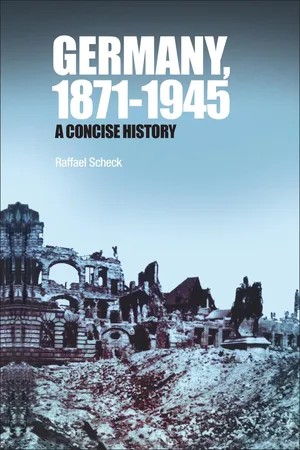 eBook - PDF
Germany, 1871-1945
A Concise History
- Raffael Scheck(Author)
- 2008(Publication Date)
- Berg Publishers(Publisher)
Hardly a civilian did not loose a father, son, or brother in the war. Multiple losses within the same family were common. Over two million German soldiers were killed in the war, more than from any other nation in the First World War (although France and Serbia sustained higher losses in relation to their population). Millions more returned with handicaps, mental illness, or scarred for life by shell shock. These losses were enormously costly for the state, too, as it had to support widows and children of fallen soldiers and pay (meager) compensation for disabled soldiers. In short, the war put a heavy strain on German society and confronted the state authorities with unprecedented tasks. One of the most daunting tasks for states was the organization of the war economy. Work force and production shifted to industries that were essential for the war. If possible, factories tried to produce goods that were needed by the army. Peace goods and consumer goods became rare and thus expensive. Huge state investment went to 98 • Germany, 1871–1945 heavy industry, particularly to the largest enterprises, as they seemed more efficient and had stronger lobbies. This created much bitterness among smaller entrepreneurs and all those businessmen and artisans who could not participate in the armaments production. Disgruntled lower middle-class people found that the state seemed to neglect them and that the workers were better off than they because the workers had large interest organizations. Many of these people tended to blame the Jews for their economic plight, blending allegedly Jewish-led socialism together with allegedly Jewish capitalism into one powerful hallucinatory target. Anti-Semitism began to find increasing resonance among these groups. In order to give meaning to the suffering and to stabilize the home front, govern-ments formulated war aims.
Index pages curate the most relevant extracts from our library of academic textbooks. They’ve been created using an in-house natural language model (NLM), each adding context and meaning to key research topics.

