History

Causes of WWI
The causes of WWI can be attributed to a complex web of factors, including militarism, alliances, imperialism, and nationalism. Tensions between major powers in Europe, particularly the rivalry between Germany and Britain, played a significant role in the outbreak of the war. The assassination of Archduke Franz Ferdinand of Austria-Hungary in 1914 acted as a catalyst, leading to the declaration of war.
Written by Perlego with AI-assistance
Related key terms
1 of 5
10 Key excerpts on "Causes of WWI"
 eBook - ePub
World War I
People, Politics, and Power
- Britannica Educational Publishing, William Hosch(Authors)
- 2009(Publication Date)
- Britannica Educational Publishing(Publisher)
CHAPTER 1 THE ROOTS OF WORLD WAR IA fter forty-three years of peace among the Great Powers of Europe, an act of political terrorism on June 28, 1914 provoked two great alliance systems into mortal combat. The South Slav campaign against Austrian rule in Bosnia, culminating in the assassination of Archduke Francis Ferdinand—the Habsburg heir apparent—at Sarajevo, catalyzed a rapid chain reaction leading to War. This local crisis quickly engulfed all the powers of Europe through the mechanisms of the Triple Alliance and the Triple Entente, diplomatic arrangements meant precisely to enhance the security of their members and to deter potential aggressors. The long-term causes of the war can therefore be traced to the factors that impelled the formation of those alliances, increased tensions among the Great Powers, and made at least some European leaders desperate enough to seek their objectives even at the risk of a general war. These factors include the forces of militarism and mass mobilization, instability in domestic and international politics occasioned by rapid industrial growth, global imperialism, popular nationalism, and the rise of a social Darwinist world-view. However, the question of why World War I broke out should be considered together with two further questions: why did this period of peace between the Great Powers of Europe finally end, and why did it end in 1914 rather than before or after?A portrait of Otto Eduard Leopold von Bismarck, the first chancellor of the German Empire, c. 1880. Hulton Archive/Getty ImagesINDUSTRIALISM AND IMPERIALISM
PATTERNS OF POPULATION
In the 19th century, both demographic and industrial growth in Europe were frantic and uneven, with both qualities contributing to growing misperceptions and paranoia in international affairs. The European population grew at the rate of 1 percent per year in the century following 1815, an increase that would have been disastrous had it not been for the outlet of emigration and the new prospects of employment in the rapidly expanding cities. However, as the distribution of Europe’s peoples changed radically, the military balance among the Great Powers also shifted. In the days of Louis XIV, France was the wealthiest and most populous kingdom in Europe, numbering 25,000,000 to Britain’s 14,500,000 as late as 1789. When the French Revolution unleashed this national power through rationalized central administration, meritocracy, and a national draft predicated on patriotism, it achieved unprecedented organization of force in the form of armies of millions of men. eBook - ePub
- Pat Morgan, Liam McCann(Authors)
- 2020(Publication Date)
- G2 Entertainment(Publisher)
WWI
T he Causes of War
I t was triggered by two shots from an opportunistic assassin’s pistol. It erupted into the most widely devastating war the world had ever seen, involving more than seventy million combatants and killing more than sixteen million people.The Great War was like no other conflict the world had ever seen, or ever will see again. Of those seventy million military personnel, more than nine million never went home. Advances in the technology of war meant weapons were more deadly than ever, and their effects reached far beyond the battlefields. War spread to each corner of the planet as every one of the world’s major powers entered the fray. And when the fighting was over, the ‘war to end wars’ had resulted in the dismantling of four empires and the redrawing of the map of Europe.The one thing it didn’t do was end war. Despite the formation of the League of Nations in a futile attempt to avert further conflicts, festering nationalism provoked by the Great War and the formation of new, deadly ideologies led eventually to the killing fields of the natural sequel: World War II.To understand these consequences, and to unravel the tangle of ambitions, treaties and alliances that led inexorably to World War I, it’s necessary to delve decades back into history. First, though, let us shed some light on the spark that ignited the powder keg: the assassination of Archduke Franz Ferdinand, heir to the throne of the Austro-Hungarian Empire, in Sarajevo on 28 June 1914.A would-be assassin attached to the Black Hand secret military society fires at Franz Ferdinand, Archduke of the Austro-Hungarian Empire, and his wife Sophie in Sarajevo on 28 June 1914. A further, successful assassination attempt was made later in the day.The assassin was Gavrilo Princip, a Serbian student who had been supplied with weapons by the Black Hand, a secret nationalist group opposed to the control of Bosnia and Herzegovina by the Empire. Franz Ferdinand had already survived one assassination attempt by colleagues of Princip when his car stopped on its way out of town and the little Serb stepped forward to seize his opportunity, shooting the Archduke and his wife Sophie. He did not know that his actions would set in train a world-changing chain of events. eBook - ePub
Mapping the First World War
The Great War through maps from 1914-1918
- Peter Chasseaud(Author)
- 2013(Publication Date)
- Collins(Publisher)
Chapter 1 The Causes of the WarPosition of the Fleet at Spithead on 24 June 1911.Although the First World War was triggered by a local dispute between Austria–Hungary and Serbia, its origin was an existential struggle between empires. These empires were the German Second Reich, under Kaiser Wilhelm II; the Russian, ruled by Tsar Nicholas II; the Austro-Hungarian Dual Monarchy, held together by Emperor and King (Kaiser und König) Franz Joseph II; and the Ottoman (Turkish), under Sultan Abdul Hamid II but with power increasingly in the hands of the ‘Young Turks’ of the Committee of Union and Progress. On the fringes at the outset, but drawn in by the system of alliances, were the Republican French and monarchical-democratic British Empires. While these two had been traditional enemies for reasons of proximity, religion, maritime and imperial rivalry, this enmity had faded in the face of the growing industrial, military, naval and manpower strength of Germany, which under Wilhelm II demanded its imperial ‘place in the sun’. France and Britain in any case both had their own quarrels with Germany. France burned for la revanche – revenge against Germany for the loss of the provinces of Alsace and Lorraine following the disastrous Franco-Prussian War of 1870–71. Britain resented the deliberate challenge to the Royal Navy, her empire and her trade represented by Wilhelm’s building up of the Kriegsmarine, and also the vain posturing of this upstart grandson of Queen Victoria. eBook - ePub
The Political Economy of Global Security
War, Future Crises and Changes in Global Governance
- Heikki Patomäki(Author)
- 2007(Publication Date)
- Routledge(Publisher)
4 The origins of the First World War Using historical counterfactuals in constructing open-system explanationsWhat explains the 1914–18 war that claimed the lives of 10 million people, caused unprecedented levels of social and industrial mobilisation and triggered some of the most remarkable military and, subsequently, political revolutions? There are thousands of scholarly and popular works on the Great War. However, many well-known historical accounts of the First World War contextualise the war only briefly before moving to discussing in detail its outbreak, escalation, strategies, battles, negotiations and outcomes (e.g. Stevenson 2004); or tend to focus on the armaments race of the last decade before the war (e.g. Stevenson 1996). However, there have also been longerterm historical accounts, such as A.J.P. Taylor’s (1971) standard benchmark treatise The Struggle for Mastery in Europe, 1848–1918 ; Joachim Remak’s (1976) The Origins of World War I, 1871–1914 ; and Eric Hobsbawm’s (1994a) repeatedly reprinted The Age of Empire, 1875–1914 , focusing on the war in the last chapter.1The academic discipline of International Relations (IR) was founded in 1919 in response to the Great War. As a social science, IR has been expected to search for generalisable theories and causal accounts. Its original task was to find out the causes of war in order to prevent the catastrophe of 1914–18 from ever being repeated. The catastrophe was soon repeated – or, in an important sense, continued – in the form of the Second World War. Before long, in the cold war context, the First World War lost its special importance for IR. For instance, both Neorealist (Waltz 1979:172; Gilpin 1981:145, 192–94, 200–7) and neo-Marxist (Wallerstein 2000:258) theories of hegemonic stability and succession present the outbreak of the First World War as a mere instance of theory-derived and simple law-like regularities in world politics. These studies do not compare different explanatory stories or assess critically the available empirical evidence about trends and episodes that led to the outbreak of the war. Even the more open-minded empirical studies of war and peace (e.g. Vasquez 1999:268–69, 272–74) have characteristically discussed the origins of the First World War only as an empirical case of one war among numerous wars. A notable exception to this tendency to neglect concrete analysis of the causes of the First World War has been the lateral pressure theory. This was developed by Nazli Choucri and Robert C. North (1975) to synthesise historical narratives of the long-term developments that led to the 1914–18 war and, simultaneously, test quantified hypotheses against the available data. With the exception of the lateral pressure theory and a few notable articles (e.g. Lebow 2000; 2001), and with a partial exception of works such as Richard Hamilton and Holger Herwig’s (2003) The Origins of World War I
- M. Jasinski(Author)
- 2011(Publication Date)
- Palgrave Macmillan(Publisher)
CHAPTER 9 The Outbreak of World War I A rguably the best case study to comprehensively illustrate the dynamics of the impact of the combination of the level of generalized social trust, major power status, and economic growth identified as key factors determining the onset of militarized interstate disputes in the quantitative analyses above is the interaction of European major powers leading up to the outbreak of World War I. With the centennial of the outbreak of the First World War rapidly approaching, it is perhaps appropriate to reflect on the causes of that system-altering conflict, all the more so as many of the factors that contributed to its outbreak persist even to this day. Although the quantitative portion of this project dealt with militarized interstate disputes rather than wars, it must be noted that wars are almost invari- ably preceded by such disputes, which then escalate until they pass the war threshold. Such was the case during the fateful events of 1914. One of these factors is the impact of economic development and interdependence on international conflict. Whereas today, in the era of globalization, there exists considerable optimism that the combination of democracy, universal hospitality, and international institutions (the three components of Kantian peace) have all but banished conflict at least among the states that are well integrated into the international economic system (Jervis 2002), one should not forget that similar predictions were being made prior to 1914. That staggeringly destructive and costly war took place in spite of predictions that such a conflict was extremely unlikely to occur due to the heightened international interdependence caused by the industrial revolution and the expanding international trade fostered by the so-called Pax Britannica, the growing wealth of nations, and the increased costs of major conflict due to a variety of modern technologies (Wolf 2005). eBook - ePub
Explaining War and Peace
Case Studies and Necessary Condition Counterfactuals
- Jack Levy, Gary Goertz(Authors)
- 2007(Publication Date)
- Routledge(Publisher)
Either future, or others we have not described, could have come to pass—just as World War I could have been averted. Social scientists and historians of a deterministic persuasion err in thinking that major social and political developments are invariably specific instances of strong, or even weak, regularities in social behavior. These developments are sometimes the result of accidental conjunctions; they are events that might have had a low subjective probability. Conversely, events that seem highly likely may never happen. The concatenation of particular leaders with particular contexts, and of particular events with other events is always a matter of chance, never of necessity (Almond and Genco 1977).Contingency and causation
The origins of World War I are best understood as a confluence of three largely independent chains of causation that came together in 1914. Their interaction has the characteristics of a complex, nonlinear system. The value of important variables was not independent, but depended on the presence and value of other key variables. And they in turn depended on the changing understandings actors had of their strategic interactions.A linear model that specified the presence of A (the set of variables associated with the German security dilemma), B (the set of variables relevant for Austria’s security dilemma) and C (Russian willingness to risk war to support Serbia) would only capture part of the strategic picture. The values of A, B and C were determined by gestalt shifts that took place in 1909 in Russia and in 1914 in Austria–Hungary and Germany. The presence of A*B*C prior to these gestalt shifts would not have produced a war. Nor, I have argued, would their coincidence have been likely to do so after 1916 or 1917 if the political alignment in the Balkans had changed, if Russia’s domestic situation had become more acute or if the Schlieffen Plan had been replaced by a more defenseoriented alternative. War required the coincidence of A*B*C after the gestalt shifts and before important underlying conditions changed to produce further shifts. The catalyst for the C gestalt shift was Russia’s perception of its humiliation in the 1908–9 Bosnian Annexation Crisis, and for the A and B shifts, the twin assassinations at Sarajevo.World War I is not unique in its nonlinearity. World War II, which brought about the next transformation of the international system, was also the product of a highly contingent set of conditions. Aggressive as Hitler was, it is more difficult to imagine Germany starting a war in a less fortuitous context. In the 1930s, France was divided internally, and Britain and France were loath to collaborate with the Soviet Union. Because his imperial policy in Africa had run afoul of Britain, Mussolini abandoned his opposition to German expansion and entered into an alliance with Hitler. In the Far East, Japan attacked China, and posed a serious security threat to the Soviet Union and the Western powers. Isolationism guaranteed that the United States, whose intervention had determined the outcome of World War I, was no longer a player in the European balance of power. Hitler could attack his enemies piecemeal, while counting on the support of Italy and the neutrality of the Soviet Union and the United States. The end of the Cold War – which brought about the third system transformation of the century – can also be described as the result of complex, path dependent, nonlinear interactions (Lebow and Stein 1994). eBook - PDF
Competing Voices from the Russian Revolution
Fighting Words
- Michael C. Hickey(Author)
- 2010(Publication Date)
- Greenwood(Publisher)
It also has important implications for the study of revolutionary social history. One recent study, for example, has argued that during the war peasants developed new ways of thinking and interacting with the state that shaped their views of revolution in 1917 and then influenced their interactions with the Soviet government during the Civil War. 10 15 THE CONTEXT OF WORLD WAR I A Brief Description of Russian Conditions during World War I In July 1914, Tsar Nicholas II decided to mobilize the Russian Army against the Austro-Hungarians. For more than a decade, tensions had been building toward a general European war. The tsar’s declaration— Russia’s response to the complicated diplomatic crisis set off when a Serbian nationalist assassinated the Austrian Archduke Franz Ferdinand in the Bosnian city of Sarajevo on 28 June 1914—brought matters to a head. Germany responded by declaring war on Russia, which set off a chain reaction of war declarations. Dominos set up by prewar alliance systems crashed one upon another: Russia, Great Britain, France, and their allies now were at war against Germany, Austro-Hungary, and their allies (which from 1915 would include the Ottoman Turks). Many of the tsar’s advisors thought Russia simply could not back down from this war, especially given its diplomatic failures since the humiliating Russo- Japanese War of 1904–1905. Most of them believed that the war would strengthen Russia’s position in the European order and reinforce its role as the leader of the Slavic nations. A few expected that war would quell the strikes and student demonstrations that had been building in number and force in the first half of 1914. The conservative official Petr Durnovo, however, had warned the tsar that Russia was ill-prepared for a major war, that Russia’s allies would let it bear the brunt of the conflict, and that the result could very well be collapse and revolution. eBook - PDF
World War One
The Global Revolution
- Lawrence Sondhaus(Author)
- 2020(Publication Date)
- Cambridge University Press(Publisher)
1 The World in 1914 and the Origins of the War 1878 Congress of Berlin alters Balkan borders; Ottoman Empire weakened. 1882 Triple Alliance formed (Germany, Austria-Hungary, Italy). 1889–1914 Second Socialist International provides leading forum against militarism. 1892–94 France and Russia conclude military convention and treaty of alliance. 1898 German Reichstag approves “Tirpitz Plan” for naval expansion. 1898 Spanish-American War signals emergence of the United States as an imperial power. 1899–1902 Anglo-Boer War exposes Britain’s isolation; Anglo-Japanese alliance (1902). 1903 Coup in Serbia installs pro-Russian Karageorgevic ´ dynasty. 1904–05 Entente Cordiale links France with Britain. Russo-Japanese War foreshadows trench warfare. 1906 HMS Dreadnought commissioned; Anglo-German naval race accelerates. 1907 Anglo-Russian Entente completes Triple Entente. 1908 Austria-Hungary annexes Bosnia (occupied since 1878). 1911–12 Italo-Turkish War features first combat use of airplanes. 1912–13 Balkan Wars further weaken Ottoman Empire, destabilize region. the world in 1914 and the origins of the wa r 8 The controversy over the origins of World War I began in the summer of 1914, as soon as the declarations of war were exchanged. The decision of the victors to include a war-guilt clause in the Treaty of Versailles reflected their conviction, unanimous as of 1919, that Germany had been responsible for the war. Their verdict was rejected by virtually all German academicians and, during the 1920s, by a broad spectrum of revisionist historians who blamed the alliance system, the great powers collectively, or one or more of the great powers other than Germany. While the experience of World War II refocused the lion’s share of the responsibility on Germany, the scholarship of subsequent decades further explored the roles of all of the belligerents, their domes- tic politics, diplomatic alignments, and war aims as of 1914.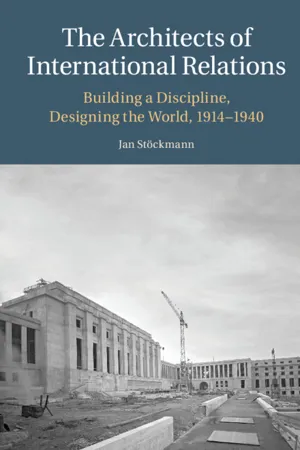 eBook - PDF
The Architects of International Relations
Building a Discipline, Designing the World, 1914-1940
- Jan Stöckmann(Author)
- 2022(Publication Date)
- Cambridge University Press(Publisher)
57 Edgard Milhaud, Plus jamais! L’organisation de la paix, le pacte de la Société des nations, les amendements nécessaires (Geneva, 1919), p. i. 58 H. N. Brailsford, The Origins of the Great War (London, 1914). Understanding the Causes of War 39 newspaper articles in Der Krieg und die Große Politik (1917), and Helena Swanwick’s essay Women and War (1915). They wrote from different angles and employed different styles but essentially pursued the same research goal – to understand, by rational inquiry, the causes and patterns of the current war. In doing so, they associated themselves with an emerging network of scholars, politicians, journalists, activists, and philanthropists who subsequently set up the first IR institutions. In other words, the war jump-started the development of IR as a new academic field. The most striking argument in this emerging literature was that the war had been caused by a flawed system of international politics. Until 1914, the critics argued, foreign policy had been in the hands of govern- ments unaccountable to parliamentary control. International treaties had been kept secret and diplomatic services had recruited their officials from a small elite. Virtually all decision-makers were white men. The ruling class regarded war as a “pleasure party” (Lustpartie), to use Immanuel Kant’s words. 59 While the lack of democratic control was obvious in the case of Germany, none of the belligerent governments was particularly open for dissent either. Nor did the dissenters stand much of a chance. The British, for example, imprisoned E. D. Morel for sending pamphlets to French writer Romain Rolland in neutral Switzerland. By loosely referring to France and Britain as “the democ- racies”, historians have neglected the effects of female disenfranchise- ment, censorship, and the intimidation of the opposition.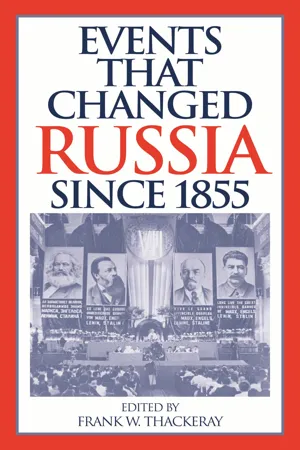 eBook - PDF
- Frank W. Thackeray(Author)
- 2007(Publication Date)
- Greenwood(Publisher)
94 Events That Changed Russia since 1855 After the war, Europeans turned their backs on the liberal politics of the nineteenth century, which had emphasized individual rights, in favor of political parties, both socialist and fascist, that stressed the collective. In this regard, the Great War is often considered the watershed event that divided the nineteenth and twentieth centuries. In Russia and the Soviet Union, the Bolshevik Revolution and World War II became the primary events that forged Soviet society and dominated official memory. Never- theless, the Great War fundamentally altered the course of Russian history and stands among the major events that shaped modern Russia. On June 28, 1914, a Bosnian Serb assassinated Archduke Franz Ferdi- nand, heir to the Austro-Hungarian throne. A month later, on July 23, after receiving assurances of support from Germany, Austria-Hungary sent Serbia a series of demands. The Serb government rejected the demand that Austria be allowed to participate in the assassination investigation. To permit Austria’s involvement would be a breach of Serbian sovereignty. The Russian Empire pledged its support to Serbia. In recent decades, both Germany and Austria-Hungary had diplomatically humiliated Russia, and Russia vowed not to see its influence in the Balkans further diminished. Still, Russian military planners disliked the idea of war. Not only did they—along with the rest of Europe—hold the German army in high regard, but they also were in the process of implementing a new armaments program that would not come to fruition until 1917–1918. And yet, if Russia did not appear strong, other countries, such as its ally France, might question its worthiness as a partner. It seemed better to risk war now, while Russia had allies, than to postpone it into the future when its situation might be worse. As diplomatic efforts waned, military leaders urged mobilization.
Index pages curate the most relevant extracts from our library of academic textbooks. They’ve been created using an in-house natural language model (NLM), each adding context and meaning to key research topics.

