History

America in WW1
During World War I, America initially remained neutral but eventually joined the Allies in 1917. The US played a significant role in the war effort, providing troops, supplies, and financial aid. The war ended in 1918 with the signing of the Treaty of Versailles.
Written by Perlego with AI-assistance
Related key terms
1 of 5
9 Key excerpts on "America in WW1"
 eBook - PDF
- Paul Boyer, Clifford Clark, Karen Halttunen, Joseph Kett(Authors)
- 2017(Publication Date)
- Cengage Learning EMEA(Publisher)
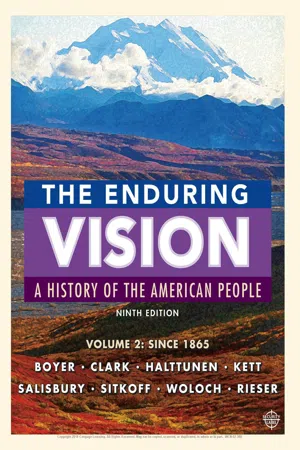
Global Involvements and World War I, 1902–1920 Defining America’s World Role, 1902–1914 (622) What goals underlay America’s early-twentieth-century involvements in Asia and Latin America? The “Open Door”: Competing for the China Market The Panama Canal: Hardball Diplomacy Roosevelt and Taft Assert U.S. Power in Latin America and Asia Wilson and Latin America War in Europe, 1914–1917 (626) Considering both immediate and long-term factors, why did the United States go to war in 1917? The Coming of War The Perils of Neutrality The United States Enters the War Mobilizing at Home, Fighting in France, 1917–1918 (629) How did Washington mobilize the nation for war, and what role did U.S. troops play in the war? Raising, Training, and Testing an Army Organizing the Economy for War With the American Expeditionary Force in France Turning the Tide Promoting the War and Suppressing Dissent (635) How did Americans respond to propaganda and suppression of dissent? Advertising the War Wartime Intolerance and Dissent Suppressing Dissent by Law Economic and Social Trends in Wartime America (638) What was the war’s economic, political, and social impact on the American home front? Boom Times in Industry and Agriculture Blacks Migrate Northward amid New Activist Energies Women in Wartime Public-Health Crisis: The 1918 Influenza Pandemic The War and Progressivism Joyous Armistice, Bitter Aftermath, 1918–1920 (644) How did the League of Nations begin, and why did the Senate reject U.S. membership in the League? Wilson’s Fourteen Points; The Armistice The Versailles Peace Conference, 1919 The Fight over the League of Nations Racism and Red Scare, 1919–1920 The Election of 1920 The Whole Vision (649) 22 WORLD WAR I POSTER URGING FOOD CONSERVATION, BY ILLUSTRATOR JAMES MONTGOMERY FLAGG Home-front propaganda played a key role in mobilizing Americans in support of the war effort in 1917–1918. eBook - ePub
Writing the Great War
The Historiography of World War I from 1918 to the Present
- Christoph Cornelissen, Arndt Weinrich, Christoph Cornelissen, Arndt Weinrich(Authors)
- 2020(Publication Date)
- Berghahn Books(Publisher)
Chapter 13
FINDING A PLACE FOR WORLD WAR I IN AMERICAN HISTORY
1914–2018
Jennifer D. KeeneWorld War I has occupied an uneasy place in the American public and political consciousness.1 In the 1920s and 1930s, controversies over the war permeated the nation’s cultural and political life, influencing memorial culture and governmental policy. Interest in the war, however, waned considerably after World War II, a much larger and longer war for the United States. Despite a plethora of scholarly works examining nearly every aspect of the war, interest in the war remains limited even among academic historians. In many respects, World War I became the “forgotten war” because Americans never developed a unifying collective memory about its meaning or the political lessons it offered. Americans remembered the Civil War as the war that ended slavery and saved the union, World War II as “the good war” that eliminated fascist threats in Europe and the Pacific, the Cold War as a struggle for survival against a communist foe, and Vietnam as an unpopular war. By comparison, World War I failed to find a stable place in the national narrative.The 2014–18 global centennial commemoration created a cultural moment when it became almost mandatory for Americans to acknowledge the war. These remembrances occurred during an uneasy time in post-9/11 American society. The flawed military interventions in Afghanistan and Iraq, instability in the Middle East, worries that the “American Century” had ended, and concerns about maintaining civil liberties during an endless domestic “war on terror” prompted a myriad of articles and reflections in the popular press that drew parallels between the present and 1914–18. Public intellectuals used the exercise of centennial commemoration to interrogate the dilemmas plaguing the United States in the twenty-first century.2 eBook - PDF
Safe Passage
The Transition from British to American Hegemony
- Kori Schake(Author)
- 2017(Publication Date)
- Harvard University Press(Publisher)
Europe’s carnage called into question its emulation, and America began striking virtuous poses as an advocate of negotiated peace and eco-nomic interdependence. 82 America had often exemplified the aspirations of people yearning to be free; with its entry into World War I and its conduct of the e u ro p e a n p ow e r 234 postwar peace negotiations, it put the best elements of its domestic political ideology on a pedestal not only as the most virtuous organ-ization of relations between a people and their government but also as the form of government least likely to be predatory interna-tionally. As Adam Tooze concludes, “The Great War may have begun in the eyes of many participants as a clash of empires, a classic great power war, but it ended as something far more morally and politi-cally charged—a crusading victory for a coalition that proclaimed itself the champion of a new world order.” 83 It only ended that way because of American involvement. No longer available |Learn more
Liberty, Equality, Power
A History of the American People, Concise Edition
- John Murrin, Paul Johnson, James McPherson, Alice Fahs(Authors)
- 2013(Publication Date)
- Cengage Learning EMEA(Publisher)
C H A P T E R 23 war and society, 1914 – 1920 EUROPE ’ S DESCENT INTO WAR AMERICAN NEUTRALITY Submarine Warfare The Peace Movement Wilson ’ s Vision: “ Peace without Victory ” German Escalation AMERICAN INTERVENTION MOBILIZING FOR “ TOTAL ” WAR Organizing Industry Securing Workers, Keeping Labor Peace Raising An Army Paying the Bills Arousing Patriotic Ardor Wartime Repression THE FAILURE OF THE INTERNATIONAL PEACE The Paris Peace Conference and the Treaty of Versailles The League of Nations Wilson versus Lodge: The Fight over Ratification The Treaty ’ s Final Defeat THE POSTWAR PERIOD: A SOCIETY IN CONVULSION Labor – Capital Conflict Radicals and the Red Scare Racial Conflict and the Rise of Black Nationalism T he First World War broke out in Europe in August 1914. The Triple Alliance of Germany, Austria-Hungary, and the Ottoman Empire squared off against the Triple Entente of Great Britain, France, and Russia. The United States entered the war on the side of the Entente (the Allies, or Allied Powers, as they came to be called) in 1917. Over the next year and a half, the United States converted its large, sprawling economy into a disciplined war production machine, raised a five-million-man army, and provided both the war matériel and troops that helped propel the Allies to victory. But the war also convulsed American society more deeply than any event since the Civil War. The U.S. gov-ernment pursued a degree of industrial control and social regimentation unprecedented in American history. Signif-icant numbers of Americans from a variety of constituen-cies opposed the war. Disadvantaged groups stirred up trouble by declaring that American society had failed to live up to its democratic and egalitarian ideals. Wilson supported repressive policies to silence these rebels and to enforce unity and conformity on the American people. In the process, he tarnished the ideals for which America had been fighting.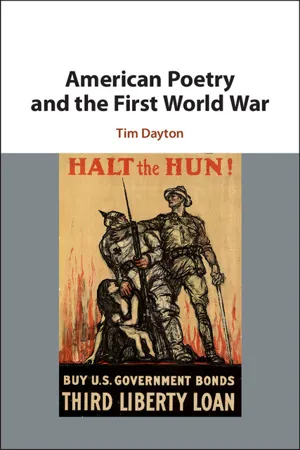 eBook - PDF
- Tim Dayton(Author)
- 2018(Publication Date)
- Cambridge University Press(Publisher)
From the springboard of generally accepted presuppositions about America and its relation to the rest of the world, Wilson crafted a justification for and vision of American intervention in the First World War. This justification and this vision illuminate vital aspects of American culture, especially – but not only – in the twentieth century. They would set up, among other things, the characteristic antipathy between literary modernism – a major compo- nent of what Lionel Trilling in the s would identify as an “adversary culture” (xv) – and the traditional culture of the social and cultural elites who reigned prior to the war, and who attempted, with uneven success, to maintain their position afterward. Wilson’s justification of direct American intervention into the war faced an immediate difficulty. In the combatant nations of Europe, the war could be – and was – seen as defensive in a straightforward, territorial sense. Thus, while men were willing to fight, this willingness was generally based on “defensive patriotism,” and not “enthusiasm for war as such” (Clark ). Wilson would have to present the United States as declaring war on some basis other than territorial defense since the Atlantic Ocean presented an insuperable barrier to invasion, even were Germany so inclined. Wilson could point to provocations: unrestricted submarine warfare meant the loss of American lives, German agents had sabotaged munitions plants that supplied the Allies, and a proposal had been tendered that Mexico join the side of Germany should the United States declare war. But the Allies, especially the United Kingdom, primary enforcer of a naval blockade of the Central powers, had also provoked the United States. Wilson had to present something more compelling, and more elaborate, than the thin case for self-defense. eBook - PDF
War and American Popular Culture
A Historical Encyclopedia
- M. Paul Holsinger(Author)
- 1999(Publication Date)
- Greenwood(Publisher)
World War I, like the American Revolution and the Civil War, was a singing war. New York City's "Tin Pan Alley" cranked out more than seven thousand songs to cheer on the nation's military men as they supposedly were marching directly on Berlin and conquering the German Kaiser himself. At home, wives and sweethearts promised to "Keep the Home Fires Burning," and to "Smile, 196 WAR AND AMERICAN POPULAR CULTURE Smile, Smile." Flag-waving, patriotic silent films kindled a war-like spirit in their viewers. It was hard not to want to rush off to fight after viewing scenes of the beautiful Mary Pickford, "America's sweetheart," being brutalized by vicious enemy officers or seeing through the eyes of the "Little Tramp," Charlie Chaplin, how remarkably easy, and even funny, war could be. In comparison with the massive destruction of men and materiel that other Allied nations experienced during World War I, American losses in the country's less than one year of combat (slightly more than 53,000 deaths and "only" 200,000 wounded) were relatively light. Sadly, however, such sacrifices pro- duced little of significance. In January 1918, President Wilson had enunciated his famous "Fourteen Points" to help the American public understand why they were in the war. Freedom of the seas, no entangling alliances, home rule for all peoples, and an end to war all seemed worth fighting and, if necessary, dying for. Now, with the war at an end, it was clear that none of these lofty dreams had been achieved. The seas remained in the hands of the great powers. Though Germany was stripped of all its colonies, colonialism continued unabated. Eu- rope's entangling alliances were becoming even more confused. When the Allies created the League of Nations, the Republican-controlled U.S. Senate, as much to spite Wilson as anything else, refused to allow the nation to become a member. eBook - ePub
- John Mueller(Author)
- 2013(Publication Date)
- Cornell University Press(Publisher)
CHAPTER 3
WORLD WAR I AS A WATERSHED EVENT
European attitudes toward war changed profoundly at the time of World War I. There is no way to quantify this change except perhaps through a rough sort of content analysis. Before the First World War it was very easy, as documented in the previous chapter, to find serious writers, analysts, and politicians in Europe and the United States exalting war as desirable, inevitable, natural, progressive, and necessary. After the First World War, such pronouncements become extremely rare, although the excitement of the combat experience continued (and continues) to have its fascination to some.1This suggests that the appeal of war, both as a desirable exercise in itself and as a sensible method for resolving international disagreements, diminished markedly on that once war-racked continent. In an area in which war had been accepted as a standard and permanent fixture, the idea suddenly gained substantial currency that war there was no longer an inevitable or necessary fact of life and that major efforts should be made to abandon it.This change has often been noted by historians and political scientists. Arnold Toynbee points out that World War I marked the end of a “span of five thousand years during which war had been one of mankind’s master institutions.” In his study of wars since 1400, Evan Luard observes that “the First World War transformed traditional attitudes toward war. For the first time there was an almost universal sense that the deliberate launching of a war could now no longer be justified.” Bernard Brodie points out that “a basic historical change had taken place in the attitudes of the European (and American) peoples toward war.” Eric Hobsbawm concludes that “in 1914 the peoples of Europe, for however brief a moment, went lightheartedly to slaughter and to be slaughtered. After the First World War they never did so again.” And K. J. Holsti observes, “When it was all over, few remained to be convinced that such a war must never happen again.”2 eBook - ePub
Wilsonian Approaches to American Conflicts
From the War of 1812 to the First Gulf War
- Ashley Cox(Author)
- 2017(Publication Date)
- Routledge(Publisher)
This chapter will begin by addressing the traditional debates that focus on how the United States went to war for strategic and economic reasons. The second section will move on to discuss the Wilsonian interpretation of the events. The final section will address how we can use Mead’s Wilsonian framework to interpret Wilson’s decision for conflict and why this framework is an important analytical tool.The debateThis section will review the arguments that have been classically used to explain the American entry into the First World War. It will then go on to discuss the economic arguments that surrounded American entry into the conflict.The first strategic factor to consider is the classical interpretation of the origins of the First World War, which is that the United States acted only in its own strategic interest.7 This argument suggests that the United States had no need to concern itself with events in Europe until 1917 because Britain had been able to contain any potential hegemon. This section will begin by addressing the neo-realist assertion that the United States had pursued a ‘buck passing’8 strategy up to 1917 allowing the Allies to pay the price of containing Germany.9 This policy changed, so the realist argument goes, as the tide appeared to turn against the Allies in 1917. Thus the United States was forced to support the Allies when presented with potential German hegemony in Europe. In this analysis a victorious Germany would not only possess the strongest army in the world10 but it would shatter British naval supremacy, which played an important part in enforcing the Monroe doctrine.11 With the great powers of Europe defeated, Germany would be unopposed on its borders and as such could attempt to spread its influence to the new world and pose a threat to the United States.12 This scenario would not be appealing for the United States, which owed its own success in the Western Hemisphere to the lack of peer competitors and the balance of the European great powers. John Mearsheimer contends that ‘the United States entered World War One in good part because it thought that Germany was gaining the upper hand’.13 eBook - ePub
Unintended Consequences
The United States at War
- Kenneth J. Hagan, Ian J. Bickerton(Authors)
- 2012(Publication Date)
- Reaktion Books(Publisher)
SIXTHE UNITED STATES INWORLD WAR I , 1917–18
It is much easier to make war than peace.Georges Clemenceau, Paris, 19191The course and outcome of World War I were nothing like the expectations of the participants. No-one anticipated the length, the scale of the slaughter, or the outcome of that most dreadful war the world had yet seen. Nearly ten million combatants and non-combatants lost their lives in the years between 1914 and 1918, and for much of the war no-one knew how to end the conflict. The armistices and subsequent peace treaties created a world, certainly a European world, vastly different from that envisaged by those who took up war. President Woodrow Wilson asserted that the United States entered the war to make the world ‘safe for democracy’ and to bring ‘peace and safety to all nations’, but within twenty years the world faced an even greater cataclysm.The United States had no intention of entering the war in 1914. The nation was ill-prepared for a major war. There was no immediate military threat to the nation’s security. As the war dragged on, the Wilson administration gradually convinced itself that if the United States were to function as a world power, its long-term national interest required active belligerent involvement in the war. By the end of 1916 Wilson and his advisors had reached the conclusion that if the United States did not intervene militarily on the side of the Anglo–French–Russian coalition, Germany and its allies would probably win the war. They believed a triumphant and all-powerful Germany would threaten American interests around the world, especially in the Caribbean, offering a challenge to America’s hemispheric security. Germany’s use of submarines to sink merchant vessels, which resulted in the loss of American lives and weapons secretly being shipped to Britain, constituted the trigger that led to a congressional declaration of war against Germany in April 1917.
Index pages curate the most relevant extracts from our library of academic textbooks. They’ve been created using an in-house natural language model (NLM), each adding context and meaning to key research topics.

