History

American Women in WW2
American women played a crucial role in World War II, taking on various jobs traditionally held by men, such as factory work, nursing, and clerical positions. Their contributions to the war effort were instrumental in supporting the military and war production. This period marked a significant shift in societal attitudes towards women's roles in the workforce and paved the way for greater gender equality in the years to come.
Written by Perlego with AI-assistance
Related key terms
1 of 5
10 Key excerpts on "American Women in WW2"
 eBook - PDF
- Nancy F. Cott(Author)
- 2013(Publication Date)
- De Gruyter Saur(Publisher)
As a result of the war crisis . . . women were able to emancipate themselves social-ly and psychologically and to establish a greater degree of social and economic independence than they had ever known before. Looking back at the 1940s, William Chafe notes somewhat less optimistically: There was no question that economic equality remained a distant goal but the content of women's lives had changed, and an important new area of potential activity had opened up to them, with side effects which could not yet be mea-sured. Eleanor Straub flatly asserts that World War II per-manently altered concepts of welfare, industrial technology . . . the relationship of the individual to the state, and the role of in-terest and minority groups in politics, but no comparable changes in the status of women in American society are visible. 3 These discussions of women and World War II, with their contradictory findings, are based on surveys at the national lev-el. An examination of women and war in a single state affords the opportunity of testing national-level generalizations on a spe-cific test community. Few states better qualify for such a study than Michigan. With 4 per cent of America's population, the state obtained better than 10 per cent of the nearly two hun-' William Henry Chafe, The American Woman: Her Changing Social. Economic, and Political Roles, 1920-1970 (New York: Oxford University Press, 1972), 137-144. * Chester W. Gregory, Women in Defense Work during World War II: An Analysis of the Labor Problem and Women's Rights (Jericho, NY: Exposition Press, 1974), xii; Chafe, 195; Eleanor Straub, Government Policy toward Civilian Women during World War II (unpublished PhD diss. Emory Univ., 1973), 358. WOMEN AND WAR 359 dred billion dollars in prime war supply and facilities contracts awarded by the US government and the Allies from 1940 to 1945. Only New York state outranked Michigan in this catego-ry.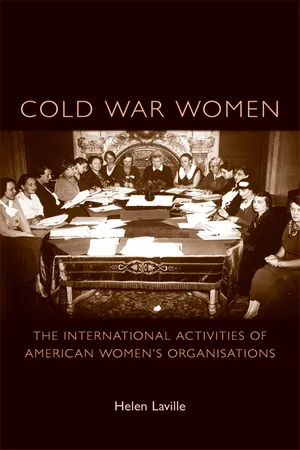 eBook - PDF
Cold War women
The international activities of American women’s organisations
- Helen Laville(Author)
- 2024(Publication Date)
- Manchester University Press(Publisher)
The YWCA expressed this belief in the 'earning' of citizenship through contribution to warfare: Women have served gallantly in every endeavor they undertook during the war - on the home front and in the uniforms of all the armed forces. They drove trucks and they operated machines. They moved into key posts in the world of business and industry. The war proved women have earned the right to achievements, in business, industry, the professions, the arts the sciences and the govemment. 90 The idea that women should be rewarded for their contribution to warfare through the extension of their role as political actors was not new. Women's contribution to the war effort in the First World War was clearly a major factor in the granting of women's suffrage in America in 1920. Leading suffragette Carrie Chapman Catt, previ- ously active in the cause of pacifism, threw the weight of the National American Women's Suffrage Association (NAWSA) behind the war effort, noting as a matter of tactics, 'Wartime service would win more support for the woman's suffrage than pacifism'. When President Woodrow Wilson signed the Nineteenth Amendment giving American women the vote, he specifically mentioned the wartime service of American women and the efforts of NAWSA, claiming the amendment was 'vitally essential to the successful prosecution of the great war'. 91 The participation of American women in the Second World War aroused similar expectations of increased political involvement. This ideological connection between contribution to a national effort and increased rights and responsibilities as citizens was not limited to armed conflicts. The Cold War was also framed as a total conflict from which the USA could not afford to exclude the contri- bution of women. American women's organisations were not above using the military imperatives of the Cold War as a platform on which to base their claim for increased rights and responsibilities.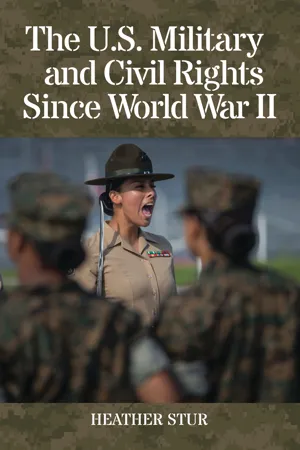
- Heather Stur(Author)
- 2019(Publication Date)
- Praeger(Publisher)
WACs had proven their suitability for combat, and male officers had noticed not just that they could do the work but also that, in the case of antiaircraft tasks, women were more skilled and efficient than the men who had been assigned to the units. American public opinion about what makes a soldier and who has the right to serve in combat was an enemy that would not budge, no matter how much proof existed of women’s capabilities. The idea that men were protectors and women needed protecting was deeply ingrained in American identity. According to this dichotomy, soldiers, especially those tasked with fighting on the front lines, could only be men. American attitudes regarding gender and the military reflected the commitment to a heterosexual gendered social order on the home front in which men were breadwinners, and women’s sphere was in the home. Proponents of the mainstream social order criticized opportunities for women, from civilian employment to military service, that offered alternatives to it. World War II was especially troubling because of the civilian and military manpower the Allied war effort required. Military leaders in the 1940s were not interested in turning the armed forces into a social experiment laboratory; personnel needs motivated them. Ideology has always had a stronger hold on Americans than practical, material need, though, and U.S. attitudes about gender and sexuality would stand as some of the strongest roadblocks in the way of the military’s integration of women during World War II and after.Since the revolutionary war, American women have found ways to support their nation’s war efforts. They have followed their husbands to the front, dressed as men and joined the army, and created makeshift hospitals to take care of wounded soldiers. Congress established the Army Nurse Corps in 1901, but personnel were not considered military and did not receive military pay or benefits. In May 1941, Republican congresswoman Edith Nourse Rogers of Massachusetts proposed a bill to establish a Women’s Army Auxiliary Corps (WAAC). Rogers had served in World War I with the YMCA in England and the American Red Cross in France, and it made her realize that women had been serving in wars in various ways without any recognition. She hoped the creation of an official section of the army for women would once and for all bring to light women’s previously hidden military service. Through their patriotic wartime service, Rogers argued, the women had earned wages and benefits that they could not receive because of their civilian status. More than that, Rogers understood that military service was tied to American citizenship, and so equal access to armed service was a civil right that women in the United States at the time did not have.5
- Andrea Walsh(Author)
- 1986(Publication Date)
- Praeger(Publisher)
Yet sexual egalitarianism still survived. Public opinion polls of Depression-era women, for example, revealed a tension between feminism and traditionalism. In one Ladies' Home Journal survey, 75 percent of the women polled believed that both husbands and wives should make important family decisions, and 60 percent objected to the word "obey" in the marriage vows. However, 90 percent felt that a wife should quit her job if her husband wished her to stay at home.(3) As American women encountered the economic and social changes wrought by war, these contradictions in "common sense" would multiply and intensify. American Womanhood on the Homefront / 51 WAR BREAKS OUT America's declaration of war however, did not immediately challenge dominant ideologies of femininity. At first leaders in government and industry merely urged women to "attend nutrition classes, hang blackout curtains, and 'build morale by being beautiful'."(4) Throughout the war, millions of American women contributed countless hours in unpaid defense work: selling war bonds, planting victory gardens, and assisting the Red Cross. A minority of women answered their nation's crisis by joining the armed services. In all, 140,000 enrolled in the Women's Army Corps (WACS), 100,000 became WAVES, 7^,000 nurses joined the army and navy medical corps, 13,000 became Coast Guard SPARS, and 1,000 aviators flew planes as WASPS. Although most women in the military performed traditionally female jobs, they achieved more equal status than they had in previous wars, largely due to both the military crisis and the efforts of women's organizations and sympathetic legislators.(5) Another minority was deprived of civil rights, unable to live as full citizens during the war. These were the over 50,000 female Japanese Americans whose story lies outside the major narrative of women's lives in World War II. eBook - PDF
War, Nation, Memory
International Perspectives on World War II in School History Textbooks
- Keith A. Crawford, Stuart J. Foster, O. L. Davis(Authors)
- 2007(Publication Date)
- Information Age Publishing(Publisher)
Some books were, however, better than others in providing a more rounded account of women’s wartime activities and experiences. Allan Todd’s The Modern World , for example, organized its 16-page chapter on “Britain and the Second World War” around five key topics, of which one was “the various roles of women during the war.” Two pages, subdivided into five sections, were devoted to women at war. The first section, “Recruit-ment,” detailed how women were conscripted for war work and how, by 1943, “over 7 million women were working in industry, or involved in the various military and defence organisations.” 55 The section entitled “Work and Industry” described in more detail the various and diverse roles women undertook during the war. In the third section, “The Armed Forces and Defence,” the textbook provided an overview of women’s wartime ser-vice and remarked, “By 1944, there were about 500,000 women in the three women’s forces and a further 600,000 involved in the ATS (Auxiliary Terri-torial Service) and the Civil Defence organizations.” 56 The next section which included three paragraphs on “Women in the SOE” departed from conventional textbook coverage by providing an account of women recruited by the Special Operations Executive (SOE). Particular attention was given to the “39 women agents” who were sent into Nazi-occupied France to liaise with the French Resistance movement. Pro-viding a very different perspective to the “behind the scenes” role of women commonly featured in other books, Todd noted that of the 39 “15 were eventually captured by the Germans and sent to concentration camps. Only two of them survived; one of them was Yvonne Baseden. Among the 12 eventually shot by the Germans were Violet Szabo, Denise Bloch, and Lilian Rolfe.” 57 In addition, accompanying the narrative is a photograph of Odette Samson and her daughters standing outside Buck-ingham Palace after she had received the George Cross for bravery.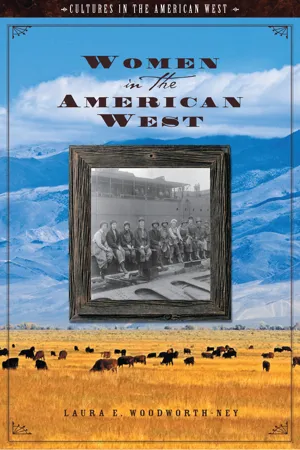 eBook - PDF
- Laura E. Woodworth-Ney(Author)
- 2008(Publication Date)
- ABC-CLIO(Publisher)
The propaganda produced by various agencies, including the Office of War Information, changed from poster slogans such as “The More Women at Work the Sooner We Win!” (Office of War Information 280 Women in the American West Poster, 1943, Northwestern University Library) to admonitions that now that the war was over, a woman’s place was in the home. By 1946, a sig- nificant number of the female wartime employed—around 2.25 million women workers—had quit their jobs, and another million were laid off or fired. Women in the defense industries represented the greatest de- cline in the female workforce, for these jobs either disappeared or were quickly transferred to men returning from war. Although many women stayed in the workforce, they found jobs in an increasingly gender- segregated economy. The service industry created the most jobs for women after the war, including clerical, cleaning, secretarial, or waitress positions. By the late 1950s, 75 percent of working women in the United States worked in positions considered suitable only for women, creating a more gender-segregated workforce than had existed before the war. These jobs paid less, came with fewer benefits, and often did not al- low for advancement. The popular perception of Rosies happily returning to new subur- ban houses with their husbands to have babies and make cookies ob- scured the reality of postwar wage work for women who had worked before the war. Those women—white, black, immigrant—found them- selves forced to give up high-paying jobs in factories with day care for jobs as cooks in schools, attendants in laundries, or maids in wealthy households. One study found that almost 75 percent of women de- fense-industry workers interviewed after the war wished to keep their wartime positions. eBook - PDF
World War II in Europe, Africa, and the Americas, with General Sources
A Handbook of Literature and Research
- Loyd Lee(Author)
- 1997(Publication Date)
- Greenwood(Publisher)
The literature on women in military organizations during World War II is sketchy and often disappointing. Many of these works, by attempting only to describe and praise rather than analyze and evaluate, miss oppor- tunities for great strides in our knowledge of women and war and specif- ically women in military hierarchies. Given that the Second World War formed the arena in which more women fought for their countries than ever before or since, it is surprising that this topic has not generated more interest among serious historians. WOMEN IN THE RESISTANCE AND OCCUPIED TERRITORIES Much of this work also falls into the memoir or narrative category, but a few historians have explored the significance of these experiences for women. Rossiter’s Women in the Resistance and Weitz’s ‘‘As I Was Then’’ on the French resistance make significant contributions to the history of women and war. Rossiter described the various underground movements against the Nazis and women’s participation in the movements, with de- tailed accounts of their exploits and the impact these experiences had on women’s political, social, and economic equality and family relationships. She concluded that participation in the resistance profoundly affected French attitudes toward women, as evidenced by women’s suffrage and their movement into new career fields. Weitz’s Sisters in the Resistance is an excellent combination of personal experience as narrated by the women themselves and analysis of that experience. She reached the opposite con- clusion from Rossiter, claiming that the birth control pill had more impact on women’s lives than did their resistance activities and arguing that con- tribution to the resistance had little impact on women’s enfranchisement. In ‘‘Partisanes and Gender Politics’’ Schwartz concluded that women chal- lenged gender roles most effectively in underground movements, but as the resistance moved above ground, they lost their combatant roles. eBook - PDF
World War II
5 volumes [5 volumes]
- Spencer C. Tucker, Priscilla Roberts, Spencer C. Tucker, Priscilla Roberts(Authors)
- 2005(Publication Date)
- ABC-CLIO(Publisher)
New York: Crown Publishers, 1995. Gluck, Sherna Berger, ed. Rosie the Riveter Revisited: Women, the War, and Social Change. Boston: Twayne Publishers, 1987. Hartmann, Susan M. Home Front and Beyond: American Women in the 1940s. Boston: Twayne Publishers, 1982. Honey, Maureen, ed. Bitter Fruit: African American Women in World War II. Columbia: University of Missouri Press, 1999. ———. Creating Rosie the Riveter: Class, Gender, and Propaganda during World War II. Amherst: University of Massachusetts Press, 1984. Litoff, Judy Barrett and David C. Smith, eds. We’re in This War Too: World War II Letters from American Women in Uniform. New York: Oxford University Press, 1994. McIntosh, Elizabeth P. Sisterhood of Spies: The Women of the OSS. Annapolis, MD: Naval Institute Press, 1998. Paton-Walsh, Margaret. Our War Too: American Women against the Axis. Lawrence: University Press of Kansas, 2002. Poulos, Paula Nassen, ed. A Woman’s War Too: U.S. Women in the Military in World War II. Washington, DC: National Archives and Records Administration, 1996. Wingo, Josette Dermody. Mother Was a Gunner’s Mate: World War II in the Waves. Annapolis, MD: Naval Institute Press, 1994. 4.6. Women in Wartime around the World Women and World War II For almost all women, whatever their nationality, World War II eventually presented challenges and demands they would not normally have encountered. In the absence of husbands and fathers, many who had never expected to have to do so were forced to fend for themselves. Some survived, others did not. For women, war could as easily become a source of suf- fering and hardship as of liberation. Almost invariably, except perhaps in the United States, they had to deal with unusual deprivations and hardships, food shortages, even starvation, disease, bombing, evacuation, homelessness, and invasion or occupation. eBook - PDF
Women and Gender in International History
Theory and Practice
- Karen Garner(Author)
- 2018(Publication Date)
- Bloomsbury Academic(Publisher)
American war makers denigrated and dehumanized the Japanese enemy through the dissemination of racially charged propaganda that portrayed the Japanese people as “beasts, vermin or devils” (Dower 1986: 294). Generating race hatred fueled white US soldiers’ hypermasculine savagery, serving the purposes of the wartime policy makers who demanded “unconditional surrender” of their enemies. Imperial Japan’s wartime propaganda likewise depicted US and British leaders and soldiers as “demonic others” on a mission to defile the Japanese “pure self” to inspire Japanese soldiers and civilians to fight to the death to defend the nation (Dower 1986). British and American war propagandists persuaded women to join the war production plants and to serve their nations on the assembly lines “for the duration” of the war with images that highlighted women’s capabilities, talents, and patriotism, such as the popular images of “Rosie the Riveter” disseminated in the United States. In Britain, larger numbers of women worked in war production plants during the Second World War compared 66 WOMEN AND GENDER IN INTERNATIONAL HISTORY to the First World War, comprising over 2.2 million of the 2.8 million workers who were “new” to the workplace. This was partly due to the fact that very early in the war, Britain had imposed a compulsory draft of single women who were between the ages of 20 and 30, for factory or military service. American women were not conscripted, but the US government’s War Manpower Commission created a “Women’s Advisory Committee” that focused on voluntary recruitment strategies; over 6 million women entered the wartime workforce (Matsumura 2007: 78). War-mobilization campaigns in the United States flattered women with high praise for those who joined the war production effort and glamorized their efforts in text and images.
- Heather Stur(Author)
- 2019(Publication Date)
- Praeger(Publisher)
One of the primary concerns the public had regarding women in the military was access to combat duty. Those Americans who accepted the idea that there were certain acceptable roles for women in the military rarely con- sidered combat to be one of those roles. In the American lexicon, “woman” and “soldier” were antonyms, and the rights of citizenship stood not as rewards for military service but rather for performing the appropriate duties associated with mainstream gender roles. Women were to keep the home fires burning and remind men of why they fought. Some critics worried about women’s safety, believing them unable to defend themselves in a com- bat situation. Others feared that women soldiers would threaten the accepted concepts of manhood and womanhood, which Americans used to define social, political, and economic relationships between men and women. Admitting women into the military wouldn’t just change the armed forces; it would transform U.S. society—and not in ways that critics of women’s mili- tary service were ready to approve. Arguments for and against women in the military played out in congres- sional debates about the creation of the WAC. Some congressmen criticized the WAC bill because the WAC would provide an avenue by which women Military Roles for Women from World War II into the Early Cold War 65 could shirk their domestic responsibilities by running off to join the military. Among the long-term consequences opponents envisioned was a declining birth rate as women would be occupied in ways other than childbearing. Others asserted that women would have to become unnaturally masculin- ized in order to perform well in the military. These mannish women might then grow enamored of their own potential and threaten male authority within the ranks. Having emasculated the U.S. servicemen, they might encourage civilian women to assert themselves and undermine the authority of their husbands, upending the family hierarchy that symbolized U.S.
Index pages curate the most relevant extracts from our library of academic textbooks. They’ve been created using an in-house natural language model (NLM), each adding context and meaning to key research topics.

