History

Women in the Civil War
During the Civil War, women played significant roles by serving as nurses, spies, and in support roles for the military. They also took on responsibilities at home, managing farms and businesses while their husbands were away at war. Some women even disguised themselves as men to fight in the war. Their contributions challenged traditional gender roles and expanded opportunities for women in society.
Written by Perlego with AI-assistance
Related key terms
1 of 5
12 Key excerpts on "Women in the Civil War"
 eBook - PDF
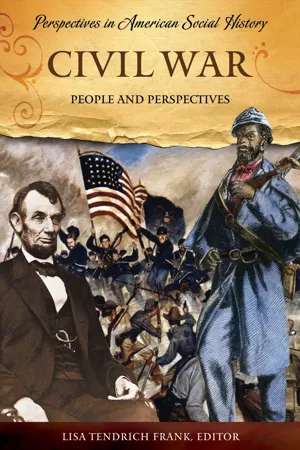
Civil War
People and Perspectives
- Lisa . Tendrich Frank(Author)
- 2009(Publication Date)
- ABC-CLIO(Publisher)
(Library of Congress) 38 C I V I L WA R P E R S P E C T I V E S I N A M E R I C A N S O C I A L H I S T O R Y race, or class, dealt with the direct and indirect results of the Civil War. As men marched off to the battlefields, it was the women left behind who had to keep society running—by raising children, feeding families, running farms and businesses, making uniforms, and provisioning armies. In both the North and South, the needs of war and a loss of manpower mandated that women take on expanded responsibilities. Some took control of family businesses and others took jobs in a growing industrial sector. Slave women also dealt with the shifting realities of wartime, as the conflict pro- vided opportunities for emancipation while wartime tensions made their lives even more precarious. Other women—white and black—became active participants in the military, as nurses, cooks, laundresses, spies, and even soldiers. Even women who were lukewarm in regard to the war dis- covered that the war became everyone’s business. Women across the nation discovered that they needed to deal with food shortages, fiscal infla- tion, the absence and deaths of family members, and the arrival of troops. Some women became refugees; others housed refugees. The war required the mobilization of the entire population, and in many cases, men, women, and children took up the rallying call. Although most scholarly attention focuses on men’s political and military roles during the Civil War, women played a vital part. The Coming of the War Although war is frequently understood as being in the domain of men, the social history of the American Civil War demonstrates that the war could not have been waged without the nation’s women. From the very outset of the conflict, women became integral to both the Union’s and Confederate’s ability and willingness to fight the war. eBook - PDF
Writing the Civil War
The Quest to Understand
- James M. McPherson, William J. Cooper, James M. McPherson, William J. Cooper, Jr.(Authors)
- 2021(Publication Date)
- University of South Carolina Press(Publisher)
The Civil War was central to the experience of black and white women of the South in a way it was not for many northern women. One result of this discrepancy is that it is harder to frame a historical study of northern women, harder to de-vise an analytical approach that disentangles the effects of a distant war from all the other forces operating in northern society during these years. In the South, even for women removed from the front lines, high conscription levels, the impact of the blockade, economic hardships, and the disintegration of slavery all meant that war was what was happening. This regional contrast has made the southern woman's war story both a more compelling one and, in many ways, an easier one to approach, de-fine and tell. 29 Nearly a century has failed to resolve debate about the war's im-pact on women, but the centrality of this question to the concerns of contemporary feminism suggest that it is unlikely to be abandoned as a framework for viewing women's experiences between 1861 and 1865. Nevertheless, most recent historical work paints a far more nuanced picture that balances change and continuity and characterizes white Civil War women as achieving at best mixed success in their progress toward the emancipatory goals of today's woman's movement. Black women demonstrated less ambivalence about changes in roles and status, 239 DREW GILPIN FAUST but despite the end of slavery, their progress toward full equality was of course inhibited by the reaction that followed Reconstruction. The Civil War women of today's historical literature are not the uncomplicated hero-ines of an older historiography, but in their diversity, their ambivalence, their uncertainty, their confusion about their goals and identities, they are arguably a great deal more interesting. eBook - PDF
Women and the American Civil War
An Annotated Bibliography
- Theresa McDevitt(Author)
- 2003(Publication Date)
- Praeger(Publisher)
She also discusses efforts of contemporary historians to interpret the story of women's participation in the war in such a way as to encourage their return to their prewar sphere. Leonard concludes that women's wartime work altered, but did not eliminate gender boundaries, but caused them to expand, allowing women greater access to public life and the professions after the war. Scholarly study based upon extensive primary and secondary sources. Includes notes, bibliography, and index. 112. Paludan, Phillip S. "A People's Contest": The Union and Civil War, 1861- 1865. Lawrence, KS: University Press of Kansas, 1996. This scholarly study examines the impact of the Civil War on the home front in the North. Provides much useful background information on social and economic conditions generally as well as some attention to women's activities and the impact of the war on them. Based upon primary and secondary sources. Index and bibliographic essay. 113. Young, Agatha. The Women and the Crisis: Women of the North in the Civil War. New York: McDowell, 1959. Written in the late 1950's, this somewhat dated treatment of women in the conflict applauds Northern women's economic and humanitarian activities, discussing them within a general narrative of the war which shows the importance of their contributions. Topics discussed include the organization of local and national soldier's aid societies, service as nurses and relief agents to soldiers and emancipated African-Americans and as spies or in providing other assistance in military endeavors. In addition to documenting these contributions, INTRODUCTORY WORKS AND ANTHOLOGIES 45 she also concludes that wartime service changed men's attitudes about what women could do, and women's attitudes towards themselves, and led directly to work in support of women's suffrage and other reforms of the Progressive Era. Short biographies of 29 Northern women appear at the end of the work with a selective bibliography and index.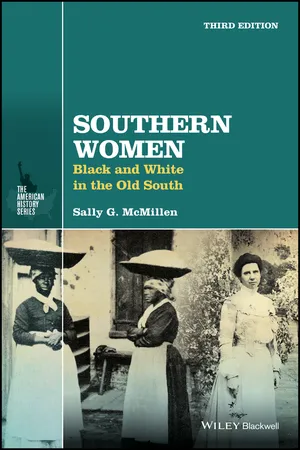 eBook - ePub
Southern Women
Black and White in the Old South
- Sally G. McMillen(Author)
- 2017(Publication Date)
- Wiley-Blackwell(Publisher)
5 Southern Women and the ConfederacyBy the time the Civil War began, southern women's hardiness had been well tested. Yet four long years of death, hardship, and sacrifices lay ahead, followed by a dozen challenging years of Reconstruction. Wars profoundly affect those on the home front, forcing women to adopt new roles and undertake greater responsibilities in the absence of men. The Civil War was no exception. Because nearly all the war was fought on southern soil, it had a greater impact on all southern women than it had on their northern counterparts.For anyone interested in understanding the female experience during the Civil War, manuscript sources are rich and extensive. Sensing the need to articulate their changing world or wanting to communicate with loved ones, a number of southern white women (at least those with the ability, time, and resources) wrote extensively. In their diaries and letters, they found an outlet to express their hopes and frustrations and share their worries, sorrows, and brief moments of elation, leaving us a profusion of diaries and letters. In addition, oral narratives from the early twentieth century provide personal insights into the lives of former slaves who, though usually young during the war, experienced the home front first hand or recalled the war's impact on their parents.The Civil War altered the South in nearly every respect and changed the lives of nearly all its women, rich and poor, black and white. The gender character of the region changed profoundly as hundreds of thousands of men left to join the Confederate Army. The mobilization of white southern men was initially high, due to patriotic fervor and a determination to whip the Yankees. Within a year, however, such excitement faded and many soldiers went home. The Confederacy then had to pass the nation's first conscription law in order to fill the ranks and force more men to serve. During four years of war, many enslaved men were forced to perform essential farm, military, and factory jobs, thus freeing more white men to take up arms. Nearly three-quarters of all eligible southern white men served in the Confederate Army at some point during the four-year conflict. eBook - ePub
- Janet M. Wilmoth, Andrew S. London(Authors)
- 2013(Publication Date)
- Routledge(Publisher)
This chapter will focus on the impact of two different wars on women’s lives, situating women’s experiences within the broader historical events influencing their families and communities. In much of America during the 19th century, especially in the rural South, the life course of women was deeply embedded in traditional family life. This was so even during wartime, although women were often called upon to take on new roles and perform nontraditional tasks to support themselves and their families. Thus, when considering women in wartime, historians often take what might be considered a “linked lives” approach and focus on women’s roles in their families and how their lives changed as a consequence of the wartime absences of the men to whom their lives were linked. The women themselves were not in combat, but military service was less of an individual affair than a community effort. Therefore, the close link between the soldiers and the home front during the Civil War meant that men’s wartime service had a greater impact on women during the Civil War than during 20th-century wars. Nevertheless, wars have always affected women’s lives. During World War II, the increased participation of women in formal military roles and war-related industries changed the nature of war’s impact on women’s lives.THE CIVIL WARBetter social organization in the North facilitated much more complex activities by women—as typified by national organizations such as the Sanitary Commission and the United States Christian Commission. In these organizations, women played major roles and learned organizational skills that were applied after the war to charitable endeavors, as well as the prohibition and woman suffrage movements. The war did not significantly alter the life course trajectories of most women in the North, where life continued more or less as normal. The impact of absent men on families was temporary, with scarcely a ripple in terms of the pool of eligible spouses, for example (Mitchell 1995). The large volume of volunteer work undertaken by Northern women seems not to have had permanent effects beyond a few leaders (Attie 1998). The disruption caused by death and severe war wounds was profound for the women affected, but did not alter the system of widowhood, except that the widows received government pensions.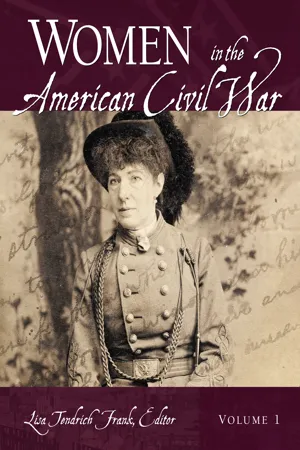 eBook - PDF
Women in the American Civil War
[2 volumes]
- Lisa . Tendrich Frank(Author)
- 2007(Publication Date)
- ABC-CLIO(Publisher)
They also had less formal involvement in the nursing profession than Northern women, but many Southern women served as nurses on an ad hoc basis whenever a bat- tle occurred near their homes. Wealthier Southern women collected food to provide holiday celebra- tions to the soldiers or basic necessities to their neighbors. And in the aftermath of the war, white Southern women formed numerous cemetery and memorial associations to celebrate the valor of Confederate soldiers. As several historians have noted, in doing so these women usually obscured their own contributions to the Confederate war effort. Indeed, the basic continuity of gender roles in the South over the course of the Civil War seems due to deliberate choices on the part of elite white women to maintain their traditional roles in ideol- ogy if not in reality. Nonslaveholding white women had always played key roles in the Southern economy, and so initially their wartime experiences represented a less dra- matic change than those of elite women. The wives and daughters of yeoman farmers had always partic- ipated in agricultural labor, and so taking over the farm during the war was not, in the beginning, a huge departure for them. But the scarcity of hired labor, the shortages of seeds and implements, the impressment of farm animals, and the Confederate tax-in-kind all combined to create great hardship for women running the small farms that constituted the majority of the Confederate homefront. Moreover, while Northern farm women benefited from a wide variety of agricultural machinery designed to main- tain production with a reduced work force, South- ern factories concentrated all their energies on war materiel. Working-class women faced even greater difficulties, as real wages declined rapidly due to inflation and scarcity constantly increased the price of food. Southern women’s vocal maintenance of a conser- vative gender ideology, both during and after the eBook - ePub
- Nancy A. Hewitt, Anne M. Valk, Nancy A. Hewitt, Anne M. Valk(Authors)
- 2020(Publication Date)
- Wiley-Blackwell(Publisher)
Chapter Ten Women in the Civil War EraHilary GreenIn 2002, Thavolia Glymph offered an incisive analysis of the scholarship on women during the Civil War and Reconstruction eras of American history. She astutely observed that the field’s “signal challenge” remains the inclusion and accounting of the “disparate experiences of the American women in war and reconstruction” (2002: 168). She demanded an intersectional approach and suggested possible directions and frameworks for eliminating the historical silences surrounding women due to their race, class, ability, ethnicity, status, and place. By characterizing the Civil War and Reconstruction eras as the “most racially gendered and regionally segregated historiographical space in US history,” she issued a call to action (2002: 171).Scholars have paid heed and responded. While the resulting work still privileges the experiences of elite white women, the field has produced more nuanced understandings of the diversity of women’s experiences during these critical eras. More attention must be given to questions regarding the intersecting and overlapping roles of race, gender, and class in shaping the experiences of white women. And, too often, black, immigrant, and Native American women still appear as afterthoughts. Nonetheless, this review of recent critical biographies, monographs, and anthologies shows progress in the field, while making it clear that more work is necessary. Like Glymph’s earlier essay, this chapter suggests possible future thematic directions, research questions, and frameworks for understanding these women as diverse and complex.The experiences of literate women continue to shape the field even as their writings are carefully mined for insights into the diversity of women’s experiences. Scholars are beginning to employ them in fresh and novel ways; for example, elite white women are placed in dialogue with black women – specifically, Charlotte Forten, Frances Ellen Harper, and Susie King Taylor. Scholars have thus begun to counter the traditional emphasis on white women’s voices. eBook - PDF
Confederate Reckoning
Power and Politics in the Civil War South
- Stephanie McCurry(Author)
- 2010(Publication Date)
- Harvard University Press(Publisher)
136 l co n f e d e ra te re c ko n i n g Soldiers’ wives’ politics constitute a critical development in Civil War history and in the long history of Southern political culture. But they are not easily read through our usual lexicon of women’s concerns. The po-litical meaning of Civil War developments has long been a central ques-tion in women’s history. 7 For the most part Southern historians have fo-cused on planter women and defined Confederate women’s politics in one of two ways: in relation either to their support for women’s rights and women’s suffrage or to Confederate nationalism and the Confeder-ate cause. But it was not planter women who embraced the identity of soldiers’ wives and made it a force in political life. And it was not as an assertion of their rights as citizens or their contribution to the military defeat of the Confederacy that the women made their claims. 8 Con-federate soldiers’ wives did not make predictable claims about women’s rights or citizens’ rights; in fact they did not much speak a language of rights at all. Nor did they align themselves clearly for or against the Con-federate cause; in fact they did not much speak a language of national-ism at all. 9 Rather their new political significance was evident in their participation in community deliberations and in the actions they took to shape public and even military policy in their own interests. The central story of women’s politics in the war is thus about their partic-ipation in the basic practices and organization of political life: the way the women intruded into local circuits of power and authority and claimed qualification to speak, power to act, entitlement to state resources, and in the relationships they developed with the state that claimed to represent and rule them. Their politics was important in the histori-cal process that unfolded in the Civil War and not just in the outcome of it. By 1863, soldiers’ wives were a force to be reckoned with in the C.S.A.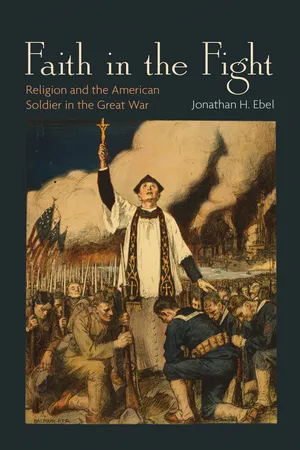 eBook - PDF
Faith in the Fight
Religion and the American Soldier in the Great War
- Jonathan H. Ebel(Author)
- 2010(Publication Date)
- Princeton University Press(Publisher)
4 If we follow recent scholarship on gender and the American Civil War and broaden the notion of “service” to include the contribution of goods produced in and sent from the home, the numbers of American women involved in the Great War soars. 5 On the Western Front, women were involved in clerical work and nursing, hospitality and entertainment, refu-gee relief and ambulance driving. More than 5,300 American women went to France to serve as nurses in the A.E.F. hospitals run by the Red Cross. At least 2,500 more served overseas in volunteer auxiliary services such as the YMCA and the Salvation Army. American women also served in the French and British armies and their volunteer auxiliaries. 6 The offi-cial report to General Pershing from E. C. Carter, Chief of the YMCA in France proclaimed, “No single factor has contributed so much to the influence of the Association upon the Army as the presence of this large company of magnificent American women. The service they have ren-dered is beyond praise.” 7 This was, indeed, a significant development in the history of gender and warfare in America. But though the Great War was fought by living, breathing men and women with particular histories and unique voices, these flesh-and-blood soldiers and war workers marched alongside powerful, tenacious, fre-quently religious character types, symbols, and myths. Mythic characters and narratives told people how to respond to war, how to act, how to conceive of morality and duty; those responding to war lived in and lived out those myths. Mythic notions of wartime gender roles shaped women’s as well as men’s experiences and understandings of the Great War. While American men drew on images of Christ, crusaders, and more modern American heroes, American women often turned to more general domes-tic ideals to frame their service.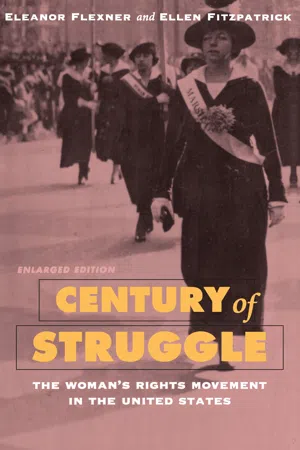 eBook - PDF
Century of Struggle
The Woman’s Rights Movement in the United States, Enlarged Edition
- Eleanor Flexner, Ellen Fitzpatrick, Ellen F. Fitzpatrick(Authors)
- 1996(Publication Date)
- Belknap Press(Publisher)
Many a small-town woman or farmer’s wife whose tasks had been limited and whose horizon had been narrow, as well as the city matron previously caught up in a round of fashion and pleasure who became engrossed in some facet of the Commission’s work, could never be quite the same person afterwards. An aspect of the war which had a long-term impact on many women working in hospitals or on the battlefields was the sheer volume of suffer-ing that could not be visibly mitigated by the primitive resources then available. Often the crude surgery was unsuccessful because it was followed by gangrene. Shattered limbs had to be amputated without any pain-killer other than stupefying amounts of liquor; there were no analgesics (except limited amounts of morphine) nor any antibiotics or tranquilizers even in existence to help men who quite frequently knew they were dying. Just as The Civil War 101 little could be done to alleviate winter cold, summer heat, or the torture of flies hovering over suppurating wounds. It was one thing to face such con-ditions in ordinary family life, where medicine in those days was also fre-quently helpless, but quite another to encounter it when multiplied by the thousands and tens of thousands. “Nursing” under such conditions could bring little satisfaction to the sketchily trained women, who nevertheless stayed valiantly on duty until they themselves not infrequently collapsed from disease or overwork. It was worse for southern women—and their patients—because the tight Union blockade affected both medical supplies and food, and because there was no counterpart to the northern Sanitary Commission to supplement the bun-gling efforts of military authorities. The Civil War made even more novel demands on women than those of nursing or relief work; it brought them into national politics on other issues than their own enfranchisement.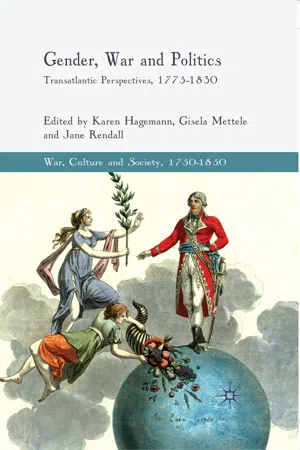 eBook - PDF
Gender, War and Politics
Transatlantic Perspectives, 1775–1830
- K. Hagemann, G. Mettele, J. Rendall, K. Hagemann, G. Mettele, J. Rendall(Authors)
- 2010(Publication Date)
- Palgrave Macmillan(Publisher)
13 Such scholarship escalated substantially in 1980 with Mary Beth Norton’s Liberty’s Daughters and Linda Kerber’s Women of the Republic. Both historians addressed the war’s impact on women but focused more on the intellectual and social ramifications of the political conflict. Other historians did the same, but a few, such as Paul Kopperman and Linda Grant De Pauw, looked specifically at women’s roles with the military. 14 Exploration has continued through the turn of the century as historians have dug deeper into the gen- der issues intrinsic to this revolution and war. Joan Gundersen and Carol Berkin, for example, provided closer looks at women’s agency during the conflict. Alfred F. Young concentrated on one Revolutionary woman, the sol- dier Deborah Sampson, while I analysed the complex relationships between the Continental Army and its camp followers. 15 This recent scholarship not only incorporates more examination of the ethnic, dispossessed and work- ing women that Revolutionaries and later generations of Americans tended to dismiss but also emerges from and poses questions about the concept of separate spheres. 16 These interpretations may also reflect how the incorpora- tion of women in modern military forces challenges that concept today. Women warriors in truth and tale The term heroine frequently, though not invariably, refers to a woman who has exhibited valour within—or at least straddling the bounds of—what society defines as properly feminine. Historically, Americans have com- mended women who endured much in order to defend their homes and sustain their families, but they have shown ambivalence about female cour- age in battle. The desire to extol spirit and sacrifice in the name of cause and country has come up against the desire to enforce social order. Yet the Revolutionary era in America and Europe provided many opportunities for women to take on the warrior role and for other people to recount their feats in print and performance. eBook - PDF
Gender Matters
Race, Class and Sexuality in the Nineteenth-Century South
- L. Whites(Author)
- 2016(Publication Date)
- Palgrave Macmillan(Publisher)
As a result the southern soldier had to recognize, if only unconsciously, the extent to which his manhood and independence was relational—a social construction built upon the foundation of women’s service and love, out of the fabric of his women’s “dependence.” For the more the war called forth women’s domestic labor into the public arena, making public those “small gifts of service,” the more the war itself was transformed from a struggle of men in defense of their individual prerogatives into a battle for the “fire- sides of our noble countrywomen.” Confederate women seized this oppor- tunity to lay claim to an increased reciprocity in gender relations. As one woman wrote to the newspaper, “. . . do impress upon the soldiers, that they are constantly in our thoughts, that we are working for them, while they are fighting for us—and that their wants shall be supplied, as long as there is a woman or a dollar in the ‘southern Confederacy.’ ” 49 Confederate women found that the war might support a newly inde- pendent stature on their part. As Rebecca Latimer Felton wrote, “Nobody chided me then as unwomanly, when I went into a crowd and waited on suffering men. No one said I was unladylike to climb into cattle cars and box cars to feed those who could not feed themselves.” 50 Nor did the press find Amy Clark to be “unwomanly” when it was discovered that not only had she enlisted with her husband, but after he was killed she fought on alone in the ranks as a common soldier. She was described as “heroic and self-sacrificing” (emphasis added).
Index pages curate the most relevant extracts from our library of academic textbooks. They’ve been created using an in-house natural language model (NLM), each adding context and meaning to key research topics.

