History

Women in China
Women in China have played significant roles throughout history, with their status and roles evolving over time. Traditional Chinese society was patriarchal, but women still had influence within the family and community. In modern times, women have made strides in education, employment, and politics, although gender inequality and traditional expectations persist in some areas.
Written by Perlego with AI-assistance
Related key terms
1 of 5
8 Key excerpts on "Women in China"
 eBook - PDF
- Paul J. Bailey(Author)
- 2012(Publication Date)
- Red Globe Press(Publisher)
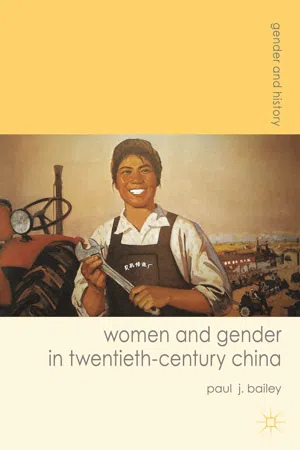
4 1 Women in Pre-Twentieth-Century China During the last two decades or so more attention has been paid to how polit-ical, economic, legal and even technological change impacted upon women’s lives and gender discourse (Ebrey, 1990, 1993; Bray, 1997; Bernhardt, 1999; Birge, 2002). 1 Women’s experiences, roles and status are now seen as very much influenced by age (life cycle), class and ethnicity, as well as fluctuating over time. Influencing much of this research is the aim of highlighting the ways in which women’s lives were shaped by their own choices and participa-tion in family and social life, in other words attributing some form of agency to women rather than portraying them simply or only as the passive, voiceless and exploited victims of an unchanging Confucian patriarchy. In early imperial China (206 BCE–220 CE), for example, maternal power was quite pervasive, and many elite women had considerable control over their personal finances (both early law and custom concurred that a wife owned her dowry).Women were also dominant in all forms of textile work in early China, which gave them a powerful role in the household (and wider) economy since cloth was exchanged as a de facto currency and used to pay taxes to the state. The most precious textile, silk, which supplemented metal coinage and was sometimes used to pay armies, was produced in weaving workshops run by the state or important families that employed hundreds of women. Furthermore, biographies of women at this time all refer to elite women who excelled in reading and writing. Aristocratic women at court, as well as imperial consorts and dowagers, were famed for their patronage of scholarship and literature, and some of them contributed significantly in their own right to historical schol-arship or other forms of literature (Hinsch, 2002, pp. 55–61; Lewis, 2007, pp.156–65, 169–73). eBook - PDF
- Tani Barlow, Inderpal Grewal, Caren Kaplan, Robyn Wiegman, Inderpal Grewal, Caren Kaplan, Robyn Wiegman(Authors)
- 2004(Publication Date)
- Duke University Press Books(Publisher)
If gender simply means the cultural clothing that women put on over their bodies, then Chinese women were only latent historical subjects or ‘‘invisible’’ historically. But if gender is the processes of the materializa-tion of di√erences, including the di√erence of sex, then this Jiao nü yi gui shows women, or more accurately, funü, to be very much present in the historical record. Here the subject women is not the point. Chen did not have to provide his readers with fully enumerated charts of the di√erential positions through which the gendering of the sexes, the positing of sex di√erence, took place. By the eighteenth century the discourse on kin di√erence had been normalized into the foundational category of broadly shared experience. Theorizing ‘‘Women’’ 49 Producing Woman (Nüxing) Imperialism forced into crisis the texts and the world of gendering pro-tocols that Chen Hongmou and those like him had so strenuously at-tempted to stabilize and reproduce. The Manchu dynasty’s long, slow implosion and the imperialists’ relentless penetration of the heartland through the treaty port system transformed the political elites’ social con-figuration and powers. Where previously the monarchy and bureaucracy had enabled Confucian o≈cials to regulate the meaningful world, social upheaval dispersed these older powers. The old political order buckled in 1905, when the Qing throne abolished the civil service examination system. Eager to replace the old-style elites and their intellectual commitments, a modern, post-Confucian, professionalized intellectual emerged who over-saw the appropriation of foreign signs into the new, domestic, urban mass media. In the early twentieth century a new social formation arose calling itself zhishi jieji (intellectual class), later qiming xuezhe (enlightened scholars), and finally (under the same forces that produced political funü or women as a political category), zhishifenzi , or Chinese intellectual under Maoist inscrip-tion.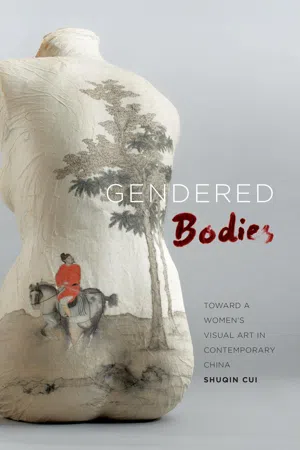 eBook - PDF
Gendered Bodies
Toward a Women's Visual Art in Contemporary China
- Shuqin Cui(Author)
- 2015(Publication Date)
- University of Hawaii Press(Publisher)
How does dynastic history read if empresses and concubines are taken into account? How did modern woman in the early twentieth century participate in nation-building discourse? Where were the female fighters when wartime history centered primarily on male heroes? 42 Gendering of Historiography How do Mao’s socialist China and the Cultural Revolution look from the perspective of gender? How does the commercial culture reshape the female body into a sexually attractive commodity? In sum, what is the historiography when written from an analytical approach with gender as the historical subject? In considering these questions, one finds that Hu Ming’s (re)writing of history uses clothing as a dress code to map transitions signified in the his-tory of fashion. What the artist has accomplished is not only a revision of social-national history, but also a history of female clothing, or historiogra-phy in terms of dress code. The style of each figure’s garment reflects her historical period and the identity she embodies. One may say that in wear-ing her dress, the figure wears the nation and its history. “Clothes contrib-ute their social, gender, national, and racial identities,” as Paola Zamperini suggests, thus “in any given culture, fabricating a dress and wearing it si-multaneously define the body as a cultural artifact. We cannot think about clothes without thinking about the body underneath, and we cannot see the body without thinking about the clothes.” 21 With this body-dress complex as a point of departure, one can see that Hu Ming’s scroll unfolds first with a group of female figures in the Manchu women’s long robe, scepter hairdo, and platform shoes, marking ethnic iden-tity and the time of the Qing dynasty. The presence of Manchu women in the absence of Manchu rulers changes general history into gendered history, where empresses, princesses, or concubines assert their position.
- Kartik C Roy, Cal Clark, Hans C Blomqvist(Authors)
- 2008(Publication Date)
- World Scientific(Publisher)
Chapter 5 Gender, Institutions, and Empowerment: Lessons from China Jude Howell 1. Introduction This chapter examines the role of state and non-state institutions in shaping the position of women in Chinese society. It argues that though state institutions have played a crucial role in enabling women’s economic and political participation, the essentially top-down approach to women’s empowerment has key limitations. The contradictions and weaknesses of such an approach have become accentuated in the reform period as the rise of market forces undermines the capacity of the state to allocate and regulate resources. The chapter begins by providing an overview of women’s current economic, social, and political status in China. It then proceeds to examine the role of state institutions in advancing the eco-nomic, social, and political position of women. The third section explores the rise of more independent women’s organizations in China and their contribution to new perspectives and approaches that query established practices and policies. In the conclusion we reflect upon the lessons from the Chinese case, underlining the salience of both state and non-state insti-tutions in the effective empowerment of women. 2. Overview of Women’s Status in China In this section we examine the economic, political, and social status of Women in China. We begin by outlining the situation of women in pre-liberation China, and then move on to introduce the changes brought 103 about after the coming to power of the Chinese Communist Party in 1949, and then focus our attention on the changes in women’s status dur-ing the reform period. Women’s position in pre-liberation China was strongly influenced by Confucian norms and values. Within this value framework, women were expected to be obedient first to their fathers, then to their husbands, and later in life to their sons (Curtin, 1975; Davin, 1976). eBook - PDF
Women Cross-Culturally
Change and Challenge
- Ruby Rohrlich-Leavitt(Author)
- 2011(Publication Date)
- De Gruyter Mouton(Publisher)
Surely the context is vital here. Chinese women fought an oppression blacker and more absolute than that faced by women of the West. The official in-stitutions of traditional China were male dominated to a degree unsur-passed in the world. Chinese women once dealt with this situation with a combination of passivity and covert sabotage. In a few decades they changed their strategy to one of open struggle, and, in alliance with the The Women's Movement in the People's Republic of China 469 forces of national and socialist revolution, they have demolished much of the social framework of their oppression. These developments have taken place under a state that officially guarantees full sexual equality but still lacks the resources to provide all the necessary material conditions for it. Nor is the idea of the equality of men and women entirely accepted by the people. Old ideas die hard. Such limitations are inevitable. Mao Tse-tung himself has acknowledged that women's liberation is not yet complete (Malraux 1970:463-465), and as long as the Chinese women's movement itself does not accept the status quo as satisfying its ultimate aspirations, we can surely salute its achieve-ments without ignoring its problems. REFERENCES BELDEN, JACK 1949 China shakes the world. New York: Harper Brothers. CHINESE COMMUNIST PARTY 1942 Resolutions of the Central Committee of the Chinese Communist Party on the present direction of work amongst women in the anti-Japanese base areas, in Documents of the women's movement of the liberated areas (in Chinese). Edited by the Women's Federation of China. New China Publishing House. ΗΙΝΤΟΝ, WILLIAM 1966 Fanshen. New York: Monthly Review Press. LENIN, v. I. 1938 International Women's Day, in Women and society. By V. I. Lenin. New York: International Publishers. (Reprinted from Pravda, March, 1920.) LIU, HENG 1949 Chehu, the village where cloth is produced in every home, in The production campaign of village women in the liberated areas of China. eBook - PDF
Confucianism and Women
A Philosophical Interpretation
- Li-Hsiang Lisa Rosenlee(Author)
- 2012(Publication Date)
- SUNY Press(Publisher)
The May Fourth Movement and Communist China both radically rejected Confucianism, seeing it as the root of China’s malaise and inferiority. Their nationalistic discourse, in turn, laid the foundation for the later Western feminists’ and Asian specialists’ represen- tation of Confucianism as the root of gender oppression in the history of Chinese women. Beginning in the early 1970s, there was a surge of interest in Chinese gender studies on the part of Western feminists as well as Asian specialists who often frame Chinese women’s liberation chronologically in relation to Western intellectual traditions. 1 The surge of feminists’ writings and the like on the condition of Chinese women formed part of the grand feminist movement toward constructing a global history of women designed to validate feminists’ 1 2 CONFUCIANISM AND WOMEN defiance of patriarchal social structures as well as the social construction of gender in the West. By going beyond the Western sphere, feminists intended to validate their insistence on the urgency of the problem of gender oppres- sion, while expanding their sphere of concern to include their less fortunate sisters in the third world. The dream of forming a global sisterhood across cultural, geographical, religious, and ethnic boundaries underlies the well- meaning intent of Western feminists in their writings on the condition of third world women. While the concept of “gender” is well articulated and deconstructed in contemporary feminist scholarship, the concept of “culture” remains relatively marginal in cross-cultural studies of the problematic of gender. The lack of attention to the element of “culture” in feminist writings constitutes an obstacle to a genuine understanding of the gender system in an alien culture, where gender is encoded in the context of a whole different set of background assumptions.
- A. Dooling(Author)
- 2005(Publication Date)
- Palgrave Macmillan(Publisher)
Still others depicted the sexism and discrimination women activists experienced in the political arena in an attempt to bring greater attention to potential sites of tension and to underscore the relevance of sexual politics within the revolutionary process. While the degree to which these authors were successful in conveying their vision can only be judged through a critical evaluation of actual texts, the main point I wish to emphasize here is that a narrow definition of feminism as about sexuality and rights (basically, the liberal position) will not be sufficient given the historical framework in which the politics of gender were lived and written about in China at the time. To elucidate feminist literary/cultural praxis in China involves, finally, a reexamination of the masculinist assumptions and paradigms that undergird some cultural–historical approaches to modern China. For the difficulty of identifying moments of cultural resistance by women would appear to stem not just from the specific contexts in which Chinese feminism historically unfolded, but also from certain literary historiographic practices, which may be implicated in under-emphasizing women’s/feminist cultural agency. One may see this in some work that brackets women and feminist issues as separate from major topics such as modern narrative (Chen, 1990) and realism (Anderson, 1990; Wang, 1992), but it is also in evidence in examples of feminist scholarship. I focus the following comments on the latter. Certainly, as even a cursory survey of bibliographies of contemporary research would attest, there has been no dearth of scholarly attention to Chinese women or gender-related matters. Yet, for all the exciting archival discoveries and keen critical insights that such research has begun to yield, there remains a need to understand the basic protocols of mainstream Chinese literary history that can marginalize women’s literary feminism. eBook - PDF
Overt and Covert Treasures
Essays on the Sources for Chinese Women
- Clara Wing-chung Ho(Author)
- 2012(Publication Date)
- The Chinese University of Hong Kong(Publisher)
Social Status, Gender Division and Institutions: Sources Relating to Women in Chinese Standard Histories Yi Jo-lan INTRODUCTION Traditionally scholars have valued “standard histories” ( zhengshi 正史 ) as records of political events in Chinese history, where the main actors were men. Although they are now more readily available than ever before for research, they are still underused as a means of gaining a better understanding of Chinese women. This chapter aims to help scholars remedy this deficiency by giving guidance on their use, analyzing their contents and providing an assessment of the histories’ strengths and weaknesses as source materials in research on women in imperial China. WOMEN IN THE STANDARD HISTORIES Source materials relating to women in the standard histories can be loosely grouped under the following three headings: social status, gender division and institutions. Social Status: Women in the Palace Due to their high social status, empresses, consorts, and princesses are often included in the standard histories. They are primarily located in three different section formats: annals, biographies, and tables. Most are mentioned in the “basic annals” ( benji 本紀 ), “hereditary house” ( shijia 世家 ), “tables” ( biao 表 ) and “biographies or memoirs” ( liezhuan 列傳 ) sections. For example, they appear in the sections of “Annals of Empresses” ( huanghou benji 皇后本紀 ), “Biographies of Empresses”
Index pages curate the most relevant extracts from our library of academic textbooks. They’ve been created using an in-house natural language model (NLM), each adding context and meaning to key research topics.

