History

Women in Early Japan
Women in early Japan held important roles in both the household and religious practices. They were often responsible for managing the household and raising children, and some women even held positions of power as priestesses. While they were generally subordinate to men in the social hierarchy, women in early Japan had significant influence and were valued for their contributions to family and community life.
Written by Perlego with AI-assistance
Related key terms
1 of 5
9 Key excerpts on "Women in Early Japan"
- Erica Baffelli, Andrea Castiglioni, Fabio Rambelli, Erica Baffelli, Andrea Castiglioni, Fabio Rambelli(Authors)
- 2021(Publication Date)
- Bloomsbury Academic(Publisher)
Though the project was criticized for lacking an overall discussion of methodology or the broader implications of gender (Hastings 2001), it demonstrated the importance of religion in creating gender roles. In a similar vein, Women and Class in Japanese History , edited by Hitomi Tonomura, Anne Walthall, and Wakita (1999), considers how both gender and class shaped women’s experience throughout Japanese history. Yet again, chapters dealing WOMEN 259 specifically with religion were sparse, covering female sovereignty in ancient Japan, medieval nunhood, and medieval women’s associations. Notable in all three of these compilations of essays is the predominance of historians rather than religious studies scholars. While scholars of religion such as Helen Hardacre and Kawamura Kunimitsu contributed to Gender and Japanese History , for example, many of those writing on religion were historians. For instance, Wakita, editor of two of these compilations, was a historian of medieval Japan and an expert on Noh. In “The Formation of the Ie and Medieval Myth,” Wakita analyzed deities in Noh theatre, the Shint ō sh ū ( c. 1350), and picture scrolls of origin stories ( engi emaki ) to show how the medieval ie household was reflected in representations of the divine in theatre, mythology, and popular stories. Thus, the impetus to “include” women came first from the field of history before being fully embraced by religious studies scholars. However, by the early 2000s, focus on women within philosophical and religious systems within East Asia began to emerge. Women and Confucian Cultures in Premodern China, Korea and Japan , edited by Dorothy Ko, Jahyun Kim Haboush, and Joan R. Piggott (2003), considers the role of Confucianism in premodern East Asia. Though the authors were primarily historians, their focus on Confucianism required them to consider other philosophical discourses as well. eBook - PDF
Dimensions of Japanese Society
Gender, Margins and Mainstream
- K. Henshall(Author)
- 1999(Publication Date)
- Palgrave Macmillan(Publisher)
Gender cannot be meaningfully studied in isolation. Concepts of maleness and related expectations cannot be properly understood without contrast to concepts of female- ness and related expectations, and vice-versa. Interactions between male and female, in sexual and other types of relationship, also need to be examined. Moreover, historical, economic, political, and other factors in the constructing of gender need to be taken into account. 1.2 FROM REIGNING EMPRESS TO SILLY SERVANT: THE HISTORICAL DOWNGRADING OF THE FEMALE Clearly, to judge from the views of the ko ¯ha/samurai, women have not generally been held in high regard by men for much of Japan’s history. Their lack of status has reflected this. The status of women in very early times, however, does not seem to have been so lowly. Women in those days appear to have enjoyed considerable authority and power as shamans, chieftains, and empresses. They had respect in various fields such as politics, religion, society, the arts, and even matters military. In ancient times there were a number of real and mythical female figures of prominence, at least as many as in the ancient and early The Essentials of Society 9 history of most nations. The supreme Shinto ¯ deity in Japan’s mythol- ogy, which was first written down in the late seventh century, 20 is Amaterasu the Sun Goddess. Japan is one of very few cultures to represent the sun by a female. (And theoretically she has never experienced a decline in status.) The most respected of all the rulers of the hundred or so chiefdoms that made up Japan in the third century was Himiko, the queen of Yamatai. 21 She had come to power through warfare, and was acknowledged by Chinese visitors of the day as over-lord of the entire nation. In legends of roughly the same period the female warrior-leader Jingu ¯ was given great respect for her courage and fighting prowess. In the seventh and eighth centuries there were several reigning empresses. eBook - ePub
Women in Asia
Tradition, modernity and globalisation
- Louise Edwards, Mina Roces(Authors)
- 2020(Publication Date)
- Routledge(Publisher)
This is not just a rhetorical question, and the answer is not a simple ‘yes’ or ‘no’. In this essay I want to convey the complexity of an answer to the question. On the one hand, there are commonalities among all or at least most Japanese women—factors that affect all women because they are women. On the other hand, Japanese women are not all alike and their experiences have been diverse due to differences in class, generation or age, geography (regional as well as urban vs rural), ethnicity and education. By looking at four areas of activity—the home, the workplace, the public arena and the world of popular culture—we will see that the range of options for women has widened during the past three decades. However, we will also see that the patriarchal underpinnings of social, economic and political institutions and practices remain firmly entrenched to perpetuate the sexual division of labour. These institutions and practices, both informally and formally, act as powerful influences on women’s choices.At the same time, while still generally favouring men, the messages that these institutions and practices send to women are not always consistent or uniform. These contradictions open up a space in which women are able to try to accommodate their individual needs and desires to the state’s and society’s expectations. The state, for example, promotes an image of women that is oriented contradictorily to both production and reproduction while the media encourages women to be consumers. Women may respond in different ways to these varied and sometimes contradictory conceptions of their proper role. However, I have said ‘accommodate’ to indicate that radical feminism has not been widely accepted by Japanese women (not that it has in any society) and to suggest that the ideology placing women primarily in nurturing roles has in many if not most cases been internalised.The home: women’s domain?
Some scholars, such as Sumiko Iwao (1993), as well as most Japanese men and the media, represent the home as a sphere where Japanese women enjoy dominant status and power. In most Japanese families the husband hands over his pay packet to his wife who then gives him ‘an allowance’ for pocket money and generally takes charge of the day-today management of the household’s activities and expenses. She is also fully responsible for the rearing and education of the children. The images of ‘the professional housewife’ and ‘education mama’ which have emerged in the post-World War Two period indicate the complete devotion and skill required for success in these endeavours as well as the high social value placed on women’s role as wives and mothers. eBook - ePub
- Karen Offen, Chen Yan, Karen Offen, Chen Yan(Authors)
- 2020(Publication Date)
- Routledge(Publisher)
In this essay, I will first explain briefly how women’s history developed in Japan, referencing early research on the topic. Then, I will discuss the arguments about the shift from women’s history to gender history, the necessity of which has been loudly insisted on since the middle of the 1990s. Third, I will explain the organizational development as observed in the establishment of the Gender History Association of Japan in which I myself participated and served as the second president from 2008 to 2010. The fourth point I wish to consider is the realignment of the Science Council of Japan to include more women and the resultant efforts on the part of practitioners of women’s/gender history to change history textbooks for high school students to accommodate gendered viewpoints. Finally, I will discuss the task of gendering contact zones, colonialism and empire with particular attention to the issue of ‘comfort women’.A Brief Historiography of Women's History in Japan
According to Hiroko Nagano, a historian of the Edo period teaching at Chuo University, Tokyo, the development of women’s history in Japan can be divided roughly into three periods.2 The first is from 1930s to 1970s. The period begins with Itsue Takamure’s (legendary independent historian and poet, 1894–1964) energetic work on matriarchy in ancient Japan, which was first published in 1938.3 After World War II, as women gained the right to vote, several women’s history books appeared one after another. The most popular among them was Japanese Women’s History by Kiyoshi Inoue (1913– 2001),4 a professor emeritus at the University of Kyoto, who wrote the history from the Marxist perspective, the most influential meta-narrative among Japanese historians in those days. In the 1970s, interest in women’s everyday life rose and many local study groups emerged to probe for ordinary women’s past and their experiences. Representing this trend, Nobuhiko Murakami (1909–1983), an independent writer, published four volumes of Japanese Women’s History in the Meiji Period between 1969 and 1972, in which he emphasized the importance of ordinary women and their everyday experiences in presenting women’s history.5 Murakami’s work intended to criticize Inoue’s Marxist narrative for its monolithic description of women’s history leading toward emancipation, its narrow focus on a few emancipatory leaders such as Eiko Kageyama,and its naïve grasp of sex discrimination as part of class oppression,expecting that the former would dissolve with the victory of the laboring class over the capitalists. Murakami’s criticism provoked heated discussion among historians; these debates are recorded in a book, Documents of Contentions Concerning Women’s History edited by Yukiko Kozai.6 Tamae Mizuta, a historian of social thought, participated in this debate and pointed out that discrimination and oppression based on sex are different from those based on class, a claim that is now taken for granted.7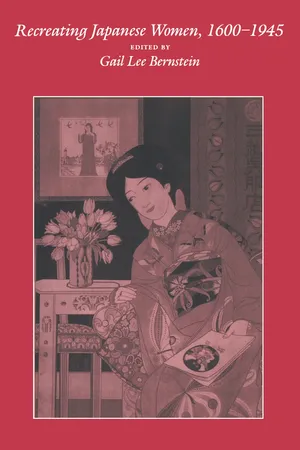 eBook - PDF
- Gail Lee Bernstein(Author)
- 1991(Publication Date)
- University of California Press(Publisher)
Moreover, the evidence pre-sented concerning the division of reproductive labor in Tokugawa and early Meiji households implies that to view mothering as woman's uni-versal and natural destiny is to deny history. Joan Kelly has argued that the histories of men and women some-times diverge and that progress for men does not always constitute progress for women. 75 The changes in the family division of labor and in women's roles that occurred during the formation of the Japanese industrial nation-state may further exemplify the divergence of the his-tories of the two genders. When workplace and home were one, women labored at a variety of productive and reproductive tasks; with the emergence of new specialized institutions that removed men and chil-dren from the home for long hours each day, women alone remained bound to the home in middle-class twentieth-century Japan. The situa-tion of lower-class women was also in flux, and their energy was taxed more than ever in their efforts to obtain adequate incomes and to main-tain a decent home life. The new order offered women unprecedented educational and vo-cational opportunities. But did these opportunities offset new con-straints in the household division of labor and the state's attempt to re-define women as ryosai kenbo? At first glance, only the gains stand out. Compulsory education was required for girls as well as boys, and con-ceptions of female inferiority lessened as mothers were accorded greater responsibility for childrearing. Yet closer scrutiny reveals that, by 1900, women had been barred from politics, virtually stripped of property rights and the right to serve as family heads, and nearly ex-75. Joan Kelly, Did Women Have a Renaissance? in Women, History, and Theory: The Essays of Joan Kelly (Chicago: University of Chicago Press, 1984), 19-51. THE HOUSEHOLD DIVISION OF LABOR 41 eluded from universities, the gateways to leading corporate and bureau-cratic positions. eBook - ePub
- Joyce C Lebra(Author)
- 2019(Publication Date)
- Routledge(Publisher)
Chapter 11Women in the Political SystemAlthough men have traditionally dominated the political system in Japan, frequently women have held important political positions. Prior to the eighth century, women could succeed to the throne and rule as empresses. Chinese thought and custom influenced the adoption of the Taihō Code which undermined women’s position in Japan. Women’s basic equality was replaced by the Chinese concept of women’s inferiority and heavenly ordained subjugation to men. These changes were slow in penetrating the Japanese social and political systems. In the Kamakura period (1185–1333), women could no longer succeed to the throne, but they were still acknowledged as legal persons. They retained their property rights and could avail themselves of divorce, although their access to power was not as great as men’s. During this period an exceptional woman, Masako Hōjō, took power in the wake of the death of her husband, the Shogun Yoritomo. She kept the loyalty of her late husband’s retainers and manipulated Court relationships in her efforts to consolidate her position and power. With the help of her father, she made her son the Shogun and ruled as his regent. Later she had him murdered when he attempted to rule himself and exiled her father when he opposed her. Masako Hōjō later ruled through her brother as the regent of her late husband’s two-year-old great grand nephew, the Shogun. Ruling through sons, brothers and other relatives was not required because of her sex, but it was rather a traditional means of exercising political power.Political confusion and internal warfare characterized the period between 1336 and 1573, when the central government lost its control over the local leaders. Military power became a prerequisite for political power. The social code of the newly dominant military class assigned women to subordinate roles within the family and limited their access to political roles. Without direct access to military power, women resorted to personal influence on the men in powerful positions. Marriage was a political device for the powerful families to create alliances, often using the women as hostages. Married women provided access to power through their husbands for their male relatives. During this period, women had no legitimate access to political positions. During the Tokugawa period (1600–1867), the rigid social and political system prevented women from taking active political roles; women’s positions were limited to those in and around the home. What little political influence they could obtain was exercised through their personal and family relationships, a common means of exercising political power.
- Hans C. Blomqvist, Kartik Roy, Clement A. Tisdell(Authors)
- 1996(Publication Date)
- Praeger(Publisher)
6 Women in Japan Jane Richardson and Paul Riethmuller Long inconspicuous as members of society, Japanese women have made a significant contribution to the development of one of the world's largest economies. Rarely seen as industrial or commercial leaders, the women of Japan have nevertheless been integral to the successful modernization of Japan throughout the history, but most particularly in the twentieth century as providers of important ancillary and support roles. While the women of Japan can be broadly described as "policy implementors" rather than "policy instigators," they can nevertheless lay claim to at least one third of the success of their nation's economy (Iwao 1993: 157). INTRODUCTION One of the most significant economic and social developments to have occurred in Japan over the past decade has been the increased involvement of women in the workforce. About 39 percent of those employed in Japan's major industries in 1992 were women, an increase from 1975 when women represented 32 percent of those employed. According to the 1992 Employment Status survey conducted by the Management and Coordination Agency, the percentage of the female population engaged in "regular employment" (those in work for thirty days or more per year) exceeded 50 percent for the first time in Japan's postwar history in 1992 (Ippan Joho Information Bulletin, 1993). In the less important industries such as agriculture, women are also a significant part of the workforce. This is particularly so on the small farms that have dominated the agricultural sector for much of the postwar period. Men in the younger age groups left these farms for the factories of the cities during the 1950s, leaving the farm work to women and older men (Fukutake 1980). However, unlike other high- income (Western) countries, few women in Japan have risen to senior management positions.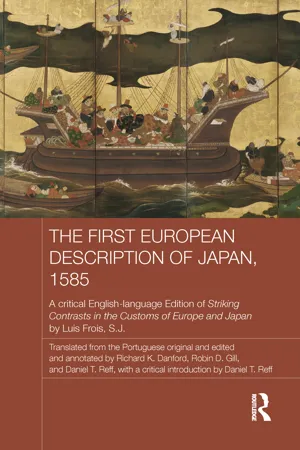 eBook - ePub
The First European Description of Japan, 1585
A Critical English-Language Edition of Striking Contrasts in the Customs of Europe and Japan by Luis Frois, S.J.
- Luis Frois SJ, Daniel T. Reff, Richard Danford, Robin Gill(Authors)
- 2014(Publication Date)
- Routledge(Publisher)
2 Women, their persons and customs1. In Europe a young woman’s supreme honor and treasure is her chastity and the inviolate cloister of her purity; women in Japan pay no mind to virginal purity nor does a loss of virginity deprive them of honor or matrimony.During the sixteenth century European women continued to struggle as they had for centuries with societal norms that cast them in a subordinate role relative to men. Although women did “men’s work” (e.g. butcher, fisher, merchant, renter, moneylender, sovereign), and did it well1 this reality was systematically obscured and women by and large were denied access to education, opportunity, and power. The situation might have been better for Japanese women; it is hard to say, given that literature and the historical record are ambiguous. While Shinto’s most beloved kami was a woman–(the Sun Goddess, Amaterasu–) and the Pure Land schools of Buddhism proclaimed women capable of salvation, Shinto, Buddhism, and Confucianism more frequently spoke of women as “imperfect” (respectively: sources of pollution; spiritually “obstructed;” a potential threat to familial harmony) and best suited to supporting roles.As this first distich and the twenty-seven that follow suggest, Europeans treated women’s bodies as a fetish. This fetishization is often reflected in Frois’ surprise that Japanese women’s clothing revealed as much as it did. Beginning with distich twenty-nine, Frois’ focus is more on behavior and rights and responsibilities. Again, the tone of the distichs is one of surprise that Japanese women enjoyed inheritance of property, relative freedom of movement, etc.While Frois’ distichs in this chapter necessarily provide a partial picture of the lives of women in Japan as well as Europe, they tend to support recent scholarship that has emphasized the significant changes in gender roles in Japan, particularly since the Meiji Period (1868–1912). The Japan that Frois experienced was a nation of mostly farm households and small businesses (i.e., artisans and merchants) where men and women worked together at home, sharing many rights and responsibilities, including nurturing and child-rearing. Complicating matters, however, was the rise to power of the samurai during the late medieval and warring states period (1467–1568), which created a privileged male culture centered on warfare. The empowerment of the samurai class and the subsequent emulation of their norms by lesser classes undermined the relative gender equality that Frois mentions or alludes to. Gender inequality was further exacerbated during the second half of the nineteenth century when the Japanese state whole-heartedly pursued industrialization, relegating women to a cult of domesticity while promoting male education and employment away from home.2 eBook - ePub
- Laura Dales(Author)
- 2009(Publication Date)
- Routledge(Publisher)
sengyō shufu—sararīman) model and the family model. In this context, models should not be interpreted as representing a universal pattern, nor do they reveal the subtle variations and adaptations that are made by those encompassed. It is precisely this that makes them useful in an overview of this nature yet also limits their applicability to a detailed analysis of women’s issues. While particular models (and ideals) may be promulgated and propagated by media, folklore, state policy and legislation, the adoption, adaptation and rejection of models occurs on a daily basis in the lived experiences of individuals. The model captures only one aspect or one point in time of that experience, using that information as a centre point for extrapolation or speculation on a broader scale. However, the model cannot reveal the ways that individuals transgress, challenge or reform ideals, nor can it reveal the individualistic ways that this occurs; hence it is useful in broad discussions and has limitations as a lens for micro studies. It is with these limitations in mind that I proceed.Women in Imperial Japan—family and feminism
Women’s lives are nothing but a series of services, first to parents when young, then to husbands and parents- in-law when married, and when children come, they are busy caring for them and supervising the food and kitchen work.(Fukuzawa, cited in Fujiwara 1988: 19)These words were written by liberal social critic and proponent of Western thought Fukuzawa Yukichi, and they illustrate the status of the majority of Japanese women towards the end of the nineteenth century. Influenced by the work of John Stuart Mill and inspired by the work of Japanese female activists, Fukuzawa’s critique of female subordination in society illustrates two key points: that feminist thought had taken root in Japan long before the women’s lib movement bloomed and that advocates of gender equality could be found even within the depths of the Meiji revival of patrilineal and patriarchal customs (Fujiwara 1988: viii).In Imperial Japan (the period spanning 1890–1945) the family was the crucible of feminine duty. The responsibilities of the daughterly role gave way to those of the wife, daughter- in-law and mother. The Meiji (1868–1912) abolition of the distinct class system and the reduced influence of the aristocratic (samurai) code meant that women who had previously enjoyed relative flexibility of status were now bound to the Confucian ‘three obediences’ to which the above quote refers (Iwao 1993: 5). The catchphrase ‘ryōsai kenbo’ (good wife, wise mother) exemplifies the ideal of femininity prescribed by the Meiji state, and the promotion of women’s education reflected this emphasis on women as ‘intelligent incubators’.1
Index pages curate the most relevant extracts from our library of academic textbooks. They’ve been created using an in-house natural language model (NLM), each adding context and meaning to key research topics.

