History

Women in the Song Dynasty
During the Song Dynasty, women's roles and status in Chinese society were influenced by Confucian ideals, which emphasized women's domestic roles and subordination to men. However, some women in the Song Dynasty were able to attain education and participate in literary and artistic pursuits, contributing to the cultural and intellectual life of the time. Despite these opportunities, women's rights and freedoms were still limited.
Written by Perlego with AI-assistance
Related key terms
1 of 5
6 Key excerpts on "Women in the Song Dynasty"
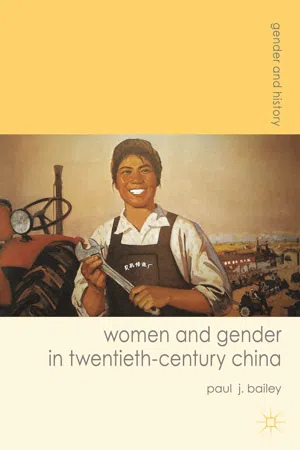 eBook - PDF
- Paul J. Bailey(Author)
- 2012(Publication Date)
- Red Globe Press(Publisher)
4 1 Women in Pre-Twentieth-Century China During the last two decades or so more attention has been paid to how polit-ical, economic, legal and even technological change impacted upon women’s lives and gender discourse (Ebrey, 1990, 1993; Bray, 1997; Bernhardt, 1999; Birge, 2002). 1 Women’s experiences, roles and status are now seen as very much influenced by age (life cycle), class and ethnicity, as well as fluctuating over time. Influencing much of this research is the aim of highlighting the ways in which women’s lives were shaped by their own choices and participa-tion in family and social life, in other words attributing some form of agency to women rather than portraying them simply or only as the passive, voiceless and exploited victims of an unchanging Confucian patriarchy. In early imperial China (206 BCE–220 CE), for example, maternal power was quite pervasive, and many elite women had considerable control over their personal finances (both early law and custom concurred that a wife owned her dowry).Women were also dominant in all forms of textile work in early China, which gave them a powerful role in the household (and wider) economy since cloth was exchanged as a de facto currency and used to pay taxes to the state. The most precious textile, silk, which supplemented metal coinage and was sometimes used to pay armies, was produced in weaving workshops run by the state or important families that employed hundreds of women. Furthermore, biographies of women at this time all refer to elite women who excelled in reading and writing. Aristocratic women at court, as well as imperial consorts and dowagers, were famed for their patronage of scholarship and literature, and some of them contributed significantly in their own right to historical schol-arship or other forms of literature (Hinsch, 2002, pp. 55–61; Lewis, 2007, pp.156–65, 169–73). eBook - PDF
The Inner Quarters
Marriage and the Lives of Chinese Women in the Sung Period
- Patricia Buckley Ebrey(Author)
- 1993(Publication Date)
- University of California Press(Publisher)
Still, part of the explanation for the failure of women's situations to improve undoubtedly lies in the dynamic interactions of developments begun in the Sung. WOMEN'S HISTORY AND CHINESE HISTORY Women's history, at its best, does not just inform us about women in the past; it challenges us to reexamine our understandings of history and historical processes. If I have been successful in these regards, readers of this book should be ready to look on familiar topics in Chinese history like commercialization, Neo-Confucianism, the legal system, and the class struc-ture with new questions in mind. They should stop to think whether major social or economic changes would have had consequences for women similar to or different from those for men. When reading disquisitions on virtue, beauty, cosmology, or equity, they should be more sensitive to messages about gender. When considering men's lives or thoughts, they should more readily keep in mind their relations with women and children and be more open to signs of ambivalence, ambiguity, and emotions. They may even begin to expect more of historians on topics other than women and gender that are difficult to research because of the paucity or biases in the sources. For my part, I found that trying to see women in historical context made me question my basic understandings of Chinese culture and history. For instance, I found it necessary to present the cultural matrix of ideas about women, sexuality, and affinity as an unintegrated assemblage communicated WOMEN, MARRIAGE, AND CHA NGE 271 through a wide variety of media, ranging from didactic texts, folktales, and clothing styles to housing layouts. I came to think that these ideas were expressed in fragmented ways, often through images that carried ambiguous meanings, in large part because the feelings or ideas people were struggling with were ones that fit uncomfortably with rationalized and moralized views of Chinese society.
- Ann A. Pang-White(Author)
- 2016(Publication Date)
- Bloomsbury Academic(Publisher)
21 Here is where history and social studies are critical in providing empirical evidence to explain why social or political reality may be at odds with the original philosophical ideal. Within the context of the Southern Song dynasty 南宋 (1127– 1279), a time of extreme political instability, we will now turn to Zhu Xi’s view on the role of women, their education, and property rights as embedded in such a cultural context. II.2. Women’s Role, Identity, and Responsibility It should not come as a surprise that in Confucian ethics and social philosophy the gender identity of a woman begins at birth as a female . This first stage of natural identity ties her to the social roles that she is expected to perform throughout her life in relation to the other sex and gender. Before Zhu Xi, Liu Xiang’s Lienü Zhuan 《列女傳》 (Biographies of Women, 79–8 BC), Bao Zhao’s Nüjie 《女誡》 (Lessons for Women, ca. 45–114), the Song sisters’ Nü Lunyu 《女論語》 (The Analects for Women, ca. 780–805), and Lady Zheng’s Nü Xiaojing 《女孝經》 (The Book of Filial Piety for Women, ca. 730 or later) were already widely circulated. Zhu Xi cited texts from the first two (composed during the Han period) in his work, and he probably was familiar with the latter two as well (composed during the Tang NEO-CONFUCIANS AND ZHU XI ON WOMEN 73 period). Because Zhu Xi did not write a treatise specifically addressing the subject of women, we can only get a glimpse of his view on women from his occasional discussion of them in the Zhuzi Yulei ( Chu Tzu y ü -lei ) 《朱子語類》 (Classified Conversations of Zhu Xi [Chu Hsi]), the Zhuwenkung Wenji 《朱文公文集》 (Collected Works of Zhu Xi), the Jinsi Lu 《近思錄》 (Reflections on Things at Hand), the Xu Jinsi Lu 《續近思錄》 (Further Reflections on Things at Hand), the Jiali 《家禮》 (Family Rituals), the Xiao Xue 《小學》 (Elementary Learning), and from the eulogies and burial inscriptions that he wrote for deceased women. eBook - ePub
- Patricia Ebrey(Author)
- 2003(Publication Date)
- Routledge(Publisher)
*Most historians of China have heard the charge that the revival of Confucianism in the Song period initiated a decline in the status of women. The principal accusations are that Neo-Confucianism fostered the seclusion of women, footbinding, and the cult of widow chastity. It is widely recognized that these constraints on women had become more oppressive by the Qing dynasty, but their roots are traced back to the Song period.1 Cheng Yi’s (1033–1107) statement that “To starve to death is a small matter, but to lose one’s chastity is a great matter” is commonly blamed for much of the misery of women in late imperial China.The evidence offered to support these charges is of several sorts. In his Zhongguo funü shenghuo shi (History of Chinese Women’s Lives), written in 1928, Chen Dongyuan argued that women’s lives started to deteriorate after Cheng Yi and Zhu Xi (1130–1200) promoted “the idea that women must value chastity.” Thus “the Song really was the turning point in women’s lives.”2 More recently, Zhu Ruixi, after examining a wide range of evidence concerning views on women and marriage in the Song, concluded that these attitudes gradually hardened during the Song, bringing in divorce as well as remarriage.Especially from the time of Song Lizong [r.1225–1264], because of the honor granted Neo-Confucianism in the intellectual sphere, the right of women to seek divorces was almost completely eliminated, and their right to remarry after the death of their husbands decreased every day.3Popularizers and polemicists have been quicker to assert the influence of Neo-Confucianism on female seclusion, footbinding, and even female infanticide. Lin Yutang in My Country and My People and Howard Levy in Chinese Footbinding report that Zhu Xi, while prefect of Zhangzhou in southern Fujian, promoted footbinding as a way to foster the separation of men and women and encourage chastity by making it difficult for women to move about.4 Feminists have picked up these charges. Elisabeth Croll writes that “the Neo-Confucian philosophers of the Song dynasty (960–1267) further elaborated the code of feminine ethics by re-emphasizing the practices of segregation and seclusion, and introducing the practice of bound feet.”5 Esther Yao states that “Infanticide was extremely prevalent in the Song Dynasty–being greatly influenced by the philosophy of Neo-Confucianism which denied women basic human rights, including the right to live.”6 Authors of textbooks have also incorporated these charges against Neo-Confucianism. Dun J. Li, in his textbook for American students, The Ageless Chinese: A History eBook - PDF
Women of the Conquest Dynasties
Gender and Identity in Liao and Jin China
- Linda C. Johnson(Author)
- 2011(Publication Date)
- University of Hawaii Press(Publisher)
The Mingshi (History of the Ming Dynasty) and the draft history of the Qing dynasty have even more. 2 Women of the Conquest Dynasties Examining the ideals of womanly behavior as represented in the lienü chapters of the Liao and Jin histories and some inscribed epitaphs is a fruitful place to begin this study of Liao and Jin women. The lienü chapters cannot be taken as accurate biographical accounts of individual lives; rather, these stories have a didactic function, celebrating the virtues valued by the respec-tive societies, or indeed by the Yuan compilers of these histories, as models of feminine behavior. Exemplary women in the Liaoshi brought Confucian culture, gave sage advice to emperors, and demonstrated loyalty to their husbands by honoring the ancient steppe custom of following in death. Jurchen women led troops in battle, fortified cities against the enemy, and raised the battle flags dropped by their fathers or husbands. Other Jin women fought to preserve their hus-bands’ names before defending their own chastity. Han Chinese women in the Jinshi displayed more conventional virtues, such as committing suicide to avoid dishonor or remarriage. One woman, a prostitute, climbed the city walls to exhort the defenders to attack the enemy before plunging to her death. The selections in these chapters reflect particular behaviors that these societies valued in women, including courage, physical bravery, military action, loyalty, and—surprisingly—education in the Chinese classics. These biographies depart from examples in previous lienü zhuan in ways that shed light on the values of their respective societies and reflect contem-porary ethical standards for women. eBook - PDF
Overt and Covert Treasures
Essays on the Sources for Chinese Women
- Clara Wing-chung Ho(Author)
- 2012(Publication Date)
- The Chinese University of Hong Kong(Publisher)
Therefore, there is considerable gender division based on the historian’s use of a construction of male and female natures that portrays female beauty and sexual attractiveness as threatening to both the emperor and the good of the state. Once again the description of women is based largely on how this reflects on the male domain of affairs of state. Even the very nature of a woman’s appearance is mainly relevant in the light of whether her beauty could turn the emperor’s head. Family Relationships and Ethics The collected works ( wenji 文 集 ) display a greater variety of roles for women, as well as more details of their family relationships than the standard histories. For example, although the wives and mothers of officials are sometimes mentioned in their husbands’ and sons’ biographies or included in the lienü zhuan , the actual details of their lives or the relationships with their family members are omitted. 18 Generally speaking, there are more descriptions of women as wives and mothers than as grandmothers, sisters-in-law and aunts in the standard histories. However, the histories do include descriptions of relationships between mothers and sons, such as those between empresses or consorts and their imperial sons. These reveal the extent to which a mother’s status was dependent on that of her son. Marital relationships were also touched upon in accounts in the basic annals and biographies sections. While the huanghou benji and the houfei zhuan record the love between husbands and wives, as in the case of female beauty, this was often represented negatively. For example, criticism was leveled against emperors who brought about disaster through their obsession with their empress or consorts. This is in contrast to the entries in the lienü zhuan. The lienü zhuan describes various women who were faithful to their husbands or who died defending their chastity, but does not reveal any sense of love between the married couple.
Index pages curate the most relevant extracts from our library of academic textbooks. They’ve been created using an in-house natural language model (NLM), each adding context and meaning to key research topics.

