History

Women In Medieval India
Women in Medieval India played diverse roles in society, including as rulers, administrators, scholars, and artists. While some women faced restrictions due to societal norms, others enjoyed significant freedom and influence. The status and rights of women varied across regions and time periods, reflecting the complex and dynamic nature of gender dynamics in medieval Indian society.
Written by Perlego with AI-assistance
Related key terms
1 of 5
6 Key excerpts on "Women In Medieval India"
 eBook - PDF
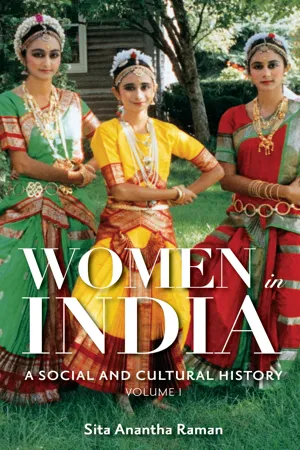
Women in India
A Social and Cultural History [2 volumes]
- Sita Anantha Raman(Author)
- 2009(Publication Date)
- Praeger(Publisher)
The other is the clouded face of the domestic handmaiden trailing behind men in life expectancy, nutrition, health, education, pay, and other rights on the subcontinent. 1 However, behind this colorful essentialization of Indian women lies the complex real- ity of myriads of feminine personas in a sea teaming with self-sacrificing her- oines like Sita in the epic Ramayana, modern feminists in the guise of Shakti, and the victims of gender, religious, caste, and class inequalities. This poses several dilemmas to the historian. What could an engendered history then include, which female narratives would one recount, and how does one retrieve the voices of the apparently voiceless? A work of this scope cannot cover all the narratives, since such a vast undertaking would lose its critical edge, and its diluted or descriptive litany may be unreadable. Due to the longevity of Indian history, this study of women is therefore divided into two broad chronological sections, i.e., the premodern era from antiquity to the early medieval Hindu kingdoms and the later era under Turko-Afghan and Mughal dynasties, colonial rule, and the independent state after 1947. The four interrelated themes focus on gender and female sexuality, viz., premodern social, religious, cultural, political paradigms of women in male-authored texts; their later resurrection by men and women for contemporary political and social purposes; women’s narratives in their social contexts; and the contentious issues of female agency and objectification. TEXT, CONTEXT, AND RE-CREATED TEXTS No matter how unassailable texts and material artifacts appear to be, the historian views them as contested territory. This work attempts to be critical in its assessment of the primary evidence from literature, art, and archaeol- ogy, as well as of secondary scholarship on women in Indian history.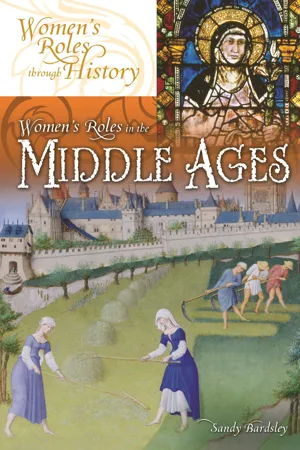 eBook - PDF
- Sandy Bardsley(Author)
- 2007(Publication Date)
- Greenwood(Publisher)
Introduction: Medieval Women Discussing medieval women as a group implies that they saw they had something in common. Yet chances were that a medieval noblewoman or a queen saw little, if any, connection between herself and a peasant woman, and that a Christian woman and a Jewish woman regarded themselves as having little in common. Medieval women were divided from one another in many ways: by their social class, their religion, their age, their marital sta- tus, and by the place and the period in which they lived. Yet, as historians look back at the experiences of medieval women, they cannot help but see common patterns that transcend barriers of class, religion, age, time, and place. Two patterns in particular emerge in this study of medieval women. First, women as a group were virtually always viewed as inferior to men as a group. In other words, medieval societies—like those that preceded and followed them—were patriarchal. Second, individual women could some- times overcome this inferior status and break the rules assigned to their sex. The fact that some women were able to break these rules did not, how- ever, mean that all women were able to do so. How did medieval women differ from one another? When a medieval person thought about his or her identity, class status may often have been more important than gender. The life of a medieval noblewoman was cer- tainly different from that of a nobleman in terms of work, responsibilities, and behavioral expectations, but it was arguably less different than the gap between a noblewoman and a peasant woman. Class changed over time and place, too: in some regions of Europe in the early Middle Ages, class distinctions were less entrenched. In later periods, people became acutely 2 Women’s Roles in the Middle Ages conscious of social class and strove to improve their families’ places in the social hierarchy. eBook - ePub
Studying Gender in Medieval Europe
Historical Approaches
- Patricia Skinner(Author)
- 2018(Publication Date)
- Bloomsbury Academic(Publisher)
and modern society. And – as Virginia Woolf articulated so elegantly in 1929 – having ‘a room of one’s own’ was and is a still struggle. To these examples of social injustice we could add many more, and medieval historical research can strengthen and deepen movements of resistance.Campaigners for women’s rights in the 1970s and 1980s also focused on the dynamics of how power and knowledge were transferred between generations. Some female writers were held up as early champions of ‘feminism’ for pushing back against the misogynist ideas of their age, but attention also focused on women’sagency Ability to effect change for oneself or others, independently or collaboratively, their ability to grasp and hold onto power and influence through their actions or life cycle events such as marriage and motherhood. A focus on women and power emerged in feminist medieval history, and was championed by scholars such as Pauline Stafford, Janet Nelson (see Chapters 4 and 5 ), Suzanne Fonay Wemple and others. It may be no accident in Anglophone scholarship that considerable work was done on women and power during the decade following an era of powerful women leaders of the United Kingdom, India, Pakistan and Israel (whether this will be repeated in our own era, with women leading many more nation states, is yet to be seen). Rapidly, however, the focus changed to an emphasis on women’s power in relation to that of men, and the emergence of gender studies that explicitly offered a broader interpretation of power and emphasized itscontingency Reliant on other factors, not fixed. But whilst Joan Scott championed gender as a ‘useful category of analysis’, its very openness to interpretation provoked antipathy as well, as we shall see.A gendered reshaping of the medieval starts in Chapter 3 with recognizing the gendered understanding of the human body, and the ways in which authority is claimed over it. Monica Green has been at the forefront of examining women’s experiences of healthcare across a lengthy continuum, in particular the ways in which areas of medicine specific to women’s bodies, gynaecology and obstetrics (the field concerned with pregnancy and childbirth) became dominated by male medical practitioners and increasingly ‘medicalized’ between the medieval and early modern periods. Her work engages directly with the ways in which the life and health of the baby (representing the father’s living legacy) can often take precedence, still, over that of the mother, leading to invasive interventions in the birth by ‘professionals’. Men’s bodies, whilst not so prominent in a medical literature promoting fertility, feature more heavily in legal sources about interpersonal violence and injury, and the ‘maimed man’ might occupy a liminal place in his community. Also discussed is one of the most controversial (and thus stimulating) books published at the start of the 1980s, John Boswell’s Christianity, Social Tolerance and Homosexuality: Gay People in Western Europe from the Beginning of the Christian Era to the 14th Century eBook - PDF
Visible Histories, Disappearing Women
Producing Muslim Womanhood in Late Colonial Bengal
- Mahua Sarkar(Author)
- 2008(Publication Date)
- Duke University Press Books(Publisher)
[Meanwhile] the Vedic dasi (the woman in servitude), captured, subjugated, and enslaved by the conquering Aryans, but who also represents one aspect of Indian womanhood, disappeared without leaving any trace of herself in nineteenth century history. . . . [The] Aryan woman came to occupy the cen-tre of the stage in the recounting of the wonder that was India.”25 Women’s participation in activities outside the domestic sphere in performance, reli-gious preaching, or the labor force would mark them as deviants and prosti-tutes.26 Thus, in colonial Bengal poor women who had to seek work outside the domestic sphere, indeed, whose labor enabled the bhadramahila to attain and maintain the high standards of refinement and chastity required of them, found themselves first ostracized by the bhadralok’s vigorous campaign to distance their women and the andar mahal (inner quarters) from “the contami-nating culture of the lower orders,” and eventually simply written out of the new nation’s normative history.27 Class and caste were not the only mechanisms of exclusion. In late colonial Bengal, yet another set of inequities—and one that remains mostly unexam-ined—existed between the discursive representations of Hindu and Muslim women even within the middle classes. It is true, as Ratnabali Chatterjee re-minds us, that Muslims were generally “excluded” from deliberations over the substance of Hindu nationalist reforms in the nineteenth century.28 However, as we shall see, such exclusion was neither automatic nor incidental; it had to be argued into place. What is more, Hindu/Brahmo women had an impor-tant role to play in this process of securing the negative representations and eventual invisibility of Muslim women in the dominant imaginations of the national modern. Gender inequality is widely defined as a problem of men dominating women. eBook - ePub
International Perspectives on Gender and Higher Education
Student Access and Success
- Christine Fontanini, K.M. Joshi, Saeed Paivandi, Christine Fontanini, K.M. Joshi, Saeed Paivandi(Authors)
- 2020(Publication Date)
- Emerald Publishing Limited(Publisher)
Women were encouraged to participate in religious ceremonies, acquire highly intellectual knowledge, and become teachers of great admiration (for example, Gargi, Maitraey, and Jayanti). Consecutively, with evolution and recognition of certain annexures to Vedas like the Brahmanas (Aitareya Brahmana), Upanishads, Smritis (Manusmriti), and Sutras (Dharmasutras evolved during 500 to 200 bc), the role of women got confined to patriarchal hegemony with restricted education, and her prime task directed to serve the male. The “Sati” tradition (whereby a widow voluntarily or forcefully was surrendered to the pyre of the demised husband) was another ruthless practice of the period. Varna system (class system) later divided the society into four varnas or classes, which plagued the society and infused caste system. Unfortunately this prevails even today in a different and partial form. During the early Medieval Period, women were married as early as between the age of 6 to 8, she was denied education, but was respected at home, and had property rights. The Medieval era was dominated by Muslim rulers in India. There are examples of diligent and courageous female rulers in both Hindu and Muslim reigns like Razia Sultana (1236–1240), Chand Bibi, Tarabai, and Rani Ahilyabai. These were efficacious female administrators and political influencers both as wives and daughters. During this period, several unethical practices such as child marriages, sati tradition and its honoring, restricted widow remarriages, lack of education for women, subsuming role of women in society and family, and dowry in the name of the traditional “Stridhan” gained prominence. During the colonial rule, the lack of dignity of women was empathetically challenged, largely by Western-educated liberal Indian men eBook - ePub
Women in Asia
Tradition, modernity and globalisation
- Louise Edwards, Mina Roces(Authors)
- 2020(Publication Date)
- Routledge(Publisher)
5Diversity and the status of women: the Indian experienceRuchira Ganguly-ScraseSchool of Humanities and Social SciencesCharles Sturt University ‘The secondary status of woman is a pan-cultural fact’…So argued Sherry Ortner in 1970 in her now famous essay, ‘Is female to male as nature is to culture?’ At the end of the twentieth century it is impossible to universalise the subordination of the world’s women in such a fashion, let alone homogenise the mass of Indian women. Grappling with diversity and difference is central to understanding the position of women in India. Since the heydays of the women’s liberation movement in the 1970s, when there was a sense of women’s solidarity and sisterhood, feminist theorists have shifted their attention to the study of difference among women. Scholarly analysis used to focus on women’s shared oppression and male domination, but more recent research has shown that male domination and female subordination is far from uniform. On the contrary, women’s experiences are distinguished by their specific locations within particular ethnic, class and religious groupings.Thus, no unitary categorisation of Indian women is possible. For example, in India over the past two decades the achievements of urban middle-class women in salaried and professional jobs have been as spectacular as the relentless exploitation and acute deprivation of female agricultural labourers (Bardhan 1993). There are many powerful and influential Indian women in the professions, business, bureaucracy and government who enjoy the privileges and benefits of their class position. Such women have also gained from the anti-colonial straggles of the Indian nationalist movement, which gave them a voice in the political arena. After independence from British colonial rule in 1947 these women had relatively easy access to the expanding civil service as well as representation in parliament. However, the vast majority of women in India do not belong to this affluent middle class. Their lives are constrained by problems typical of a post-colonial developing economy.
Index pages curate the most relevant extracts from our library of academic textbooks. They’ve been created using an in-house natural language model (NLM), each adding context and meaning to key research topics.

