History

Women Soldiers in the Civil War
During the Civil War, some women disguised themselves as men to fight in the conflict. They served in both the Union and Confederate armies, taking on various roles such as soldiers, spies, and nurses. Their contributions challenged traditional gender roles and expanded the perception of women's capabilities in wartime.
Written by Perlego with AI-assistance
Related key terms
1 of 5
9 Key excerpts on "Women Soldiers in the Civil War"
 eBook - PDF
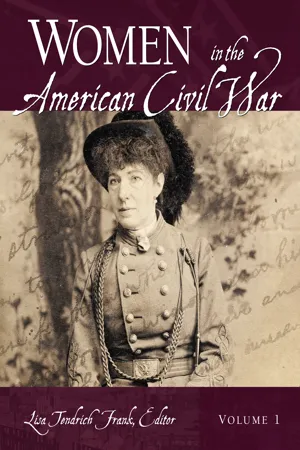
Women in the American Civil War
[2 volumes]
- Lisa . Tendrich Frank(Author)
- 2007(Publication Date)
- ABC-CLIO(Publisher)
Female Combatants Despite public sensitivity, gender constraints, and government policy, hundreds of young women dis- guised themselves as men, enlisted, and served the Confederacy and the Union as combatants during the American Civil War. The exact number of female combatants is impossible to determine, however, because only the women who were dis- covered as such can be found in the records. In an age when dress, more than anything else, deter- mined one’s gender, women easily passed the superficial physical exams required for enlistment. In addition, if the men with whom they lived, slept, and fought recognized a female combatant among their ranks, they seldom reported the impostors to their superiors. Instead, capture by the enemy, the treatment of certain wounds, as well as pregnancy or birth led to the discovery and discharge of women soldiers. Often discharge did little to curb women’s wartime service. Records indicate that several discharged women soldiers went to other regiments to reenlist. Women’s motivations for enlistment ranged from a desire to remain with a lover, husband, or other family member, to a need for money or a thirst for adventure. For the most part, women, like their male counterparts, joined the armed forces for the social and economic opportunities that enlistment provided as well as out of a devotion to their country or region. How- ever, female combatants, unlike men, could easily get released from their enlistment if they so desired. By outing themselves to the proper author- ities or by discarding their disguises, they could return home and resume their civilian lives. Women in uniform fought from the beginning of the war in 1861 to its conclusion in 1865. Women fought not only in minor scrimmages, but also in major confrontations in every theater of the war.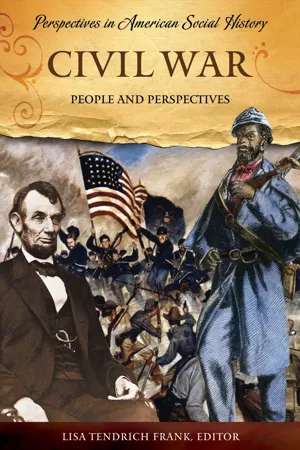 eBook - PDF
Civil War
People and Perspectives
- Lisa . Tendrich Frank(Author)
- 2009(Publication Date)
- ABC-CLIO(Publisher)
The service of women that came to light did so as a result of several factors. In some instances, doctors or fellow soldiers discovered disguised women when they were killed or wounded, when they became pregnant and delivered a baby, or when they were captured. Other female combatants revealed their identities after the end of the war. Scholars have been able to document the participation of female sol- diers in every major Civil War battle. For example, at least 10 fought at Antietam and five fought at Gettysburg. These women joined the military with similar justifications as their male counterparts: to collect bounties and wages, to demonstrate their patriotism, and even to escape the general ennui that many claimed characterized the home. Once in the army, the performance of women did not contrast sharply with that of male soldiers. Female soldiers often rose in the ranks, a reality confirmed by the dismissal of several sergeants from duty. Although they broke the law by concealing their identities, neither the Confederacy nor the Union court-martialed women for their deceptions. Sarah Emma Edmonds, who fought for the Union as Franklin Thompson, received a pension for her service in the correspondent in attendance. The Civil War, however, brought the greatest opportunities to her. During the Civil War, Mary Livermore became a vital part of the U.S. Sanitary Com- mission. After rising through the ranks of vol- untary associations in Chicago, she became an Associate Manager of the Northwestern Branch of the Sanitary Commission. She worked closely with Jane Hoge. As managers, Livermore and Hoge oversaw the sorting of donated goods as well as the packing and sealing of boxes headed to soldiers on the battlefields. eBook - PDF
Gender Matters
Race, Class and Sexuality in the Nineteenth-Century South
- L. Whites(Author)
- 2016(Publication Date)
- Palgrave Macmillan(Publisher)
As a result the southern soldier had to recognize, if only unconsciously, the extent to which his manhood and independence was relational—a social construction built upon the foundation of women’s service and love, out of the fabric of his women’s “dependence.” For the more the war called forth women’s domestic labor into the public arena, making public those “small gifts of service,” the more the war itself was transformed from a struggle of men in defense of their individual prerogatives into a battle for the “fire- sides of our noble countrywomen.” Confederate women seized this oppor- tunity to lay claim to an increased reciprocity in gender relations. As one woman wrote to the newspaper, “. . . do impress upon the soldiers, that they are constantly in our thoughts, that we are working for them, while they are fighting for us—and that their wants shall be supplied, as long as there is a woman or a dollar in the ‘southern Confederacy.’ ” 49 Confederate women found that the war might support a newly inde- pendent stature on their part. As Rebecca Latimer Felton wrote, “Nobody chided me then as unwomanly, when I went into a crowd and waited on suffering men. No one said I was unladylike to climb into cattle cars and box cars to feed those who could not feed themselves.” 50 Nor did the press find Amy Clark to be “unwomanly” when it was discovered that not only had she enlisted with her husband, but after he was killed she fought on alone in the ranks as a common soldier. She was described as “heroic and self-sacrificing” (emphasis added). eBook - PDF
Confederate Reckoning
Power and Politics in the Civil War South
- Stephanie McCurry(Author)
- 2010(Publication Date)
- Harvard University Press(Publisher)
136 l co n f e d e ra te re c ko n i n g Soldiers’ wives’ politics constitute a critical development in Civil War history and in the long history of Southern political culture. But they are not easily read through our usual lexicon of women’s concerns. The po-litical meaning of Civil War developments has long been a central ques-tion in women’s history. 7 For the most part Southern historians have fo-cused on planter women and defined Confederate women’s politics in one of two ways: in relation either to their support for women’s rights and women’s suffrage or to Confederate nationalism and the Confeder-ate cause. But it was not planter women who embraced the identity of soldiers’ wives and made it a force in political life. And it was not as an assertion of their rights as citizens or their contribution to the military defeat of the Confederacy that the women made their claims. 8 Con-federate soldiers’ wives did not make predictable claims about women’s rights or citizens’ rights; in fact they did not much speak a language of rights at all. Nor did they align themselves clearly for or against the Con-federate cause; in fact they did not much speak a language of national-ism at all. 9 Rather their new political significance was evident in their participation in community deliberations and in the actions they took to shape public and even military policy in their own interests. The central story of women’s politics in the war is thus about their partic-ipation in the basic practices and organization of political life: the way the women intruded into local circuits of power and authority and claimed qualification to speak, power to act, entitlement to state resources, and in the relationships they developed with the state that claimed to represent and rule them. Their politics was important in the histori-cal process that unfolded in the Civil War and not just in the outcome of it. By 1863, soldiers’ wives were a force to be reckoned with in the C.S.A.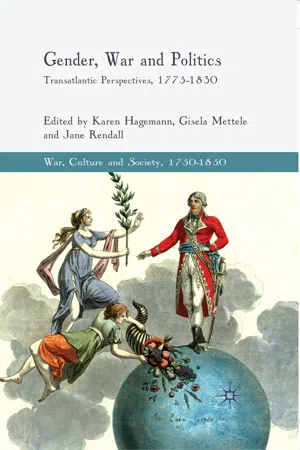 eBook - PDF
Gender, War and Politics
Transatlantic Perspectives, 1775–1830
- K. Hagemann, G. Mettele, J. Rendall, K. Hagemann, G. Mettele, J. Rendall(Authors)
- 2010(Publication Date)
- Palgrave Macmillan(Publisher)
13 Such scholarship escalated substantially in 1980 with Mary Beth Norton’s Liberty’s Daughters and Linda Kerber’s Women of the Republic. Both historians addressed the war’s impact on women but focused more on the intellectual and social ramifications of the political conflict. Other historians did the same, but a few, such as Paul Kopperman and Linda Grant De Pauw, looked specifically at women’s roles with the military. 14 Exploration has continued through the turn of the century as historians have dug deeper into the gen- der issues intrinsic to this revolution and war. Joan Gundersen and Carol Berkin, for example, provided closer looks at women’s agency during the conflict. Alfred F. Young concentrated on one Revolutionary woman, the sol- dier Deborah Sampson, while I analysed the complex relationships between the Continental Army and its camp followers. 15 This recent scholarship not only incorporates more examination of the ethnic, dispossessed and work- ing women that Revolutionaries and later generations of Americans tended to dismiss but also emerges from and poses questions about the concept of separate spheres. 16 These interpretations may also reflect how the incorpora- tion of women in modern military forces challenges that concept today. Women warriors in truth and tale The term heroine frequently, though not invariably, refers to a woman who has exhibited valour within—or at least straddling the bounds of—what society defines as properly feminine. Historically, Americans have com- mended women who endured much in order to defend their homes and sustain their families, but they have shown ambivalence about female cour- age in battle. The desire to extol spirit and sacrifice in the name of cause and country has come up against the desire to enforce social order. Yet the Revolutionary era in America and Europe provided many opportunities for women to take on the warrior role and for other people to recount their feats in print and performance. eBook - ePub
- Janet M. Wilmoth, Andrew S. London(Authors)
- 2013(Publication Date)
- Routledge(Publisher)
This chapter will focus on the impact of two different wars on women’s lives, situating women’s experiences within the broader historical events influencing their families and communities. In much of America during the 19th century, especially in the rural South, the life course of women was deeply embedded in traditional family life. This was so even during wartime, although women were often called upon to take on new roles and perform nontraditional tasks to support themselves and their families. Thus, when considering women in wartime, historians often take what might be considered a “linked lives” approach and focus on women’s roles in their families and how their lives changed as a consequence of the wartime absences of the men to whom their lives were linked. The women themselves were not in combat, but military service was less of an individual affair than a community effort. Therefore, the close link between the soldiers and the home front during the Civil War meant that men’s wartime service had a greater impact on women during the Civil War than during 20th-century wars. Nevertheless, wars have always affected women’s lives. During World War II, the increased participation of women in formal military roles and war-related industries changed the nature of war’s impact on women’s lives.THE CIVIL WARBetter social organization in the North facilitated much more complex activities by women—as typified by national organizations such as the Sanitary Commission and the United States Christian Commission. In these organizations, women played major roles and learned organizational skills that were applied after the war to charitable endeavors, as well as the prohibition and woman suffrage movements. The war did not significantly alter the life course trajectories of most women in the North, where life continued more or less as normal. The impact of absent men on families was temporary, with scarcely a ripple in terms of the pool of eligible spouses, for example (Mitchell 1995). The large volume of volunteer work undertaken by Northern women seems not to have had permanent effects beyond a few leaders (Attie 1998). The disruption caused by death and severe war wounds was profound for the women affected, but did not alter the system of widowhood, except that the widows received government pensions.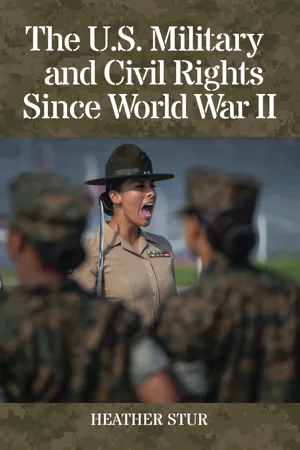
- Heather Stur(Author)
- 2019(Publication Date)
- Praeger(Publisher)
One of the primary concerns the public had regarding women in the military was access to combat duty. Those Americans who accepted the idea that there were certain acceptable roles for women in the military rarely con- sidered combat to be one of those roles. In the American lexicon, “woman” and “soldier” were antonyms, and the rights of citizenship stood not as rewards for military service but rather for performing the appropriate duties associated with mainstream gender roles. Women were to keep the home fires burning and remind men of why they fought. Some critics worried about women’s safety, believing them unable to defend themselves in a com- bat situation. Others feared that women soldiers would threaten the accepted concepts of manhood and womanhood, which Americans used to define social, political, and economic relationships between men and women. Admitting women into the military wouldn’t just change the armed forces; it would transform U.S. society—and not in ways that critics of women’s mili- tary service were ready to approve. Arguments for and against women in the military played out in congres- sional debates about the creation of the WAC. Some congressmen criticized the WAC bill because the WAC would provide an avenue by which women Military Roles for Women from World War II into the Early Cold War 65 could shirk their domestic responsibilities by running off to join the military. Among the long-term consequences opponents envisioned was a declining birth rate as women would be occupied in ways other than childbearing. Others asserted that women would have to become unnaturally masculin- ized in order to perform well in the military. These mannish women might then grow enamored of their own potential and threaten male authority within the ranks. Having emasculated the U.S. servicemen, they might encourage civilian women to assert themselves and undermine the authority of their husbands, upending the family hierarchy that symbolized U.S.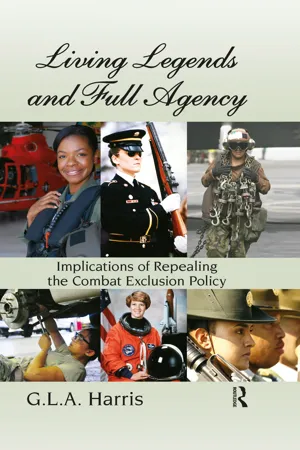 eBook - PDF
Living Legends and Full Agency
Implications of Repealing the Combat Exclusion Policy
- G.L.A. Harris(Author)
- 2014(Publication Date)
- Routledge(Publisher)
WOMEN AND WAR I 2 ◾ Women and War To say that women and war are incompatible elements of society, as the naysayers suggest, is to conveniently ignore women’s past and present performance as a collec-tive and as inherent parts of the milieu. Since the beginning of time and through-out ourstory, women have always fought alongside their brethren in battle to such a degree that DePauw (1998) considers women and war to be inextricable. Yet, modern-day rhetoric, at least within the United States, would have us believe that even with the recent repeal of the combat exclusion policy, the notion of women fghting in war is not only at best culturally unacceptable but at worst reckless. As Mazur (1998) puts it, war then always becomes this novel act in which women partake, even if they have done so repeatedly, time and time again. In the United States, women have served as a convenient resource for the military each time the nation has been called to arms. But, it is also important to note that ourstory is forever being fltered through the lens of the victor, not the so-called victim since to the victor goes the spoils of war. Further, memories become conveniently short and selective in recollection. However, despite the attempt to extricate any credit from the record and/or to couch the verbiage in such ways as to cast doubt about their presence and participation, leaving it to speculation at best, ourstory is incon-trovertible and still abounds with innumerable examples to the contrary, that in efect, and for ad infnitum , women have always and continue to assume integral roles in war. But this absence of women’s voices as part of the discourse about war should not be surprising. For example, take the American military’s philosophy, values, and beliefs about war, given its faithful adaptation of the Prussian thinker Karl von Clausewitz’s philosophies espoused in On War . eBook - PDF
Children and Armed Conflict
Cross-disciplinary Investigations
- D. Cook, J. Wall, D. Cook, J. Wall(Authors)
- 2011(Publication Date)
- Palgrave Macmillan(Publisher)
Stories of young heroines in past times of national crisis encouraged thou- sands of girls at the beginning of the 20 th century to seek out forms of war service. As a rule, of course, the service expected of women and girls took domestic forms such as nurture and nursing, but it readily included forms we might call auxiliary, such as communications, trans- portation of arms, or spying. The context from which these two girls’ autobiographies emerged was not only historically rich in mythic precedents but also spread across diverse national cultures from France 7 to Russia in 1914–1918. Journalists (including the new phenomenon of female reporters) sent back accounts that girls had volunteered to fight and succeeded in joining male regiments, whether by cross-dressing to conceal their identities or by securing the assistance of older men, who helped them blend into a regiment. Many of them referred to 19 th -century role models whose stories of female heroism they had absorbed when they were younger. Like studies of civil war in our own day, the memoirs by Yurlova and Nowosiel ⁄ ska indicate that political upheavals facilitate the mobiliza- tion of children in wartime and that social chaos unsettles gendered identity formation. The forces that draw children into war are inter- related, and they complicate simple conceptions of identity. Key factors in the mobilization of children, blurring their socially conferred iden- tities, are mobile guerilla warfare, the accompanying destruction of homes and families, famine, proliferating weapons, and a patriotic endorse- ment of violence as a means to secure political control. For girls, one further factor may also be the ambiguous sexuality of the tomboy or prepubescent child. Older women who cross-dress may have other, sexual motives, as Julie Wheelwright argues in her book Amazons and Military Maids (1989). By contrast, asexuality appears to be an insistent theme in accounts of girl soldiers until recent decades.
Index pages curate the most relevant extracts from our library of academic textbooks. They’ve been created using an in-house natural language model (NLM), each adding context and meaning to key research topics.

