History

Conscription Civil War
Conscription during the Civil War refers to the mandatory enlistment of individuals into the military. It was a contentious issue, leading to protests and riots in both the Union and Confederate states. The implementation of conscription laws significantly impacted the war effort and had social and political ramifications that extended beyond the battlefield.
Written by Perlego with AI-assistance
Related key terms
1 of 5
11 Key excerpts on "Conscription Civil War"
 eBook - ePub
Journal of the Civil War Era
Fall 2014 Issue
- William A. Blair(Author)
- 2014(Publication Date)
- The University of North Carolina Press(Publisher)
7Yet this narrative overlooks the attitudes of countless men, like John Harrold, who saw in military service not opportunity but unwanted danger. It overlooks the darker side of citizenship during the Civil War, the stories of men and women who resisted the duties imposed by the nation-state—men and women for whom citizenship was more burden than aspiration. My exploration of the darker side of Civil War citizenship is influenced by such historians as Steven Hahn, Stephanie McCurry, and Gregory Downs, who have recovered alternative political ideals and practices among African Americans and women: ideals and practices that did not fit neatly into the existing framework of liberal citizenship but challenged and sometimes transformed it.8 I also take inspiration from critical scholarship on citizenship throughout American history and in the history of other parts of the world as well. Some of the most insightful studies of U.S. citizenship have emphasized its exclusive as well as its inclusive qualities, its uncertainties and inconsistencies rather than its legal clarity, its repressive as well as its emancipatory potential. Federalism, race, gender—these and other factors have regularly unsettled the purported uniformity of citizenship. The fact that beginning in 1790 naturalization was restricted to those identified as white is a glaring example of this tendency. Rogers Smith, in one particularly influential interpretation, argued that the illiberal, exclusive tendencies of U.S. citizenship were not temporary aberrations but fundamental foundations. Scholarship on citizenship also encourages us to avoid a narrow, legalistic conception of the term and instead approach it as a capacious, fluid concept that was shaped not just by politicians and legal thinkers but also by ordinary men and women, soldiers and civilians, immigrants and the native-born.9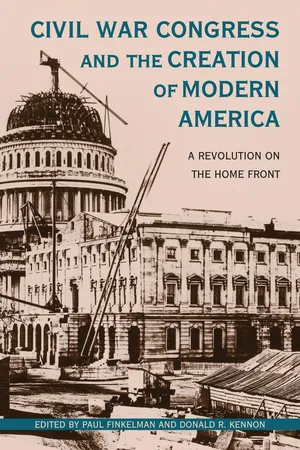 eBook - ePub
Civil War Congress and the Creation of Modern America
A Revolution on the Home Front
- Paul Finkelman, Donald R. Kennon, Paul Finkelman, Donald R. Kennon(Authors)
- 2018(Publication Date)
- Ohio University Press(Publisher)
Jennifer L. Weber Conscription and the Consolidation of Federal Power during the Civil WarIN MARCH 1863, an increasingly desperate Union Congress passed a new law called the Enrollment Act to encourage more men to volunteer for military service. In theory, it was a carrot-and-stick sort of arrangement: enlist honorably and receive a healthy incentive for doing so, or undergo the shameful act of being drafted and pass on any bonus. In practice, the arrangement was more complicated because of the various legal options it provided for men to avoid service altogether. And, as it turned out, the law had far-reaching consequences for Americans. The bland legal language of the Enrollment Act belied the changes that it set in motion, changes that resulted in a tectonic shift in the relationship between federal and state governments and between the nation and its people. The transformation that Americans experienced as a result of the draft act fell into three categories: who would raise troops, the degree to which federal government could use coercion, and the ability of the federal government to gather and keep information on its citizenry.1The United States Army had a mere 16,000 members as of 1860, and they were spread widely across the West. About a third of the officers, along with a handful of enlisted men, resigned to join the Confederacy. Clearly, the Union army did not have the manpower to bring the rebels in line. The day after the Confederates took Fort Sumter, President Abraham Lincoln issued a proclamation asking for 75,000 militiamen to suppress them. In the early days of the conflict, war fever gripped the North, and so many men volunteered that the states in charge of enlisting them turned them away. Rebels and Yankees alike predicted the war would last a mere ninety days. South Carolina Senator James Chesnut had offered to drink all the blood that would be spilled, and Southerners assured each other that “a lady’s thimble will hold all the blood that will be shed.” In the North, loyal men continued to step forward enthusiastically well after ninety days had come and gone. For the next year or so, volunteers—the term “militiaman” had been rapidly replaced—were rewarded for their efforts with a hundred-dollar bounty payable upon their being mustered out at the end of their three-year term. Northern recruitment efforts hummed along until the spring of 1862, when enlistments started to drop off.2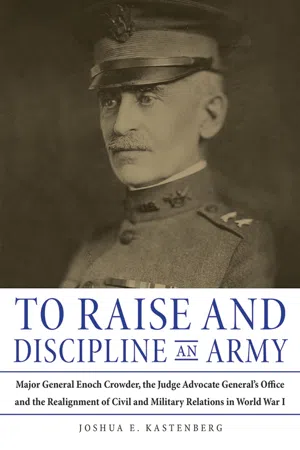 eBook - ePub
To Raise and Discipline an Army
Major General Enoch Crowder, the Judge Advocate General’s Office, and the Realignment of Civil and Military Relations in World War I
- Joshua Kastenberg(Author)
- 2017(Publication Date)
- Northern Illinois University Press(Publisher)
1In 1915 General William Harding Carter analyzed the Civil War conscription experience and concluded that “the failure of execution of the conscription or draft act during the Civil War makes it most unlikely that the principle of compulsory service will ever be acceptable to our people, unless the very existence of the Republican institutions shall be at stake.” Carter, a Civil War, frontier, and Spanish-American War veteran, misjudged the nation’s willingness to conscript its citizens for a foreign war, but clearly the 1863 Draft Riots influenced the military establishment’s strategic thinking in preparing for a pending war in Europe. Crowder believed that conscription was inherently constitutional, but he understood that the Civil War draft, with its multitude of exemptions and payoffs, was not a model for a modern conscription program.2In one respect, the Supreme Court unintentionally made military conscription appear to Crowder to be more likely sustainable against a challenge in federal court. In 1905 the justices decided in Jacobson v. Massachusetts that a state could mandate vaccinations against diseases that had the potential to threaten the health of the state’s population. Placed within the decision is a statement that a citizen could be compelled “to take his place in the ranks of the army of his country, risk the chance of being shot down in its defense.” In 1916 the justices decided in Butler v. Perry that the Thirteenth Amendment, which outlawed peonage and slavery, did not apply to a state’s mandated conscription of civil labor as long as it applied to all males. Like Jacobson, Butler was not a military compulsion case, but Crowder and many preparedness adherents believed it stood for the proposition that citizens could constitutionally be compelled to perform labor for the public good, even if the labor was dangerous.3 eBook - PDF
- William G. Ross(Author)
- 2017(Publication Date)
- Cambridge University Press(Publisher)
Since these decisions were rendered when the war was more than half over, however, they may have been decided too late to encourage litigation by opponents of the draft, which itself was not commenced until nearly two years after the start of the war. Opponents of the World War I draft contended that the Civil War draft was more constitutional and palatable insofar as conscripts were not being sent beyond the nation’s borders, while proponents of conscription argued that the Civil War draft was less acceptable because it forced Americans to take up arms against their Southern brethren. 147 Chambers, To Raise an Army, 56. 148 See Hughes, “War Powers Under the Constitution,” 234 n.1; United States v. Sugar, 243 Fed. 435 (E.D. Mich. 1917). 149 Kneedler v. Lane, 45 Pa. State Reports, 275 (1864). 150 Burroughs v. Peyton, 16 Gratt. 470 (1864). Military Conscription 37 Although several state supreme courts in the South had upheld the Confederate draft on the basis of war power provisions in the Confederate constitution that were practically identical to those in the federal constitution, these decisions, like the Pennsylvania decision, were rendered under a constitution that did not include the Thirteenth Amendment’s prohibition against involuntary servitude. Although many proponents of conscription cited the Confederate cases as significant judicial precedents, the invocation of Confederate precedent seems perverse. Since the Confederacy was formed and was fighting to preserve slavery, its courts might seem naturally inclined to interpret its constitu- tion’s war powers in a manner that would sustain the constitutionality of a form of involuntary servitude, even though military conscripts were white rather than black. The Confederate decisions in favor of conscription therefore could have been used as an argument against the constitution- ality of conscription, although there is no apparent evidence that this was done. eBook - PDF
Weary of War
Life on the Confederate Home Front
- Joe A. Mobley(Author)
- 2008(Publication Date)
- Praeger(Publisher)
Many turned out in protest at the communities of Magnolia and Camden. Judge John Brown reported that the conscripts displayed a “spirit of disloyalty beyond what was expected.” 14 The Confederate Congress approved its third and final conscription act on Febru- ary 17, 1864. That law extended the age limits for conscripts from seventeen to fifty. Those draftees who were over forty-five and under eighteen were to be utilized as reserves to defend their respective states and to carry out special assignments. The War Department hoped this maneuver would release more troops who were already in the army for duty on the major battlefields. But because it created a further drain on the male labor supply at home, it widened the gap of cooperation and support between the yeoman class and the central government. 15 Conscription, Desertion, and Internal Conflict 53 Even though the Confederate government managed to draft a large segment of the South’s white male population into the army, those men were not necessarily willing to remain there. As time went on, more and more discontented soldiers deserted, and desertion became a major problem for Confederate and state authorities. The majority of deserters came from the poorer classes, and many—if not most—of them were conscripts. Some draftees were “motivated, conscientious, and demonstrably good fighting men; but they appeared to be a distinct minority. Conscripts and substitutes as a rule had to be guarded in camp to prevent them from plundering their compatriots or deserting the army. In battle, they were an almost total liability. They would not fight under any inducement; and if somehow forced to the front lines, they would go over to the enemy at the first chance.” The War Department first became concerned about desertion in the summer of 1862. eBook - ePub
- Allan R. Millett, Peter Maslowski(Authors)
- 2012(Publication Date)
- Free Press(Publisher)
National conscription was an even more profound assertion of centralized authority. On April 16, 1862, the Confederacy enacted the first national draft law in American history. Fighting for freedom and states’ rights, the South paradoxically forced individuals to serve under central authority. The Confederate congress understood that conscription, although distasteful, was necessary. Casualties were high, few men volunteered, and the 1861 one-year enlistments soon expired. The law made all white males between the ages of eighteen and thirty-five members of the army for three years, automatically reenlisting the one-year volunteers for two more years. Subsequent legislation extended the age limits to seventeen and fifty, and in February 1864 the congress ordered all men already in the army to serve for the duration. Compulsory reenlistment meant that southerners served until they were killed or discharged due to disability, they deserted, or the war ended.Two features weakened Confederate conscription. First, the law permitted substitutes. The substitute market was discriminatory and fraudulent. Prices soared to more than $5,000, which only the rich could pay, and many substitutes were unfit or soon deserted. When the Confederate congress later abolished substitution and made men who had provided substitutes liable for service, the rich felt betrayed. Second, although the original law contained no exemptions, a mere five days later congress began to correct this “oversight” by providing for several exempt categories; subsequent legislation expanded the exemption list. Exemptions included a large number of state and national government officials, militia officers, workers in critical war-production occupations, professional men, and one white man for every twenty slaves. Southerners abused many of these categories, and ultimately the Confederacy exempted about 50 percent of the men called out by conscription.The North also felt a manpower squeeze during 1862. Realizing his error, Stanton reestablished Federal recruiting in June, and on July 2 Lincoln called for 300,000 three-year volunteers, but the response was slow. Like the South, the North turned to compulsion, though less directly. The Militia Act of July 17, 1862, authorized the president to “make all necessary rules and regulations” for states without adequate militia laws. Broadly interpreting that provision, on August 4 the government called for a draft of 300,000 nine-month militia. A proviso stated that a special militia draft would be conducted to meet the deficiency of three-year volunteers in those states failing to reach their quotas. Governors protested their quotas were too high and that the date for the special draft was too soon, and antidraft disturbances occurred in Wisconsin and Pennsylvania. Under pressure Stanton postponed the militia draft, which never went into effect. However, the threat of conscription brought forth 421,000 volunteers and 87,500 militiamen. Since the government considered one volunteer equivalent to four nine-month militiamen, the states more than met the July and August calls. But it had not been easy.
- L-Cmdr Michael S. Trench(Author)
- 2014(Publication Date)
- Golden Springs Publishing(Publisher)
CHAPTER FIVE — THE DRAFT
When the Civil War began, the militaries of the Union and Confederacy raised their Armed Forces the way American governments always had; they accepted volunteers from the states. Both sides had a small regular Army, much too small to fight the war alone, so the Federal governments called on the states to supply the necessary manpower.Initially, this process was approximately the same on both sides. This is not particularly surprising since the federal governments and militaries on both sides had, until recently, been one system. The process started with the President petitioning Congress for a specified number of troops. Once Congress approved the number and duration of their commitment, the President called on the individual states for their share of the total number. The number each state contributed was usually determined by population. Once notified, the governors allowed men to go out and recruit volunteers. The men who recruited troops were usually well known within their city or county, and may or may not have had any military training. Once approximately one hundred men volunteered, they were formed into a company. When ten companies were formed, they were formed into a regiment.Once units were formed, the men voted for their company and field grade officers. Although not always militarily sound, the election of officers was an accepted practice when the Civil War began. Since most units came from a small area, the men usually shared a geographic and ethnic similarity, and many volunteered because they knew who they would serve under. Lincoln and Davis were both elected officers during their military service, Davis as a Colonel of the First Mississippi Rifles and Lincoln as a Captain of the Illinois Militia.After the men elected the company and field grade officers, those officers elected the Regimental officers. The governors actually commissioned the Regimental officers, but usually agreed with those elected by the junior officers. Once the units were completely filled out and officers elected, they headed out to war. Regiments were kept together as a rule, and formed part of a larger unit under a General Officer from the regular Army. The state government usually outfitted the men with weapons and equipment, resulting in wide variations in uniforms and weapons. eBook - PDF
Defense Manpower Planning
Issues for the 1980s
- William J. Taylor, Eric T. Olson, Richard A. Schrader, William J. Taylor, Eric T. Olson, Richard A. Schrader(Authors)
- 2013(Publication Date)
- Pergamon(Publisher)
An all-volunteer force is the norm in American history. Only during periods when •Conscription and the All-Volunteer Army in Historical Perspective by Robert K. Griffith, Jr., has appeared previously in Volume X (September 1980) of Parameters—Journal of the U.S. Army War College, pp. 61-69, and is reproduced here with their permission. 21 22 Defense Manpower Planning there was a broad popular consensus of a clear and present danger to society have the American people resorted to conscription. POPULAR OPPOSITION TO CONSCRIPTION Only as colonials of Great Britain did the American people ever come close to experiencing universal military service. Yet even in the 18th century, as the frontier moved west and men found profit more appealing than military service, the settled and secured regions along the Atlantic coast modified the universal service implied by the militia system. As the threat receded, active participation in the militia became voluntary and the units themselves became increasingly social in nature. During the Revolution volunteers made up the backbone of both the Continental Line and those units that served beyond their states' borders. By the 19th century, the volunteer system had triumphed, despite the fact that the Militia Act of 1792, which formed the basis of US military manpower policy for over 100 years, reiterated the principle of univer-sal military obligation. Even during the Civil War, when both the Union and Confederacy resorted to rudimentary state-controlled forms of conscription, volunteers formed the bulk of the contending armies. 2 World War I brought the first truly modern draft (modern in the sense that it permitted no hiring of substitutes and was centralized at the federal level) in the American experience. The draft supplied two-thirds of the manpower needed for the war, but it was strictly a wartime measure.
- (Author)
- 2018(Publication Date)
- Cuvillier Verlag(Publisher)
Es gilt nur für den persönlichen Gebrauch. 59 before going to war. The army thus became a ‘school of standardization’ and a ‘place of national integration’ (p. 112). Then in 1798, the Jourdan Law officially established conscription under the principle of a permanent force that could guarantee the protection of France from potential foreign threats. The word conscription itself stems from this time, as men had to register to be drafted ( inscription ) depending on the nation’s priorities. Hence, conscription did not mean mandatory military service automatically but the fact that one could be drafted at any moment (p. 124). After World War II, classical military service was reestablished and a series of recruitment centers were built throughout the country. During the Algerian war, conscripts were sent to fight following the idea that fighting in northern Africa meant fighting in France itself (Crépin, 2009, p. 381). Later on, France’s international participation with contingents of UN blue helmets gave military service more acceptance among the population. In 1995, when Jacques Chirac took office, he instaured a Strategic Committee for a potential reform of the Armed Forces, which was finally decided in 1996. The idea was “not to go back into the past, but to prepare the Army for the future” (p.406). The law that ended conscription was signed in 1997, clearly stating that military service was suspended and could always be reestablished if need be. 2.2. Recruitment goes digital: the military and social media The study of the military evolves with changes in the institution and its context. The Web 2.0 era now provides a new dimension for the study of the military and its relations with society. The ‘nature of communication’ (Shields, 2013) of military content now has a digtal dimension that funnels messages to massive and specific publics. Recruitment is an example of a military practice that adapts constantly to its audience. eBook - PDF
Remaking Modernity
Politics, History, and Sociology
- Julia Adams, Elisabeth S. Clemens, Ann Shola Orloff, Julia Adams, Elisabeth S. Clemens, Ann Shola Orloff, George Steinmetz(Authors)
- 2005(Publication Date)
- Duke University Press Books(Publisher)
By incorporating the wide swath of ‘‘the people’’ as citizens, conscription o√ered a way to build popular support for the regime in power while also gaining a measure of central direction over those newly mobilized into politics. Bringing the people into the regime as citizens, binding them into a political community and to the state through obligation— that was the key to consolidating a regime suddenly depen-dent on popular mobilization, strengthening the hold of elites over state power, and building the military means necessary to contend with the crises they faced. ≤∂ We can see how both reformers and the representatives of those newly mobilized into politics understood citizen conscription to help consolidate a politically mass-mobilizing regime in three distinct ways, each correspond-ing to a di√erent sense in which the policy incorporated the people as citizens. By leveling social di√erences in the military and political spheres, conscription rendered all (male) citizens formally equal. By breaking down the insulation of the line army from society and instead bringing the army closer to the people, conscription integrated the people and their state into a single polity. And by making military service an obligation of national cit-izenship, conscription politicized relations of citizens to one another, the state, and armed conflict, transforming military service into the constitutive political act and military mobilization itself into a form of political mobili-zation on behalf of the regime in power. What national conscription o√ered reformers was a way to foster and channel the mobilization of the popular classes, broadening the social foun-dation of the regime in power while undercutting threats to its stability. What it o√ered the masses was political recognition if not democracy, a way to participate in at least one of the state’s chief endeavors, and a way— perhaps only symbolically—to appropriate the state as their own. eBook - ePub
The Advent of the All-Volunteer Force
Protecting Free Society
- William A. Taylor(Author)
- 2023(Publication Date)
- Routledge(Publisher)
Avant, The Market for Force: The Consequences of Privatizing Security (Cambridge: Cambridge University Press, 2005); George Q. Flynn, The Draft, 1940–1973 (Lawrence: University Press of Kansas, 1993); and Charles C. Moskos, A Call to Civic Service: National Service for Country and Community (New York: Free Press, 1988). Douglas W. Bristol Jr. and Heather Marie Stur, eds., Integrating the US Military: Race, Gender, and Sexual Orientation since World War II (Baltimore: Johns Hopkins University Press, 2017); William A. Taylor, Military Service and American Democracy: From World War II to the Iraq and Afghanistan Wars (Lawrence: University Press of Kansas, 2016); Peter S. Kindsvatter, American Soldiers: Ground Combat in the World Wars, Korea, and Vietnam (Lawrence: University Press of Kansas, 2003); Peter D. Feaver and Richard H. Kohn, eds., Soldiers and Civilians: The Civil-Military Gap and American National Security (Cambridge, MA: MIT Press, 2001); David R. Segal, Recruiting for Uncle Sam: Citizenship and Military Manpower Policy (Lawrence: University Press of Kansas, 1989); and Eliot A. Cohen, Citizens and Soldiers: The Dilemmas of Military Service (Ithaca, NY: Cornell University Press, 1985). Dennis Laich, Skin in the Game: Poor Kids and Patriots (Bloomington, IN: iUniverse, 2013); Andrew J. Bacevich, Breach of Trust: How Americans Failed Their Soldiers and Their Country (New York: Henry Holt, 2013); and Kathy Roth-Douquet and Frank Schaeffer, AWOL: The Unexcused Absence of America’s Upper Classes from Military Service—and How It Hurts Our Country (New York: HarperCollins, 2006). For the American Civil War, see Timothy J. Perri, “The Evolution of Military Conscription in the United States,” Independent Review 17, no. 3 (Winter 2013): 429–439, esp. 430–432. For World War I, see John W. Chambers, To Raise an Army: The Draft Comes to Modern America (New York: Free Press, 1987). For World War II, see J. Garry Clifford and Samuel R
Index pages curate the most relevant extracts from our library of academic textbooks. They’ve been created using an in-house natural language model (NLM), each adding context and meaning to key research topics.

