History

Confederate Economy
The Confederate economy refers to the economic system of the Confederate States of America during the American Civil War. It was primarily agrarian, relying heavily on cotton and tobacco production, and lacked the industrial infrastructure of the Union. The Confederate economy faced significant challenges due to blockades, inflation, and resource shortages, contributing to the eventual defeat of the Confederacy.
Written by Perlego with AI-assistance
Related key terms
1 of 5
7 Key excerpts on "Confederate Economy"

- Emory M. Thomas(Author)
- 2021(Publication Date)
- University of South Carolina Press(Publisher)
These liabilities, internal and external, conditioned the economic response to what became a war of attrition. Yet that response, when compared to the antebellum status quo, constituted nothing less than an eco-nomic revolution. In contrast to the economy of the Old South, the Confederate Southern economy was characterized by the decline of agriculture, the rise of industrialism, and the rise of urbanization. 2. Ibid. THE CONFEDERACY AS A REVOLUTIONARY EXPERIENCE SS Agricultural Decline No one knows how many Southerners in 1861 seriously believed that one Southerner can lick ten Yankees. It is safe to say that an overwhelming majority of Confederates did be-lieve as articles of national faith that cotton is king and a nation of farmers will never go hungry. However, the South-ern nation was still young when both doctrines had proven, not merely false, but mutually exclusive. Quite unwittingly the Confederacy reduced King Cotton to the status of pawn. The government took the first step when it imposed the cotton embargo in 1861. Diplomatically the logic of the move was clear. Cotton was the bait to lure England and France into recognizing Confederate nationhood. To avoid a cotton famine, the South believed, England and France would have to come to Confederate terms with the American Question. England and France never took the bait. Having spent her greatest economic resource in hopes of securing European intervention, the Confederacy found that her cotton was worth little else. By the time the Confederate State Depart-ment realized that its cotton famine ploy had failed, the United States navy was ready to enforce its blockade of South-ern ports. For most of the Confederate period the Southern cotton trade, instead of a solid asset, was a high-risk speculation. Cotton was the chief commodity involved in Southern block-ade-running. And it must be said that this adventurous trade bore some fruit. eBook - PDF
Writing the Civil War
The Quest to Understand
- James M. McPherson, William J. Cooper, James M. McPherson, William J. Cooper, Jr.(Authors)
- 2021(Publication Date)
- University of South Carolina Press(Publisher)
Schwab, Robert Cecil Todd, and Paul W. Gates, works that ap-peared decades ago but remain useful today. 13 Economic historians who have approached the Confederacy as a dis-tinct epoch usually have a specific purpose: to assess the role of the Confederate Economy in the outcome of the war. Had the war been as short as most southerners expected, the balance sheet of economic re-sources between North and South would have been inconsequential. But in the war that came, a modern industrial war of attrition, economic re-sources and their mobilization counted a great deal. Recent work runs the gamut from studies that emphasize the Confederacy's economic adapt-ability and achievement to those that stress its limits and failure. No scholar has argued the case for economic departure more cogently than Emory Thomas. In a nation founded by planters to preserve plantation agricul-204 BEHIND THE LINES ture, Thomas argues, capital swelled, cities mushroomed, and war indus-tries burgeoned. The Confederate South underwent nothing short of an economic revolution. 14 William Freehling, on the other hand, portrays a Confederate Economy more continuous with the Old South and in the end mortally wounded by slavery. The magnitude of the Confederacy's internal problem would have baffled the greatest statesmen, he ar-gues. Only a miracle could have transformed the southern economy into a sophisticated military-industrial complex. 15 Although our understanding of aspects of the Confederate Economy remains more impressionistic than systematic and sketches of veterans returning to wasted farmsteads still outweigh serious analyses of the dev-astation, scholars have in recent years sought to chart the course of the Confederate Economy by taking on a wide range of topics: agriculture; manufacturing; economic and fiscal policy; urban growth; slave labor; railroads and transportation; blockade and trade; economic privation and public relief, and more. eBook - ePub
Themes of the American Civil War
The War Between the States
- Susan-Mary Grant, Brian Holden-Reid, Susan-Mary Grant, Brian Holden-Reid(Authors)
- 2009(Publication Date)
- Routledge(Publisher)
9By most criteria, therefore, Southern capitalism was anything but furthered by the Civil War. Commodity output was severely damaged and Southern industrialization, lagging far behind the North in 1860, slipped still further behind. Only if we define capitalism so as to exclude slavery can it be said to have been furthered by the wartime experience. As we shall see later, this effect was of major proportions, though not perhaps primarily in the South. For the ending of Southern slavery did not produce wage labor in the region so much as a bewildering array of labor systems, including sharecropping, tenant farming, the crop lien system, and other contractual agreements generally designed to give as little true freedom to the freedmen and to perpetuate racial inequality throughout the region. Thus the South emerged from the Civil War as a backward economic region, characterized by low wages, low productivity, underdevelopment, and a chronic shortage of productive capital. Most republicans had hoped that the war and Reconstruction would together remake the South in the image of the North. By the mid-1870s, if not earlier, it was apparent that this project lay in ruins.10The Northern War Economy
Those who have claimed that the Civil War promoted American capitalism, however, have not based their case on the Southern experience. For the impact of the war upon the North was, of course, very different. The war years gave a great boost to certain industries in the North and produced institutional changes that were beneficial to Northern capitalism during the war itself and for many years thereafter. Nevertheless, and quite apart from the sacrifices entailed by the military struggle, some groups in the North suffered severe deprivation. It is perhaps ironic that under the Republicans, ostensibly the party of “free labor,” labor lost heavily. In fact a relatively large number of labor unions came into existence in the war years—at least ten national unions as well as local ones were created between 1863 and 1866—but these were essentially defensive reactions to a deteriorating environment. Although the war effort should have made labor comparatively scarce, this effect was offset by the arrival of some 800,000 immigrants. Wages actually rose by perhaps 50 percent during the war but failed to keep pace with prices. In the first two years of the war wages rose 20 percent but prices rose by 50 percent. The following year prices rose even faster and the result was the organization of unions and the outbreak of strikes in the winter of 1863–64. By the end of the war prices were perhaps more than two-thirds higher than on the eve of conflict. Meanwhile, federal troops and martial law had been employed to defeat strikers.11 eBook - ePub
State and Citizen
British America and the Early United States
- Peter Thompson, Peter S. Onuf, Peter Thompson, Peter S. Onuf(Authors)
- 2013(Publication Date)
- University of Virginia Press(Publisher)
Civil War. I attempt to recast economic nationalism, however, in broader terms. Economic nationalism is not so much a series of specific economic policies but rather is a more generalized concept in which independence movements create “imagined economies” that articulate a possible economic future. Both colonists and Confederates had to answer a series of economic questions to make a persuasive case for independence. How would the new nation trade with other countries, especially the former “mother” country? Would the new nation remain agricultural, or would it seek to foster cities and manufacturing? What role would the state play in fostering economic development? In the heated debate over rebellion and independence, colonists and Confederates alike answered these questions in speeches, pamphlets, and editorials. In both discourses of independence, visualizing an imagined economy became an essential part of creating an imagined community. 3 The colonists put forward a relatively conservative economic vision in which independence would reinforce its role as a commodity producer in the Atlantic economy. During the decade leading up to the Revolutionary War, most colonists readily accepted an economic role within the British Empire as a producer of commodities and a consumer of manufactured goods. When the colonies declared themselves independent, they invoked natural rights ideology to justify free trade with other nations. Free trade, however, was designed to reinforce international exports of staple crops rather than revolutionize the American economy. Confederate secessionists viewed political independence much differently—they saw it as an opportunity to create a more modern economy. Secessionists often celebrated free trade, believing that such policies would divert capital and trade to the South so that cities such as Norfolk, Charleston, and Savannah would become the continent’s great commercial centers eBook - ePub
Modernizing a Slave Economy
The Economic Vision of the Confederate Nation
- John Majewski(Author)
- 2011(Publication Date)
- The University of North Carolina Press(Publisher)
This chapter shows how that visible hand made Confederates more likely to resort to far stronger state action when war endangered the survival of slavery. Whether it was government investment in railroads, government ownership of key industries, or government regulation of commerce, Confederates adopted centralized control of the economy with surprisingly little opposition. States’ rights objections to a strong central government, so prominent in the South under the old Union, did little to slow down the growth of the Confederate state. In antebellum debates, secessionists never imagined creating a Confederate Leviathan, but their general economic philosophy certainly helped make one possible.The creation of a strong Confederate state revealed the powerful sense of nationalism that knit together the supporters of the Confederacy’s slave society. In many ways, the nationalistic spirit grew stronger as the war progressed. Nationalism, though, had significant costs as well as benefits. Blinded by their fundamental assumption that “interests” dictatedILLUSTRATION 5The portraits on these notes symbolize a modern Confederate Economy and a strong Confederate state. The small size of the persons relative to the state capitol suggests the primacy of government over that of the individual. (Currency from the collection of the author)human behavior, secessionists believed that the South’s substantial population of Upcountry farmers and slaves would quietly acquiesce to the formation of a modern slaveholding republic. Supposing that they could manipulate and control others, secessionists resembled the “man of system” that Adam Smith described in The Theory of Moral Sentiments . Smith observed that the man of system “seems to imagine that he can arrange the different members of a great society with as much ease as the hand arranges the different pieces upon a chess-board.” The man of system, Smith cautioned, invariably forgot that “in the great chess-board of human society, every single piece has a principle of motion of its own, altogether different from that which the legislature might chuse [sic] to impress upon it”.1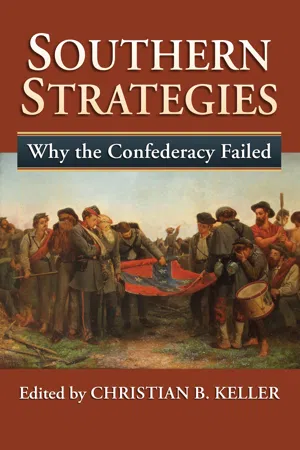 eBook - ePub
Southern Strategies
Why the Confederacy Failed
- Christian B. Keller(Author)
- 2021(Publication Date)
- University Press of Kansas(Publisher)
The Lincoln administration was gifted by a robust, preexisting financial sector, an economy balanced by agriculture and industry, and, perhaps most importantly, longer-standing faith in the government both domestically and abroad. Thus, the Union was far better positioned to finance its war effort in a manner that best enabled long-term market stability (and did so), while the Confederacy, with little financial strength and an economy based strongly on cash crops, did the opposite: raising fast funds early on that eventually crippled its economy in the long term. Confederate failures to better balance revenues from taxes, bonds, and the printing press directly contributed to high inflation rates that would place the rebel economy in a downward spiral, retard efforts to supply and pay its armies effectively, and dampen Southern morale. From a strategic perspective, Confederate financial ways were ill considered, all but ensuring the young nation’s already weak fiscal means would be grossly inadequate and poorly utilized in pursuit of the policy end of independence. A review of early Confederate congressional decision-making on these methods reveals the overall trend. 12 Taxation: Too Little, Too Late In early 1861, the Confederate legislature began the difficult task of approving and instituting the procedures they would employ to fund the government and the war effort. As one historian put it, an examination of this process reveals that the Confederacy adopted financially “unsound policies during the first two years of hostilities and could not redirect policy effectively thereafter.” Driven by a belief in a short conflict and reinforced by grandiose visions of states’ rights, these policies severely restricted direct taxation of the Southern population and instead relied heavily on paper money, bonds, and treasury notes eBook - ePub
Colossal Ambitions
Confederate Planning for a Post–Civil War World
- Adrian Brettle(Author)
- 2020(Publication Date)
- University of Virginia Press(Publisher)
Sound finances had to be the priority for the government, and planners for the new nation expressed remorse over the memory of the 1840s debt defaults by southern states. Diplomats tracked the performance of the Cotton Loan in London and Paris and compared it with the dollar—gold convertibility prices in New York. Such present-day preoccupations had future consequences for what planners wished the Confederate Economy to become. They had to adjust their preferred vision of a world with nations connected by free trade and cooperative economies devoted to comparative advantage. Instead, with a more mercantilist way of thinking about the economy, the Confederacy aimed for a trade surplus, and hence a flow of gold and silver into Confederate coffers. Imports would be limited by the establishment of a significant manufacturing sector—economic planners not only sought to import goods and knowhow in order to boost wartime munitions production; they also consciously set about the development of new advanced industries. 1 Electoral and military issues had to be resolved before any clarification of the future relations between the Confederacy and the United States. In terms of any territorial settlement, leading Confederates continued to resist any idea of uti possidetis (what you have you hold); aiming instead to recover lost land via postwar state conventions and even by military reconquest. At the same time, the imminence of the U.S. presidential elections meant the defeat of Lincoln would quickly deliver peace. Would-be Confederate negotiators reacted to this situation by debating the extent to which they should be magnanimous toward the Union in the context of what they believed to be a victory. Tactically, they wondered if they should try and help secure this outcome by actively seeking to boost the electoral fortunes of northern Democrats with offers of commercial and even military alliance
Index pages curate the most relevant extracts from our library of academic textbooks. They’ve been created using an in-house natural language model (NLM), each adding context and meaning to key research topics.

