History

Confederate States of America
The Confederate States of America was a collection of 11 Southern states that seceded from the United States in 1860-1861, leading to the American Civil War. The Confederacy aimed to preserve the institution of slavery and maintain states' rights. The Civil War ended in 1865 with the defeat of the Confederacy and the reintegration of the Southern states into the Union.
Written by Perlego with AI-assistance
Related key terms
1 of 5
5 Key excerpts on "Confederate States of America"
 eBook - PDF
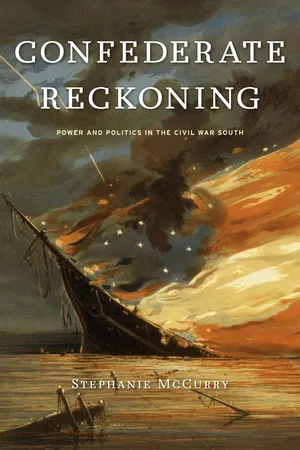
Confederate Reckoning
Power and Politics in the Civil War South
- Stephanie McCurry(Author)
- 2010(Publication Date)
- Harvard University Press(Publisher)
It was not until the destruction of slavery in the American Civil War that the le-viathan American state—the Republican Party state built by the Union war government—took off. The destruction of slavery, and with it the power of the slaveholders as a class in American political life, was the one needful thing. 8 The C.S.A.—the only explicitly pro slavery nation-state formed in the modern period—inherited all of the contradictions and liabilities of the older slaveholding states of America. With independence the slavehold-ing states got their wish, shaping their new government to establish rights of property in slaves as wholly within the control of the individual states. Sitting down to write their Constitution in Montgomery, Alabama, mem-bers of the provisional government crafted a document that defined slaves explicitly as property, put slaves definitively outside the boundaries of the political community, prohibited the incorporation of any new state that did not sanction slavery, and put it beyond the power of their federal gov-ernment to limit, revoke, or otherwise interfere with the legality of slave property or rights of slaveholders. 9 These were the purposes for which the C.S.A. was formed. Governor Brown of Georgia described the Con- 222 l co n f e d e ra te re c ko n i n g federacy as a “league between sovereigns,” and the central government as “the servant of several masters, not the master of several servants.” 10 Slaveholders had finally gotten the state they wanted. That was the state with which they would have to wage war. With 40 percent of their adult male population enslaved and unavailable for military service, Confederates faced a structural problem from the outset. “The seven Confederate states have not more than double the number of the male population capable of bearing arms, which has been offered to this [U.S.] government as volunteers since the 15th of this month,” John A. Campbell, the recently resigned associate justice of the U.S. No longer available |Learn more
- (Author)
- 2014(Publication Date)
- University Publications(Publisher)
Confederate resistance ended after Lee surrendered to Grant at Appomattox Court House on April 9, 1865. The American Civil War was one of the earliest true industrial wars. Railroads, the telegraph, steamships, and mass-produced weapons were employed extensively. The practices of total war, developed by Sherman in Georgia, and of trench warfare around Petersburg foreshadowed World War I in Europe. It remains the deadliest war in American history, resulting in the deaths of 620,000 soldiers and an undetermined number of civilian casualties. Ten percent of all Northern males 20–45 years of age died, as did 30 percent of all Southern white males aged 18–40. Victory for the North meant the end of the Confederacy and of slavery in the United States, and strengthened the role of the federal government. The social, political, economic and racial issues of the war decisively shaped the reconstruction era that lasted to 1877. Causes of secession The Abolitionist movement in the United States had roots in the Declaration of Independence. Slavery was banned in the Northwest Territory with the Northwest Ordinance of 1787. By 1804 all the Northern states had passed laws to abolish slavery. Congress banned the African slave-trade in 1808, although slavery grew in new states in the deep south. The Union was divided along the Mason Dixon Line into the North (free of slaves), and the South, where slavery remained legal. Despite compromises in 1820 and 1850, the slavery issues exploded in the 1850s. Lincoln did not propose federal laws against slavery where it already existed, but he had, in his 1858 House Divided Speech, expressed a desire to arrest the further spread of it, and place it where the public mind shall rest in the belief that it is in the course of ultimate extinction. Much of the political battle in the 1850s focused on the expansion of slavery into the newly created territories. Both North and South assumed that if slavery could not expand it would wither and die. eBook - PDF
- George Grant, Michael Swift(Authors)
- 2011(Publication Date)
- Taj Books International(Publisher)
22 THE SOUTH SECEDES JANUARY 1861 L incoln’s electoral victory ensured that there was little chance of compromise; indeed, before his inauguration in March, while Democrat James Buchanan retained office, the first secessions took place. At the forefront of the pro-slavery states, South Carolina voted to withdraw from the Union on December 20, 1860. The rationale behind the decision was that, just as each individual state had voted in convention to join the Union, so a vote in a similar body could see the individual state withdraw. For a brief period, other southern states did not act so precipitously, hoping that some form of compromise could still be found. However, during January 1861, a further six southern states— Alabama, Mississippi, Florida, Georgia, Louisiana, and Texas—also voted to secede. So far, all the secessionist states were those from the deep south. The more northerly pro-slavery states—North Carolina, Virginia, Arkansas, and Tennessee—remained within the Union; indeed, they would not actually secede until after the fall of Fort Sumter. On February 4, 1861, delegates from the seven secessionist states met in a convention at Montgomery in Alabama in order to establish the Confederate States of America and to agree a new constitution. At the convention, the moderates within the pro-slavery states held sway and many of the more extreme motions—such as a demand for the restoration of the transatlantic slave trade with Africa—were successfully resisted. The draft constitution, officially issued on March 11, 1861, was in most respects very similar to the original constitution of the U.S., save for the fact that it adopted a pro-southern interpretation of the contentious clauses within the original contract and also enshrined the position of slavery. The convention also selected Jefferson Davis and Alexander H. Stephens as provisional President and Vice-President respectively. No longer available |Learn more
Liberty, Equality, Power
A History of the American People, Concise Edition
- John Murrin, Paul Johnson, James McPherson, Alice Fahs(Authors)
- 2013(Publication Date)
- Cengage Learning EMEA(Publisher)
But President-elect Lincoln sent word to key Republican senators and congressmen to stand firm against compromise on the territorial issue. “ Entertain no proposition for a compromise in regard to the extension of slavery, ” wrote Lincoln. “ We have just carried an election on principles fairly stated to the people. Now we are told in advance, the government shall be broken up, unless we surrender to those we have beaten .. . . If we surrender, it is the end of us. ” Lincoln ’ s advice was decisive: The Republicans voted against the Crittenden proposal and any other attempt to compromise. Nothing that happened in Washington would have made any difference to the seven states that had seceded. No compromise could bring them back. No power could “ stem the wild torrent of passion that is carrying everything before it, ” wrote former U.S. senator Judah P. Benjamin of Louisiana. Secession “ is a revolution ” that “ can no more be checked by human effort . . . than a prairie fire by a gardener ’ s watering pot. ” Establishment of the Confederacy The seceded states held a convention in Montgomery, Alabama, where they drew up a constitution and established a government for the new Confederate States of America. The Confederate constitution guaranteed slavery in the states and the territories, strengthened the principle of state sovereignty, and prohibited its Congress from enacting a protective (as distinguished from a revenue-raising) tariff. It limited the president to a single six-year term. Until elections could be held in November 1861, delegates constituted themselves a provisional Congress and elected Jefferson Davis and Alexander Stephens as provisional president and vice president. 340 C H A P T E R 1 5 SECESSION AND CIVIL WAR, 1860 – 1862 Copyright 2014 Cengage Learning. All Rights Reserved. May not be copied, scanned, or duplicated, in whole or in part. WCN 02-300 Davis and Stephens were two of the ablest men in the South. eBook - PDF
Secession as an International Phenomenon
From America's Civil War to Contemporary Separatist Movements
- Don Doyle(Author)
- 2010(Publication Date)
- University of Georgia Press(Publisher)
The northern response to this challenge has frequently taken second place in the literature to an interest in the development of southern, or Confeder-ate, nationalism; historians have been far more interested in why the South se-ceded and whether by that process a separate nation was created than in why the North sought to prevent secession and how by that process a single nation was sustained. Hindsight is part of the problem here, but historians’ fascination with the perceived underdog, the lack of appreciation of the development of a specifically northern nationalism against which southern nationalism devel-oped in the first place, and the sense of the South as a region persistently dif-ferent from if not at odds with the rest of the United States have all contributed to a large literature on the subject of white southern support for secession and a concomitant dearth of material on northern opposition to it. The American Civil War was a war of state formation, yet when the war came many of the most influential bodies with respect to propaganda and support were private concerns, not state ones. Northern elite organizations such as the Loyal Publication Society of New York had the self-appointed task of both pro-mulgating their own perspective on American nationalism and interpreting and disseminating the Lincoln administration’s position on secession in support of that nationalism: in the denial of secession a nation was finally conceived but not yet born. It would take a military victory to confirm America’s “new birth of freedom,” and for that, the morale of the people was a crucial component. In successfully meeting the challenge of how to conduct, and win, a long war, the people established beyond doubt the legitimacy of the American federal system as a constitutionally validated perpetual union.
Index pages curate the most relevant extracts from our library of academic textbooks. They’ve been created using an in-house natural language model (NLM), each adding context and meaning to key research topics.

