History

Civil War Battles
The Civil War Battles were a series of military engagements fought between the Union and Confederate forces in the United States from 1861 to 1865. Key battles such as Gettysburg, Antietam, and Bull Run were pivotal in shaping the outcome of the war. These battles were significant in determining the course of American history and the abolition of slavery.
Written by Perlego with AI-assistance
Related key terms
1 of 5
7 Key excerpts on "Civil War Battles"
 eBook - PDF
Securing the Peace
The Durable Settlement of Civil Wars
- Monica Duffy Toft(Author)
- 2009(Publication Date)
- Princeton University Press(Publisher)
This is not to say that the terms of negotiated settlements are evolving and improving, or that this finding may not change. Nevertheless, the results of the present study and of others con- firm this state of affairs. 12 Definitions This section introduces the key terms of the book, including both what is meant and what is not meant by my use of the expressions “civil war,” “military victory,” “negotiated settlement,” “security sector,” “enduring peace,” and others. Civil War A civil war is a fight that occurs within the boundaries of an internation- ally recognized state. There must be at least two sets of organized com- batants with the capacity to physically harm one another. According to these parameters, genocide, in which one side murders the other (where the “other” is generally unarmed—or armed but not organized), would thus not be considered a civil war in this analysis. In addition, one of the combatants must be a state (since the focus of analysis here is the civil war, I typically refer to the state as either the “incumbent government” or the “center”). This would preclude consideration of communal conflicts in which the state is not involved in the actual fighting (although it might 10 C H A P T E R 1 be involved in trying to end the fighting). Finally, there must be a substan- tial number of deaths over a defined period. The threshold of deaths used here—at one thousand battle-related deaths per year on average—is that used by the Correlates of War Data Set. 13 Thus, to cite one important example, the conflict in Northern Ireland would not be included in the analysis, although lessons about terminating violence might nevertheless be learned from that case. Military Victory Military victories are situations in which one side in a war is defeated, with the other party emerging as the victor. eBook - PDF
- Keith D. Dickson(Author)
- 2022(Publication Date)
- For Dummies(Publisher)
2 Making War IN THIS PART . . . Get a fast and furious overview of military systems, military terminology, the difference between strategy and tactics, and the relationship of battles to campaigns. Understand the relationship between the science and art of war. Get an understanding of the basic principles and processes of prosecuting war. CHAPTER 4 Civil War Armies: Structure and Organization 55 Chapter 4 Civil War Armies: Structure and Organization W ar is both an art and a science. The way in which knowledge is applied and principles are employed is an art. But, because it deals with specific principles and knowledge, it is also a science. To understand what hap-pened during the Civil War, you must become familiar with some basic military concepts and learn a bit of vocabulary. This way, when you read accounts of bat-tles in this book, or more detailed accounts of the campaigns and battles of the Civil War in other books, you will have some idea of what the author means. This chapter walks you through some terms and concepts that give you just what you need to understand and appreciate what happened during the war and why. IN THIS CHAPTER » Defining war » Understanding the principles of strategy that shape the conduct of war » Discovering the three levels of war and how they interrelate » Examining the art of war and how commanders apply the art » Breaking down the military organization of Civil War armies 56 PART 2 Making War Understanding the Basics of War When the existing unfavorable conditions between states (or nations) can no longer be tolerated, there is a resort to armed force called war. War, in essence, is a contest of wills in which the opponents employ armed violence against each other to compel a change favorable to the state. The victor in war is the state that breaks the other’s will to resist. The outcome of the contest is defined in political terms. eBook - PDF
War and American Popular Culture
A Historical Encyclopedia
- M. Paul Holsinger(Author)
- 1999(Publication Date)
- Greenwood(Publisher)
As long as such rhetoric survived, there was little hope that the country could ever be brought back together. For more than one hundred years, the Civil War has fascinated Americans perhaps more than any other military conflict. Thousands of books, both fiction and nonfiction, have been written about various aspects of the combat. There seems no end to such volumes or their popularity among readers; Charles Fra- zier's 1997 novel Cold Mountain topped the New York Times best-seller list for many weeks. On any given week, hundreds of Civil War "re-enactors" try to understand better what the war was all about by recreating the fighting of in- dividual battles before appreciative audiences (see battlefield reenactments). ah Even computer simulations prominently feature the Civil War and offer students of the era an opportunity to plot strategy afresh and possibly, this time, let the South emerge victorious. What is often forgotten in the midst of such pro-Civil War fervor is that this was truly a "brother's war." That, above all other facts, makes it this nation's most regrettable military experience. No wars are ever "good wars," despite attempts to convince the public otherwise, but the conflict that the North called the Civil War and the South, the War between the States, despite all the honor we have accorded it, was one of the worst. During the war, brothers occasionally fought and killed each other. Families, especially in the border states, were torn apart, and the enmity still has not fully healed. That, perhaps, is the war's saddest legacy of all. See: Catton, Bruce. The Centennial History of the Civil War. 3 vols. Garden City, NY: Dou- bleday, 1961-1965. . The Coming Fury. Garden City, NY: Doubleday, 1961. McPherson, James M. The Battle Cry of Freedom: The Civil War Era. New York: Oxford University Press, 1988. . For Cause and Comrades: Why Men Fought in the Civil War. New York: Oxford University Press, 1997. Woodworth, Steven, ed. eBook - PDF
- Jacob Bercovitch, Victor Kremenyuk, I William Zartman, Jacob Bercovitch, Victor Kremenyuk, I William Zartman(Authors)
- 2008(Publication Date)
- SAGE Publications Ltd(Publisher)
31 The Spread of Civil War 1 K r i s t i a n S k r e d e G l e d i t s c h INTRODUCTION Civil war has been by far the most common form of conflict in the international system since 1945. 2 Although interstate conflicts have been more lethal, in the sense that each single conflict on average generates a larger number of casualties, outbreaks of civil wars have been more frequent, and civil wars tend to be more persistent and more difficult to settle than interstate conflicts. 3 In addition to the direct fatalities as a result of acts of combat, civil wars have also created large indirect costs through economics losses, and often leave severe legacies in the countries affected, which threaten to undermine the future economic and political viability of affected countries (see e.g. Ashford and Huet-Vaughan 1997; Collier et al. 2003; Ghobarah, Huth and Russett 2003; Kang and Meernik 2005; Lopez and Wodon 2005; Plümper and Neumayer 2006). Indeed, Collier et al. (2003) argue that the long-term effects of civil war are so severe as to amount to “development in reverse”. The salience of civil conflicts in the post-Cold War era has led to a great deal of interest in whether and how external efforts may help facilitate the resolving of such conflicts (see e.g. Hampson 1996; Stedman, Rothchild and Cousens 2002; Zartman 1995). Although civil wars clearly pose very severe problems for the countries where conflict takes place, intrastate conflict has traditionally not been thought of as an “international” problem or security concern. Whereas relations between states have always been a central topic in the study of conflict, much of the academic research on civil war has treated conflict within countries primarily as a “domestic” or “internal” issue, where the causes and consequences of conflict have been assumed to be confined to the country where the conflict takes place. eBook - PDF
- P. Scott Corbett, Volker Janssen, John M. Lund, Todd Pfannestiel, Paul Vickery, Sylvie Waskiewicz(Authors)
- 2014(Publication Date)
- Openstax(Publisher)
As they drag on, the energy and zeal that marked the entry into warfare often wane, as losses increase and people on both sides suffer the tolls of war. The American Civil War is a case study of this characteristic of modern war. Although Northerners and Southerners both anticipated that the battle between the Confederacy and the Union would be settled quickly, it soon became clear to all that there was no resolution in sight. The longer the war continued, the more it began to affect life in both the North and the South. Increased need for manpower, the issue of slavery, and the ongoing challenges of keeping the war effort going changed the way life on both sides as the conflict progressed. MASS MOBILIZATION By late 1862, the course of the war had changed to take on the characteristics of total war, in which armies attempt to demoralize the enemy by both striking military targets and disrupting their opponent’s ability to wage war through destruction of their resources. In this type of war, armies often make no distinction between civilian and military targets. Both the Union and Confederate forces moved toward total war, although neither side ever entirely abolished the distinction between military and civilian. Total war also requires governments to mobilize all resources, extending their reach into their citizens’ lives as never before. Another reality of war that became apparent in 1862 and beyond was the influence of combat on the size and scope of government. Both the Confederacy and the Union governments had to continue to grow in order to manage the logistics of recruiting men and maintaining, feeding, and equipping an army. Confederate Mobilization The Confederate government in Richmond, Virginia, exercised sweeping powers to ensure victory, in stark contradiction to the states’ rights sentiments held by many Southern leaders.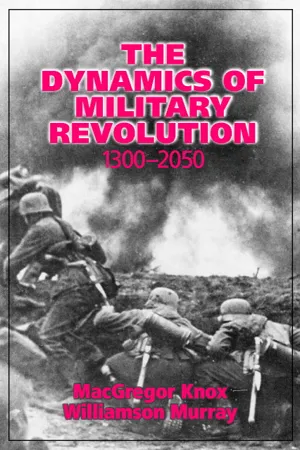
- MacGregor Knox, Williamson Murray(Authors)
- 2001(Publication Date)
- Cambridge University Press(Publisher)
The U.S. Civil War exemplifies - unlike the Prusso-German wars of 1866 and 1870-71, which it dwarfed in both duration and magnitude of effort - 1 Carl von Clausewitz, On War, eds. and trans. Michael Howard and Peter Paret (Princeton, NJ, 1976), p. 204 [book 3, Chapter n ] . 74 The U.S. Civil War 75 a military revolution. It took place within the context of two nonmilitary revolutions, both of which fostered revolutionary changes in the nature and purposes of war. Neither the Union nor the Confederacy fully understood these changes. Like Lincoln in Stephen Vincent Benet's epic poem, John Brown's Body, the people of the North and South could truly say: I have not once controlled the circumstances. They have controlled me. But with that control They made me grow or die. And I have grown/ The Civil War combined the mass politics and passions of the Wars of the French Revolution with the technology, productive capacity, and manage- rial style of the emerging Industrial Revolution. The result, foreseen by Lincoln in December 1861, was a "remorseless, revolutionary struggle" that prefigured the First World War, and similarly beggared the ability of contemporaries to imagine its sweep, duration, and consequences. 3 The Union and Confederacy fielded armies that dwarfed all military formations previously seen in the New World. They supplied these vast hosts with food, munitions, and equipment shipped by railroad and steam- ship. They connected units hundreds of miles apart with webs of telegraph lines and motivated soldiers and civilians with ceaseless propaganda. When necessary they repressed dissent through intimidation, arbitrary arrest, and the occasional murder. Before the war was half over, both sides had aban- doned cherished notions of individual liberty and had conscripted men for military service for the first time in American history. In their quest to finance the struggle, they trampled venerable traditions of limited taxation and fiscal rectitude. eBook - PDF
- Jack S. Levy, William R. Thompson(Authors)
- 2009(Publication Date)
- Wiley-Blackwell(Publisher)
7 These wars were the primary focus of Clausewitz ([1832]1976), who wrote after the experience of the French Revolutionary and Napoleonic Wars (1792–1815) and who emphasized the importance of major battles between the armies of the leading states in the system. 8 Interstate wars, however, constitute only one manifestation of the wide variety of sustained, coordinated violence that we observe over the millennia. In addition to fighting other states in interstate wars, states fight domestic challengers in internal or civil wars for the control of the state or for seces- sion from the state. Those domestic challengers may fight each other. States may also fight non-state entities in their external environments, as illus- trated by the current US wars against al Qaeda and against the Taliban insurgency in Afghanistan, and by the frequent armed conflicts between the state of Israel and the Palestinian authority and other non-state actors such as Hezbollah and Hamas. Wars may involve many of these elements simultaneously. The Iraq War started out as an interstate war (between the United States and the Iraqi government of Saddam Hussein) but then involved a domestic insurgency against an external state (the US), a civil war (between Shia and Sunni) for the control of Iraq, a war for secession from – or at least independence within – Iraq (by the Kurds), and interna- tional intervention in the civil war by state and non-state actors (the United States, Iran, and al Qaeda). We must also remember that the nation-state, or even the broader cat- egory of the territorial state, is a relatively modern phenomenon. Before the rise of the state in early modern Europe, life was organized around kings and nobles, before that around “city-states,” and long before that around looser forms of social organization, including agricultural communities and groups of hunter -gatherers. 9 During each of these periods organized violence between groups was fairly frequent.
Index pages curate the most relevant extracts from our library of academic textbooks. They’ve been created using an in-house natural language model (NLM), each adding context and meaning to key research topics.

